Newsletter Subscribe
Enter your email address below and subscribe to our newsletter

HVAC made simple
By Savvy Mavi — Sustainability Expert | The Furnace Outlet
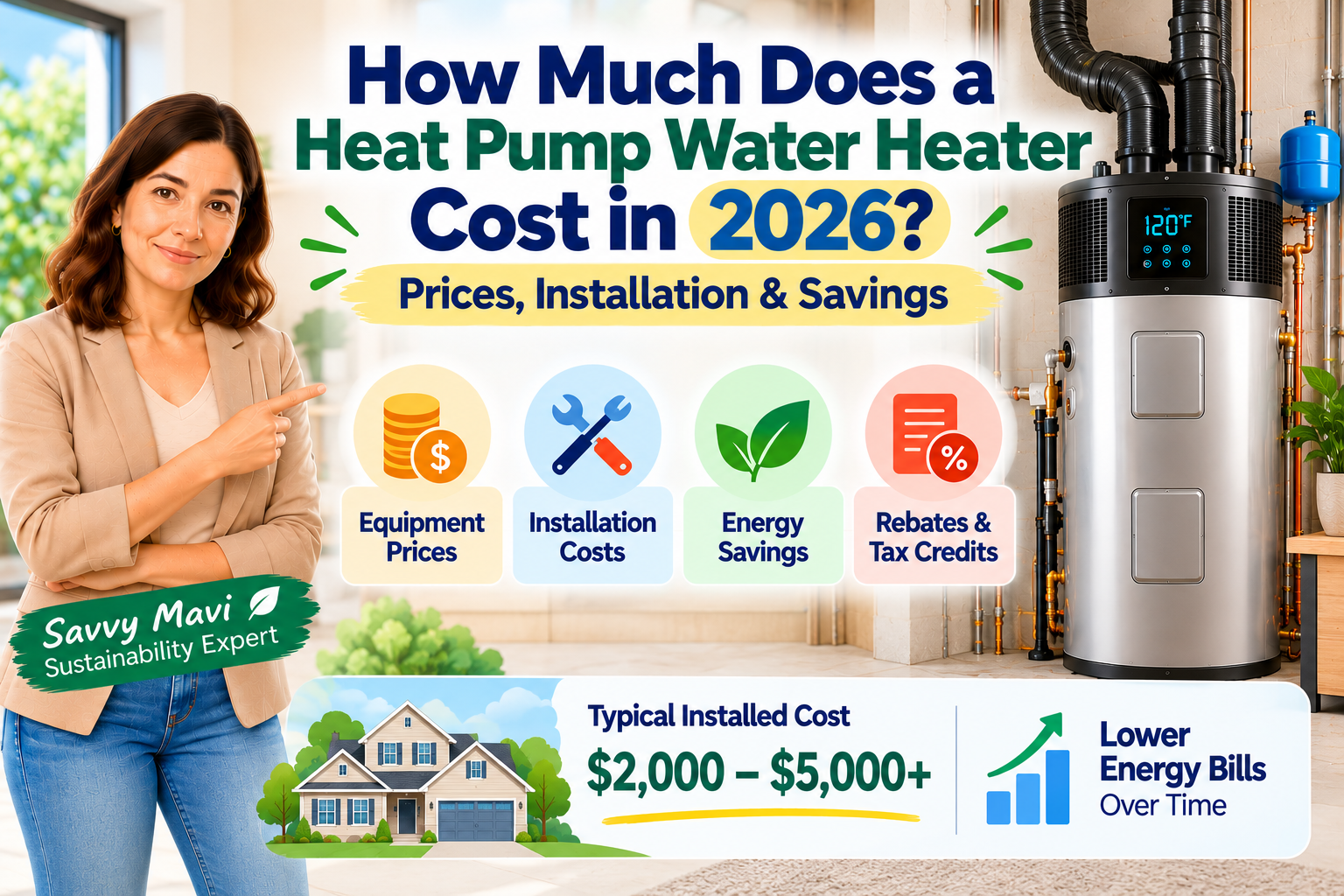
If you are considering replacing your existing water heater in 2026, one of the first questions you probably have is: How much does a heat pump water heater actually cost? The answer involves more than the price of the equipment. Installation labor, tank capacity, electrical requirements, condensate drainage, available incentives, and long-term electricity consumption all influence the total investment.
As someone passionate about energy-efficient home technologies, I believe heat pump water heaters deserve serious consideration. They use electricity to transfer heat from surrounding air into stored water rather than relying entirely on electric resistance heating. According to the U.S. Department of Energy, this technology can be two to three times as energy efficient as conventional electric resistance water heating.
However, I would never recommend purchasing a heat pump water heater simply because it promises lower electricity bills. The initial investment can be substantial, particularly when replacing a gas water heater or upgrading an older home’s electrical infrastructure. In this guide, I will break down the major costs, explain what affects installation pricing, and show homeowners how to calculate realistic long-term value.
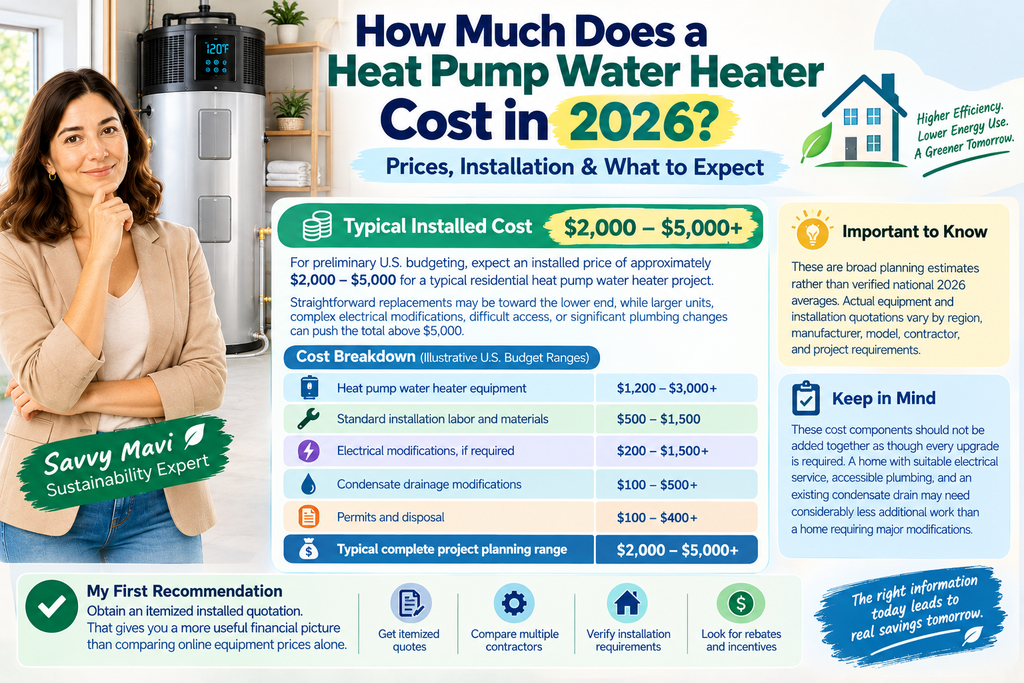
For preliminary U.S. budgeting, I would investigate an installed price of approximately $2,000–$5,000 for a typical residential heat pump water heater project. Straightforward replacements may fall toward the lower end, while larger units, complex electrical modifications, difficult access, or significant plumbing changes can push the total above $5,000.
The following figures are broad planning estimates rather than verified national 2026 averages. Actual equipment and installation quotations vary by region, manufacturer, model, contractor, and project requirements.
| Cost Component | Illustrative U.S. Budget Range |
|---|---|
| Heat pump water heater equipment | $1,200–$3,000+ |
| Standard installation labor and materials | $500–$1,500 |
| Electrical modifications, if required | $200–$1,500+ |
| Condensate drainage modifications | $100–$500+ |
| Permits and disposal | $100–$400+ |
| Typical complete project planning range | $2,000–$5,000+ |
These cost components should not simply be added together as though every installation requires every upgrade. A home with suitable electrical service, accessible plumbing, and an existing condensate drain may need considerably less additional work than a home requiring major modifications.
My first recommendation is to obtain an itemized installed quotation. That gives you a more useful financial picture than comparing online equipment prices alone.
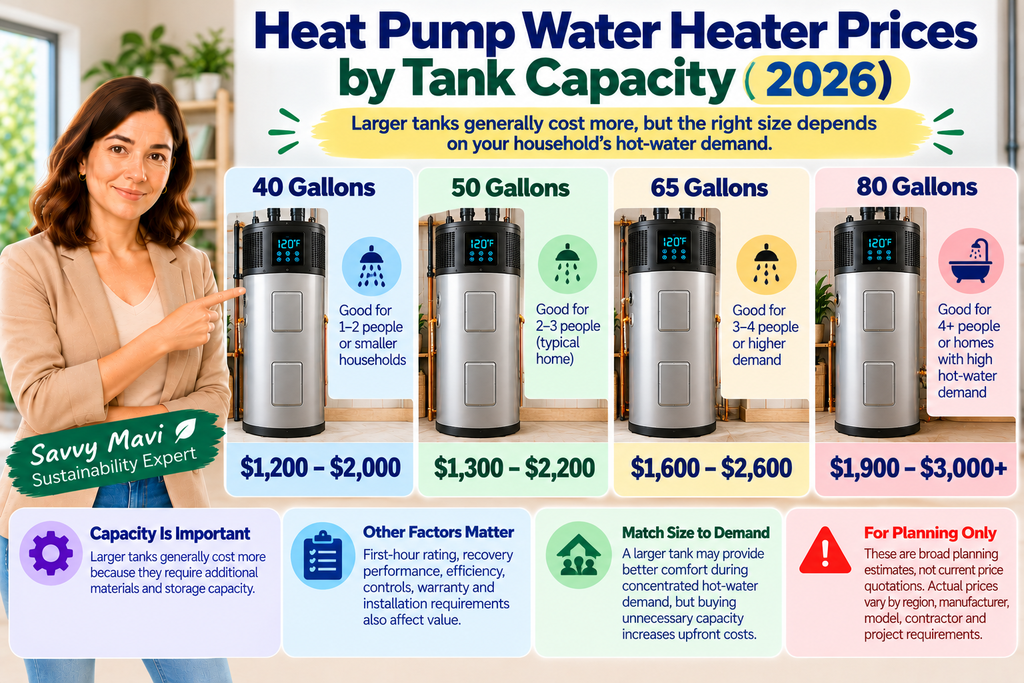
Tank capacity is one of the most important factors influencing equipment cost. Residential heat pump water heaters are commonly available in nominal capacities around 40, 50, 65, and 80 gallons, although availability varies by manufacturer.
Larger tanks generally cost more because they require additional materials and storage capacity. However, capacity alone does not determine value. First-hour rating, recovery characteristics, efficiency, controls, warranty, and installation requirements also matter.
| Nominal Capacity | Illustrative Equipment Budget |
|---|---|
| 40 gallons | $1,200–$2,000 |
| 50 gallons | $1,300–$2,200 |
| 65 gallons | $1,600–$2,600 |
| 80 gallons | $1,900–$3,000+ |
I would use these ranges only for initial research, not as current price quotations for specific products. Premium models and specialized configurations can fall outside them.
A larger tank may provide better comfort during concentrated hot-water demand, but buying unnecessary capacity increases upfront costs and may affect space requirements. I would calculate peak-hour demand before deciding whether a 50-, 65-, or 80-gallon system makes sense.
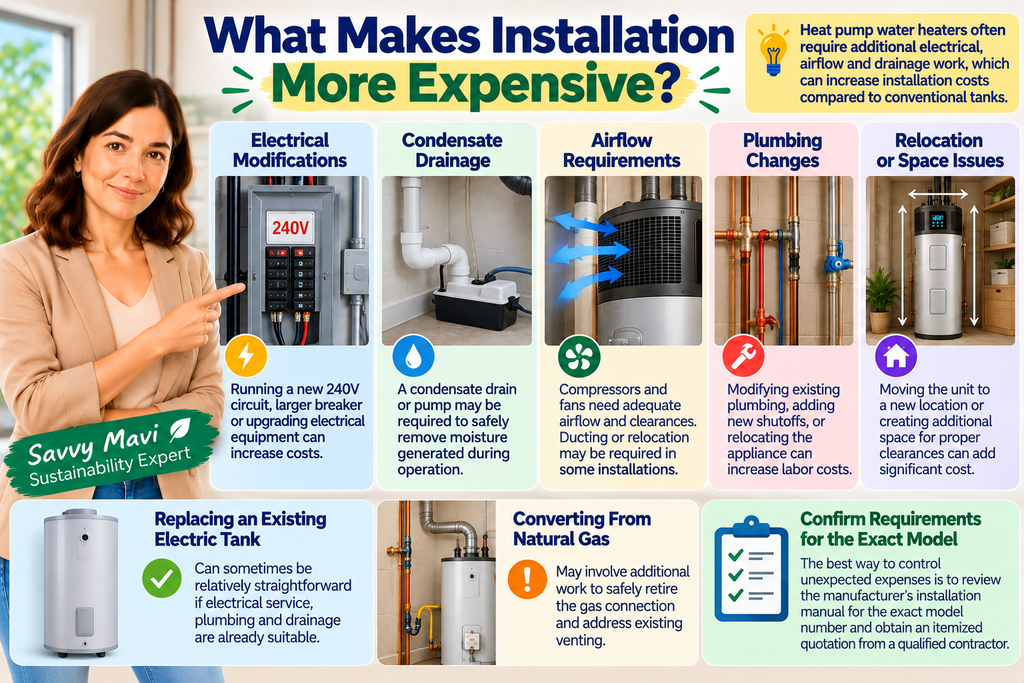
Heat pump water heaters have installation requirements that conventional electric resistance tanks do not always share. Their compressors and fans need suitable airflow, and the appliances produce condensate that must be drained appropriately.
Electrical service is another important consideration. Some models require dedicated 240-volt circuits, while certain products are designed for different electrical arrangements. I would never assume that every heat pump water heater requires identical wiring or breaker specifications.
The best way to control unexpected expenses is to confirm installation requirements for the exact model number before purchasing equipment.
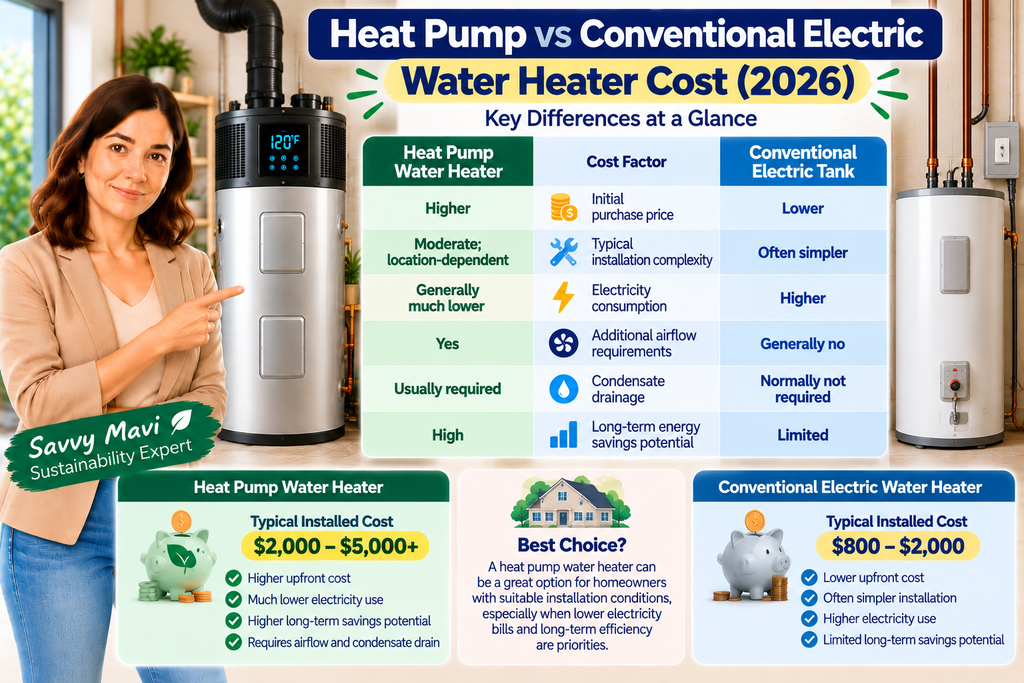
Conventional electric resistance water heaters generally have lower initial purchase prices. For a typical replacement, I would investigate an installed budget around $800–$2,000, depending on equipment and installation conditions.
Heat pump models often require a larger initial investment, but they can consume substantially less electricity. ENERGY STAR highlights the potential for meaningful annual energy savings when homeowners replace standard electric resistance water heaters with qualifying heat pump equipment.
| Cost Factor | Heat Pump Water Heater | Conventional Electric Tank |
|---|---|---|
| Initial purchase price | Higher | Lower |
| Typical installation complexity | Moderate; location-dependent | Often simpler |
| Electricity consumption | Generally much lower | Higher |
| Additional airflow requirements | Yes | Generally no |
| Condensate drainage | Usually required | Normally not required |
| Long-term energy savings potential | High | Limited |
I would generally favor investigating a heat pump water heater when replacing an electric resistance tank in a suitable home. The operating-cost difference can be significant, especially for households with substantial daily hot-water consumption.
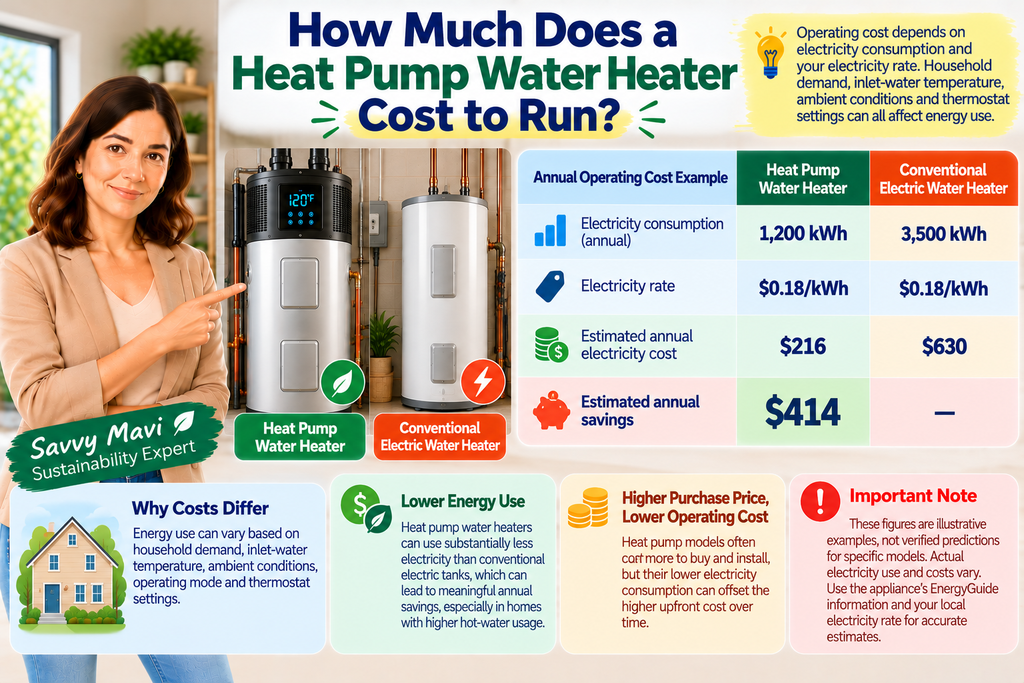
Operating cost depends on electricity consumption and the price paid per kilowatt-hour. Household demand, inlet-water temperature, ambient conditions, operating modes, and thermostat settings can all affect energy use.
Consider a hypothetical heat pump water heater consuming 1,200 kWh annually. At an electricity rate of $0.18 per kWh, the estimated annual electricity cost would be $216. If a comparable conventional electric water heater consumes 3,500 kWh under the same assumed usage conditions, its annual electricity cost would be $630. That represents a hypothetical annual difference of $414.
| Annual Operating Cost Example | Heat Pump | Conventional Electric |
|---|---|---|
| Electricity consumption | 1,200 kWh | 3,500 kWh |
| Electricity rate | $0.18/kWh | $0.18/kWh |
| Estimated annual cost | $216 | $630 |
| Estimated annual savings | $414 | — |
These figures are illustrative, not verified predictions for specific models. Homeowners should use the exact appliance’s EnergyGuide information and their actual electricity tariff when estimating savings.
For me, this is where heat pump technology becomes particularly attractive. The higher purchase price can be offset by lower electricity consumption over several years, provided the installation is suitable and expected savings materialize.
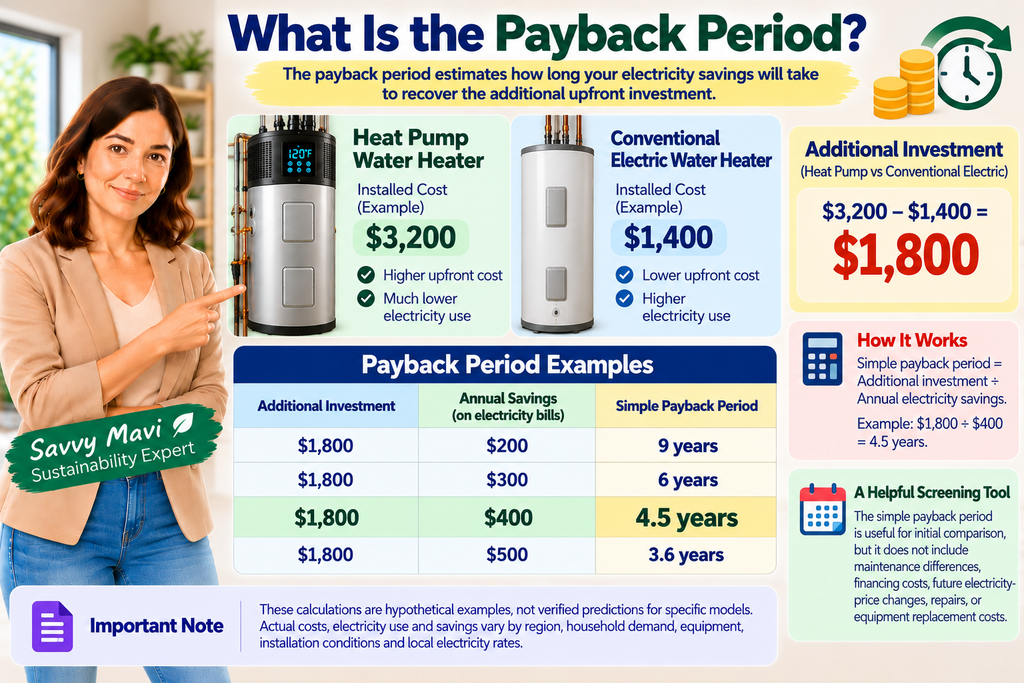
The simple payback period estimates how long electricity savings would take to recover the additional initial investment. Suppose a heat pump water heater costs $3,200 installed while a conventional electric replacement costs $1,400. The additional investment is $1,800. If estimated annual electricity savings are $400, the simple payback period would be 4.5 years.
If annual savings are only $200, the same additional investment would require nine years to recover.
| Additional Investment | Annual Savings | Simple Payback |
|---|---|---|
| $1,800 | $200 | 9 years |
| $1,800 | $300 | 6 years |
| $1,800 | $400 | 4.5 years |
| $1,800 | $500 | 3.6 years |
These calculations exclude maintenance differences, financing, future electricity-price changes, repairs, and equipment replacement costs.
I would use simple payback as an initial screening tool rather than a complete financial analysis. Homeowners planning to remain in their property for many years should also compare expected lifetime ownership costs.
Replacing a gas water heater with a heat pump model can involve more installation work than replacing an existing electric resistance tank. The project may require a new electrical circuit, condensate drainage, changes to the installation location, and proper retirement of the existing gas connections.
The operating-cost comparison also becomes more complicated because electricity and natural gas have different pricing structures. A heat pump water heater may use substantially less purchased energy, but inexpensive natural gas can reduce or eliminate its operating-cost advantage in some markets.
I would therefore calculate the total installed cost and expected annual operating expenses before converting from gas. The decision may still make sense for homeowners prioritizing electrification and eliminating combustion at the appliance, but financial payback should not be assumed.
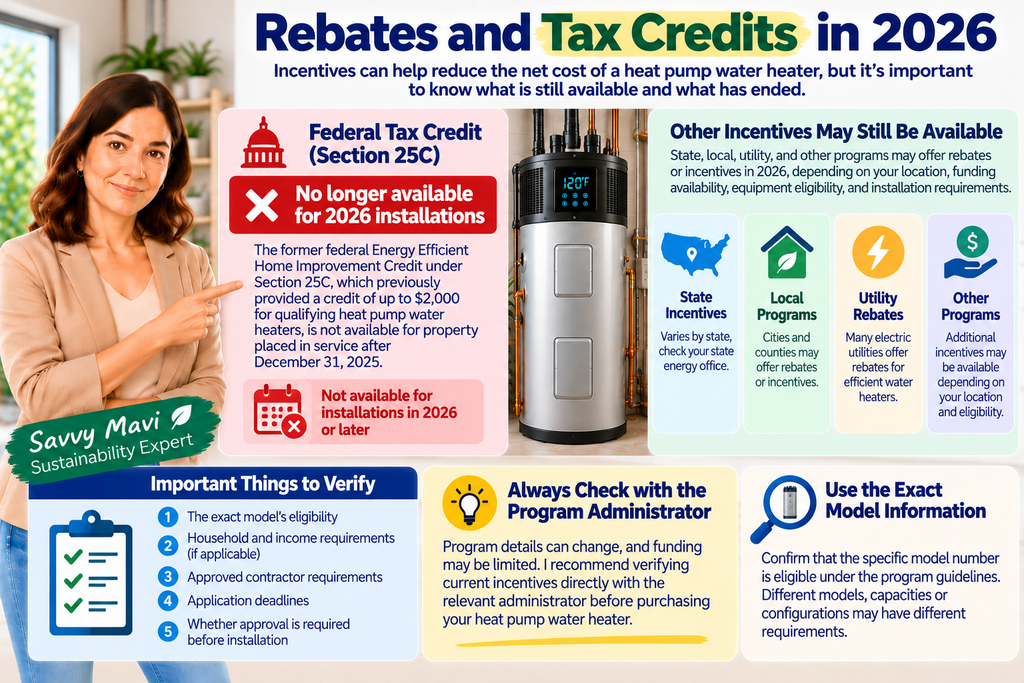
Incentives can reduce the net cost of heat pump water heaters, but homeowners need to be particularly careful with outdated tax-credit information. The former federal Energy Efficient Home Improvement Credit under Section 25C, which previously provided a credit of up to $2,000 for qualifying heat pump water heaters, is not available for property placed in service after December 31, 2025. Homeowners installing a new system in 2026 should not include that former federal credit in their cost calculations.
State, local, utility, and other programs may still provide incentives, depending on location, funding availability, equipment eligibility, and installation requirements.
I would verify any available incentive directly with its administrator before purchasing. Confirm the exact model, household eligibility, contractor requirements, application deadline, and whether approval must occur before installation.
Beyond equipment and installation, several ownership expenses deserve attention. Heat pump water heaters may require air-filter cleaning, condensate-system maintenance, and access to qualified service technicians for refrigeration-related components.
Electricity consumption may also increase if the system frequently uses resistance backup heating because of unusually high demand, unsuitable ambient conditions, or operating-mode settings. Installation location can affect household heating and cooling loads because the appliance removes heat from surrounding air. The magnitude of this interaction depends on climate, location, airflow arrangement, and the broader building system.
I would also evaluate warranty coverage, replacement-part availability, expected service support, and any financing charges. A low initial quotation does not necessarily represent the lowest total ownership cost.
My preferred cost-saving strategy begins with selecting equipment that fits the home rather than purchasing a model and then modifying the home to accommodate it. Choose a capacity based on actual hot-water demand, compare multiple qualified contractor quotations, and verify electrical compatibility before ordering. If the existing location provides adequate airflow and suitable drainage, keeping the appliance there may reduce installation complexity.
I would also compare certified energy consumption, warranty coverage, and local service availability rather than choosing the least expensive equipment automatically. Finally, investigate current utility or state incentives before signing a contract. Some programs have eligibility or application requirements that must be satisfied before work begins.
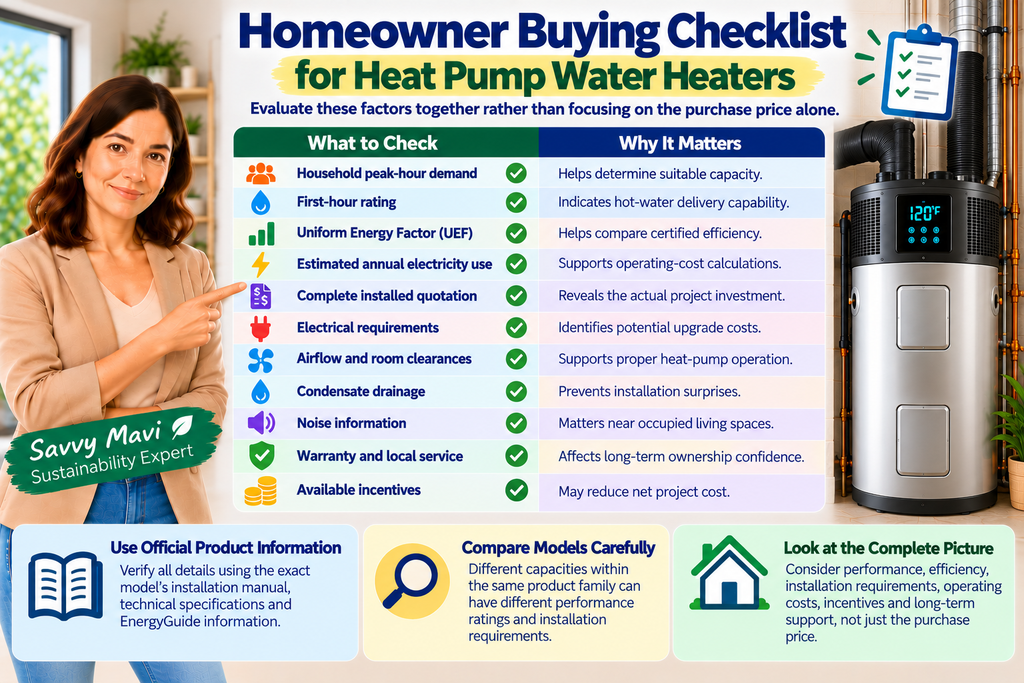
Before committing to a heat pump water heater, I would evaluate the following factors together rather than focusing on the purchase price alone.
| What to Check | Why It Matters |
|---|---|
| Household peak-hour demand | Helps determine suitable capacity |
| First-hour rating | Indicates hot-water delivery capability |
| Uniform Energy Factor | Helps compare certified efficiency |
| Estimated annual electricity use | Supports operating-cost calculations |
| Complete installed quotation | Reveals the actual project investment |
| Electrical requirements | Identifies potential upgrade costs |
| Airflow and room clearances | Supports proper heat-pump operation |
| Condensate drainage | Prevents installation surprises |
| Noise information | Matters near occupied living spaces |
| Warranty and local service | Affects long-term ownership confidence |
| Available incentives | May reduce net project cost |
I would verify these details using the exact model’s installation manual, technical specifications, and EnergyGuide information. Different capacities within the same product family can have different performance ratings and installation requirements.
For initial budgeting, I would investigate approximately $1,300–$2,200 for equipment, with the complete installed project potentially costing substantially more. Actual prices depend on the exact model, retailer, contractor, and installation requirements.
They can be more expensive to install than conventional electric resistance tanks, particularly when electrical modifications, condensate drainage, or relocation are necessary. A straightforward replacement in a suitable location may be considerably less complicated.
Savings depend on the equipment being replaced, local electricity rates, household usage, and the heat pump’s operating conditions. Replacing a conventional electric resistance tank can produce substantial savings, but homeowners should calculate estimates using certified product information.
It can be an excellent investment for homeowners with suitable installation conditions, meaningful hot-water demand, and sufficient time to benefit from reduced electricity consumption. The decision is less straightforward when installation modifications are expensive or existing gas prices are very favorable.
Installation involves plumbing, electrical systems, pressurized hot water, condensate management, and applicable building codes. I recommend using appropriately qualified professionals and following the manufacturer’s exact installation requirements.
The former federal Section 25C credit does not apply to qualifying property placed in service after December 31, 2025. Other incentive programs may still be available, but eligibility must be verified directly with the relevant administrator.
When evaluating heat pump water heater prices in 2026, I would divide the decision into three numbers: equipment cost, complete installed cost, and long-term operating cost. Looking at only one of these figures can create a misleading impression of value.
A conventional electric water heater may be cheaper to purchase, but a properly installed heat pump model can substantially reduce electricity consumption. For households with suitable installation conditions and significant hot-water demand, that efficiency advantage may justify the higher initial investment.
My recommendation is to obtain detailed installation quotations, compare certified energy-consumption estimates, verify current incentives, and calculate realistic payback using local electricity prices. The best purchase is not necessarily the cheapest water heater or the most expensive high-efficiency model. It is the correctly sized system that delivers reliable comfort and sensible long-term value.
The Furnace Outlet is an independent educational and informational website. We are not affiliated with, associated with, sponsored by, endorsed by, or officially connected with any water-heater manufacturer, brand, retailer, utility, government agency, or other company mentioned in this article unless expressly disclosed. Product names and trademarks belong to their respective owners and are used for identification and informational purposes.
Our content is based on publicly available technical information, government resources, manufacturer documentation, and general water-heating principles. We do not claim to have independently laboratory-tested products unless explicitly stated. Some articles may contain affiliate links, through which The Furnace Outlet may earn a commission at no additional cost to readers.
All price ranges, savings examples, and payback calculations are illustrative and should not be interpreted as guaranteed 2026 quotations or actual product performance. Installation involves electrical systems, plumbing, pressurized hot water, and safety requirements. Always follow manufacturer instructions, applicable codes, and permit requirements, and consult appropriately qualified professionals for installation, maintenance, and repairs.