Newsletter Subscribe
Enter your email address below and subscribe to our newsletter

HVAC made simple
By Savvy Mavi — Sustainability Expert | The Furnace Outlet
Choosing between a heat pump water heater and a conventional electric water heater is no longer just about the purchase price. With electricity costs, household energy efficiency, and long-term sustainability becoming increasingly important, homeowners have good reasons to examine how these two technologies compare. Both use electricity, both can provide reliable hot water, and both are available in familiar storage-tank configurations. However, the way they heat water—and the amount of electricity they need to do it—can be dramatically different.
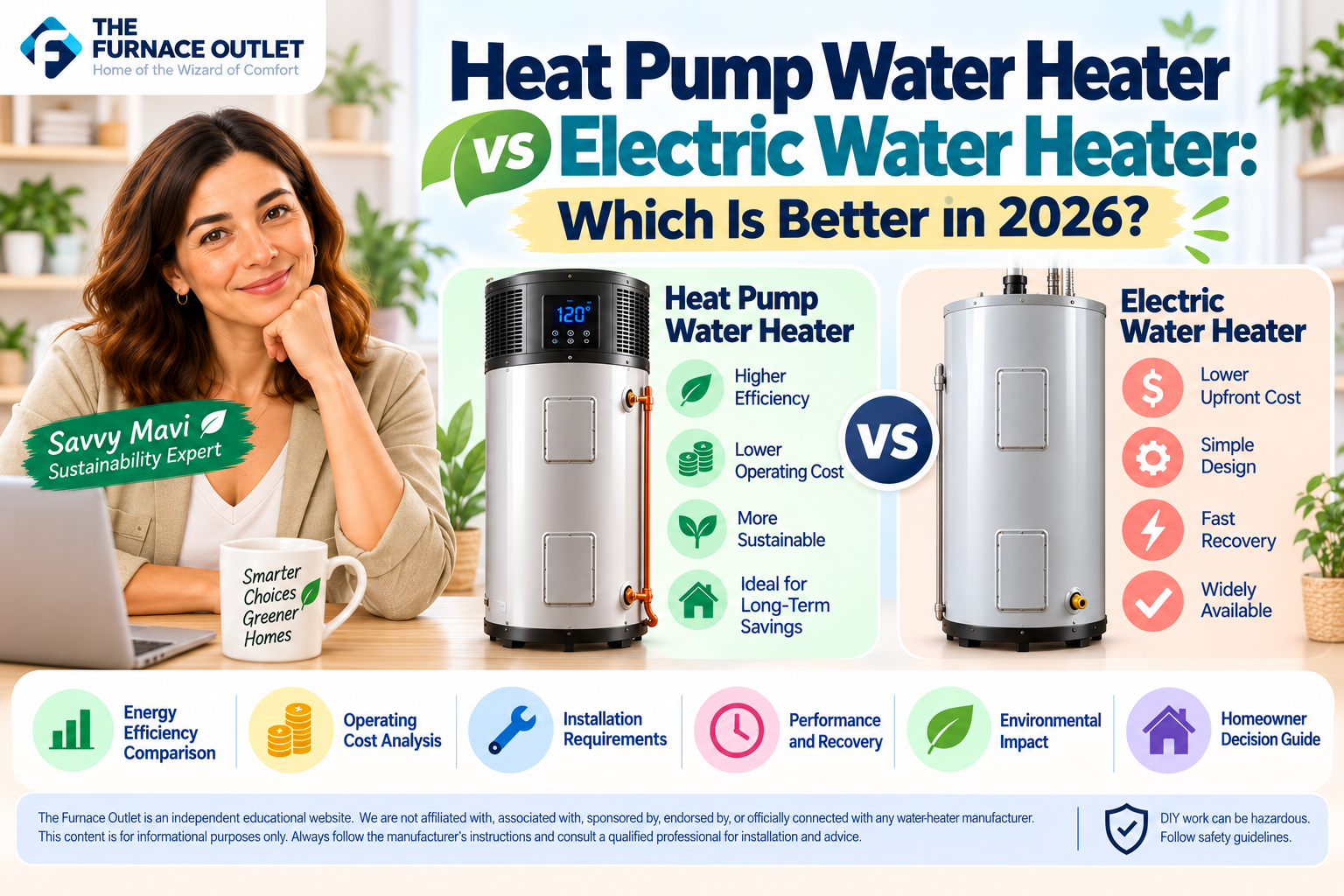
As someone passionate about sustainable home technologies, I find heat pump water heaters particularly exciting because they offer a practical opportunity to reduce energy consumption without abandoning the convenience of stored hot water. According to the U.S. Department of Energy, heat pump water heaters can be two to three times as energy efficient as conventional electric resistance water heaters. That efficiency advantage can translate into meaningful operating-cost savings over the equipment’s service life.
However, I would not automatically recommend a heat pump model for every household. Conventional electric water heaters remain attractive because they are relatively inexpensive, mechanically simple, compact, and generally easier to install. The better choice depends on your budget, installation location, hot-water requirements, local electricity rates, and long-term priorities.
In this guide, I will compare both technologies across efficiency, upfront cost, annual electricity consumption, recovery performance, installation, maintenance, environmental impact, and overall value. My goal is to help you choose the system that makes the most sense for your home rather than simply selecting the technology with the most impressive efficiency rating.
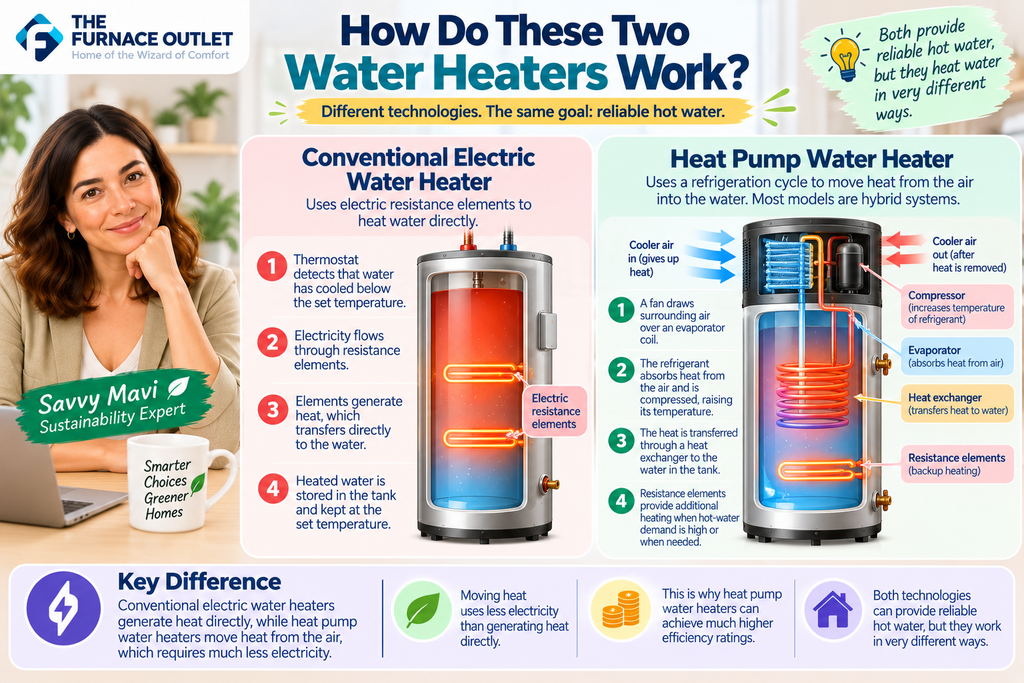
A conventional electric water heater uses electric resistance elements installed inside a storage tank. When the thermostat detects that the stored water has cooled below the desired temperature, electricity flows through the elements, generating heat that transfers directly into the water. The process is straightforward, dependable, and relatively easy to understand.
A heat pump water heater works differently. Instead of generating most of its heat directly, it uses a refrigeration cycle to absorb thermal energy from surrounding air and transfer that energy into the water. A compressor, evaporator, refrigerant circuit, and heat exchanger work together to move heat efficiently.
Most residential heat pump water heaters are hybrid systems, meaning they also contain electric resistance elements. These elements can provide additional heating when hot-water demand is unusually high or operating conditions require assistance.
The distinction is important because moving heat generally requires considerably less electricity than generating an equivalent amount of heat through resistance elements. That is the fundamental reason heat pump water heaters can achieve much higher efficiency ratings.
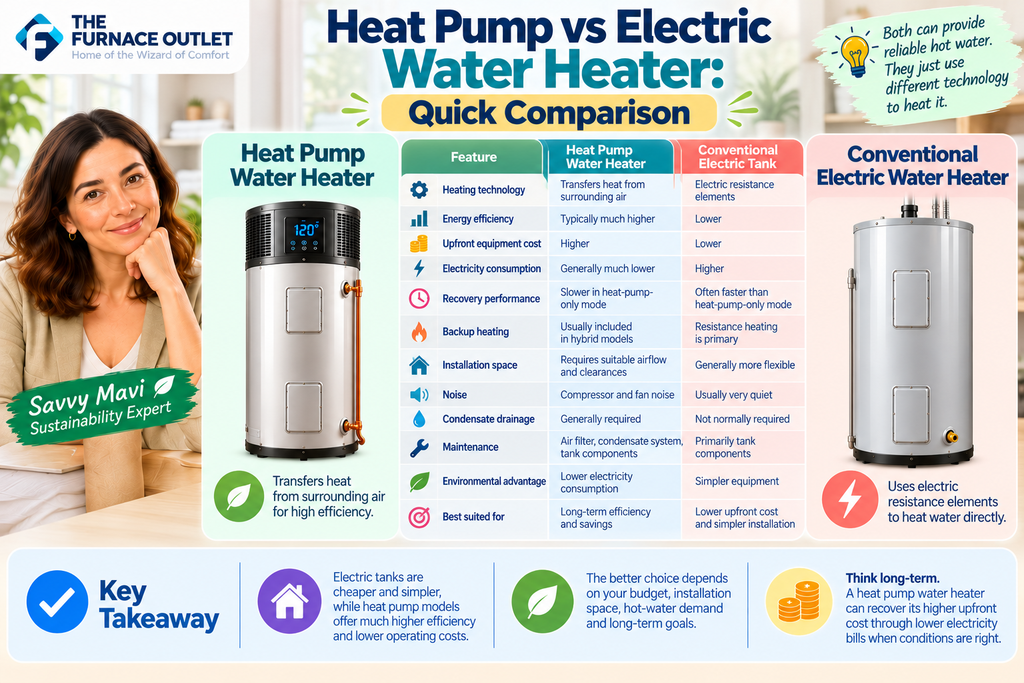
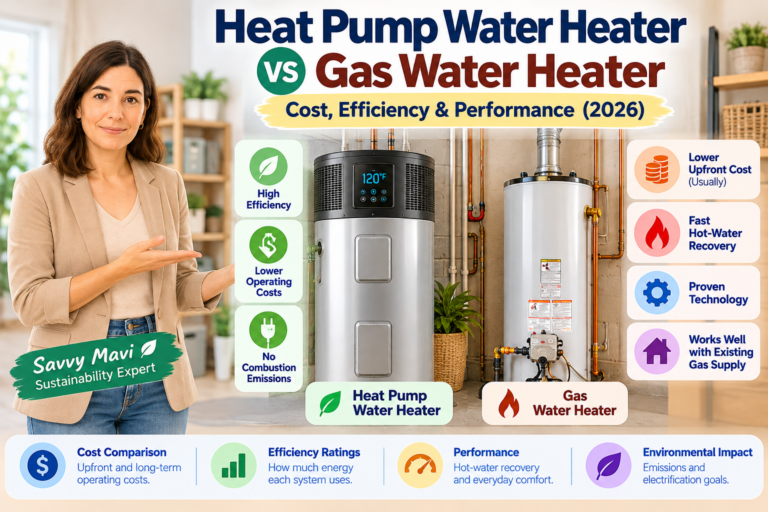
| Feature | Heat Pump Water Heater | Conventional Electric Tank |
|---|---|---|
| Heating technology | Transfers heat from surrounding air | Electric resistance elements |
| Energy efficiency | Typically much higher | Lower |
| Upfront equipment cost | Higher | Lower |
| Electricity consumption | Generally much lower | Higher |
| Recovery performance | Slower in heat-pump-only mode | Often faster than heat-pump-only mode |
| Backup heating | Usually included in hybrid models | Resistance heating is primary |
| Installation space | Requires suitable airflow and clearances | Generally more flexible |
| Noise | Compressor and fan noise | Usually very quiet |
| Condensate drainage | Generally required | Not normally required |
| Maintenance | Air filter, condensate system, tank components | Primarily tank components |
| Environmental advantage | Lower electricity consumption | Simpler equipment |
| Best suited for | Long-term efficiency and savings | Lower upfront cost and simpler installation |
This comparison highlights why I would approach the decision as a long-term ownership question. A conventional electric water heater can be cheaper and easier to install, but the heat pump model can recover its additional investment through reduced electricity consumption when installation conditions and usage patterns are favorable.
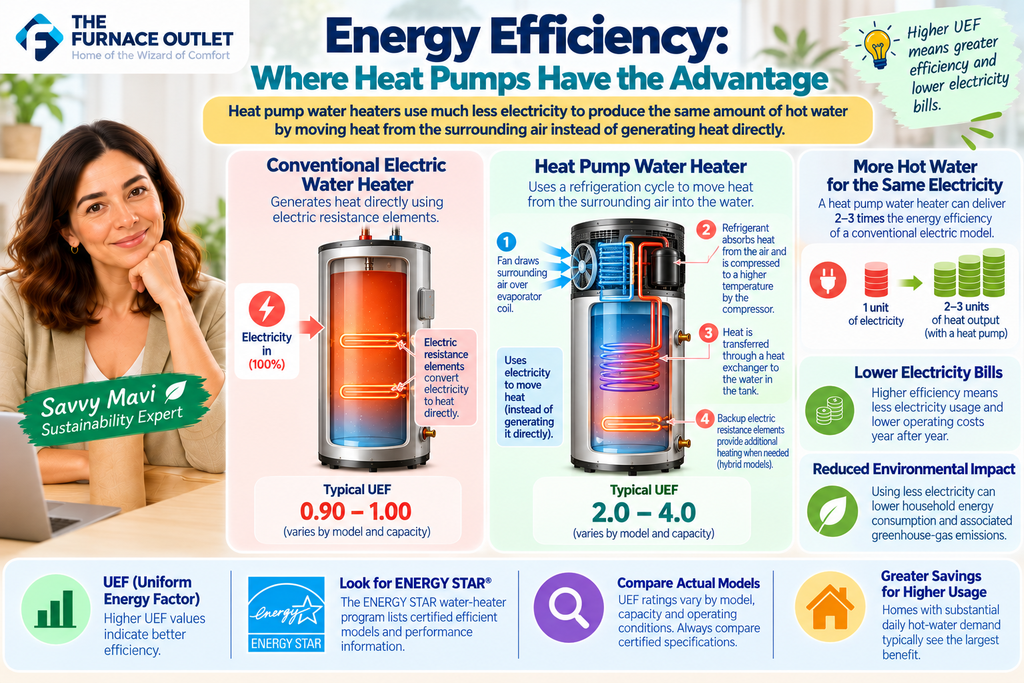
Efficiency is the most significant difference between these technologies. Conventional electric resistance heating converts electrical energy into heat, while heat pump technology uses electricity to transfer additional heat from the surrounding environment.
Residential water-heater efficiency is commonly expressed through Uniform Energy Factor, or UEF. Higher UEF values generally indicate better efficiency when comparing appropriate products within the same usage category.
Modern heat pump water heaters can achieve UEF ratings substantially above those of conventional electric resistance tanks. However, ratings vary by model, capacity, and operating conditions, so I would always compare certified specifications rather than assuming every heat pump unit performs identically.
The ENERGY STAR water-heater program provides useful information about qualifying efficient water-heating technologies and product performance. I recommend using certified efficiency data when comparing individual models.
For me, the environmental benefit is particularly compelling. Reducing the electricity needed to produce the same amount of hot water can lower household energy consumption year after year, especially in homes with substantial daily hot-water demand.
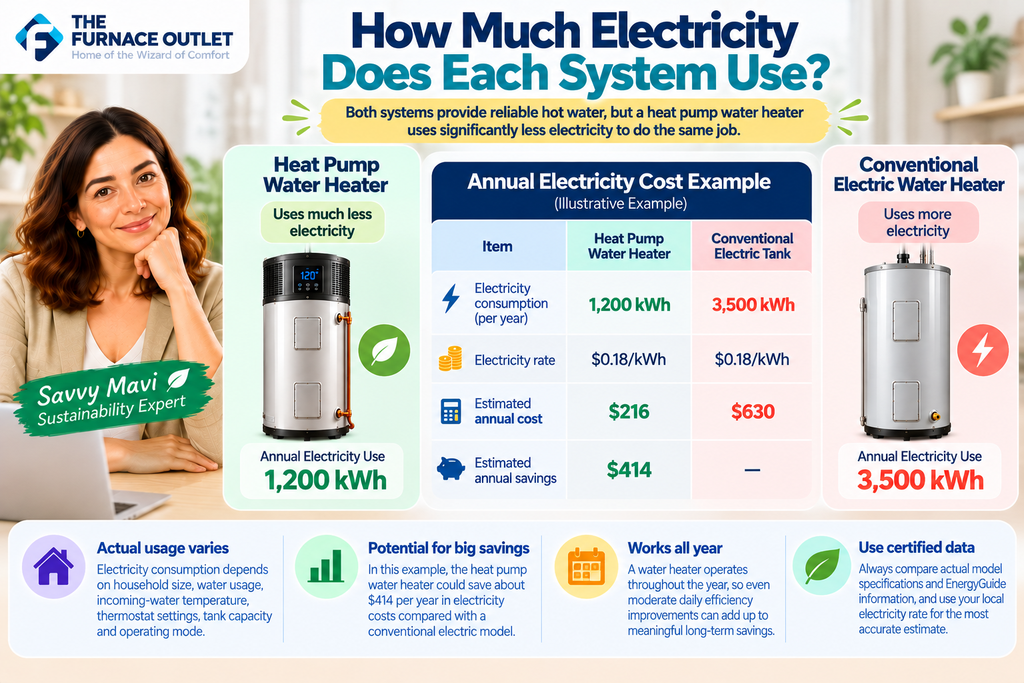
Actual electricity consumption depends on household size, water usage, incoming-water temperature, thermostat settings, tank capacity, ambient conditions, and operating mode. Nevertheless, an illustrative calculation helps demonstrate the potential difference.
Suppose a conventional electric water heater consumes 3,500 kWh annually while a comparable heat pump model consumes 1,200 kWh under the same assumed usage conditions. At an electricity price of $0.18 per kWh, their estimated annual operating costs would differ substantially.
| Annual Cost Example | Heat Pump | Conventional Electric |
|---|---|---|
| Electricity consumption | 1,200 kWh | 3,500 kWh |
| Electricity rate | $0.18/kWh | $0.18/kWh |
| Estimated annual cost | $216 | $630 |
| Estimated annual savings | $414 | — |
These figures are illustrative rather than predictions for a specific product or household. Actual savings should be calculated using the model’s EnergyGuide information, comparable usage assumptions, and your local electricity tariff.
The important point is that a water heater operates throughout the year. Even moderate daily efficiency improvements can accumulate into meaningful savings over several years.
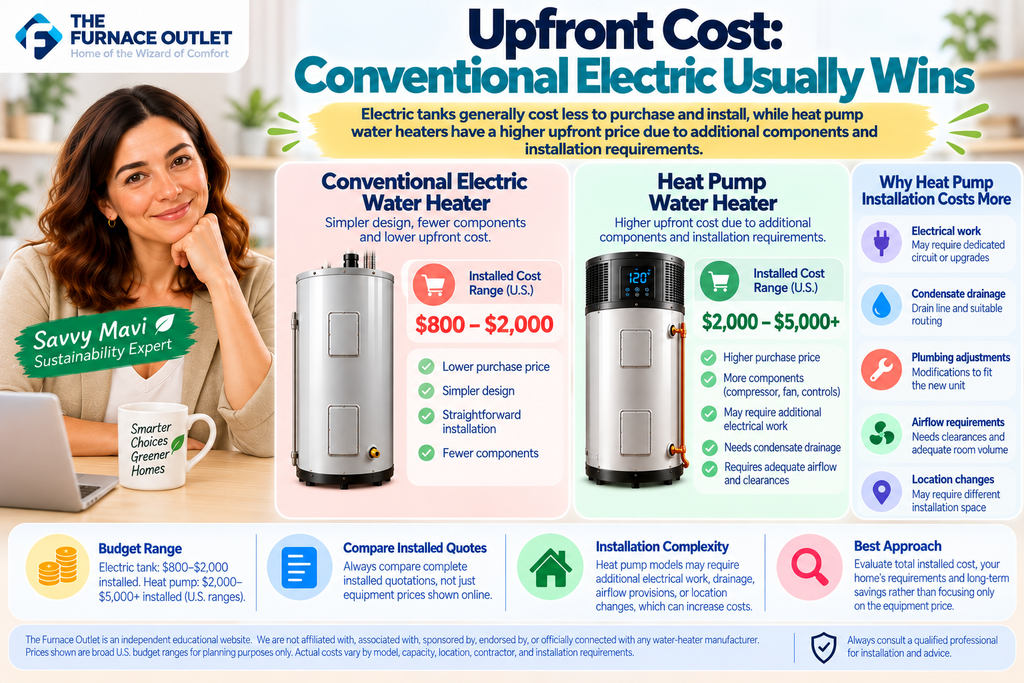
A conventional electric storage water heater generally costs less to purchase than a comparable heat pump model. Its simpler design, fewer mechanical components, and relatively straightforward installation requirements help keep initial costs lower.
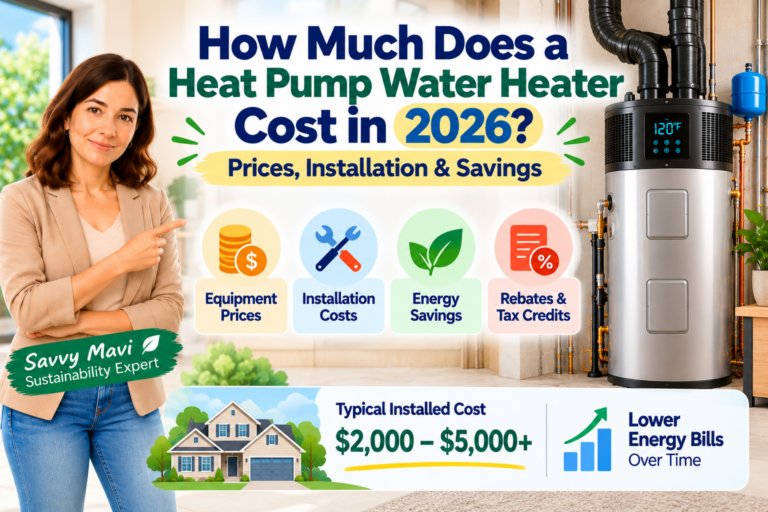
For planning purposes, a conventional electric tank replacement might cost approximately $800–$2,000 installed, while a heat pump water heater project might fall around $2,000–$5,000 or more. These are broad U.S. budgeting ranges, not verified 2026 quotations, and actual prices vary considerably by capacity, contractor, location, electrical work, and installation complexity.
A heat pump installation may require additional electrical work, condensate drainage, plumbing adjustments, airflow provisions, or changes to the installation location. Those costs can make a substantial difference to the project budget.
I would therefore compare complete installed quotations rather than equipment prices displayed online. A relatively affordable heat pump model can become expensive if the installation requires major modifications, while a straightforward replacement may offer much better economics.
The higher upfront price of a heat pump water heater should be evaluated against its expected electricity savings. Consider a hypothetical project where a conventional electric water heater costs $1,500 installed and a heat pump model costs $3,000 installed. The additional investment is $1,500. If the heat pump saves $375 annually in electricity, the simple payback period would be four years.
That calculation excludes financing costs, maintenance differences, changing electricity rates, future repairs, and differences in equipment lifespan. It also assumes that the estimated savings are actually achieved.
For homeowners expecting to remain in their property for several years, the operating-cost advantage can make heat pump technology financially attractive. However, if installation costs are unusually high or household hot-water consumption is very low, the payback period may be considerably longer.
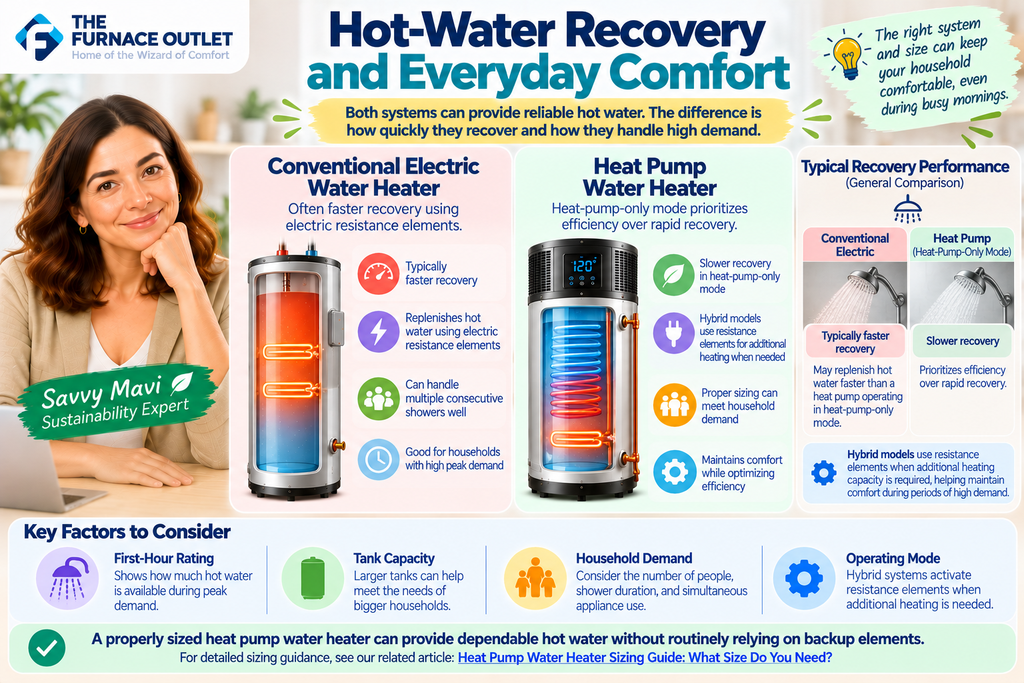
One concern I frequently encounter is whether a heat pump water heater can provide enough hot water for a busy household. The answer depends on sizing and operating mode. Heat-pump-only operation generally prioritizes efficiency over rapid recovery. A conventional electric resistance tank may replenish hot water faster than a comparable heat pump operating exclusively through its compressor.
Hybrid systems address this limitation by activating resistance elements when additional heating capacity is required. That helps maintain comfort during periods of substantial demand, although electricity consumption increases when resistance heating operates.
I would compare first-hour rating, tank capacity, recovery characteristics, and household peak-hour demand before selecting either technology. A properly sized heat pump water heater can provide dependable hot water without routinely relying on backup elements. For additional sizing guidance, readers can explore our related article, Heat Pump Water Heater Sizing Guide: What Size Do You Need?
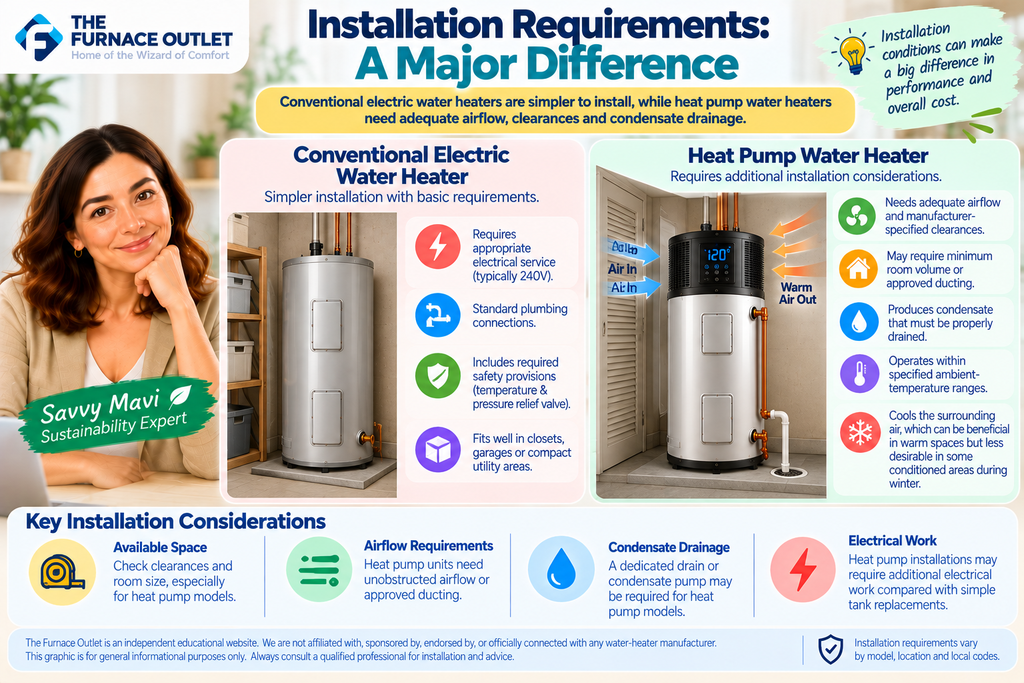
Installation conditions can strongly influence which technology is more practical. Conventional electric water heaters generally require suitable electrical service, plumbing connections, required safety provisions, and adequate physical space. They do not need to extract heat from surrounding air, making them relatively flexible for closets and compact utility areas.
Heat pump water heaters require additional consideration because their compressors and fans need appropriate airflow. Manufacturers specify installation clearances, operating-temperature ranges, and sometimes minimum room volumes or approved ducting arrangements.
Heat pump operation also produces condensate that must be properly drained. The appliance cools the surrounding air while operating, which can be beneficial in some warm locations but less desirable in certain conditioned spaces during winter. I would evaluate the installation location before comparing product prices. A highly efficient water heater installed in an unsuitable environment may fail to deliver the performance its specifications suggest.
Conventional electric resistance water heaters are generally very quiet because they do not rely on a compressor or fan for normal heating. Heat pump water heaters produce mechanical sound from their compressor and airflow system. The noise level varies by model and operating conditions, and manufacturers may publish sound ratings.
In a garage, basement, or separate utility room, that sound may be barely noticeable. In a closet beside a bedroom or home office, however, it could become more significant. Noise is not necessarily a reason to reject heat pump technology, but I would include it in the selection process rather than discovering the issue after installation.
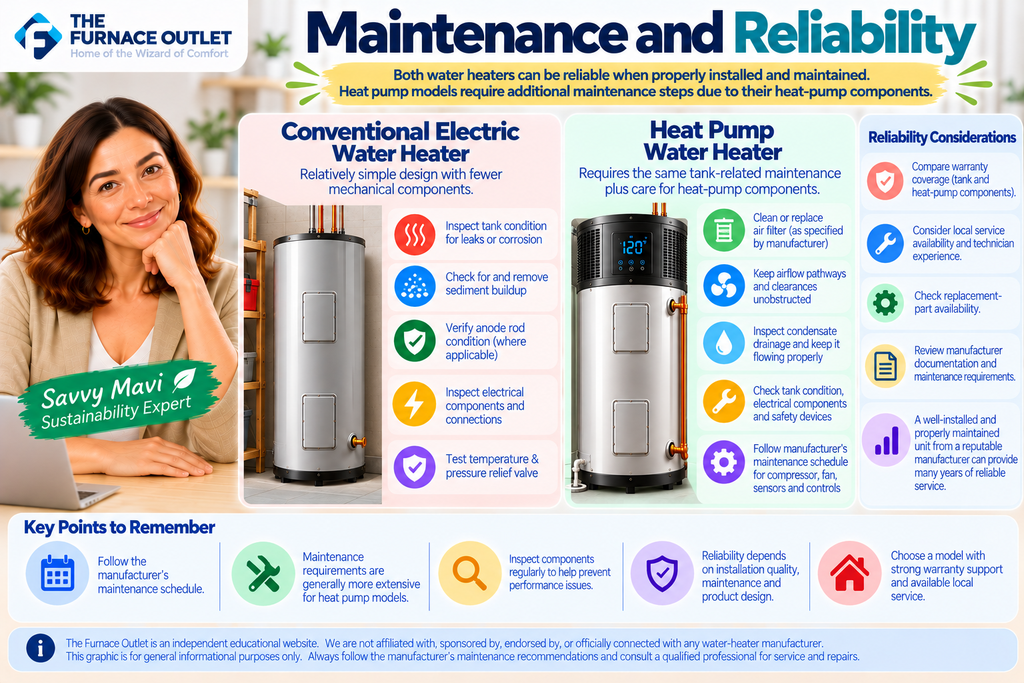
Conventional electric water heaters benefit from relatively simple mechanical designs. Maintenance commonly involves attention to tank condition, sediment accumulation, anode protection where applicable, electrical components, and safety devices. Heat pump water heaters require many of the same tank-related maintenance considerations, along with care for the heat-pump components. Depending on the model, this may include cleaning an air filter, keeping airflow pathways unobstructed, inspecting condensate drainage, and following manufacturer-prescribed maintenance procedures.
The additional compressor, fan, sensors, and controls introduce components that conventional electric tanks do not have. However, that does not automatically mean a particular heat pump model will be unreliable. I would compare warranty coverage, local service availability, replacement-part support, and manufacturer documentation before purchasing either type.
From my perspective, this is where heat pump technology becomes particularly meaningful. A heat pump water heater can reduce the electricity required for domestic water heating, potentially lowering associated greenhouse-gas emissions depending on the electricity generation mix. Both technologies avoid combustion at the appliance, but the heat pump generally requires less electricity to deliver comparable water-heating service.
The environmental comparison also includes manufacturing, refrigerants, equipment durability, transportation, maintenance, and end-of-life handling. Heat pump water heaters use refrigerants, making responsible refrigerant management an important part of their environmental profile. Conventional electric resistance tanks avoid the need for a refrigeration circuit, although their higher electricity consumption can create a larger operating-energy footprint.
I would assess sustainability over the equipment’s complete useful life rather than judging either technology by a single environmental characteristic.

Incentives can materially affect the economics of a heat pump water heater, but homeowners should verify current program eligibility before purchasing. An important change for 2026 is that the former federal Energy Efficient Home Improvement Credit under Section 25C is no longer available for qualifying property placed in service after December 31, 2025. Homeowners should not assume that older advertisements describing the previous federal heat-pump tax credit still apply.
State, local, utility, and other incentive programs may operate under different rules and timelines. Current federal tax guidance is available through the IRS Form 5695 instructions.
I would confirm any available rebate directly with its administrator and verify that the exact equipment model, installation date, contractor, and household meet the applicable requirements.
I would generally favor a heat pump water heater when replacing a conventional electric tank in a home with suitable installation space, moderate to high hot-water demand, and an ownership horizon long enough to benefit from lower operating costs. A conventional electric tank can still be the better practical choice when upfront budget is the dominant concern, installation space is highly restricted, condensate management is difficult, or the additional cost of a heat pump installation cannot reasonably be recovered through expected savings.
Neither technology should be selected solely because it is cheaper to purchase or more efficient on paper. The best system is the one that meets household demand reliably while delivering sensible lifetime value.
Heat pump water heaters are generally more energy-efficient and can cost substantially less to operate than conventional electric resistance tanks. However, they typically cost more upfront and require suitable airflow, installation space, and condensate management. The better choice depends on the home and household.
Yes, under suitable operating conditions. DOE states that heat pump water heaters can be two to three times as energy efficient as conventional electric resistance water heaters. Actual savings depend on the specific model, installation, climate, hot-water consumption, and operating mode.
Yes. Replacing a conventional electric resistance tank with a heat pump water heater is a common upgrade, but electrical compatibility, physical dimensions, airflow, condensate drainage, and manufacturer requirements must be verified before installation.
Not necessarily. A properly sized hybrid system can provide reliable hot water, but heat-pump-only recovery is generally slower than resistance heating. Tank capacity, first-hour rating, and operating mode determine how well the appliance handles peak demand.
Service life varies by manufacturer, model, installation quality, water conditions, maintenance, and usage. Rather than relying on a universal lifespan estimate, I recommend comparing warranty coverage, service support, and the manufacturer’s maintenance requirements.
It can be, especially for households replacing high-consumption electric resistance water heaters. Compare the additional installed cost with realistic annual electricity savings, maintenance considerations, and the expected ownership period before making a decision.
When helping homeowners compare heat pump water heaters with conventional electric models, I prefer to begin with practical questions rather than efficiency ratings alone. The most energy-efficient appliance is not necessarily the best purchase if it cannot fit the available space, meet the household’s hot-water demand, or operate effectively under the home’s conditions.
For me, the decision comes down to five considerations: installation suitability, household hot-water demand, upfront budget, long-term operating costs, and ownership plans. Evaluating these factors together makes it easier to identify which technology offers the best combination of comfort, affordability, and sustainability.
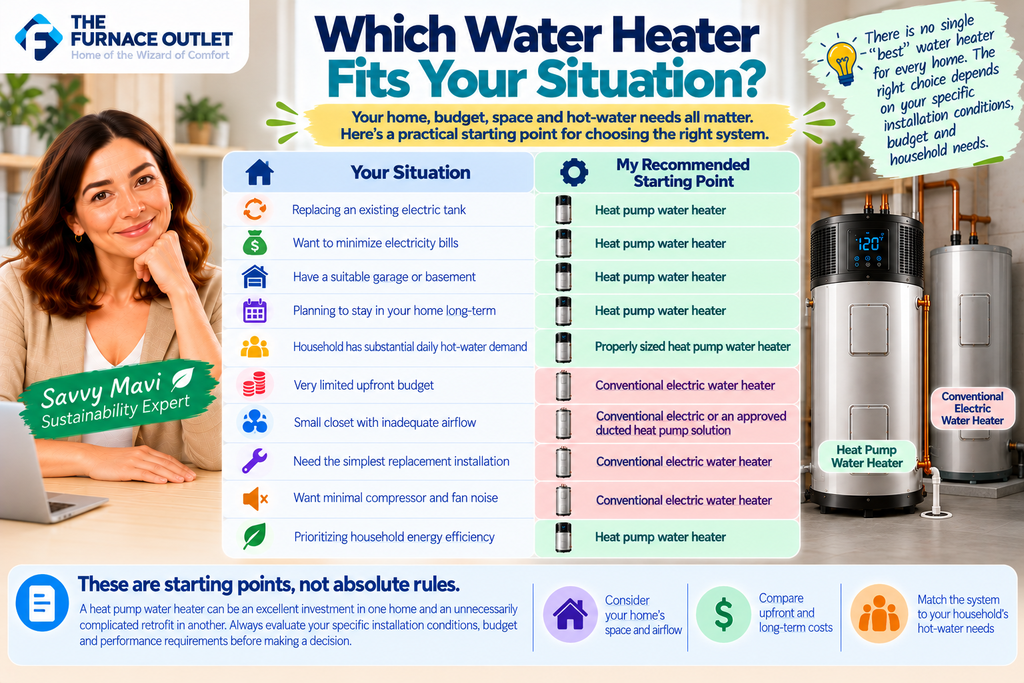
| Your Situation | My Recommended Starting Point |
|---|---|
| Replacing an existing electric tank | Heat pump water heater |
| Want to minimize electricity bills | Heat pump water heater |
| Have a suitable garage or basement | Heat pump water heater |
| Planning to stay in your home long-term | Heat pump water heater |
| Household has substantial daily hot-water demand | Properly sized heat pump water heater |
| Very limited upfront budget | Conventional electric water heater |
| Small closet with inadequate airflow | Conventional electric or an approved ducted heat pump solution |
| Need the simplest replacement installation | Conventional electric water heater |
| Want minimal compressor and fan noise | Conventional electric water heater |
| Prioritizing household energy efficiency | Heat pump water heater |
These recommendations are starting points rather than absolute rules. A heat pump water heater can be an excellent investment in one home and an unnecessarily complicated retrofit in another. The correct choice depends on the complete installation and the performance requirements of the household.

If your home has a suitable installation location, your household uses a meaningful amount of hot water, and your budget can accommodate the higher initial investment, I would generally recommend investigating a properly sized heat pump water heater first. Its potential to reduce electricity consumption makes it particularly attractive for homeowners who want to improve household efficiency without sacrificing everyday comfort.
However, if your installation space is unsuitable, your budget is limited, or the required modifications make the project disproportionately expensive, a conventional electric water heater remains a reasonable alternative. My goal is not to encourage homeowners to purchase the newest technology at any cost. It is to help them invest in equipment that delivers dependable hot water, sensible long-term value, and lower energy waste wherever practical.
If I were choosing between these two technologies for a suitable home in 2026, I would give the heat pump water heater serious preference because its efficiency advantage can produce meaningful long-term energy savings. It represents the kind of sustainable technology I appreciate most: a practical improvement that can reduce energy consumption while continuing to provide everyday comfort.
However, I would never ignore installation conditions, household demand, or financial practicality. A conventional electric water heater can remain a sensible option when simplicity, space constraints, or upfront affordability outweigh potential operating savings.
The best decision comes from comparing complete installed cost, annual energy consumption, hot-water performance, installation suitability, maintenance, and long-term value. Sustainability should not require sacrificing comfort or making an unreasonable investment. It should help homeowners choose technology that performs its job efficiently, reliably, and responsibly.
The Furnace Outlet is an independent educational and informational website. We are not affiliated with, associated with, sponsored by, endorsed by, or officially connected with any water-heater manufacturer, brand, retailer, utility, government agency, or other company mentioned in this article unless explicitly disclosed. All company names, product names, and trademarks belong to their respective owners and are referenced solely for identification, comparison, and informational purposes.
Our editorial assessments are based on publicly available technical information, government resources, manufacturer documentation, and general water-heating principles. We do not claim to have independently laboratory-tested products unless explicitly stated. Some content may contain affiliate links, through which The Furnace Outlet may earn a commission at no additional cost to the reader. Any commercial relationship should be separately disclosed where applicable.
Water-heater installation and servicing involve electrical systems, pressurized hot water, plumbing connections, and safety devices. Always follow the exact manufacturer’s instructions, verify local code and permit requirements, and use appropriately qualified professionals for installation and repairs. Prices, savings calculations, performance figures, and service-life expectations are illustrative and are not guarantees of actual results.