Newsletter Subscribe
Enter your email address below and subscribe to our newsletter

HVAC made simple

By Jake Lawson | HVAC Specialist | The Furnace Outlet
Updated October 2026 | Home Heating, Thermostat Settings & Energy Efficiency
Finding the best thermostat setting for winter is not simply about choosing a temperature that feels comfortable. The temperature you maintain throughout the day affects heating energy consumption, furnace or heat pump operation, indoor comfort, and potentially your monthly utility bills. Setting the thermostat too high can increase heating demand, while aggressive temperature reductions may leave rooms uncomfortable or create operating challenges for certain heating systems.
Many homeowners have heard that 68°F is the ideal winter thermostat setting, but that number is better understood as a useful starting point rather than a universal requirement. A well-insulated home in a relatively mild climate may remain comfortable at a lower setting, while a drafty house in a colder region may require additional attention to insulation, air leakage, and temperature distribution before occupants feel comfortable. Personal preferences, household activities, health considerations, and heating equipment also influence the most appropriate setting.
As an HVAC specialist with more than 10 years of experience, I recommend choosing winter thermostat settings based on three priorities: maintaining reasonable comfort, reducing unnecessary heating demand, and allowing the installed equipment to operate as intended. A gas furnace, an air-source heat pump, and an electric resistance heating system may respond differently to temperature setbacks, so the same schedule should not automatically be applied to every home.
In this guide, I explain practical winter thermostat temperatures for daytime, nighttime, and periods away from home. I also discuss programmable and smart thermostats, furnace versus heat pump operation, common energy-saving mistakes, and how homeowners can balance comfort with heating costs throughout the 2026–2027 winter season.
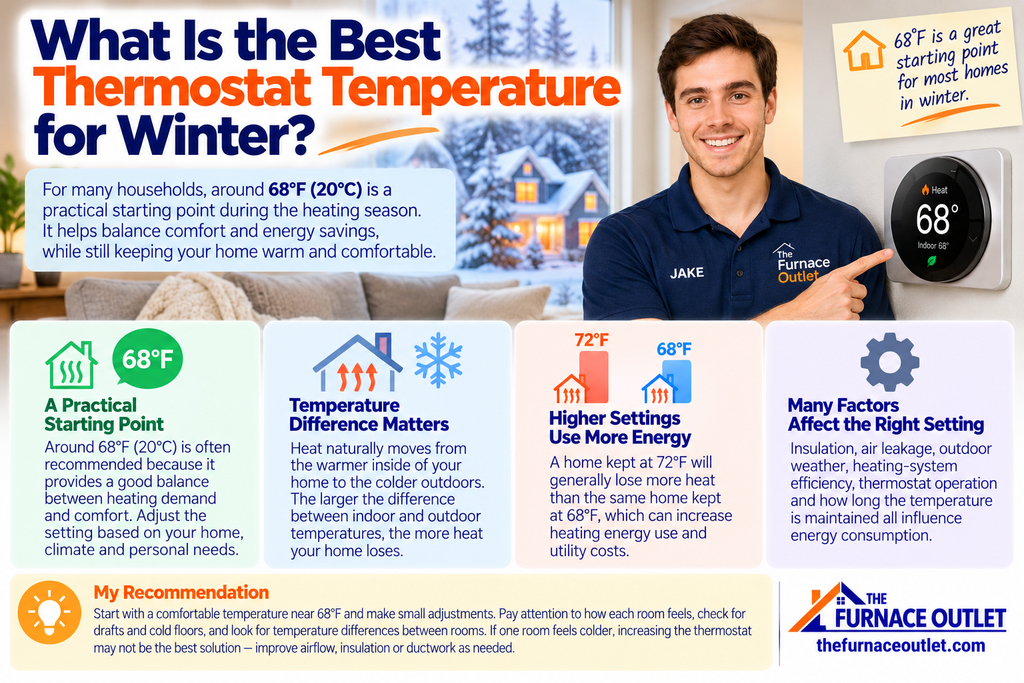
For many households, approximately 68°F (20°C) while occupants are awake and at home is a reasonable starting point during the heating season. This temperature is frequently referenced in energy-saving guidance because it provides a practical baseline for balancing heating demand and comfort. However, it is not a requirement, and homeowners should adjust the setting based on their circumstances.
The important relationship is between indoor and outdoor temperatures. During winter, heat naturally moves from the warmer interior of a building toward colder outdoor conditions. As the difference between indoor and outdoor temperatures increases, heat loss generally increases as well, assuming other building conditions remain similar. Maintaining a lower indoor temperature during appropriate periods can therefore reduce heating demand.
For example, a home maintained at 72°F during cold weather will generally lose more heat than the same home maintained at 68°F under otherwise identical conditions. The actual difference in energy consumption depends on insulation, air leakage, outdoor weather, heating-system efficiency, thermostat operation, and the duration of each temperature setting.
I recommend starting with a comfortable temperature near 68°F and making small adjustments rather than immediately adopting an aggressive energy-saving schedule. Homeowners should pay attention to occupied-room temperatures, drafts, cold floors, and differences between rooms. If one room feels substantially colder than another, increasing the thermostat setting may not be the most effective solution.
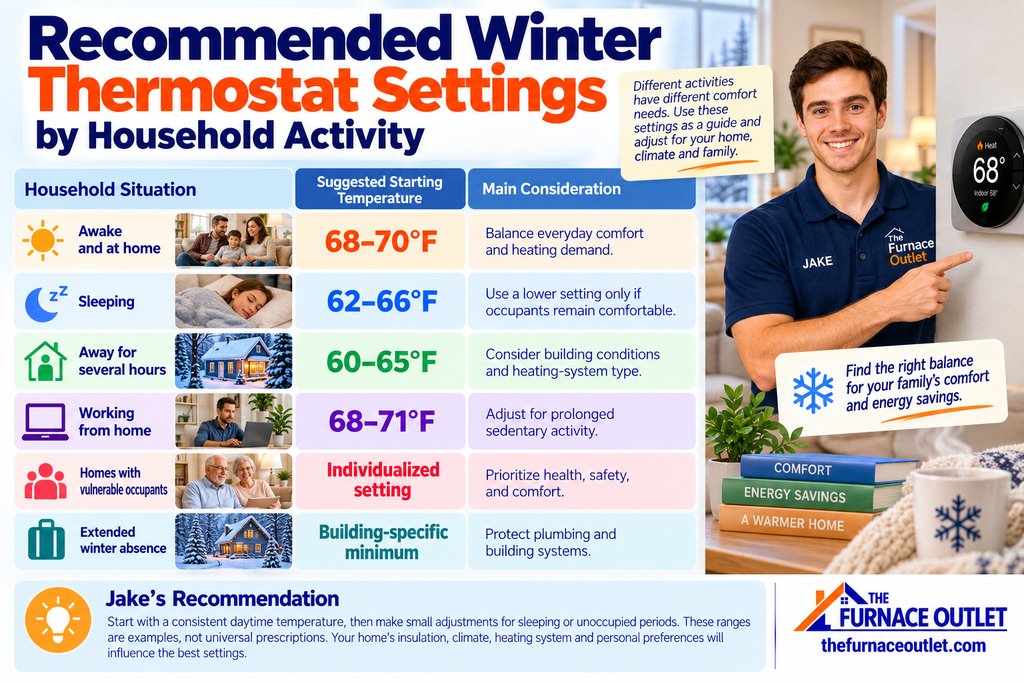
Different household activities create different comfort requirements. People who are active around the house may feel comfortable at a lower temperature than those sitting quietly for extended periods. Sleeping conditions also vary with bedding, clothing, room temperature, and individual preferences.
The following ranges provide general planning examples rather than medically appropriate temperatures for every household. People with specific health or temperature-sensitivity needs should prioritize those requirements over generalized energy-saving recommendations.
| Household situation | Suggested starting range | Main consideration |
|---|---|---|
| Awake and at home | 68–70°F | Balance everyday comfort and heating demand |
| Sleeping | 62–66°F | Use a lower setting only if occupants remain comfortable |
| Away for several hours | 60–65°F | Consider building conditions and heating-system type |
| Working from home | 68–71°F | Adjust for prolonged sedentary activity |
| Homes with vulnerable occupants | Individualized setting | Prioritize health, safety, and comfort |
| Extended winter absence | Building-specific minimum | Protect plumbing and building systems |
These temperatures are examples, not universal prescriptions. A well-insulated house may remain comfortable during a moderate setback, while a poorly insulated building may cool rapidly and require a more conservative approach. Heat pump owners should also consider whether temperature recovery will activate expensive supplemental heating.
My preference is to establish a consistent daytime temperature first, then experiment with modest changes during sleeping or unoccupied periods. This makes it easier to determine whether a particular adjustment improves efficiency without creating unnecessary discomfort.
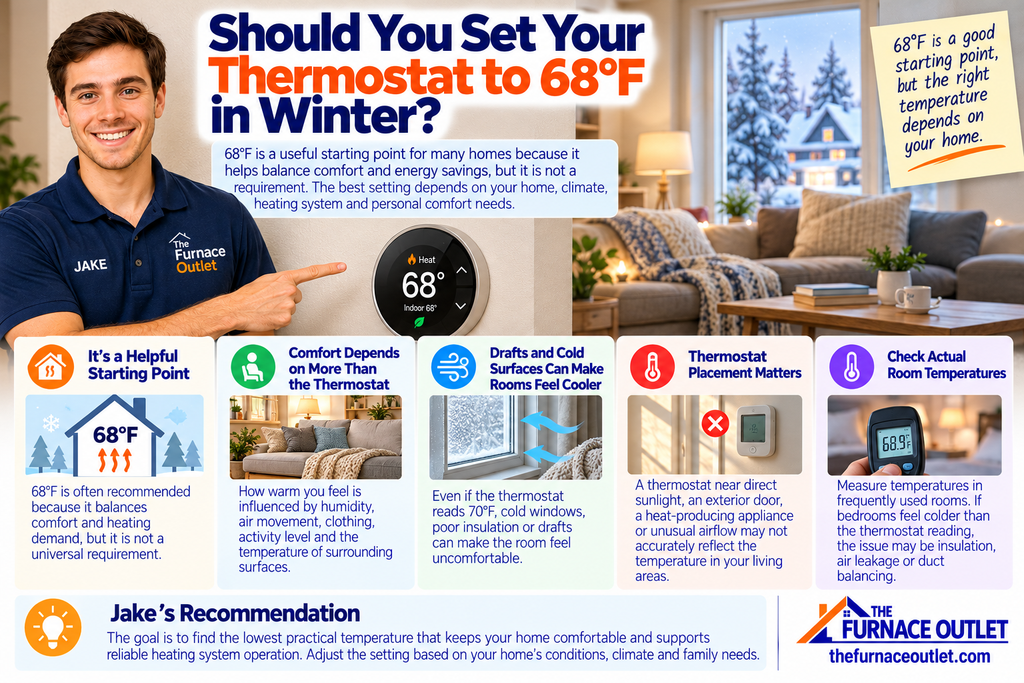
The 68°F recommendation is useful because it encourages homeowners to reconsider unnecessarily high indoor temperatures. However, the number should not be treated as a guarantee of comfort or a specific percentage of energy savings.
Comfort depends on more than the temperature displayed on a thermostat. Mean radiant temperature, indoor air movement, humidity, clothing, activity level, and the temperature of surrounding surfaces all influence how warm a person feels. A room with cold windows and noticeable drafts may feel uncomfortable even when the thermostat reads 70°F.
Similarly, thermostat placement can affect the reading. A thermostat located near direct sunlight, an exterior door, a heat-producing appliance, or an unusual airflow pattern may not accurately represent conditions in the home’s occupied areas.
I recommend checking actual temperatures in frequently used rooms before making large adjustments. If the thermostat reports 68°F but bedrooms remain noticeably colder, the problem may involve duct distribution, insulation, air leakage, or heating-system balancing rather than an inappropriate thermostat setting.
The objective is not to force every household to tolerate the same temperature. It is to identify the lowest practical setting that provides acceptable comfort and supports reliable equipment operation.
Nighttime thermostat setbacks can reduce heating demand because the home is maintained at a lower temperature for several consecutive hours. For households using conventional furnaces, a moderate reduction during sleeping hours may provide an opportunity for energy savings without significantly affecting comfort.
A starting nighttime range of approximately 62–66°F may be suitable for some households, particularly when occupants have appropriate bedding and the building retains heat reasonably well. However, others may require a warmer sleeping environment because of personal comfort, age, medical considerations, or room conditions.
I recommend avoiding sudden large setbacks when occupants are not accustomed to cooler sleeping temperatures. Begin with a reduction of approximately 2–3°F and evaluate comfort over several nights. If the change works well, a further modest adjustment may be reasonable.
Heat pump owners should be more cautious because a large morning recovery can activate auxiliary electric resistance heating in some systems. The most efficient schedule depends on the equipment, thermostat configuration, and backup-heating controls.
A lower nighttime temperature is beneficial only when it remains compatible with occupant needs and equipment operation. Energy savings should not come at the expense of inadequate heating or unsafe indoor conditions.
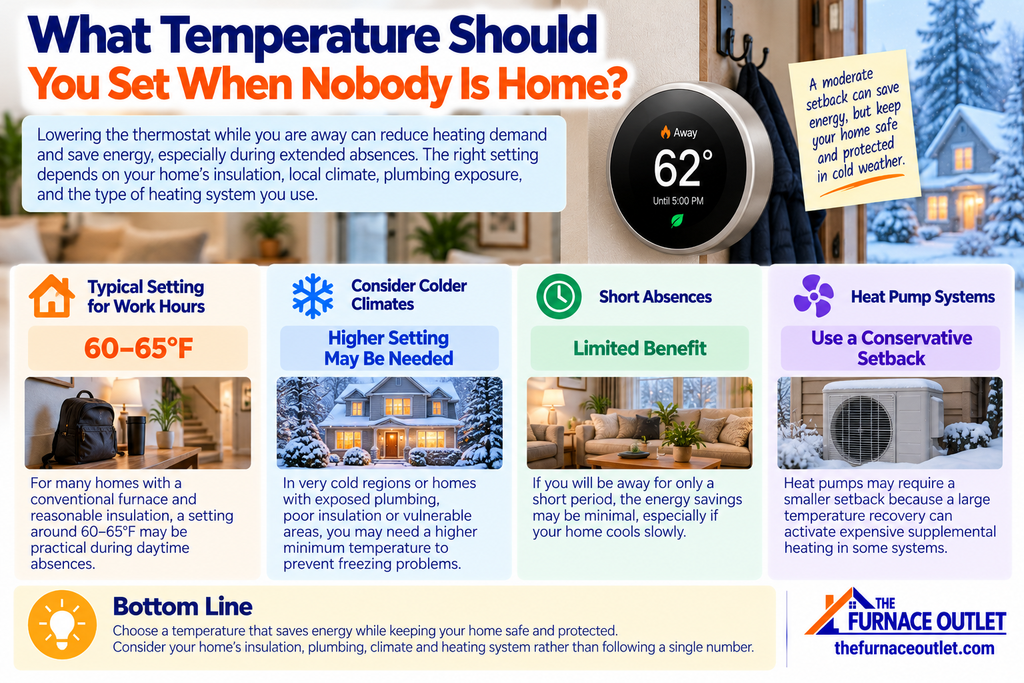
Reducing the thermostat setting while the home is unoccupied can lower heating demand, particularly when the absence lasts several hours. However, the appropriate setback depends on outdoor temperatures, building heat retention, plumbing exposure, and heating equipment.
For a conventional furnace in a reasonably insulated home, a moderate setback may be practical during work hours. Some households may use settings around 60–65°F during extended daytime absences, although these values should not be interpreted as universally safe or appropriate.
Homes with plumbing in exterior walls, poorly insulated crawlspaces, or other vulnerable locations may require higher minimum temperatures during freezing weather. The thermostat reading also does not guarantee that concealed pipes or remote rooms remain above freezing.
For shorter absences, the benefit of changing the thermostat may be limited, particularly if the building cools slowly. Heat pump systems may also require a different strategy because temperature recovery can involve supplemental heating.
I recommend reviewing the building’s characteristics before adopting a deep setback. A practical energy-saving schedule should account for the entire home rather than only the temperature measured near the thermostat.
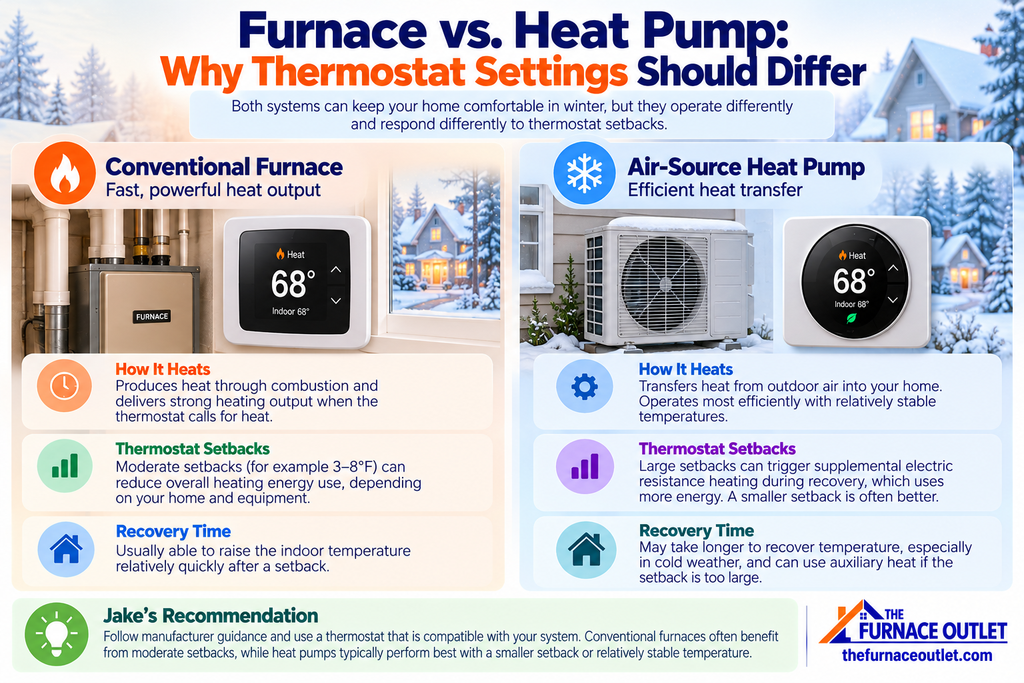
One of the most important distinctions in winter thermostat planning is the difference between conventional furnace heating and heat pump operation. Both systems maintain indoor comfort, but their operating characteristics can affect the value of temperature setbacks.
A conventional gas furnace produces heat through combustion and generally has substantial heating output during operation. When the thermostat calls for heat after a setback, the furnace operates until the indoor temperature approaches the requested setting. Depending on equipment capacity and building conditions, moderate setbacks can reduce overall heating energy consumption.
An air-source heat pump transfers heat from outdoor air into the home. Many heat pumps operate most efficiently when maintaining relatively stable temperatures, particularly when large recoveries trigger supplemental electric resistance heating. This does not mean that every heat pump must operate at one constant temperature, but setback strategies should reflect the equipment’s control system.
Modern variable-speed and cold-climate heat pumps may have sophisticated controls that manage temperature recovery differently from older equipment. Some thermostats use adaptive recovery features or outdoor-temperature information to reduce unnecessary backup heating.
I recommend following manufacturer guidance and reviewing thermostat compatibility before establishing an aggressive schedule. For heat pumps, a small setback or relatively stable temperature may be more appropriate than the deeper reductions commonly used with conventional furnaces.
Lowering the thermostat during winter can reduce heating energy consumption because it reduces the temperature difference between the interior and exterior of the home. However, the amount saved depends on how long the lower temperature is maintained and how the heating system responds.
The U.S. Department of Energy explains that homeowners may save as much as approximately 10% annually on heating and cooling by turning their thermostats back 7–10°F for eight hours per day, under suitable circumstances. This is a general potential savings estimate, not a guaranteed outcome for every home or heating system.
Actual results depend on climate, insulation, air leakage, heating efficiency, electricity or fuel prices, thermostat controls, and household occupancy. In homes with heat pumps, unnecessary auxiliary heating during temperature recovery may reduce or offset some expected savings.
Homeowners should also distinguish between energy consumption and utility bills. Even when heating energy use decreases, changes in fuel prices, fixed utility charges, and weather conditions can influence the final bill.
My recommendation is to evaluate savings over several comparable periods rather than expecting a precise percentage reduction from a single thermostat adjustment. Smart thermostat reports and utility consumption records can help identify trends, but outdoor weather should be considered when interpreting the results.
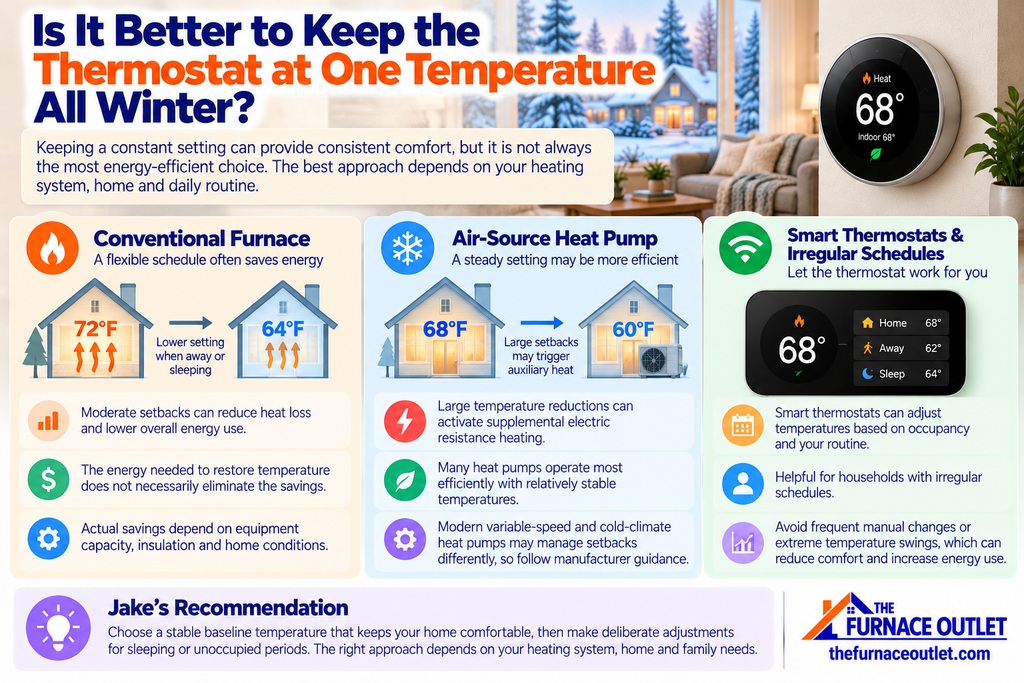
Maintaining a constant thermostat setting can provide consistent comfort and may simplify heating-system operation. However, it is not automatically the most energy-efficient strategy for every home.
For conventional furnaces, allowing indoor temperatures to decrease during suitable unoccupied or sleeping periods can reduce heat loss. The energy needed to restore the temperature does not inherently eliminate the benefit of the setback, although actual savings depend on equipment and building conditions.
For heat pumps, constant or nearly constant settings may be advantageous when large setbacks cause supplemental resistance heating to operate. Some advanced heat pump systems can manage setbacks efficiently, so homeowners should avoid assuming that all heat pumps behave identically.
A household with irregular schedules may also benefit from smart thermostat controls that adjust temperatures according to occupancy. However, frequent manual changes and extreme temperature swings can create discomfort without delivering meaningful benefits.
I recommend choosing a stable baseline and making deliberate adjustments rather than continuously changing the thermostat throughout the day. Consistency makes it easier to evaluate comfort, heating runtime, and energy consumption.
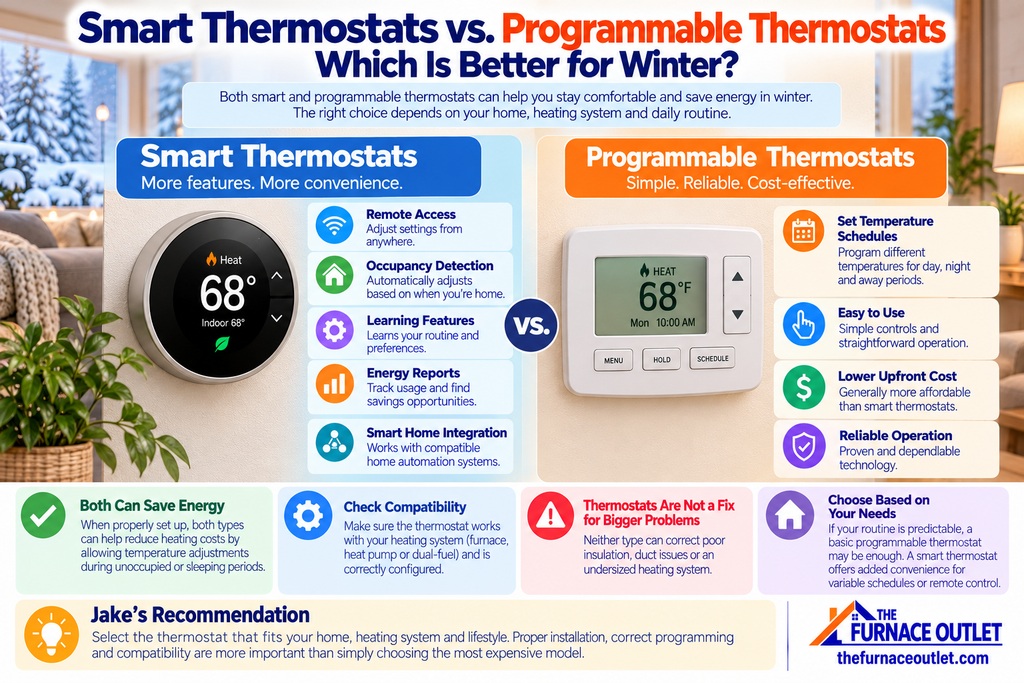
Programmable thermostats allow homeowners to establish temperature schedules for different times of day. Smart thermostats may provide additional features such as remote access, occupancy detection, learning functions, energy reports, and integration with compatible home automation systems.
These features can make energy-saving schedules easier to maintain, but the thermostat must be compatible with the installed heating equipment. A thermostat designed for a conventional furnace may not properly control a heat pump with auxiliary heating or a dual-fuel system without appropriate configuration.
For households with predictable routines, a basic programmable thermostat may provide sufficient control. A smart thermostat may offer additional convenience when occupancy patterns vary or remote adjustments are useful.
However, neither type can correct inadequate insulation, blocked ductwork, insufficient heating capacity, or mechanical faults. A poorly configured smart thermostat can also create operating problems despite its advanced features.
I recommend selecting thermostat functionality based on actual household needs and equipment requirements rather than purchasing the most expensive model available. Proper installation, programming, and compatibility are more important than the number of advertised features.
Heat pumps may use auxiliary heating when outdoor conditions or heating demand require additional capacity. In many systems, this backup consists of electric resistance heating elements, although some homes use dual-fuel arrangements involving a gas furnace.
Auxiliary heat may activate automatically during certain operating conditions, including large temperature recoveries or low outdoor temperatures. Because electric resistance heating typically consumes more electricity per unit of delivered heat than an efficiently operating heat pump, unnecessary activation can increase operating costs.
Emergency heat is a separate thermostat mode available on some systems. It is generally intended for situations in which the primary heat pump cannot operate properly and backup heating is required. Selecting emergency heat unnecessarily may cause the system to rely on a more expensive heating source.
I recommend reviewing the thermostat manual and understanding how the installed system manages supplemental heating. Homeowners should not assume that emergency heat is a faster or more efficient way to warm the house.
If auxiliary heating operates unusually often or the system struggles to maintain indoor temperature, professional evaluation may be appropriate. The cause may involve equipment capacity, controls, airflow, outdoor conditions, or other operating factors.
Indoor humidity influences how occupants perceive comfort, although its relationship with temperature is more complex than simply assuming that higher humidity always makes a room feel warmer. Very dry indoor conditions can contribute to discomfort, while excessive moisture can cause condensation and building-related problems.
For many homes, a relative humidity range of approximately 30–50% is a useful general reference. However, the appropriate winter level depends on outdoor temperature, building insulation, window performance, and condensation risk. In very cold climates, maintaining humidity near the upper end of that range may cause moisture to accumulate on cold surfaces.
I recommend using a reliable hygrometer to monitor indoor conditions rather than relying entirely on how the air feels. Homeowners should investigate recurring window condensation, damp patches, or musty odors rather than increasing humidifier output without understanding the cause.
Humidity management should complement thermostat planning, not replace it. Raising humidity cannot compensate for insufficient heating capacity, severe drafts, or inadequate insulation.
A comfortable winter home depends on appropriate temperature, controlled moisture, and a building envelope that limits unnecessary heat loss.
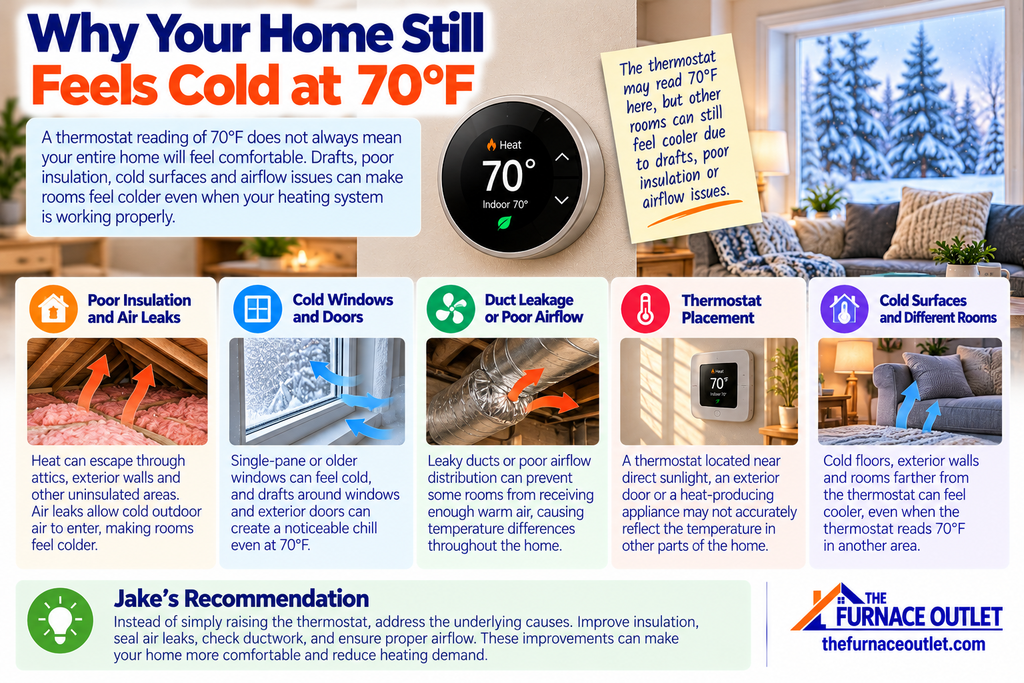
A thermostat reading of 70°F does not guarantee that every room will feel comfortable. Indoor temperature differences, cold surfaces, drafts, and airflow patterns can create discomfort even when the heating equipment reaches its requested setpoint.
Poor insulation and air leakage are common contributors. Heat can escape through inadequately insulated attics, exterior walls, windows, and other building components. Uncontrolled outdoor air entry can also create localized drafts that make occupied areas feel colder than the thermostat suggests.
Duct leakage or poor airflow distribution may cause some rooms to receive less heated air than others. Thermostat placement can further complicate the problem if the control is located in an area that warms faster than distant bedrooms or living spaces.
I recommend investigating these conditions before simply increasing the thermostat temperature. Weatherstripping, insulation improvements, appropriate duct sealing, and professional airflow evaluation may address the underlying problem more effectively.
The U.S. Department of Energy provides guidance on reducing household energy losses through insulation and air sealing. These improvements can support both comfort and lower heating demand.
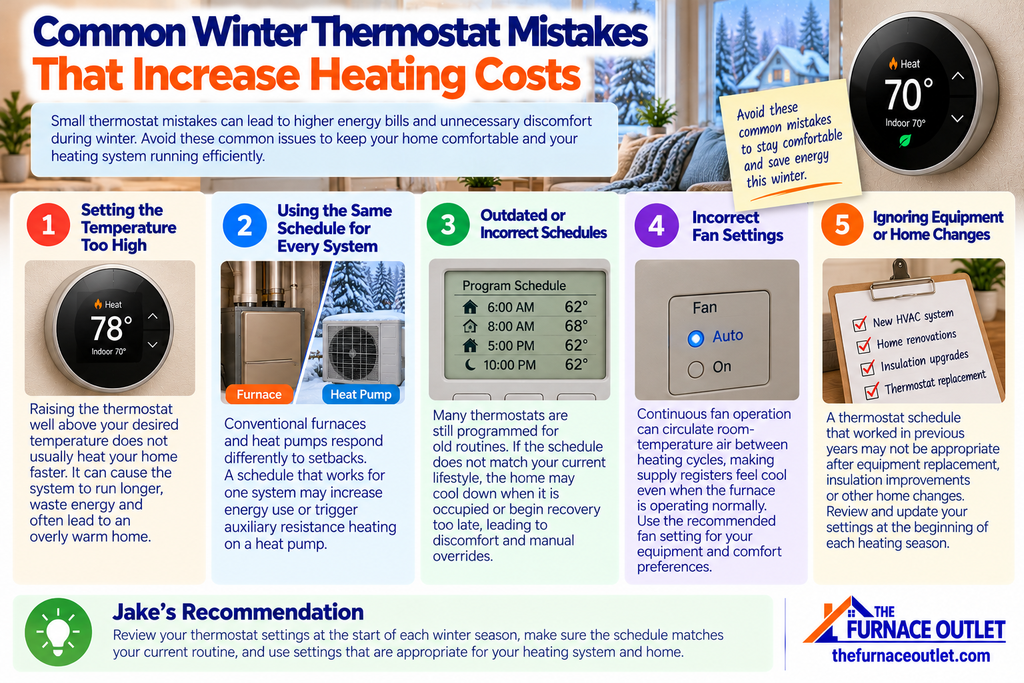
A frequent mistake is setting the thermostat dramatically higher when the house feels cold. Many conventional heating systems do not warm the home faster simply because the requested temperature is increased well beyond the desired setting. Instead, the system may continue heating longer than necessary and overshoot the intended comfort level.
Another mistake is applying the same setback schedule to every heating system. Conventional furnaces and heat pumps can respond differently to temperature recovery, particularly when auxiliary resistance heating is involved.
Homeowners may also overlook programmed schedules that no longer match household routines. A thermostat that reduces heating during occupied hours or begins recovery too late can create discomfort and encourage repeated manual overrides.
Incorrect fan settings can cause confusion as well. Selecting continuous fan operation may circulate room-temperature air between heating cycles, making supply registers feel cool even when the furnace itself is operating normally.
I recommend reviewing thermostat settings at the beginning of each heating season and after any equipment replacement. A simple configuration review can prevent unnecessary troubleshooting and improve comfort.
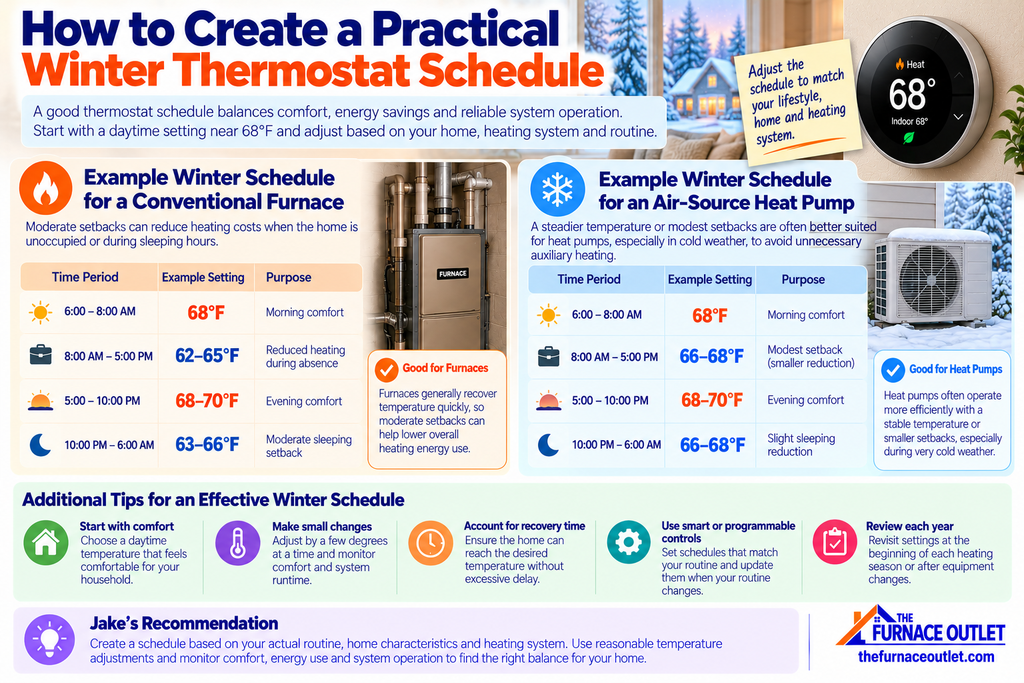
A useful thermostat schedule should reflect when the home is occupied, when occupants are sleeping, and how quickly the building loses heat. I recommend beginning with a daytime baseline near 68°F for households that find this comfortable, then making modest adjustments based on actual conditions.
For conventional furnaces, homeowners may experiment with moderate nighttime and away-from-home setbacks. The appropriate amount depends on household comfort, building characteristics, and whether the home can recover temperature without unreasonable delays.
For heat pumps, I generally recommend a more conservative approach unless the equipment and thermostat are specifically designed to manage larger setbacks efficiently. A relatively stable temperature or modest reduction may avoid unnecessary supplemental heating.
The following example illustrates how a conventional furnace household might organize a winter schedule. It is not a universal recommendation and should be adjusted for health, safety, comfort, and building conditions.
| Time period | Example setting | Purpose |
|---|---|---|
| 6:00–8:00 AM | 68°F | Morning comfort |
| 8:00 AM–5:00 PM | 62–65°F | Reduced heating during absence |
| 5:00–10:00 PM | 68–70°F | Evening comfort |
| 10:00 PM–6:00 AM | 63–66°F | Moderate sleeping setback |
For heat pump households, a steadier schedule may be preferable. Homeowners should use heat-pump-compatible thermostat settings and follow equipment-specific guidance to limit unnecessary auxiliary heating.
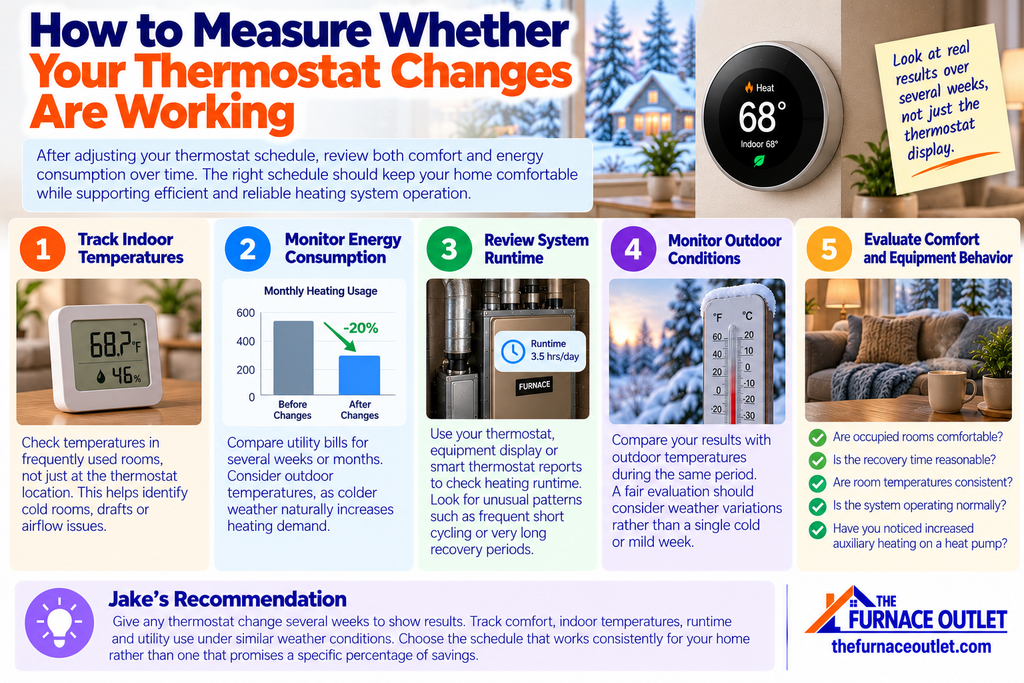
After changing a thermostat schedule, evaluate both comfort and energy consumption rather than focusing exclusively on the thermostat display. A setting that appears efficient on paper may not be practical if occupied rooms remain uncomfortable or the equipment repeatedly activates backup heating.
I recommend tracking indoor temperatures, thermostat settings, heating runtime where available, and utility consumption over several weeks. Outdoor temperatures should also be considered because colder weather naturally increases heating demand.
Smart thermostats may provide useful operating reports, but these should be interpreted carefully. A reduction in heating runtime does not necessarily correspond directly to the same percentage reduction in energy use, particularly when equipment operates at variable capacity.
Homeowners should also pay attention to unusual equipment behavior, including repeated short cycling, unexpectedly long recovery periods, or substantial temperature differences between rooms.
The most useful thermostat schedule is one that performs consistently under actual household conditions rather than one selected solely because it promises a particular percentage of savings.
For many households, 68°F is a reasonable daytime starting point because it balances moderate heating demand with acceptable comfort. However, the appropriate temperature depends on personal preferences, building conditions, heating equipment, and occupant needs.
Not necessarily. Some households remain comfortable at 65°F, particularly with appropriate clothing and good insulation. However, certain occupants may require warmer conditions, and a single thermostat reading does not guarantee that every room or plumbing location remains adequately heated.
A range around 62–66°F may be comfortable for some households, but sleeping preferences and health considerations vary. Homeowners should use a temperature that supports safe, comfortable sleep rather than following a rigid energy-saving target.
A moderate setback may reduce heating demand during extended absences, particularly with conventional furnaces. The appropriate setting depends on building conditions, freezing risk, heating-system type, and the length of the absence.
Not necessarily. Conventional furnace households may save energy through appropriate temperature setbacks. Heat pump households may benefit from steadier settings when large recoveries activate supplemental electric resistance heating.
Usually not with conventional single-stage furnaces. The system generally heats at its designed output regardless of how high the thermostat is set. Some variable-capacity systems may respond differently, but extreme setpoints can still cause unnecessary heating.
A relatively stable temperature or modest setback is often a useful starting point, especially when large recoveries could activate auxiliary resistance heating. The correct strategy depends on equipment design and thermostat controls.
Savings vary substantially. The Department of Energy notes that suitable setbacks of 7–10°F for eight hours daily may produce annual heating and cooling savings of up to approximately 10% in some circumstances, but individual results are not guaranteed.
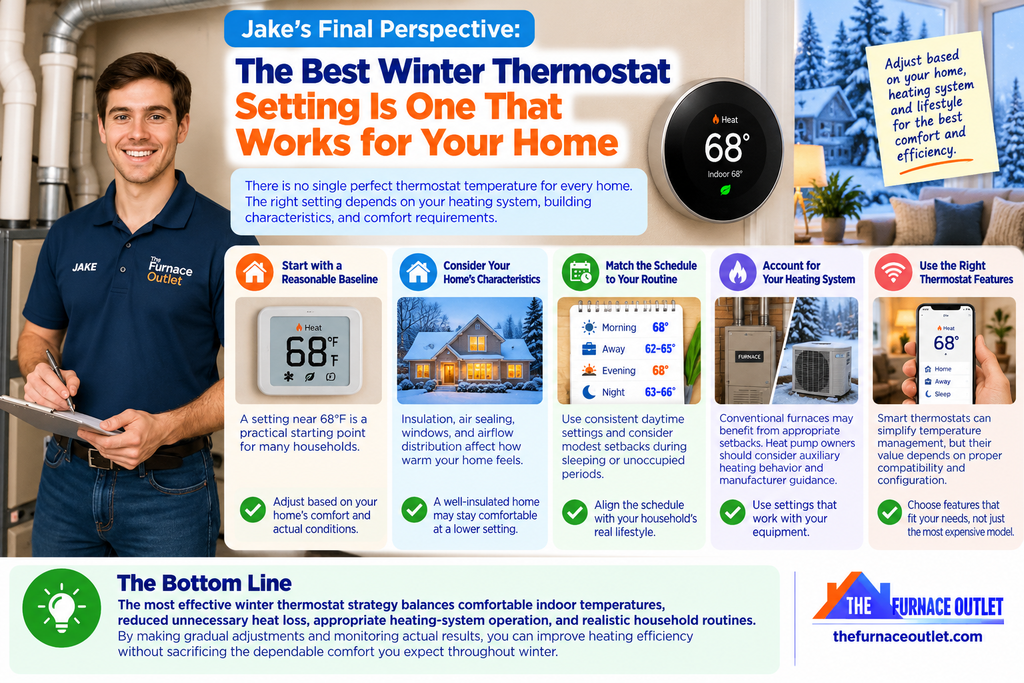
When homeowners ask me for the single best winter thermostat temperature, I explain that the answer depends on their heating system, building characteristics, and comfort requirements. A setting near 68°F is a practical starting point for many households, but it should not be treated as a universal rule. A home with excellent insulation may remain comfortable at a lower temperature, while another property may need improvements to airflow, air sealing, or heat distribution before occupants feel comfortable.
My preferred approach begins with establishing a consistent daytime temperature, reviewing household schedules, and making modest adjustments during sleeping or unoccupied periods. Conventional furnace owners may benefit from appropriate setbacks, while heat pump owners should consider auxiliary heating behavior and manufacturer guidance before making large temperature changes. Smart thermostats can simplify these routines, but their value depends on proper compatibility and configuration.
The most effective winter thermostat strategy balances comfortable indoor temperatures, reduced unnecessary heat loss, appropriate heating-system operation, and realistic household routines. By making gradual adjustments and monitoring actual results, homeowners can improve heating efficiency without sacrificing the dependable comfort they expect throughout winter.
U.S. Department of Energy — Programmable Thermostats: https://www.energystar.gov/products/smart_thermostats. This resource explains thermostat scheduling, temperature setbacks, and considerations for different heating systems.
U.S. Department of Energy — Thermostats: https://www.energy.gov/cmei/buildings/simulation-driven-smart-thermostat-benchmarking. This guidance discusses thermostat operation, energy-saving settings, and heating-control considerations.
U.S. Department of Energy — Air-Source Heat Pumps: https://www.energystar.gov/products/air_source_heat_pumps. This resource provides background on heat pump operation, efficiency, and heating performance.
U.S. Department of Energy — Insulation: https://www.energy.gov/sites/prod/files/guide_to_home_insulation.pdf. This guidance describes how insulation influences household heat loss and energy efficiency.
U.S. Environmental Protection Agency — Mold and Moisture: https://www.epa.gov/mold. This resource explains the importance of moisture control and indoor humidity management.
This article is provided by The Furnace Outlet for general educational purposes. Suggested thermostat temperatures are planning examples and should not replace equipment manufacturer instructions, applicable building requirements, or individualized medical guidance. Households with infants, older adults, people with health conditions, or occupants particularly sensitive to cold may require different indoor temperatures.
Winter thermostat setbacks should also account for plumbing protection, building insulation, severe weather, and heating-system capabilities. Heat pump owners should review manufacturer guidance before using aggressive setbacks or changing auxiliary and emergency heating settings. Thermostat wiring, heating-system configuration, and electrical repairs should be handled by qualified professionals when appropriate.
The Furnace Outlet publishes independent HVAC educational content. References to external organizations are included for informational purposes and do not imply sponsorship or endorsement.
© 2026 The Furnace Outlet | thefurnaceoutlet.com