Newsletter Subscribe
Enter your email address below and subscribe to our newsletter

HVAC made simple
By Jake Lawson | HVAC Specialist | The Furnace Outlet
Updated October 2026 | Furnace Troubleshooting, Heating Performance & Homeowner Safety
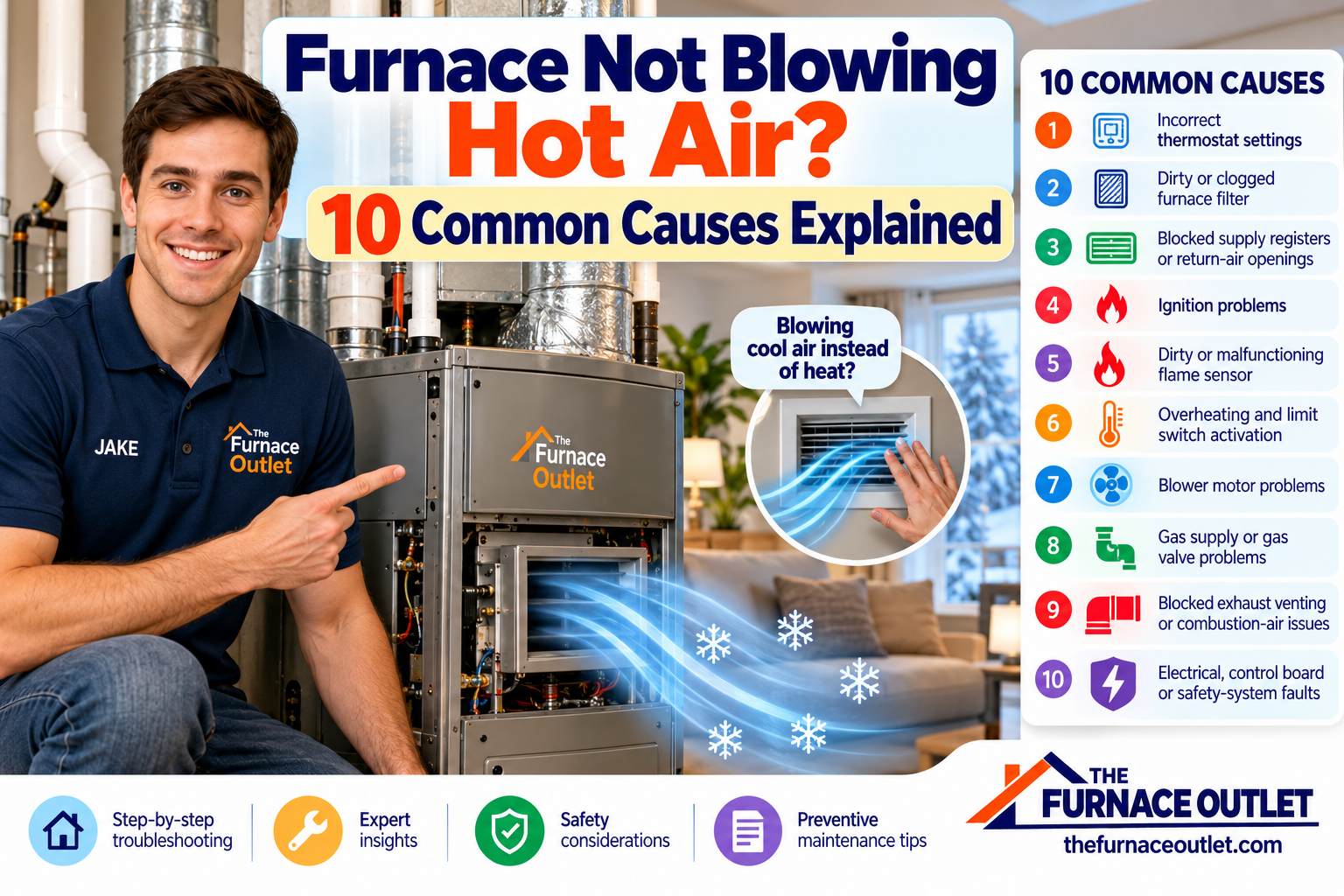
When winter temperatures begin falling, few household problems are more frustrating than switching on the furnace and discovering that the air coming from your heating vents feels cold or barely warm. The thermostat may indicate that heating is active, the blower may be running continuously, and yet the rooms remain uncomfortable. In some situations, the furnace produces no airflow at all, leaving homeowners uncertain whether the problem involves the thermostat, air filter, heating components, or the equipment itself.
A furnace that is not blowing hot air does not necessarily require replacement or an expensive repair. Some heating problems result from incorrect thermostat settings, heavily loaded filters, blocked airflow pathways, or maintenance issues that can be identified relatively easily. Other situations involve ignition failures, malfunctioning safety controls, electrical problems, or defects in combustion-related components that require professional diagnosis.
As an HVAC specialist with more than 10 years of experience, I recommend approaching this problem systematically rather than immediately replacing components or repeatedly resetting the furnace. The first step is understanding whether the furnace is blowing cool air, producing insufficient heat, cycling off prematurely, or failing to move air through the ductwork. These symptoms can appear similar from the homeowner’s perspective, but they often point toward different areas of the heating system.
In this guide, I explain 10 common reasons a furnace may stop delivering warm air, which basic checks homeowners can perform safely, and when professional servicing is necessary. I also cover warning signs involving combustion safety, overheating, and carbon monoxide, because restoring heat should never come at the expense of safe equipment operation.
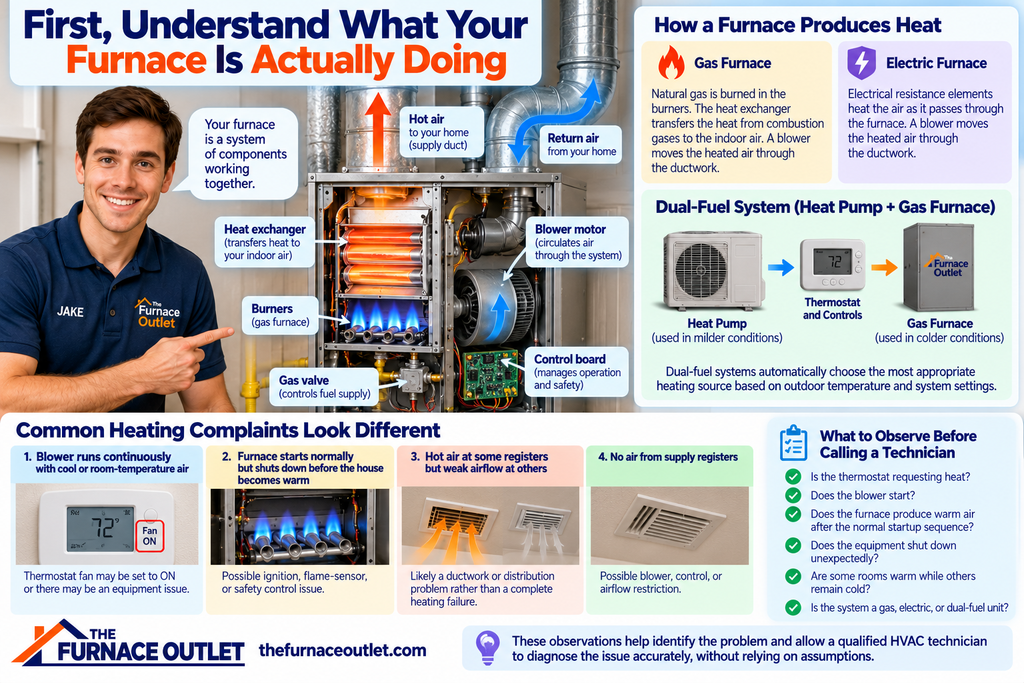
Before identifying possible causes, it helps to distinguish between several common heating complaints. A furnace that runs its blower continuously while delivering room-temperature air may have a different problem from a furnace that starts normally but shuts down before the house becomes warm. Similarly, a system producing hot air at some registers but very little airflow at others may have a distribution problem rather than a failure to generate heat.
Gas furnaces produce heat through controlled combustion and transfer that energy to indoor air through a heat exchanger. Electric furnaces use electrical resistance elements to heat the circulating air. In both systems, a blower moves air through the equipment and into the home’s ductwork. Thermostats, electrical controls, protective switches, and airflow components must operate together for the system to deliver heat reliably.
Some homeowners also have dual-fuel systems combining a heat pump with a gas furnace. These installations use additional controls to determine which heating source should operate under different conditions. Troubleshooting a dual-fuel system may therefore involve more than checking the furnace alone.
I recommend observing whether the thermostat is requesting heat, whether the blower starts, whether the furnace produces warm air after its normal startup sequence, and whether the equipment shuts down unexpectedly. These observations can help a qualified technician investigate the problem without relying on assumptions.
One of the simplest explanations for a furnace blowing cool air is an incorrect thermostat setting. If the fan control is set to ON rather than AUTO, the blower may continue circulating air even when the furnace is not actively heating. During these periods, the air coming through the supply registers may feel cool because it is approximately the same temperature as the indoor air.
The AUTO setting generally allows the furnace controls to manage blower operation according to the equipment’s heating sequence. However, some systems use specialized circulation settings, variable-speed blowers, or advanced controls that operate differently. Homeowners should therefore review their thermostat instructions rather than assuming every model behaves identically.
I recommend confirming that the thermostat is set to HEAT, checking that the requested temperature is above the current indoor temperature, and reviewing any programmed schedules that may be changing the setpoint unexpectedly. If the thermostat has replaceable batteries, follow the manufacturer’s instructions for checking or replacing them.
If the thermostat displays a heating request but the furnace does not respond appropriately, the problem may involve wiring, controls, or another equipment component. These issues should be evaluated professionally rather than addressed through random thermostat adjustments.
A heavily loaded air filter can restrict airflow through the furnace and interfere with normal heating performance. As dust and debris accumulate within the filter media, resistance to airflow may increase. When insufficient air passes through the heat exchanger, temperatures within the equipment may rise beyond intended operating limits.
Gas furnaces typically include protective temperature-limit controls designed to interrupt heating under certain abnormal conditions. Depending on the furnace and fault condition, the blower may continue operating after the burners have shut off, causing homeowners to notice cool air coming through the vents. Repeated overheating interruptions are not normal operating behavior and should be investigated.
I recommend inspecting the furnace filter before assuming that a major component has failed. Check whether the filter is excessively loaded, damaged, incorrectly fitted, or installed against the indicated airflow direction. Replace it when required by manufacturer instructions and actual condition, using a compatible filter of the correct dimensions.
For standard one-inch filters, checking approximately every 30 days during frequent operation is a useful starting point. However, replacement intervals vary with filter construction, household dust conditions, pets, and equipment runtime. If heating problems continue after an appropriate filter replacement, professional evaluation is necessary.
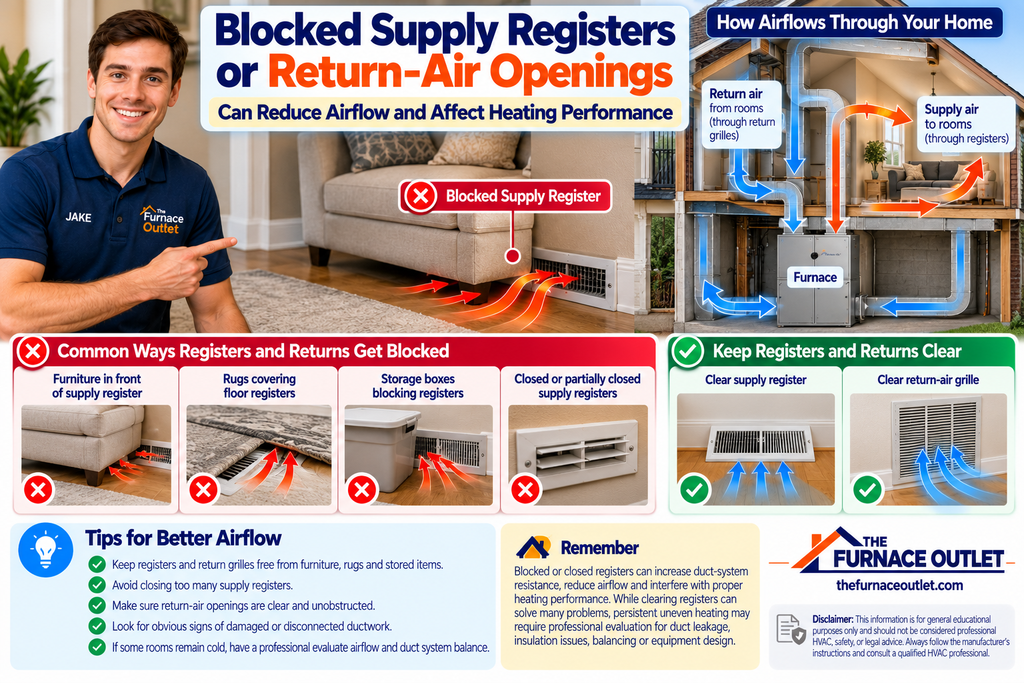
Furnaces depend on adequate airflow through the entire distribution system. Supply registers deliver heated air into occupied rooms, while return-air pathways allow indoor air to travel back toward the heating equipment. If these openings become obstructed, airflow distribution and equipment performance may be affected.
Furniture, rugs, storage boxes, and other household items can accidentally block registers or return grilles. In some homes, occupants close numerous supply registers because they believe this will redirect more heat into frequently used rooms. However, excessive restrictions can increase duct-system resistance and interfere with proper airflow.
I recommend walking through the home and checking accessible supply and return openings. Move furniture away from blocked grilles, confirm that registers intended to remain open are unobstructed, and look for obvious signs of damaged or disconnected ductwork where safely accessible.
If certain rooms remain cold while others receive adequate heat, the issue may involve duct leakage, inadequate insulation, balancing problems, or equipment design. A qualified HVAC technician can evaluate airflow and static pressure when basic household checks do not resolve the problem.
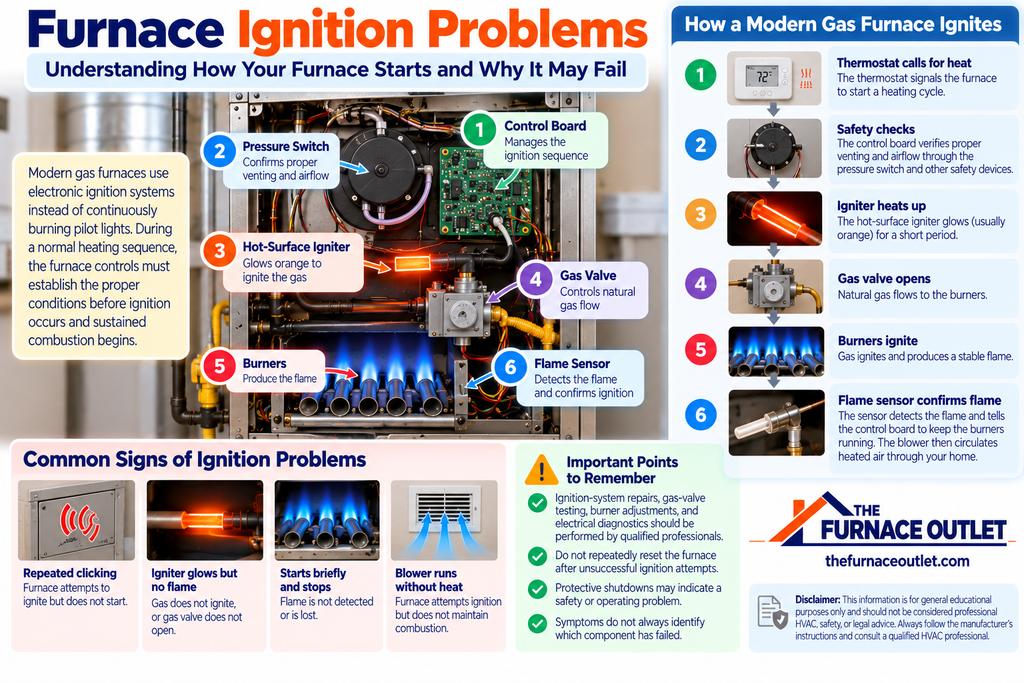
Modern gas furnaces commonly use electronic ignition systems rather than continuously burning pilot lights, although older equipment may use different arrangements. During a normal heating sequence, the furnace controls must establish appropriate operating conditions before ignition occurs and sustained combustion begins.
Depending on the design, ignition components may include a hot-surface igniter, spark ignition system, gas valve, flame-sensing equipment, and associated controls. If ignition fails, the furnace may attempt another startup sequence or enter a protective fault condition. The blower may operate without sustained heating, making it appear that the furnace is blowing cold air.
Homeowners may notice repeated clicking, unsuccessful startup attempts, or a furnace that briefly starts and then stops. These symptoms can have several causes, and they do not reliably identify which component has failed.
Ignition-system repairs, gas-valve testing, burner adjustments, and internal electrical diagnostics should be performed by qualified professionals. I strongly discourage repeatedly resetting a furnace after unsuccessful ignition attempts because protective shutdowns may indicate conditions that require investigation.
Many gas furnaces use flame-sensing equipment to verify that combustion has been established after ignition. If the control system does not receive an acceptable flame signal, it may shut off the gas supply as part of its protective operating sequence.
Homeowners sometimes describe this problem as a furnace that lights briefly but stops heating after a short period. The blower may continue operating depending on the equipment design and control sequence, producing air that no longer feels warm. However, similar symptoms can also result from gas supply issues, grounding problems, control faults, or other ignition-related conditions.
Although online troubleshooting guides frequently suggest cleaning flame sensors as a simple repair, I recommend professional diagnosis when a furnace repeatedly loses its flame signal. The technician should verify the actual fault and follow manufacturer procedures rather than replacing or cleaning components without evidence.
Protective flame-verification systems are essential to safe furnace operation. They should never be bypassed or modified to keep the burners operating.
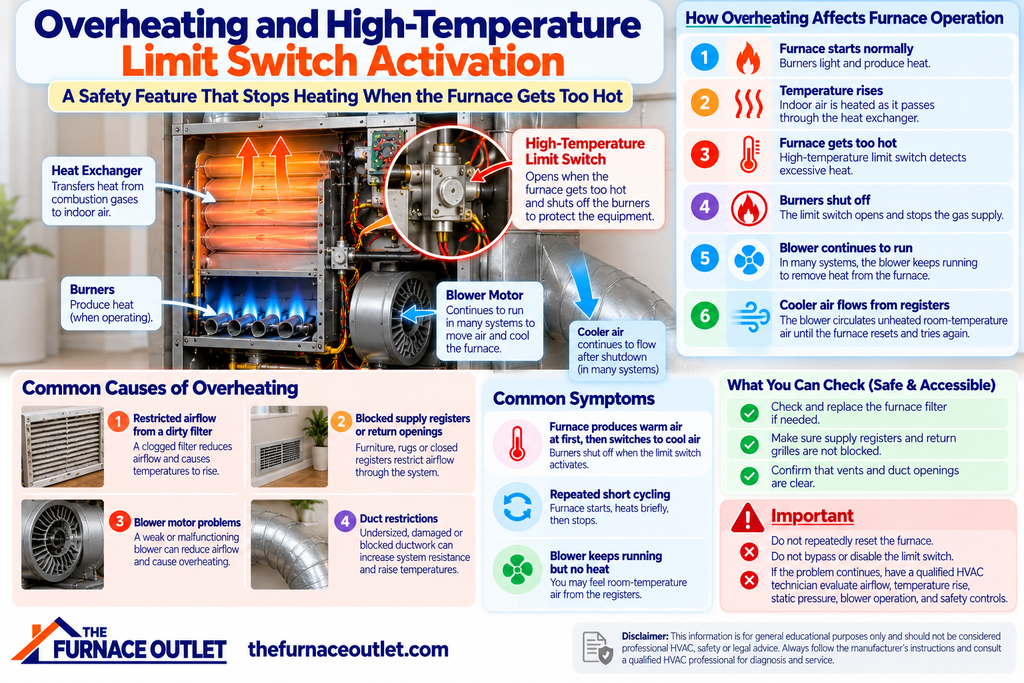
A furnace may stop producing heat because a temperature-limit control has detected an abnormal operating condition. These controls are designed to protect the equipment by interrupting heating when temperatures exceed specified limits.
Restricted airflow is one possible contributor, but overheating may also involve blower problems, incorrect airflow settings, duct restrictions, or other equipment faults. Depending on the furnace design, the blower may continue running to move heat away from internal components even after combustion has stopped.
Homeowners may notice that the furnace initially produces warm air but later switches to cool airflow before the thermostat reaches its requested temperature. Repeated cycling of this type should not be treated as normal furnace behavior.
I recommend checking only safe, accessible items such as filter condition and blocked registers. If the problem continues, a technician should evaluate airflow, temperature rise, static pressure, blower operation, and the relevant protective controls. Repeatedly resetting the furnace or bypassing a limit switch can create serious safety hazards.
The blower system is responsible for circulating air through the furnace and ductwork. If the blower motor, wheel, electrical controls, or associated components malfunction, the furnace may fail to distribute heat properly.
Symptoms vary with the fault. Some homeowners experience weak airflow, unusual blower noises, or intermittent operation. Others find that the furnace appears to generate heat but delivers little or no air through the supply registers. In certain systems, protective controls may interrupt heating when adequate airflow is not established.
Blower problems can involve mechanical wear, accumulated debris, electrical faults, incorrect control settings, or duct resistance. A homeowner should not assume that the motor itself requires replacement simply because airflow is weak.
I recommend observing airflow and listening for unusual sounds without opening electrical compartments or reaching into moving equipment. Professional diagnosis may include checking motor operation, blower-wheel condition, electrical measurements, control signals, and airflow performance.
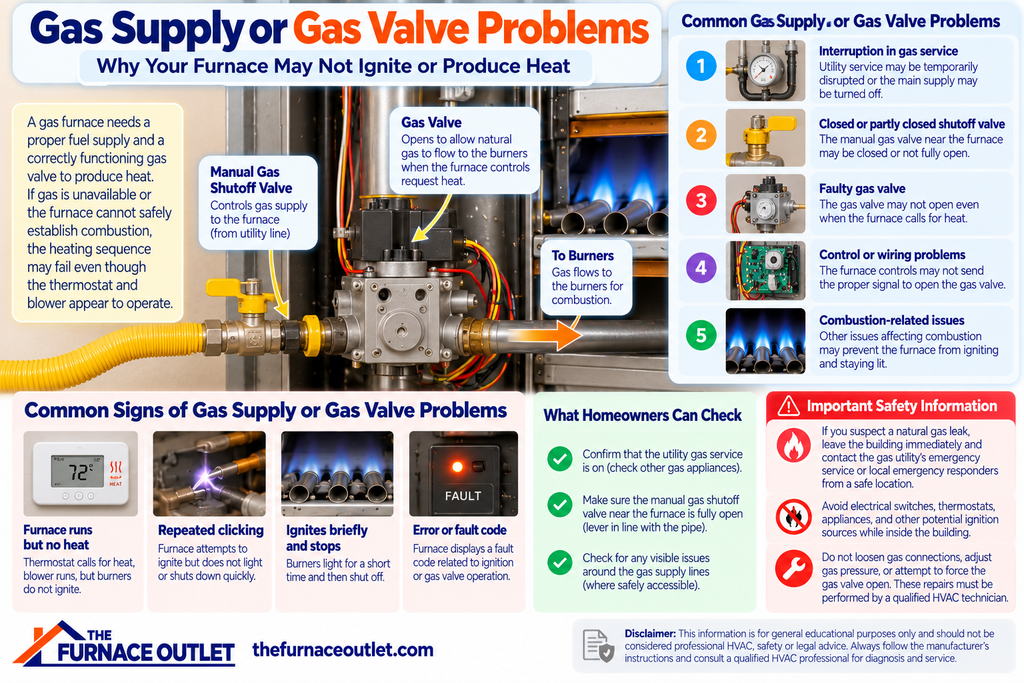
A gas furnace requires an appropriate fuel supply and correctly functioning gas-control components to produce heat. If gas is unavailable or the furnace cannot safely establish combustion, the heating sequence may fail even though the thermostat and blower appear to operate.
Potential problems include an interruption in utility service, gas-valve faults, control problems, or other conditions affecting combustion. However, these issues cannot be reliably diagnosed by observing whether warm air reaches the registers.
Homeowners should never loosen gas connections, adjust gas pressure, or attempt to force a gas valve open. If there is a suspected natural gas leak, leave the building immediately and contact the gas utility’s emergency service or local emergency responders from a safe location. Avoid electrical switches, thermostats, appliances, and other potential ignition sources while inside the affected building.
If there is no suspected leak but the furnace repeatedly fails to establish heat, a qualified technician should inspect the system according to manufacturer procedures. Fuel-system repairs and adjustments require appropriate training and equipment.
Fuel-burning furnaces require appropriate combustion air and safe removal of exhaust gases. Depending on the equipment design, venting may involve metal flue components, manufacturer-approved plastic piping, or other listed arrangements.
If an exhaust pathway becomes obstructed or a combustion-air system develops a problem, protective controls may prevent normal heating operation. Potential causes include debris, nests, snow accumulation, damaged vent components, or installation-related issues. However, not every ignition or pressure-switch fault indicates a blocked vent, so professional diagnosis remains important.
Homeowners may visually check accessible exterior vent terminations for obvious obstructions without dismantling the system. Never disconnect vent piping, bypass a pressure switch, or modify combustion-air arrangements to restore heating.
Venting defects can create serious safety concerns, including exposure to combustion gases. If components appear damaged, disconnected, or obstructed, the furnace should remain out of service until the condition has been properly evaluated.
Modern furnaces rely on electrical controls to coordinate thermostat requests, ignition, blower operation, protective switches, and shutdown sequences. A malfunction involving these systems may prevent the furnace from producing heat even when some components appear to operate normally.
Possible problems include damaged wiring, failed relays, control-board faults, transformer issues, or protective devices responding to abnormal conditions. Some furnaces display diagnostic fault codes through indicator lights or control interfaces, which can provide useful information to a qualified technician.
Homeowners may safely observe a displayed error code without opening energized compartments, but interpreting the code requires reference to the exact furnace model and its service documentation. A fault indication identifies a detected condition or operating failure; it does not necessarily prove that the component named in the code is defective.
I recommend documenting any visible diagnostic information and describing the operating symptoms when arranging service. Electrical repairs, safety-control testing, and internal diagnostics should be performed by qualified professionals.
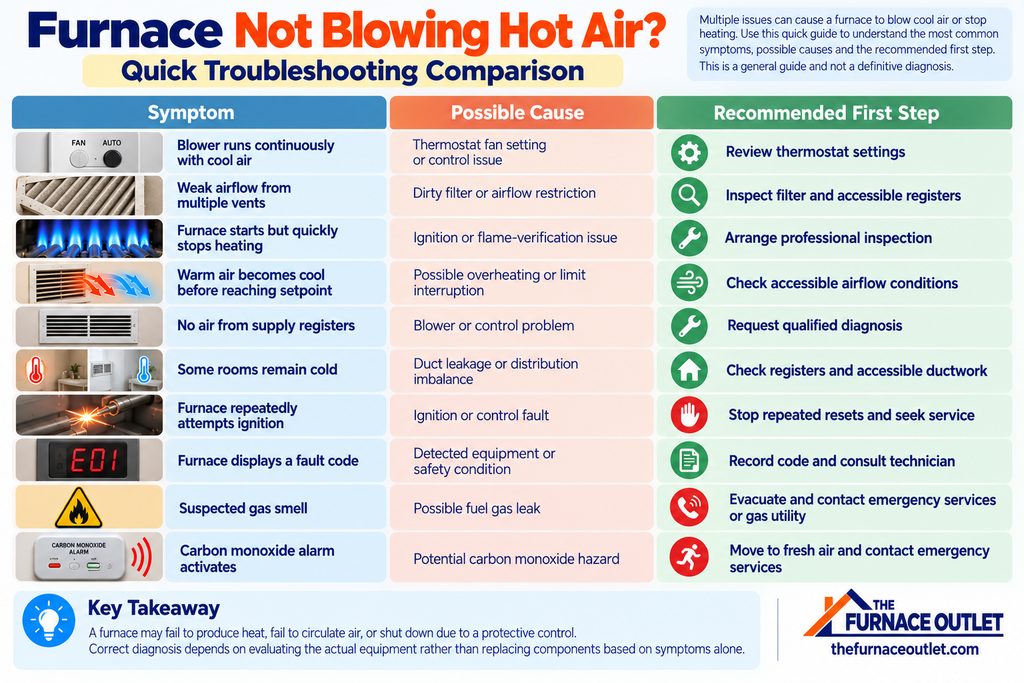
The following table summarizes common symptoms and potential explanations. Because multiple faults can produce similar behavior, these observations should guide initial troubleshooting rather than serve as a definitive diagnosis.
| Symptom | Possible cause | Recommended first step |
|---|---|---|
| Blower runs continuously with cool air | Thermostat fan setting or control issue | Review thermostat settings |
| Weak airflow from multiple vents | Dirty filter or airflow restriction | Inspect filter and accessible registers |
| Furnace starts but quickly stops heating | Ignition or flame-verification issue | Arrange professional inspection |
| Warm air becomes cool before reaching setpoint | Possible overheating or limit interruption | Check accessible airflow conditions |
| No air from supply registers | Blower or control problem | Request qualified diagnosis |
| Some rooms remain cold | Duct leakage or distribution imbalance | Check registers and accessible ductwork |
| Furnace repeatedly attempts ignition | Ignition or control fault | Stop repeated resets and seek service |
| Furnace displays a fault code | Detected equipment or safety condition | Record code and consult technician |
| Suspected gas smell | Possible fuel gas leak | Evacuate and contact emergency services or gas utility |
| Carbon monoxide alarm activates | Potential carbon monoxide hazard | Move to fresh air and contact emergency services |
The key distinction is whether the furnace is failing to produce heat, failing to circulate air, or shutting down because a protective control has detected an abnormal condition. Correct diagnosis depends on evaluating the actual equipment rather than replacing components based on symptoms alone.
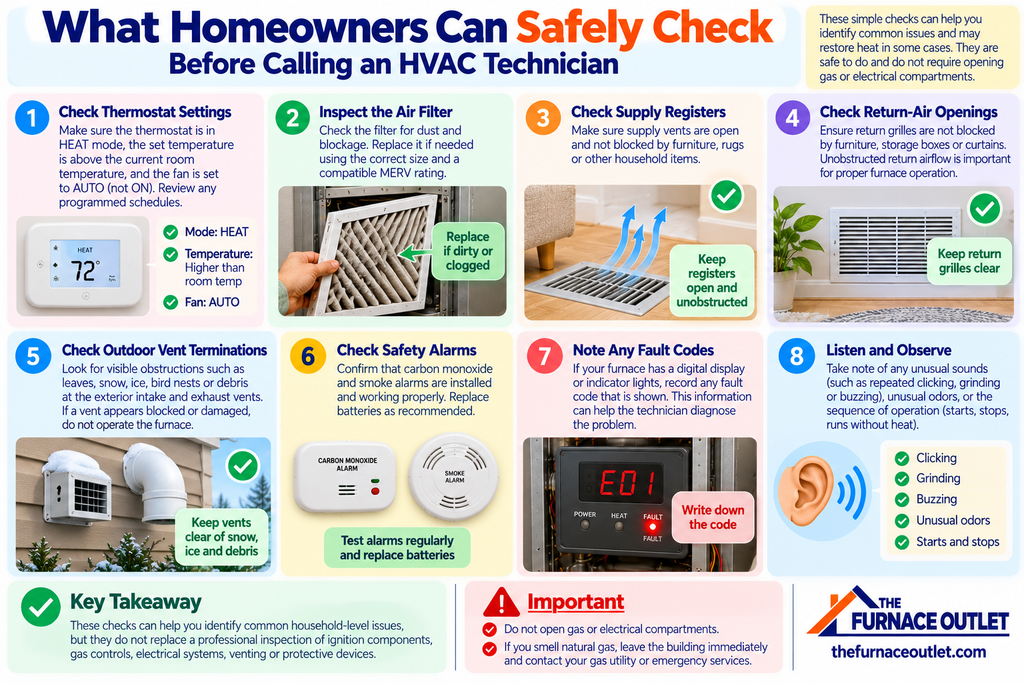
Before arranging service, homeowners can complete several basic checks without opening gas or electrical compartments. Begin by confirming that the thermostat is in heating mode and that its programmed settings reflect the desired indoor temperature. Review the fan setting and check whether the furnace responds to a normal heating request.
Next, inspect the air filter and replace it if required, using the correct size and a compatible filtration rating. Walk through occupied rooms to confirm that supply registers and return-air openings are not blocked by furniture or household items. If accessible exterior vent terminations appear obstructed or damaged, do not operate the furnace until the condition is appropriately addressed.
I also recommend checking that carbon monoxide and smoke alarms are installed and maintained according to applicable requirements. If the furnace displays an accessible diagnostic code, document it along with the timing of the problem and any unusual sounds or odors.
These checks are intended to identify obvious household-level issues. They do not replace professional inspection of ignition components, gas controls, electrical systems, venting, or protective devices.
Certain symptoms require a different response from ordinary troubleshooting. A suspected natural gas leak, smoke, visible fire, or carbon monoxide alarm activation should be treated as an immediate safety concern. Follow the relevant emergency instructions, evacuate when appropriate, and contact emergency services or the gas utility from a safe location.
Strong electrical burning odors, repeated overheating shutdowns, damaged venting, or other potentially hazardous equipment behavior also warrant stopping operation and arranging professional evaluation. Do not continue resetting equipment that repeatedly enters protective shutdown.
Carbon monoxide deserves particular attention because it is colorless and odorless. Homeowners cannot determine whether a furnace is producing or releasing carbon monoxide simply by smelling the air. Properly installed alarms and qualified equipment inspection provide important protective measures.
The CDC’s guidance on preventing carbon monoxide offers additional information about household combustion risks and recommended safety practices.
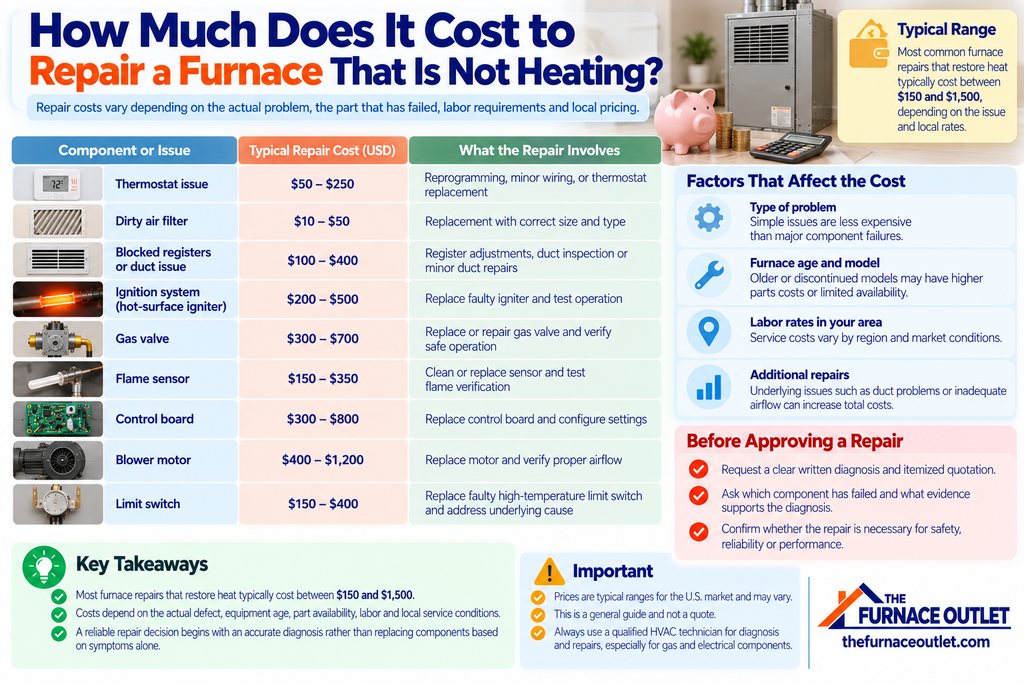
The cost of restoring furnace heat depends on the actual defect, equipment age, component availability, labor requirements, and local service conditions. A simple thermostat configuration issue or routine filter replacement may require relatively little expense, while repairs involving blower motors, control boards, ignition systems, or other major components can be substantially more costly.
I recommend requesting a clear written diagnosis and itemized quotation before approving significant repairs. The contractor should explain which component or condition has failed, what evidence supports the diagnosis, and whether the recommended work is necessary for safety, reliability, or performance.
For older furnaces, repair decisions should also consider equipment condition, efficiency, remaining service life, and the likelihood of additional failures. However, furnace age alone does not establish that replacement is necessary.
Homeowners should be cautious about recommendations to replace multiple expensive components without supporting diagnostic findings. A reliable repair decision begins with identifying the cause rather than guessing from the symptom.
Preventive maintenance cannot eliminate every equipment failure, but it can help identify certain developing problems before sustained heating demand. I recommend arranging professional servicing according to manufacturer instructions, commonly before the heating season, and maintaining a consistent household inspection routine.
Filter condition, accessible airflow pathways, thermostat settings, and unusual operating behavior deserve periodic attention. For gas furnaces, professional servicing should address relevant combustion, venting, ignition, and safety-related components. Electric furnaces require appropriate evaluation of electrical heating elements, controls, and airflow systems.
The U.S. Department of Energy’s guidance on furnaces and boilers provides useful background on heating equipment and efficiency considerations. Homeowners should also recognize that insulation, duct leakage, weatherstripping, and building heat loss influence comfort even when the furnace itself is operating correctly.
A well-maintained furnace may still struggle to heat a poorly insulated home during severe weather. For this reason, I recommend evaluating equipment performance and building conditions together.
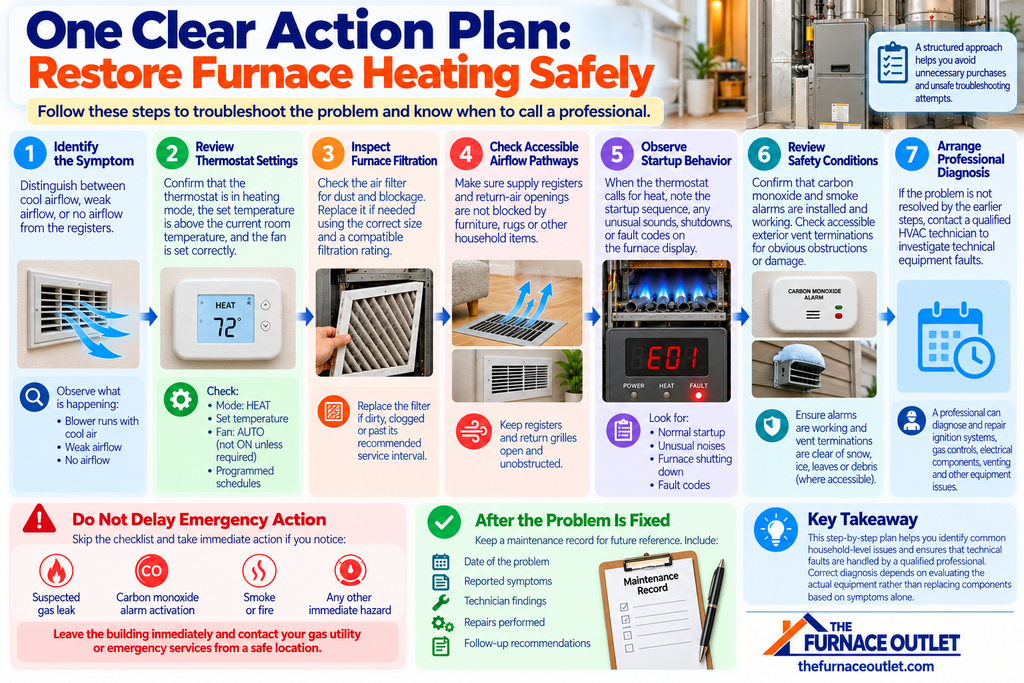
A structured approach helps homeowners avoid unnecessary purchases and unsafe troubleshooting attempts. The following sequence begins with basic observations and progresses toward professional evaluation when required.
| Step | Action | Purpose |
|---|---|---|
| 1 | Identify the symptom | Distinguish cool airflow, weak airflow, and no airflow |
| 2 | Review thermostat settings | Confirm heating demand and fan configuration |
| 3 | Inspect furnace filtration | Check condition, fit, and replacement requirements |
| 4 | Check accessible airflow pathways | Remove obstructions from supply and return openings |
| 5 | Observe startup behavior | Note unusual sounds, shutdowns, or fault codes |
| 6 | Review safety conditions | Check alarms and visible exterior vent conditions |
| 7 | Arrange professional diagnosis | Investigate unresolved or technical equipment faults |
This plan is not intended to delay emergency action. Suspected gas leaks, carbon monoxide alarms, smoke, fire, or other immediate hazards require the appropriate emergency response rather than completion of a troubleshooting checklist.
Once the problem has been corrected, I recommend keeping a maintenance record that includes the date, reported symptoms, technician findings, repairs performed, and any follow-up recommendations. This information can be useful if similar problems occur later.
Possible causes include incorrect thermostat settings, a restricted air filter, ignition problems, overheating protection, or electrical-control faults. The correct diagnosis depends on whether the furnace is generating heat and whether airflow is operating normally.
Some furnaces have a startup sequence during which airflow and heating operation do not begin simultaneously. A brief period of cooler airflow may occur depending on system design, but prolonged or repeated cool airflow during a heating request should be investigated.
Yes. A heavily loaded filter can restrict airflow and contribute to overheating conditions that activate protective controls. However, replacing the filter does not automatically correct every problem, particularly when repeated shutdowns have already occurred.
Possible explanations include a protective temperature-limit interruption, ignition-related fault, or control problem. Repeated changes from warm to cool airflow before the thermostat reaches its setpoint warrant professional evaluation.
Yes. Incorrect heating mode, fan settings, schedules, or thermostat configuration can affect furnace operation. However, persistent heating problems may also involve wiring or equipment controls that require professional diagnosis.
Follow manufacturer instructions, but do not repeatedly reset equipment that continues to shut down or displays fault conditions. Repeated resets may delay diagnosis of an underlying safety or operating problem.
Weak airflow, unusual noises, intermittent blower operation, or no airflow may suggest a blower-related problem, but these symptoms are not definitive. Professional testing is needed to distinguish motor defects from electrical, control, or duct-related issues.
Yes. Carbon monoxide is colorless and odorless. Homeowners should maintain appropriate carbon monoxide alarms and arrange qualified inspection of fuel-burning equipment rather than relying on smell to assess safety.
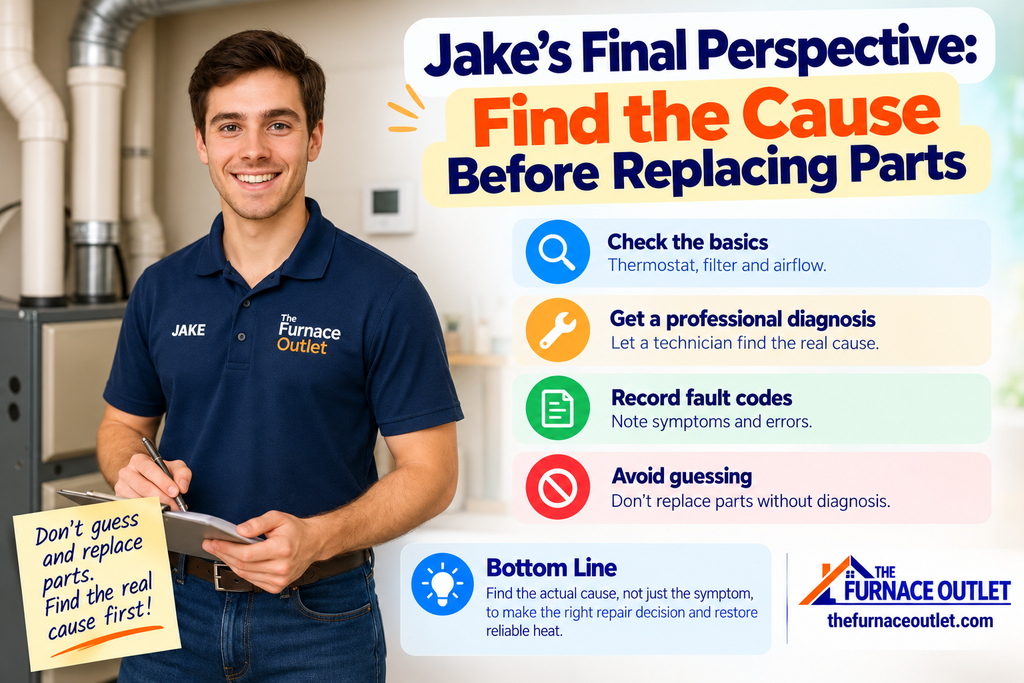
When homeowners tell me their furnace is running but not blowing hot air, I recommend beginning with a clear description of what the system is actually doing. A blower circulating room-temperature air may indicate a different problem from a furnace that repeatedly attempts ignition or stops heating because a protective control has activated. Understanding these differences helps avoid unnecessary repairs and directs attention toward the relevant equipment components.
My preferred troubleshooting process starts with thermostat settings, filter condition, and accessible airflow pathways. If those basic checks do not resolve the problem, a qualified technician should evaluate ignition operation, blower performance, electrical controls, gas supply, venting, and safety systems as appropriate. I also recommend documenting fault codes and recurring symptoms rather than repeatedly resetting equipment or purchasing replacement components without diagnosis.
The most effective approach to a furnace that is not blowing hot air combines systematic troubleshooting, compatible filtration, adequate airflow, professional diagnosis, and careful attention to combustion and electrical safety. By addressing the actual cause instead of guessing, homeowners can make better repair decisions, reduce avoidable expenses, and restore reliable indoor comfort during the heating season.
1. U.S. Department of Energy — Furnaces and Boilers
https://www.energy.gov/cmei/buildings/consumer-furnaces
Background information about residential furnace operation, heating efficiency, and equipment considerations.
2. U.S. Environmental Protection Agency — What Is a MERV Rating?
https://www.epa.gov/indoor-air-quality-iaq/what-merv-rating
Information about HVAC filtration classifications and particle-capture efficiency.
3. Centers for Disease Control and Prevention — Carbon Monoxide Prevention
https://www.cdc.gov/natural-disasters/psa-toolkit/prevent-carbon-monoxide-poisoning.html
Household carbon monoxide safety guidance and prevention recommendations.
4. U.S. Department of Energy — Minimizing Energy Losses in Ducts
https://www.energystar.gov/saveathome/heating-cooling/duct-sealing/benefits
Guidance about duct leakage, insulation, and heating distribution efficiency.
5. U.S. Consumer Product Safety Commission — Carbon Monoxide Information Center
https://www.cpsc.gov/Safety-Education/Safety-Education-Centers/Carbon-Monoxide-Information-Center
Consumer safety information about carbon monoxide hazards and protective measures.
6. ENERGY STAR — Heating and Cooling
https://www.energystar.gov/saveathome/heating-cooling
Resources about heating and cooling equipment, efficiency, and household comfort.
This article is provided by The Furnace Outlet for general educational purposes and does not replace manufacturer instructions, professional HVAC diagnosis, applicable building codes, or emergency safety guidance. Homeowners should not attempt gas-system repairs, electrical diagnostics, vent modifications, combustion adjustments, or safety-control bypasses without appropriate qualifications.
If a natural gas leak is suspected, evacuate immediately and contact the gas utility or emergency services from a safe location. If a carbon monoxide alarm activates, move occupants to fresh air and contact emergency services. Never continue operating a furnace that has been identified as unsafe.
The Furnace Outlet publishes independent HVAC educational content. External references are included for informational purposes and do not imply sponsorship or endorsement.
© 2026 The Furnace Outlet | thefurnaceoutlet.com