Newsletter Subscribe
Enter your email address below and subscribe to our newsletter

HVAC made simple
By Jake Lawson | HVAC Specialist | The Furnace Outlet
Updated October 2026 | Furnace Troubleshooting, Heating Safety & Maintenance
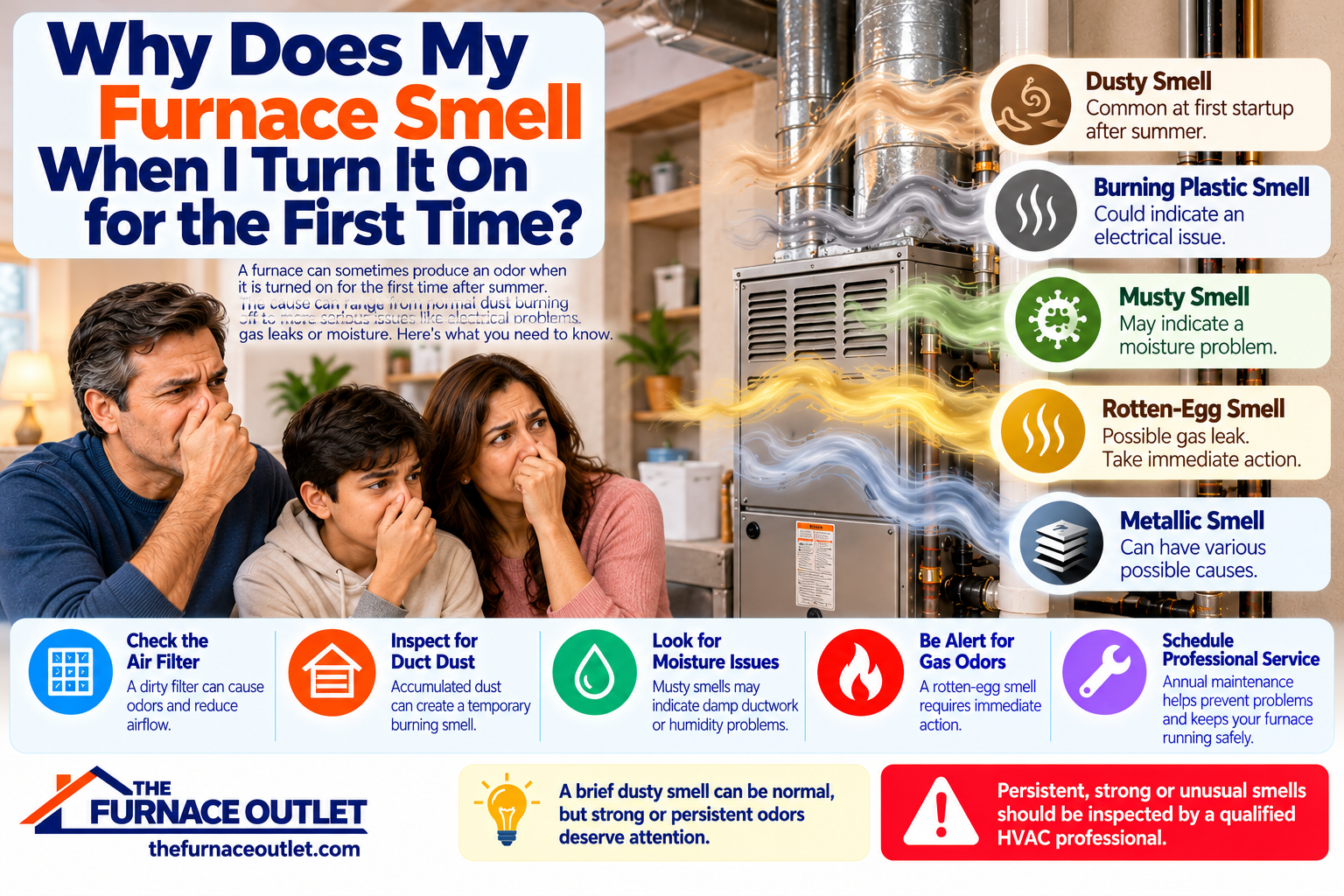
When homeowners switch on their furnaces for the first time after summer, an unexpected smell can quickly raise concerns. Some describe a dusty or slightly burnt odor coming from their heating vents, while others notice a metallic smell, a musty scent, or something resembling burning plastic. Because heating equipment involves high temperatures and, in many homes, fuel combustion, it is understandable that unfamiliar odors make people question whether their furnace is operating safely.
The good news is that a brief dusty smell during the first heating cycle can sometimes be associated with ordinary dust accumulation on components that have remained relatively cool or inactive for several months. However, not every furnace odor should be considered normal. Persistent burning smells, electrical odors, suspected natural gas leaks, smoke, and certain chemical-like odors may indicate problems requiring immediate attention. The important distinction is understanding what a smell might suggest without assuming that odor alone can reliably establish whether equipment is safe.
As an HVAC specialist with more than 10 years of experience, I recommend treating the first furnace startup as an opportunity to observe heating performance, check basic maintenance conditions, and identify warning signs. A furnace that produces a brief dusty odor and then operates normally presents a different situation from equipment that repeatedly emits strong odors, shuts down unexpectedly, or causes a carbon monoxide alarm to activate.
In this guide, I explain why furnaces sometimes smell when first switched on, which odors deserve particular concern, how air filters and ductwork influence household smells, and what homeowners should check before the heating season. I also explain when to stop using the furnace and contact a qualified professional rather than attempting to diagnose a potentially hazardous problem independently.
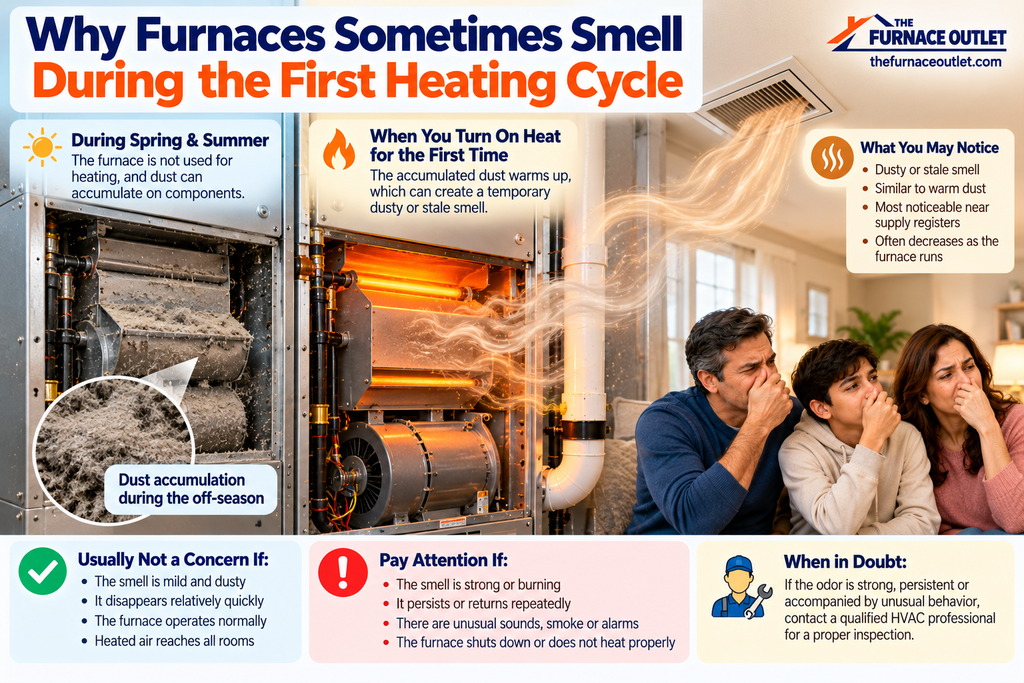
During spring and summer, a furnace may remain unused for heating even when its blower and ductwork continue operating as part of a central air-conditioning system. Depending on the equipment design and household conditions, dust and other particles can accumulate on surfaces near heating components. When the furnace begins producing heat again, some accumulated material may warm up and create a noticeable odor.
Homeowners often describe this initial smell as dusty, stale, or similar to warm dust on an electric heater. The odor may be most noticeable near supply registers because heated air carries it into occupied rooms. In some cases, it diminishes as the heating equipment continues operating and the accumulated material is no longer producing the same smell.
However, I would not use a fixed number of minutes or heating cycles to determine whether an odor is safe. The intensity, character, persistence, and accompanying symptoms matter more than an arbitrary waiting period. A faint dusty smell that promptly disappears during otherwise normal operation is less concerning than a strong burning odor that intensifies, returns repeatedly, or accompanies unusual equipment behavior.
The first heating cycle should therefore be observed rather than ignored. Homeowners should pay attention to whether the furnace starts normally, whether heated air reaches occupied rooms, and whether any unusual sounds, smoke, alarms, or shutdowns occur. If there is uncertainty about an odor, particularly when it is strong or persistent, professional evaluation is the safer approach.
A dusty smell is among the most frequently reported furnace odors at the beginning of the heating season. During periods when heating is not required, ordinary household particles may settle on certain furnace surfaces or nearby components. When those surfaces warm during the first heating cycle, the accumulated material can produce a temporary odor.
The smell is often described as warm dust rather than melting plastic, electrical insulation, or smoke. It may be distributed through the duct system, making it noticeable in several rooms even when the source is near the heating equipment. If the odor is mild, disappears promptly, and the furnace otherwise operates normally, it may be consistent with seasonal dust accumulation.
Nevertheless, a dusty description does not guarantee that the smell is harmless. A heavily loaded filter, restricted airflow, overheated component, or other mechanical problem can also contribute to unusual odors. If the smell becomes stronger, remains present, or returns during subsequent heating cycles, I recommend shutting the equipment down and arranging an inspection.
My preferred approach is to evaluate the overall operating conditions rather than identifying the smell as normal solely because it occurs in October or November. Seasonal timing provides useful context, but it does not replace an assessment of furnace safety and performance.
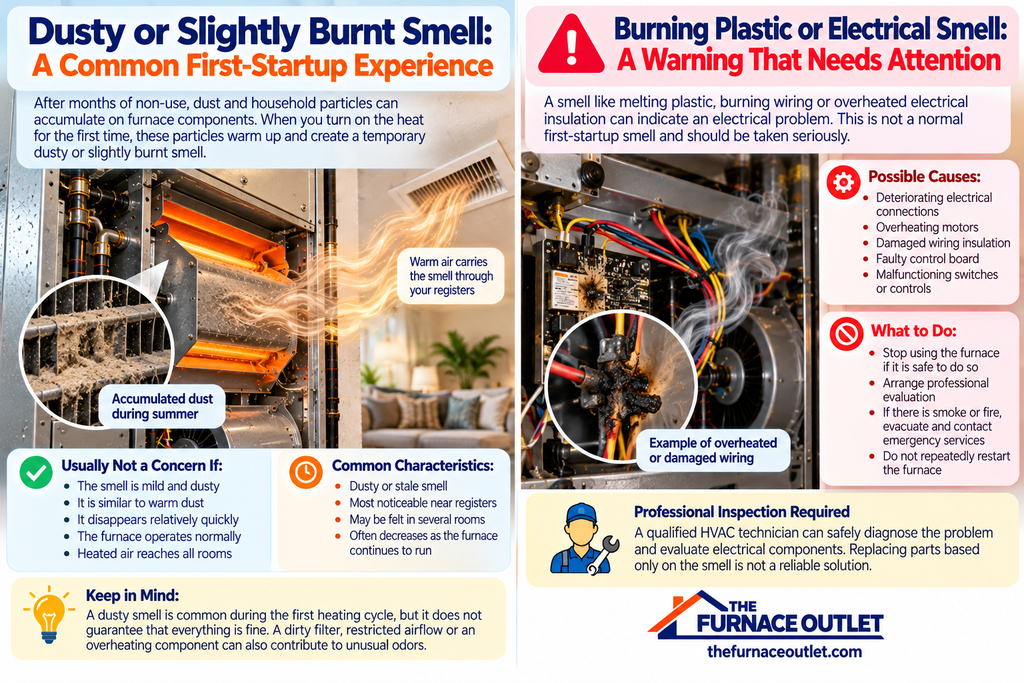
An odor resembling melting plastic, burning wiring, or overheated electrical insulation should not be treated as an ordinary first-startup smell. Furnaces contain electrical connections, motors, capacitors where applicable, control boards, switches, and wiring that must operate within their intended limits. Faults involving these components can sometimes produce distinctive burning odors.
Potential causes include deteriorating electrical connections, overheating motors, damaged wiring insulation, or malfunctioning controls. However, the precise cause cannot be established by smell alone, and homeowners should not open energized equipment compartments to investigate. Electrical faults may present shock and fire hazards, even when the furnace continues operating.
If a strong electrical or melting-plastic smell develops, stop using the furnace if it is safe to do so and arrange qualified professional evaluation. If there is smoke, visible fire, or another immediate hazard, evacuate and contact emergency services. Do not repeatedly restart the furnace to see whether the odor disappears.
A technician can evaluate the relevant electrical components using appropriate diagnostic procedures. Replacing a thermostat, blower motor, or control board based only on the perceived smell is not a reliable troubleshooting method.
Natural gas is naturally odorless, but gas utilities generally add odorants that help people recognize potential leaks. These odorants are commonly described as producing a rotten-egg or sulfur-like smell. In homes with natural-gas furnaces, an unexplained odor resembling this description requires particular caution.
If you suspect a natural gas leak, leave the building immediately and contact the gas utility’s emergency service or local emergency responders from a safe location. Avoid operating electrical switches, appliances, thermostats, telephones inside the affected building, or anything else that could create an ignition source. Do not attempt to locate the leak yourself or restart the furnace.
It is important to recognize that odor strength is not a dependable measure of leak severity. Some people may have difficulty detecting gas odorants, and environmental conditions can influence perception. For this reason, suspected leaks should be addressed through appropriate emergency procedures rather than informal smell tests.
Not every sulfur-like household odor originates from natural gas. Plumbing problems, drains, and other sources can sometimes produce similar smells. Nevertheless, where fuel gas is a plausible source, the safer response is to treat the situation as a potential leak until qualified personnel determine otherwise.
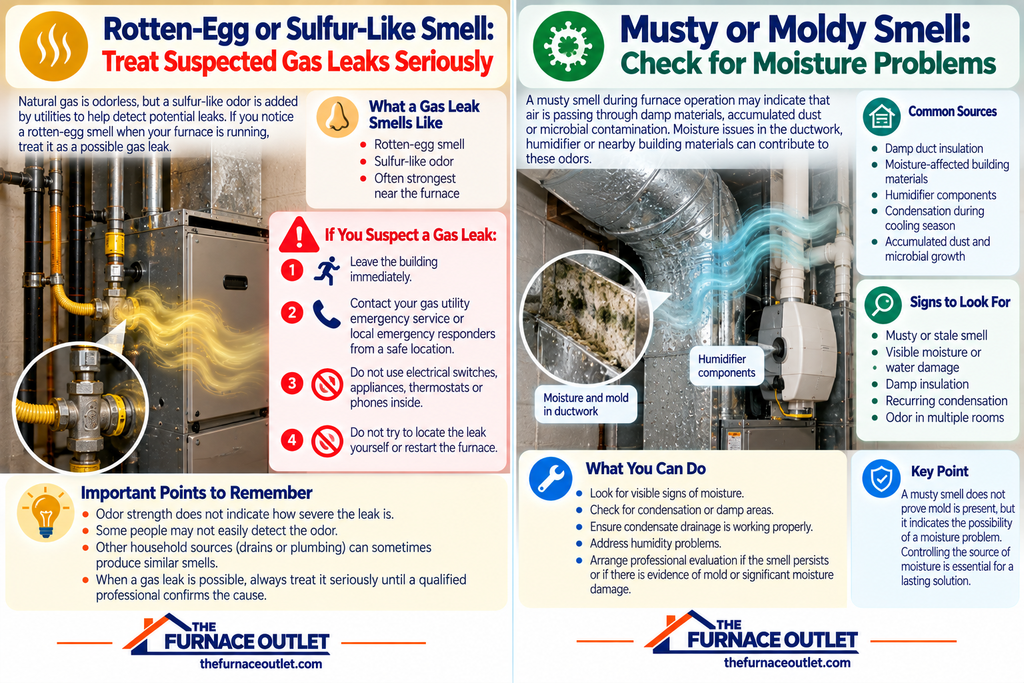
A musty smell during furnace operation may indicate that air is passing through areas containing damp materials, accumulated dust, or microbial contamination. Potential sources include moisture-affected duct insulation, nearby building materials, humidifier components, or other parts of the air distribution system. However, a musty odor does not prove that mold is present, and the absence of a smell does not establish that a building is moisture-free.
Homes with central air conditioning may experience moisture accumulation during the cooling season if condensate drainage, insulation, or humidity control is inadequate. Some damp materials may continue producing odors after the system switches from cooling to heating. Air movement through the ductwork can distribute those odors into occupied rooms.
I recommend looking for visible water damage, recurring condensation, damp insulation, and other accessible signs of moisture problems. Homeowners should avoid opening contaminated duct sections or disturbing suspected mold growth without appropriate precautions. Persistent odors or evidence of substantial moisture damage warrant professional evaluation.
The EPA’s mold guidance emphasizes the importance of controlling moisture rather than relying solely on air cleaning or surface treatments. If mold growth is confirmed, the moisture source must be corrected for remediation to provide lasting results.
Some homeowners report a metallic odor when their heating systems begin operating. This description can refer to several different experiences, including heated dust on metal surfaces, hot equipment components, or odors associated with abnormal operating conditions. Because smell descriptions are subjective, a metallic odor does not identify a particular furnace defect.
A brief unfamiliar odor during the initial heating cycle may not indicate a serious problem when the equipment otherwise operates normally. However, persistent metallic or unusually hot smells deserve attention, particularly when accompanied by abnormal noises, overheating shutdowns, or changes in airflow.
I recommend reviewing filter condition and observing whether the furnace is delivering air normally through its registers. If the odor continues or becomes stronger, professional inspection is appropriate. Homeowners should not assume that all metallic smells originate from harmless expansion of furnace components.
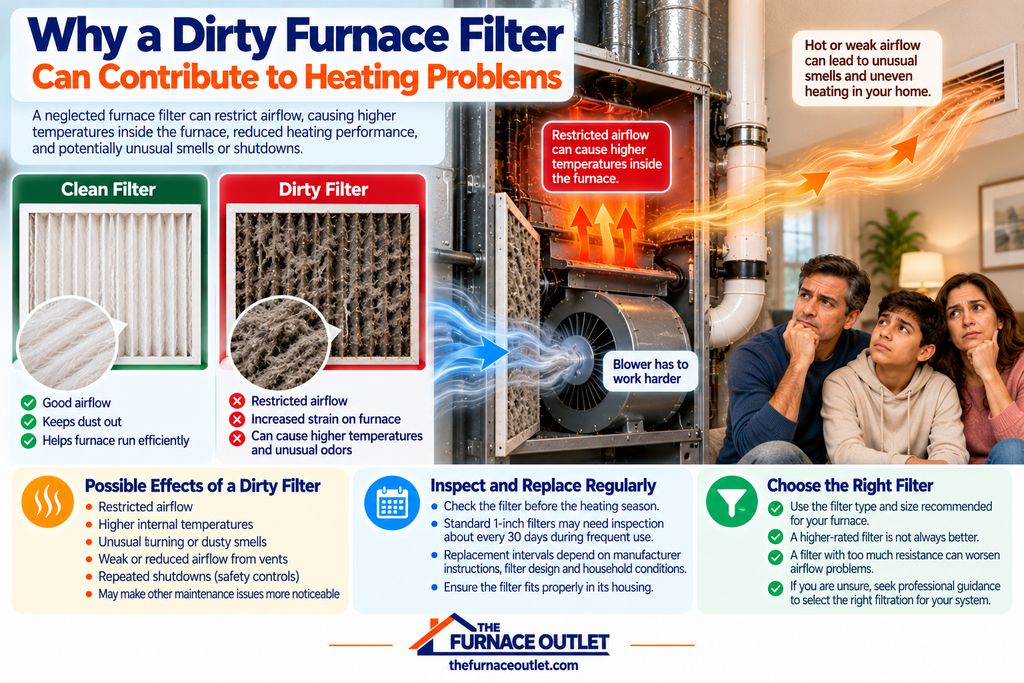
A neglected furnace filter can influence airflow and overall equipment operation. As dust and debris accumulate on the filter media, resistance to airflow may increase. If the blower cannot move sufficient air through the furnace, temperatures within certain components may rise beyond intended operating conditions, potentially triggering protective controls.
Restricted airflow does not always produce a distinctive odor, but it can contribute to conditions that homeowners notice as unusual heating performance, hot smells, weak airflow, or repeated shutdowns. A dirty filter may also allow other maintenance issues to become more noticeable during the first sustained heating demand of the season.
I recommend inspecting the filter before switching to heating mode and confirming that it fits properly within its designated housing. Standard one-inch filters may benefit from inspection approximately every 30 days during frequent operation, although actual replacement intervals depend on manufacturer instructions, filter design, and loading conditions.
Installing a higher-rated filter is not automatically the solution. A filter with excessive pressure drop may worsen airflow problems in an incompatible system. Homeowners should select filtration that meets equipment requirements and seek professional guidance when airflow performance is uncertain.
Ductwork can contain accumulated household dust and other particles, and airflow may redistribute some of this material under certain conditions. However, homeowners should avoid assuming that dusty supply registers or first-startup odors automatically mean the entire duct system requires professional cleaning.
The EPA has not established routine residential duct cleaning as a universal method for preventing health problems. Certain conditions, including substantial contamination, pest infestation, or specific debris problems, may justify evaluation, but the need should be based on actual evidence.
I recommend inspecting accessible registers, filter housings, and duct connections for obvious problems before purchasing cleaning services. Duct leakage can also affect indoor air quality by drawing contaminants from attics, crawlspaces, or other unintended spaces. Correcting leakage and maintaining compatible filtration may be more useful than indiscriminate duct cleaning.
The EPA’s guidance on residential air duct cleaning explains when cleaning may be appropriate and why homeowners should assess service claims carefully.
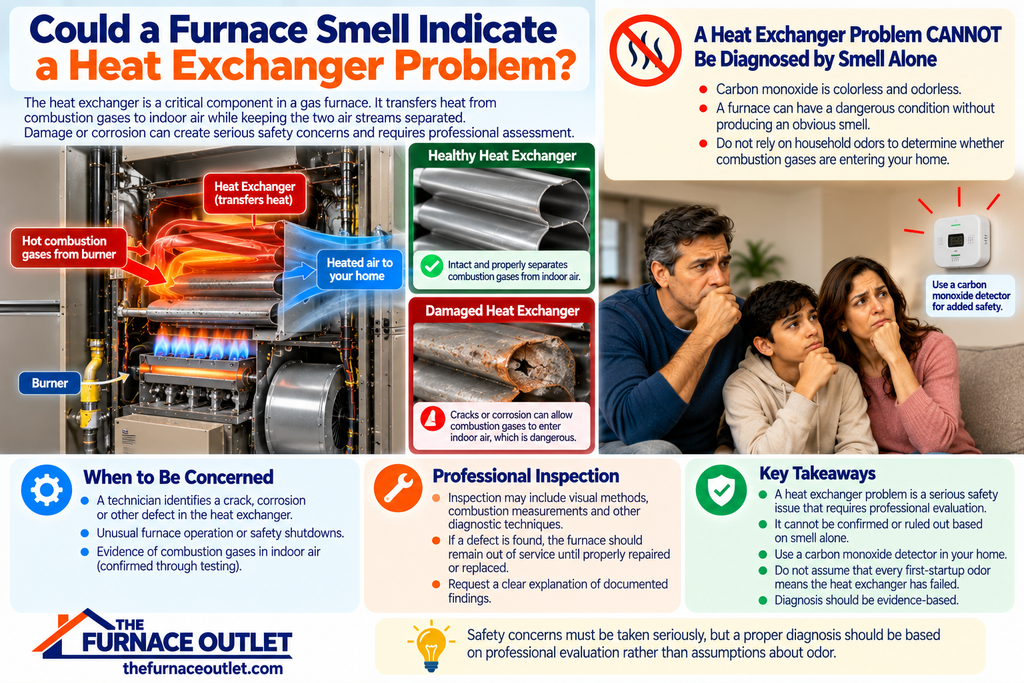
The heat exchanger is a critical component in a gas furnace because it transfers heat from combustion gases to circulating indoor air while maintaining separation between the two pathways during normal operation. Damage, corrosion, or other defects can create serious safety concerns requiring professional assessment.
However, a heat exchanger defect cannot be reliably diagnosed from a household odor. Carbon monoxide itself is colorless and odorless, and homeowners should never rely on smell to determine whether combustion gases are entering occupied spaces. A furnace may have a dangerous operating condition without producing an obvious warning odor.
If a technician identifies a heat exchanger defect or another condition that makes the furnace unsafe to operate, the equipment should remain out of service until the problem is properly addressed. Inspection may involve manufacturer procedures, visual methods, combustion measurements, and other diagnostic techniques appropriate to the furnace design.
I recommend requesting a clear explanation of documented findings rather than accepting unsupported claims that any first-startup odor means the heat exchanger has failed. Safety concerns must be taken seriously, but diagnosis should remain evidence-based.
Newly installed heating equipment may produce unfamiliar odors during initial operation because of manufacturing residues, packaging-related materials, or other installation-associated factors. The nature and expected duration of any commissioning odors depend on the equipment and manufacturer instructions.
A new furnace should not be assumed safe simply because it was recently installed. Installation defects, wiring problems, venting issues, or foreign materials left near hot components can also create unusual odors. Qualified commissioning and appropriate operational testing are important before the system enters regular service.
If an odor appears immediately after installation, I recommend contacting the installing contractor and describing the smell, operating conditions, and any associated symptoms. Strong burning odors, smoke, suspected gas leakage, or repeated shutdowns should be treated as safety concerns rather than normal break-in behavior.
Homeowners should also confirm that installation documents, warranty information, and maintenance requirements are available for future reference.
Homeowners sometimes notice heating odors more strongly in bedrooms, hallways, or rooms near particular supply registers. This does not necessarily mean the odor originates in those rooms. Air distribution patterns, duct routing, supply airflow, room size, and occupant sensitivity can all influence where a smell is most noticeable.
An odor originating near the furnace may travel through the supply system and become noticeable wherever heated air enters the home. Alternatively, an odor associated with a specific duct section, nearby building material, or room-level source may appear localized.
I recommend noting whether the smell occurs throughout the home or only in particular areas. Record when it appears, how long it lasts, and whether it coincides with furnace startup, blower operation, or another activity. These observations can help a technician narrow the investigation without relying on guesswork.
Homeowners should not attempt to redirect potentially contaminated airflow by closing large numbers of supply registers. Excessive restrictions may create additional airflow problems without addressing the source.
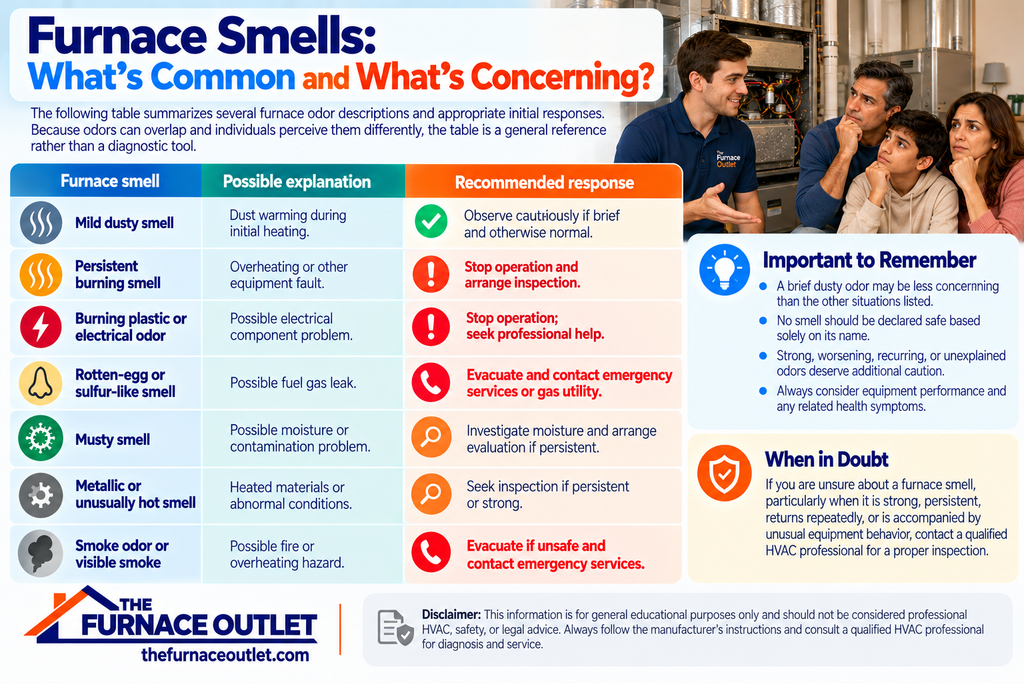
The following table summarizes several furnace odor descriptions and appropriate initial responses. Because odors can overlap and individuals perceive them differently, the table is a general reference rather than a diagnostic tool.
| Furnace smell | Possible explanation | Recommended response |
|---|---|---|
| Mild dusty smell | Dust warming during initial heating | Observe cautiously if brief and otherwise normal |
| Persistent burning smell | Overheating or other equipment fault | Stop operation and arrange inspection |
| Burning plastic or electrical odor | Possible electrical component problem | Stop operation; seek professional help |
| Rotten-egg or sulfur-like smell | Possible fuel gas leak | Evacuate and contact emergency services or gas utility |
| Musty smell | Possible moisture or contamination problem | Investigate moisture and arrange evaluation if persistent |
| Metallic or unusually hot smell | Heated materials or abnormal conditions | Seek inspection if persistent or strong |
| Smoke odor or visible smoke | Possible fire or overheating hazard | Evacuate if unsafe and contact emergency services |
A brief dusty odor may be less concerning than the other situations listed, but no smell should be declared safe based solely on its name. Strong, worsening, recurring, or unexplained odors deserve additional caution, especially when accompanied by equipment malfunction or health symptoms.
Before the first heating cycle, I recommend performing a simple maintenance review that focuses on accessible conditions rather than technical repairs. Begin by checking the furnace filter, confirming that it is properly installed, and reviewing whether replacement is needed. Inspect accessible supply registers and return-air openings to ensure that furniture, rugs, and storage items are not blocking airflow.
Next, review thermostat settings and confirm that heating schedules match current household needs. For gas furnaces, accessible exterior vent terminations should remain unobstructed, but homeowners should not dismantle venting or combustion components. Ensure that carbon monoxide alarms and smoke alarms are installed and maintained according to applicable codes and manufacturer instructions.
Professional furnace servicing should be arranged according to manufacturer requirements, commonly on an annual basis. This is particularly important when the furnace has a history of ignition problems, unusual shutdowns, airflow concerns, or unexplained odors. A qualified technician can evaluate technical components that homeowners cannot safely inspect.
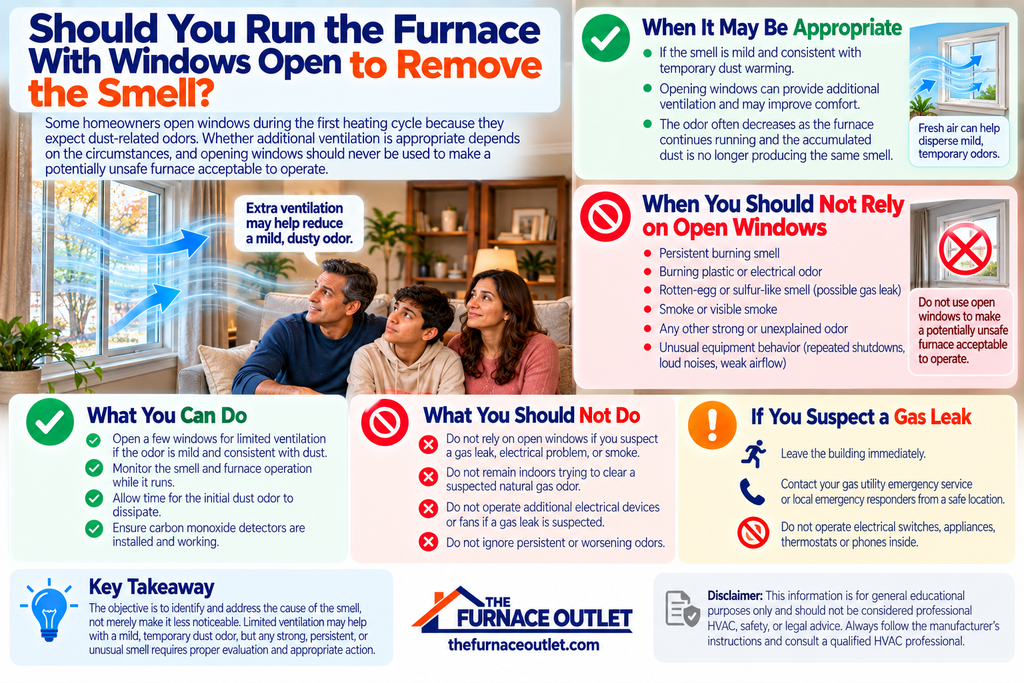
Some homeowners open windows during the first heating cycle because they expect dust-related odors. Whether additional ventilation is appropriate depends on the circumstances, and opening windows should never be used to make a potentially unsafe furnace acceptable to operate.
If the smell is mild and consistent with temporary dust warming, limited ventilation may improve comfort while the odor dissipates. However, persistent burning, suspected gas leakage, smoke, or other warning signs require stopping operation and following the appropriate safety response rather than attempting to dilute the smell.
In particular, a suspected natural gas leak requires evacuation and emergency contact from a safe location. Homeowners should not remain indoors opening windows, operating fans, or manipulating electrical devices in an attempt to clear the odor.
The objective is to identify and address the cause, not merely make an unexplained smell less noticeable.
Furnace odors can influence perceived indoor air quality, but an odor does not provide a complete measurement of airborne pollutants or health risks. Some substances are noticeable at low concentrations, while others may be hazardous without producing a detectable smell.
For example, carbon monoxide cannot be detected by human smell, making properly installed alarms essential in homes with combustion sources. Dust-related odors may be irritating to some occupants, but they do not automatically indicate a serious furnace defect. Persistent musty odors may suggest moisture problems that deserve investigation.
Homeowners with asthma, respiratory sensitivities, or other relevant health concerns should avoid unnecessary exposure to strong or unexplained odors. If symptoms occur or worsen during heating operation, seek appropriate medical advice and have the equipment evaluated as needed.
The most effective indoor air quality strategy combines source control, compatible filtration, appropriate ventilation, moisture management, and properly maintained equipment.
Homeowners do not need to complete every maintenance task in one afternoon. A structured seven-day preparation plan can help organize basic inspections, safety checks, and professional servicing before regular heating demand begins.
| Day | Action | What to accomplish |
|---|---|---|
| Day 1 | Inspect furnace filtration | Check filter fit, condition, and replacement needs |
| Day 2 | Review thermostat settings | Confirm heating mode and programmed schedules |
| Day 3 | Check household airflow | Clear accessible supply and return openings |
| Day 4 | Inspect accessible furnace surroundings | Look for debris, visible moisture, and blocked exterior vents |
| Day 5 | Test household safety alarms | Follow smoke and carbon monoxide alarm instructions |
| Day 6 | Arrange professional servicing | Review ignition, venting, combustion safety, and equipment operation |
| Day 7 | Review first-startup observations | Document unusual odors, sounds, shutdowns, or heating problems |
This plan is intended to organize routine preparation, not postpone safety concerns. If suspected gas leakage, smoke, a carbon monoxide alarm, or another immediate hazard occurs at any stage, take the appropriate emergency action immediately.
Once the furnace is operating normally, continue checking filter condition, monitoring airflow, and documenting unusual equipment behavior. A consistent maintenance record can help distinguish isolated first-startup experiences from recurring problems that require professional attention.
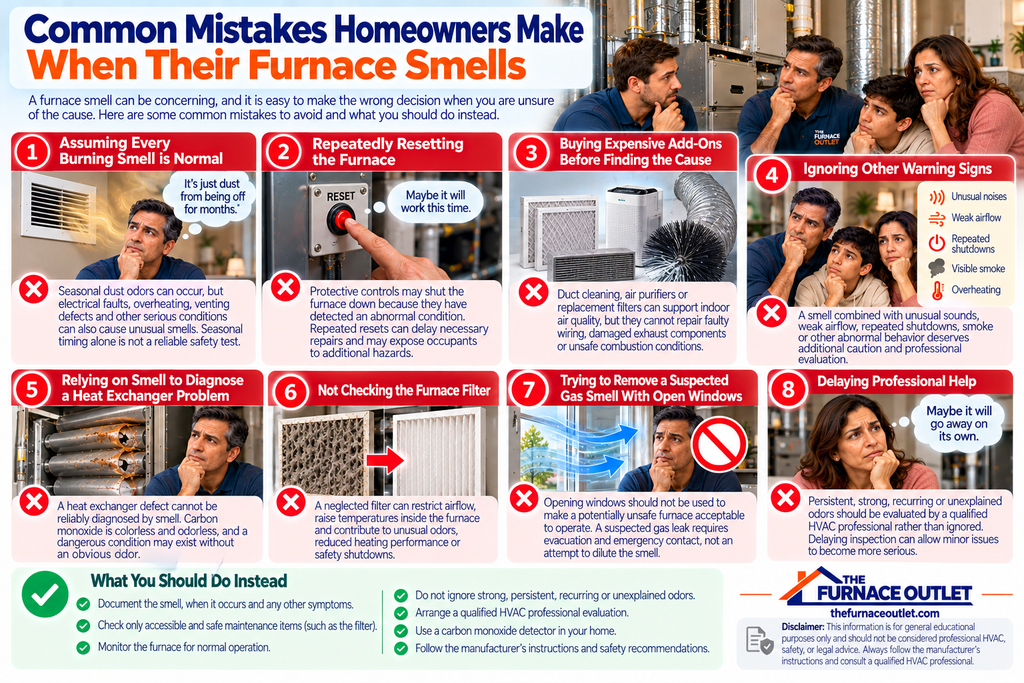
One common mistake is assuming that every burning smell is normal because the furnace has not operated for several months. Although dust-related odors can occur during initial heating, electrical faults, overheating, venting defects, and other conditions may also produce unfamiliar smells. Seasonal timing alone is not a reliable safety test.
Another mistake is repeatedly resetting a furnace that shuts down while producing unusual odors. Protective controls may interrupt operation because the equipment has detected an abnormal condition. Repeated resets without diagnosis can delay necessary repairs and potentially expose occupants to additional hazards.
Homeowners may also purchase expensive duct-cleaning services, air purifiers, or replacement filters before identifying the actual source. While compatible filtration and cleaning can support indoor air quality, they cannot repair faulty wiring, damaged exhaust components, or unsafe combustion conditions.
I recommend documenting the problem, checking only accessible and safe maintenance items, and arranging qualified evaluation when the odor is persistent, strong, or associated with abnormal operation.
A mild, temporary dusty odor can occur during the first heating cycle after a period of inactivity. However, strong, persistent, or unusual odors should not automatically be considered normal, particularly when accompanied by smoke, shutdowns, or other warning signs.
There is no universally safe duration. A mild dust-related odor may disappear relatively quickly, but persistence, intensity, recurrence, and accompanying symptoms are more important than a specific number of minutes. Seek professional evaluation if the smell continues or becomes concerning.
A burning-plastic smell may indicate an electrical or overheating problem, although the precise cause requires evaluation. Stop using the furnace if it is safe to do so and contact a qualified professional. Smoke or other immediate hazards require emergency action.
A heavily loaded filter can restrict airflow and contribute to abnormal furnace temperatures, but odor alone cannot establish that the filter is responsible. Inspect the filter safely and arrange professional evaluation if overheating or persistent burning odors are suspected.
Musty odors may be associated with damp materials, accumulated debris, or moisture problems within the building or air distribution system. The source should be investigated, particularly if there is recurring condensation, visible water damage, or persistent odor.
Heat exchanger defects can create serious safety concerns, but they cannot be reliably identified by smell alone. Carbon monoxide is odorless, so homeowners should maintain appropriate alarms and rely on qualified inspection rather than attempting to diagnose heat exchanger condition from an odor.
A strong, persistent, worsening, or unfamiliar burning odor generally warrants stopping operation and seeking professional advice. Suspected natural gas leaks, smoke, fire, or carbon monoxide alarms require the relevant emergency procedures, including evacuation when appropriate.
Some air purifiers containing appropriate gas-phase filtration media may reduce certain odors under suitable conditions, but effectiveness varies considerably. Standard particle-focused HEPA filtration does not reliably remove gaseous odors, and no purifier should be used as a substitute for correcting an unsafe furnace condition.
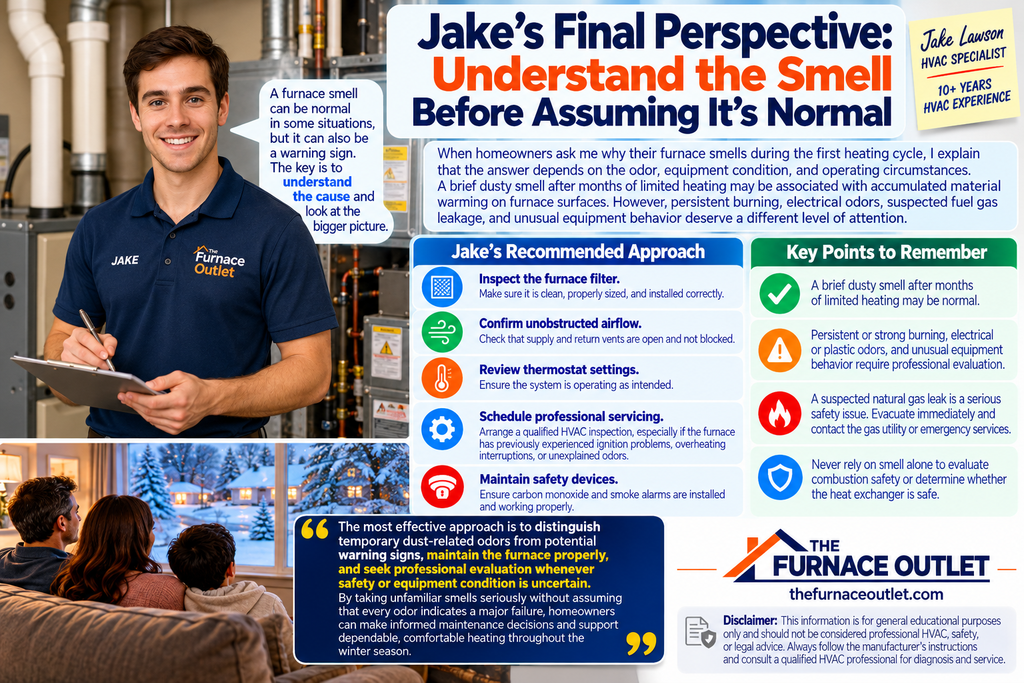
When homeowners ask me why their furnace smells during the first heating cycle, I explain that the answer depends on the odor, equipment condition, and operating circumstances. A brief dusty smell after months of limited heating may be associated with accumulated material warming on furnace surfaces. However, persistent burning, electrical odors, suspected fuel gas leakage, and unusual equipment behavior deserve a different level of attention.
My preferred approach begins with inspecting the furnace filter, confirming unobstructed airflow, reviewing thermostat settings, and maintaining carbon monoxide and smoke alarms. I also recommend scheduling professional servicing before sustained heating demand, particularly when the equipment has previously experienced ignition problems, overheating interruptions, or unexplained odors. Homeowners should never rely on smell alone to evaluate combustion safety or heat exchanger condition.
The most effective approach is to distinguish temporary dust-related odors from potential warning signs, maintain the furnace properly, and seek professional evaluation whenever safety or equipment condition is uncertain. By taking unfamiliar smells seriously without assuming that every odor indicates a major failure, homeowners can make informed maintenance decisions and support dependable, comfortable heating throughout the winter season.
1. U.S. Department of Energy — Furnaces and Boilers
https://www.energy.gov/cmei/buildings/consumer-furnaces
Information about furnace operation, efficiency, and residential heating equipment.
2. Centers for Disease Control and Prevention — Carbon Monoxide Prevention
https://www.cdc.gov/natural-disasters/psa-toolkit/prevent-carbon-monoxide-poisoning.html
Guidance on carbon monoxide risks, household combustion sources, and prevention.
3. U.S. Environmental Protection Agency — Air Duct Cleaning
https://www.epa.gov/indoor-air-quality-iaq/should-you-have-air-ducts-your-home-cleaned
Guidance on residential duct cleaning and situations that may justify evaluation.
4. U.S. Environmental Protection Agency — Mold
https://www.epa.gov/mold
Information about indoor moisture problems, mold prevention, and cleanup.
5. U.S. Environmental Protection Agency — What Is a MERV Rating?
https://www.epa.gov/indoor-air-quality-iaq/what-merv-rating
Explanation of air filter efficiency classifications and airborne particle capture.
6. U.S. Consumer Product Safety Commission — Carbon Monoxide
https://www.cpsc.gov/Safety-Education/Safety-Education-Centers/Carbon-Monoxide-Information-Center
Consumer safety information about carbon monoxide exposure and prevention.
This article is published by The Furnace Outlet for general educational purposes and does not replace manufacturer instructions, qualified HVAC inspection, gas utility emergency guidance, or applicable safety codes. Furnace odors cannot reliably diagnose equipment defects, combustion conditions, or carbon monoxide exposure. Homeowners should not attempt internal electrical repairs, gas-system adjustments, vent modifications, heat exchanger repairs, or safety-control bypasses without appropriate qualifications.
If you suspect a natural gas leak, leave the building immediately and contact the gas utility or emergency services from a safe location. If a carbon monoxide alarm activates, follow emergency instructions, evacuate to fresh air, and contact emergency services. Smoke, fire, or other immediate hazards also require prompt emergency action. Never continue operating equipment that has been identified as unsafe.
The Furnace Outlet provides independent educational HVAC information. References to outside organizations are included for informational purposes and do not imply sponsorship, affiliation, or endorsement.
© 2026 The Furnace Outlet | thefurnaceoutlet.com