Newsletter Subscribe
Enter your email address below and subscribe to our newsletter

HVAC made simple
By Jake Lawson | HVAC Specialist | The Furnace Outlet
Updated October 2026 | Estimated reading time: 12 minutes
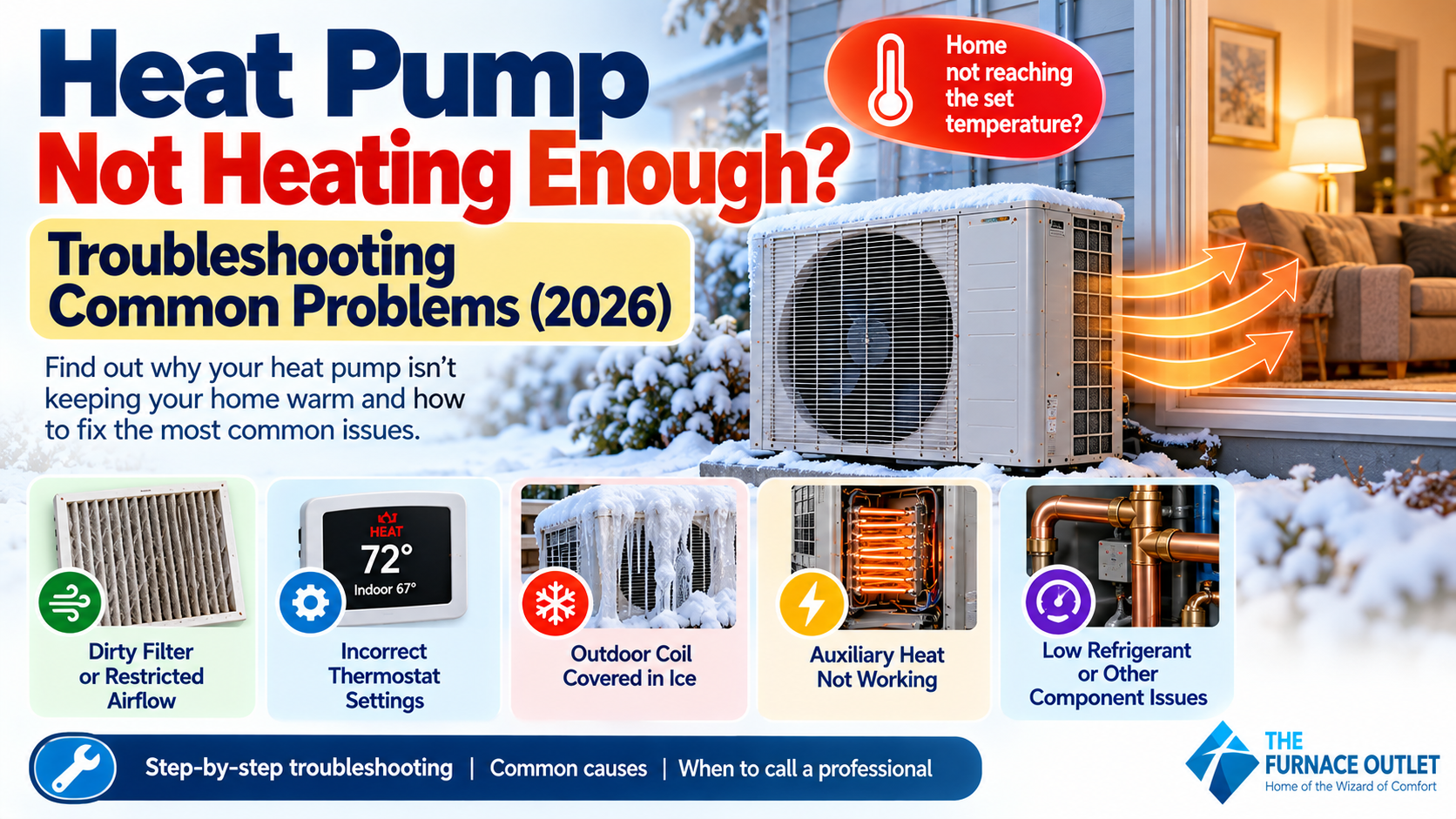
A heat pump that runs continuously but fails to keep your home warm can be frustrating, particularly during cold winter mornings when dependable heating matters most. You may notice that the thermostat is set to 72°F, but the indoor temperature remains at 67°F. The outdoor unit appears to be operating, air is flowing through the vents, and yet your home never reaches the comfort level you expect.
As an HVAC specialist with more than 10 years of experience, I have encountered this complaint in both older heat pumps and modern high-efficiency systems. The underlying problem is not always a failed component. Restricted airflow, incorrect thermostat settings, excessive building heat loss, improper equipment sizing, and normal cold-weather capacity limitations can all contribute to inadequate heating.
The first step is to determine whether your heat pump is genuinely underperforming or simply operating differently from a conventional furnace. Heat pumps generally deliver more moderate supply-air temperatures and often run for longer periods. However, a properly selected and functioning system should maintain the home’s design indoor temperature under the conditions it was designed to handle, with supplemental heating where necessary.
In this troubleshooting guide, I will explain the most common reasons a heat pump fails to heat sufficiently, the checks homeowners can perform safely, and when professional diagnosis is necessary.
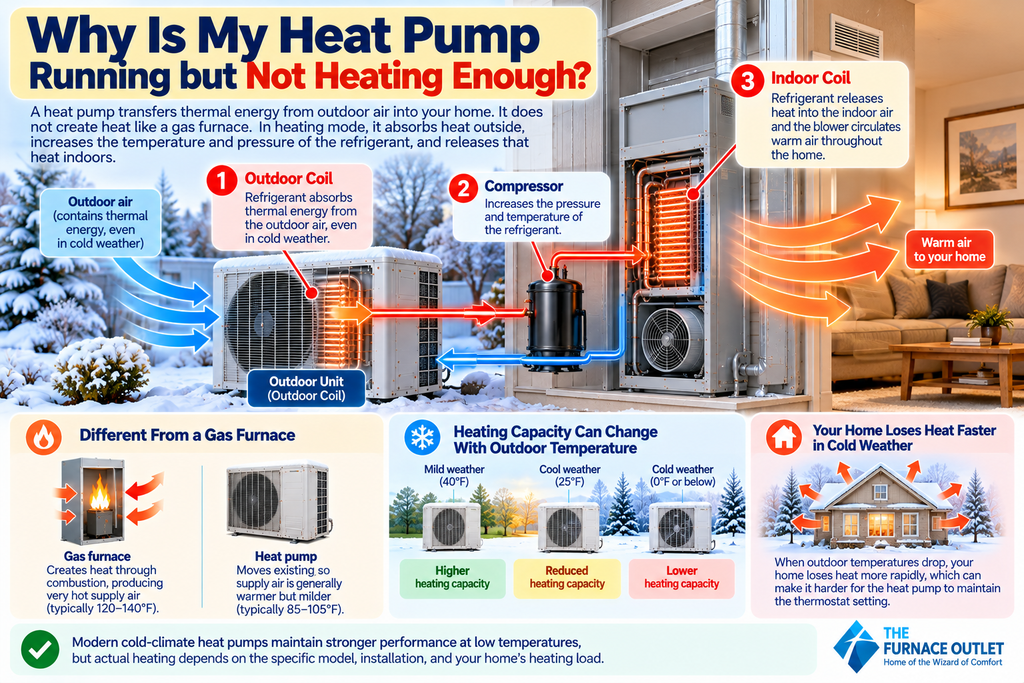
A heat pump works by transferring thermal energy from outdoor air into your home. During heating operation, refrigerant absorbs energy at the outdoor coil, the compressor increases its pressure and temperature, and the indoor coil releases heat into the living space.
Unlike a gas furnace, which creates heat through combustion, a heat pump primarily moves existing thermal energy. This allows it to operate efficiently, but its available heating capacity can change with outdoor temperature and equipment design. When outdoor temperatures drop, two things generally happen. Your home loses heat more rapidly, while some heat pumps deliver less heating capacity. This combination can create a situation in which the system runs continuously without meeting the thermostat setting.
Modern cold-climate heat pumps are designed to maintain stronger performance at low temperatures, but their capabilities still depend on the specific model, installation, and building heating load.
The U.S. Department of Energy’s heat pump systems guide explains how heat pumps operate and why their heating performance differs from conventional resistance heating. Before assuming the equipment is defective, consider whether the problem occurs only during unusually cold weather or has recently developed under conditions the system previously handled successfully.
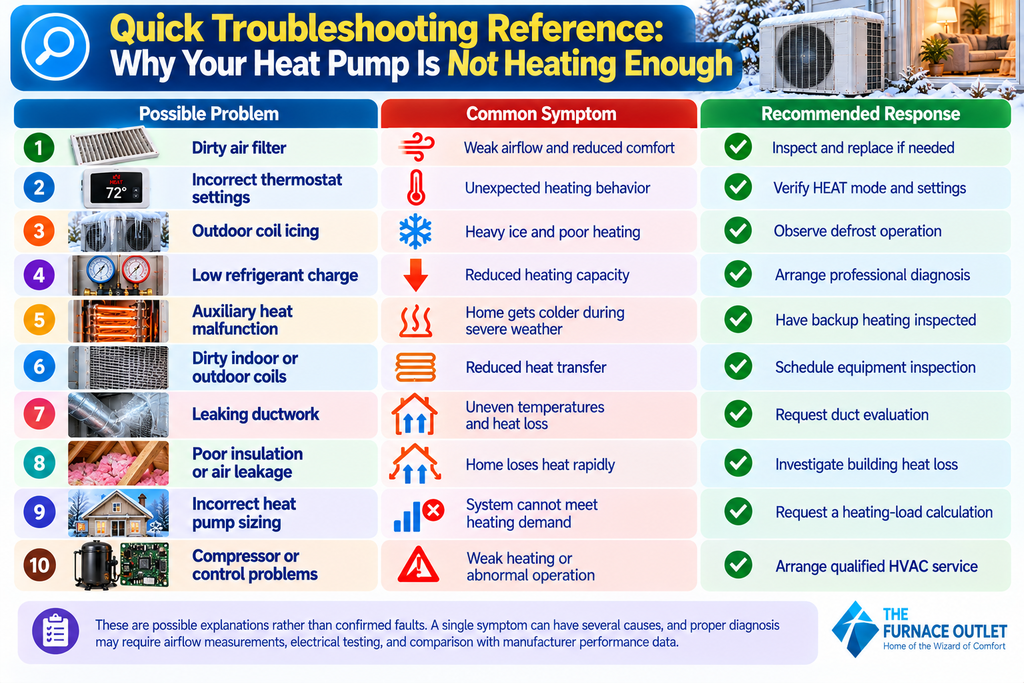
| Possible problem | Common symptom | Recommended response |
|---|---|---|
| Dirty air filter | Weak airflow and reduced comfort | Inspect and replace if needed |
| Incorrect thermostat settings | Unexpected heating behavior | Verify HEAT mode and settings |
| Outdoor coil icing | Heavy ice and poor heating | Observe defrost operation |
| Low refrigerant charge | Reduced heating capacity | Arrange professional diagnosis |
| Auxiliary heat malfunction | Home gets colder during severe weather | Have backup heating inspected |
| Dirty indoor or outdoor coils | Reduced heat transfer | Schedule equipment inspection |
| Leaking ductwork | Uneven temperatures and heat loss | Request duct evaluation |
| Poor insulation or air leakage | Home loses heat rapidly | Investigate building heat loss |
| Incorrect heat pump sizing | System cannot meet heating demand | Request a heating-load calculation |
| Compressor or control problems | Weak heating or abnormal operation | Arrange qualified HVAC service |
These are possible explanations rather than confirmed faults. A single symptom can have several causes, and proper diagnosis may require airflow measurements, electrical testing, and comparison with manufacturer performance data.
One of the first things I investigate when a heat pump is not heating sufficiently is airflow. The indoor blower must circulate enough air across the heat exchanger to distribute heating energy throughout the home. When the air filter becomes heavily loaded with dust, airflow may decline. This can reduce comfort, interfere with heat transfer, and cause certain systems to activate protective controls. Restricted airflow may also result from blocked return grilles, closed supply registers, damaged ductwork, or blower problems.
Homeowners can begin by inspecting the accessible filter and replacing it if necessary. Always use the filter size and type recommended for the equipment, because installing an excessively restrictive filter can create additional airflow problems.
I also recommend checking whether furniture, rugs, or other household items obstruct supply or return openings. If airflow remains weak after these basic checks, a qualified technician should evaluate blower operation, duct restrictions, and actual system airflow.
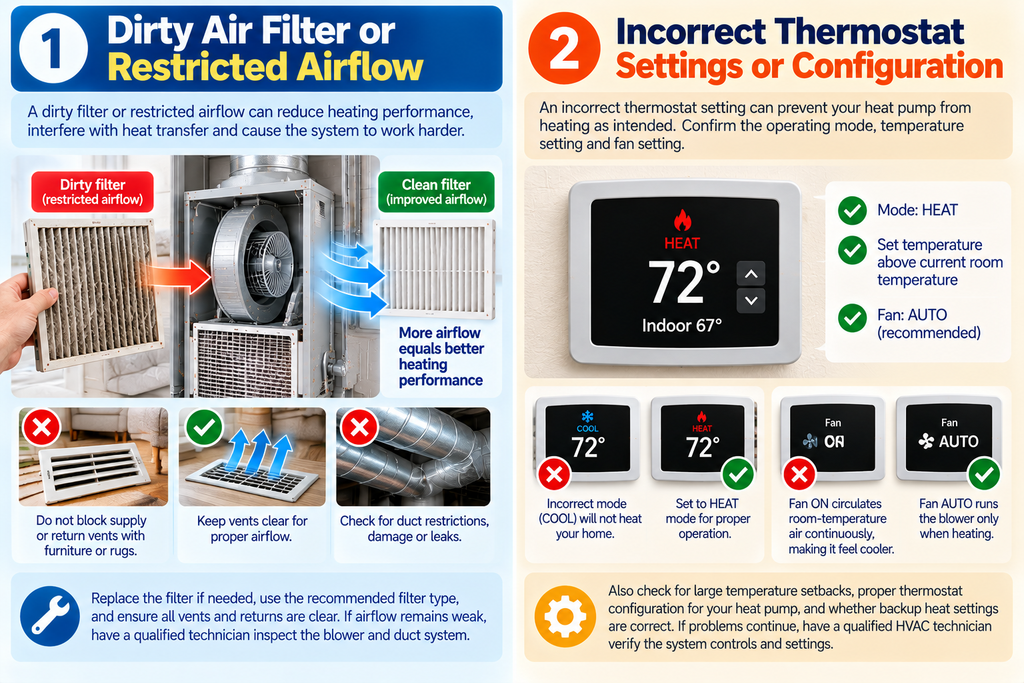
Thermostat settings can significantly affect heat pump performance. An incorrect operating mode, inappropriate fan setting, or improperly configured thermostat may prevent the system from delivering heating as intended. Begin by confirming that the thermostat is set to HEAT and that the requested temperature is above the current indoor reading. If the fan is set to ON rather than AUTO, the blower may circulate room-temperature air between active heating cycles, making the airflow feel cooler.
Heat pumps also require compatible thermostat controls for reversing-valve operation and supplemental heating where installed. If a thermostat was recently replaced, incorrect configuration may interfere with the equipment’s heating sequence.
Large temperature setbacks deserve attention as well. Some systems activate electric resistance backup heating during recovery, while others may take considerable time to restore the requested temperature. I generally recommend using thermostat settings appropriate for the specific heat pump and avoiding repeated large adjustments unless the manufacturer or installer recommends that operating strategy.
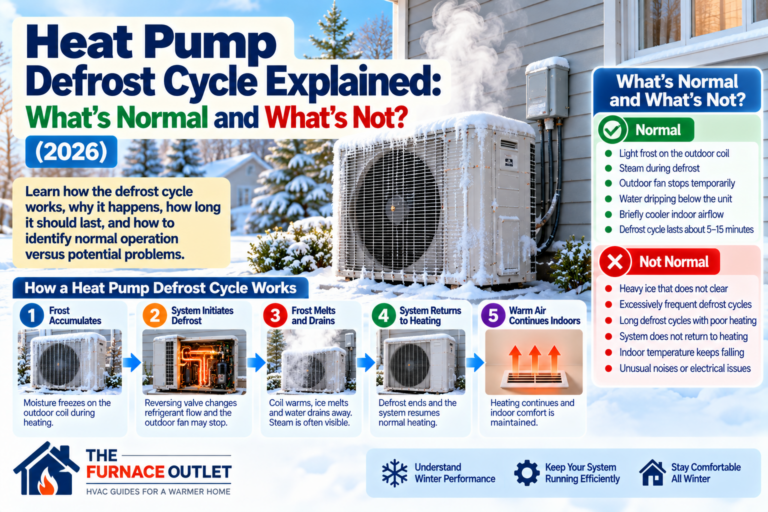
Frost accumulation is normal under certain winter conditions because the outdoor heat exchanger operates at temperatures low enough for moisture to freeze on its surface. Heat pumps manage this through automatic defrost cycles that temporarily warm the outdoor coil. During defrost, homeowners may notice steam, dripping water, changes in fan operation, or a brief interruption in normal heating.
The concern begins when frost develops into heavy ice that does not clear. Excessive icing restricts airflow and reduces the system’s ability to absorb heat from the outdoor environment. Potential causes include malfunctioning defrost sensors, control faults, drainage problems, refrigerant-related issues, or snow and debris obstructing the outdoor unit.
You can visually inspect the equipment from a safe distance and confirm that vegetation, snow, or loose debris is not blocking required airflow. Never chip ice from the coil, use sharp tools, or pour boiling water over frozen components. If heavy icing persists or the outdoor fan contacts ice, arrange professional inspection rather than repeatedly attempting to restart the system.
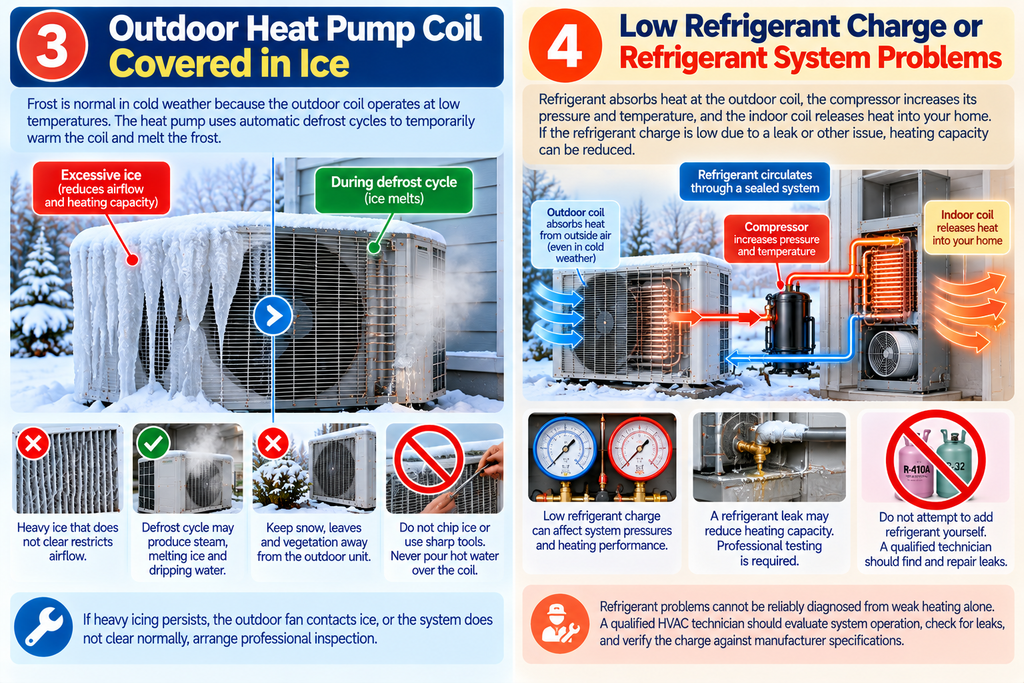
Refrigerant is essential to heat pump operation because it absorbs and releases heat as it circulates through the refrigeration system. A properly operating heat pump uses a sealed circuit, meaning refrigerant is not normally consumed during operation. If a leak develops, the refrigerant charge may fall below the amount required for efficient heating. Reduced charge can affect heating capacity, system pressures, operating temperatures, and overall performance.
However, refrigerant problems cannot be reliably diagnosed from weak heating alone. Restricted airflow, faulty sensors, expansion-device problems, and compressor issues may produce similar symptoms.
A qualified technician should evaluate operating conditions against the manufacturer’s specifications, investigate leaks where appropriate, and perform approved repairs. The EPA’s Section 608 technician certification guidance explains certification requirements for regulated refrigerant servicing activities in the United States.
I discourage homeowners from attempting refrigerant additions or opening refrigerant connections. Simply adding refrigerant without correcting an underlying leak is not a dependable long-term solution.
Many ducted heat pumps use supplemental heating to maintain comfort when outdoor conditions become too demanding for the primary heat pump alone. In all-electric installations, supplemental heating often consists of electric resistance elements installed inside the air handler. Dual-fuel systems may use a gas furnace as their backup heating source.
When supplemental heating is required but fails to operate, the heat pump may continue running while the indoor temperature gradually declines. Possible causes include failed heating elements, electrical problems, damaged controls, incorrect thermostat configuration, or sensor faults. However, some cold-climate heat pumps are designed to provide substantial low-temperature heating without supplemental heat, so its absence does not automatically indicate a malfunction.
A technician should determine whether the equipment requires backup heating under the observed conditions and verify that the supplemental system operates correctly. Emergency heat is different from normal auxiliary heating. On many systems, emergency heat bypasses the primary heat pump and relies on backup equipment. It should not be selected routinely simply because the weather is cold.
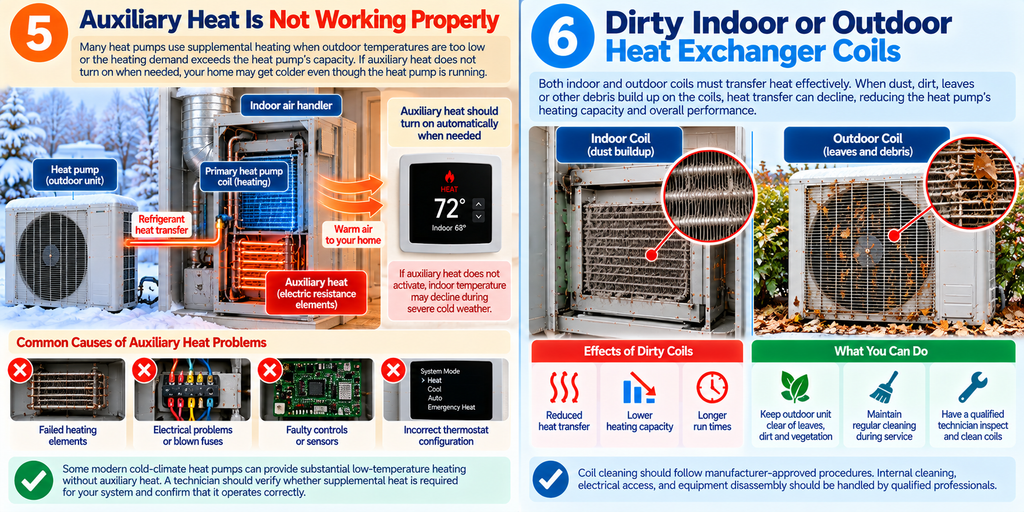
Both indoor and outdoor coils must transfer heat effectively for a heat pump to operate properly. When dust, debris, or other deposits accumulate on these surfaces, heat transfer can decline. The indoor coil may collect dust when filters are missing, poorly fitted, or inadequately maintained. The outdoor coil can become obstructed by leaves, dirt, vegetation, or environmental debris.
Reduced heat transfer may contribute to longer operating periods, lower heating output, or abnormal system conditions. However, visible dirt does not establish how much performance has been lost, and coil cleaning should follow manufacturer-approved procedures. Homeowners can keep the area around outdoor equipment free of loose debris and vegetation while respecting required clearances. Internal coil cleaning, electrical access, and equipment disassembly should be handled by qualified personnel.
I recommend having both heat exchangers inspected during routine maintenance, particularly when heating performance has gradually deteriorated.
Sometimes the heat pump generates sufficient heating energy, but the duct system fails to deliver it effectively throughout the house. Leaking supply ducts can release heated air into attics, crawl spaces, garages, or other unconditioned areas. Poorly insulated ducts may also lose heat before the air reaches the intended rooms. Disconnected duct sections, crushed flexible ducts, or poorly balanced air distribution can create significant temperature differences between rooms.
A homeowner may notice that bedrooms remain cold while areas near the air handler become comfortable. This does not necessarily indicate that the heat pump itself is undersized. I recommend having a contractor inspect accessible duct connections, insulation, leakage, and airflow distribution before replacing equipment that may otherwise be functioning properly.
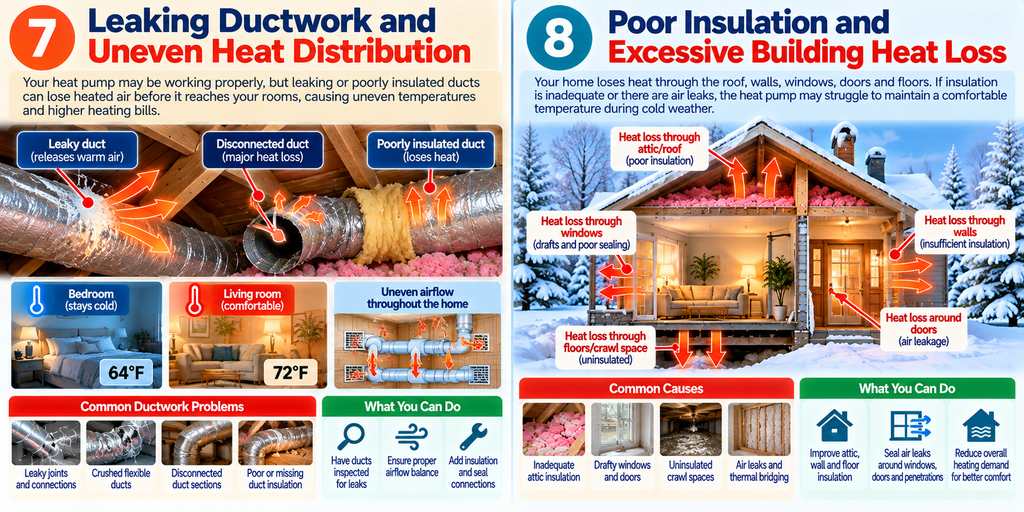
The heating equipment is only one part of the home’s comfort system. Insulation, windows, doors, air sealing, and building construction determine how quickly heat escapes during winter. A house with inadequate attic insulation or significant air leakage may lose heat faster than the heat pump can replace it during cold weather.
Drafty windows, poorly sealed penetrations, uninsulated crawl spaces, and thermal bridging can all increase heating demand. Even a properly functioning heat pump may struggle when the building loses substantially more heat than expected.
The ENERGY STAR heating and cooling guidance highlights the importance of efficient HVAC operation and improvements that support home comfort.
Before recommending a larger heat pump, I prefer to evaluate the building’s insulation and air leakage. Improving the building envelope may reduce heating demand, improve comfort, and allow existing equipment to perform more effectively.
Equipment sizing is another important reason a heat pump may fail to maintain indoor comfort. A heat pump should be selected using the home’s calculated heating and cooling requirements, not simply a rough estimate based on square footage. Heating demand depends on climate, insulation, air leakage, window performance, building orientation, and other construction characteristics. Two homes with identical floor areas can have very different heating requirements.
An undersized heat pump may operate continuously during cold weather without maintaining the desired indoor temperature. However, installing an oversized replacement can introduce other problems, including unnecessary cycling and reduced comfort under certain operating conditions. Modern variable-capacity equipment can accommodate a wider range of heating loads, but correct selection remains important.
I recommend requesting a recognized residential heating-load calculation, such as ACCA Manual J, together with equipment selection based on manufacturer capacity data at the local winter design temperature.
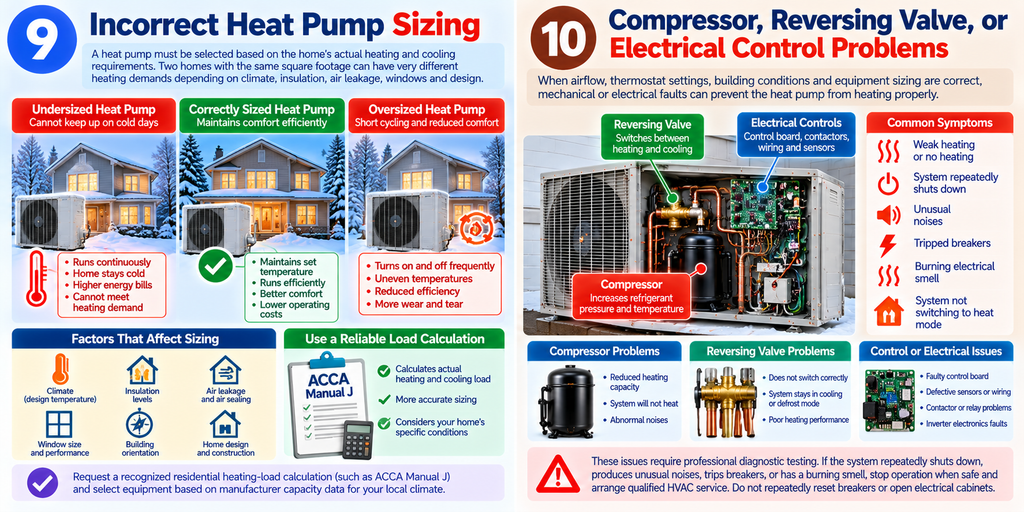
When airflow, thermostat settings, building conditions, and equipment sizing appear appropriate, mechanical or electrical faults become more important possibilities. The compressor raises refrigerant pressure and temperature so the system can transfer heat into the home. A malfunctioning compressor may reduce heating output or prevent normal refrigeration operation.
The reversing valve changes refrigerant flow direction between heating and cooling. If it or its controls malfunction, the heat pump may fail to operate in the correct mode. Electrical problems involving contactors, wiring, sensors, control boards, or inverter electronics may also interrupt heating performance. These faults require professional diagnostic testing because several components can produce similar symptoms.
If the system repeatedly shuts down, produces unusual mechanical noises, trips breakers, or emits a burning electrical smell, stop operation when safe and arrange qualified service. Do not repeatedly reset protective devices or open electrical cabinets.
There is no single outdoor temperature at which every heat pump stops heating effectively. Older systems may lose substantial heating capacity as temperatures decline, while modern cold-climate heat pumps can maintain useful output at temperatures well below freezing.
The important distinction is between a heat pump’s minimum operating temperature and its ability to meet the home’s complete heating requirement. A heat pump may continue operating at very low outdoor temperatures while delivering less heat than the building needs. In such situations, supplemental heating may be necessary.
The ENERGY STAR air-source heat pump criteria provide performance requirements that help distinguish qualifying cold-climate equipment. For homes in colder regions, I recommend comparing manufacturer-published heating capacity at the actual local design temperature with the building’s calculated heating load.
I recommend beginning with observations that do not require opening equipment cabinets or handling electrical and refrigerant components. First, confirm that the thermostat is in HEAT mode and record the requested and actual indoor temperatures. Allow enough time to determine whether the house is warming, remaining stable, or becoming colder.
Next, inspect the accessible air filter, check that vents are unobstructed, and observe the outdoor unit for heavy icing or airflow obstructions. Record whether the problem occurs during unusually cold weather, after a thermostat setback, during defrost, or continuously. If the system cannot maintain temperature despite these checks, arrange professional service. A technician should evaluate actual heating performance rather than replace components based on symptoms alone.
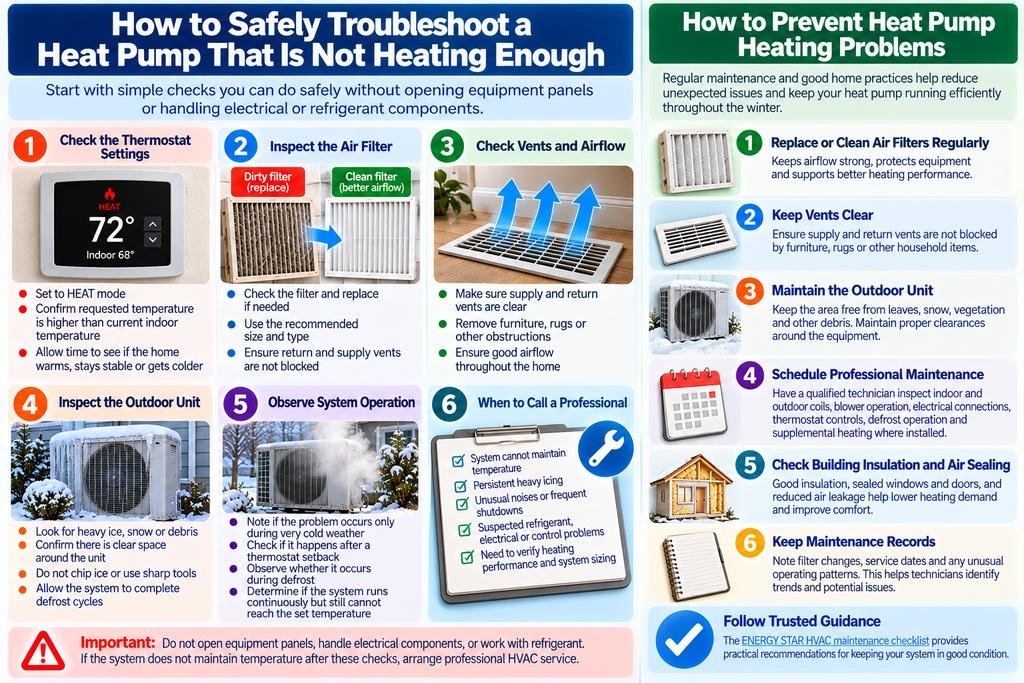
Preventive maintenance helps reduce unexpected failures and supports consistent heating performance throughout winter. Homeowners should inspect filters regularly, maintain clear supply and return vents, and keep outdoor equipment free from leaves, snow, and vegetation that could obstruct airflow.
Professional maintenance should include inspection of indoor and outdoor coils, blower operation, electrical connections, thermostat controls, defrost operation, and supplemental heating where installed. Refrigerant system testing should be performed when indicated by operating conditions or suspected faults, following manufacturer procedures.
The ENERGY STAR HVAC maintenance checklist provides practical recommendations for regular inspections and servicing.
I also recommend keeping maintenance records and noting unusual operating patterns. This information can help technicians identify whether performance has gradually declined or a problem appeared suddenly.
Possible causes include restricted airflow, insufficient heating capacity, heavy outdoor icing, refrigerant problems, excessive building heat loss, or supplemental heating that is not operating when required. Continuous operation alone is not necessarily abnormal, but declining indoor temperature deserves investigation.
As outdoor temperatures fall, the home’s heating demand generally increases. Depending on equipment design, the heat pump’s available capacity may also decrease. A properly designed system may require supplemental heating under certain conditions.
Yes. A heavily clogged filter can restrict airflow and reduce heating performance. However, replacing the filter will not resolve unrelated equipment faults or building heat-loss problems.
Increasing the setting substantially does not necessarily increase the heat pump’s available capacity. On some systems, a large adjustment may activate supplemental electric heating. It is better to investigate why the existing temperature cannot be maintained.
Arrange service when the indoor temperature continues falling, heavy ice persists, the system repeatedly shuts down, or abnormal noises and electrical symptoms appear. Burning electrical odors or smoke require urgent safety precautions.
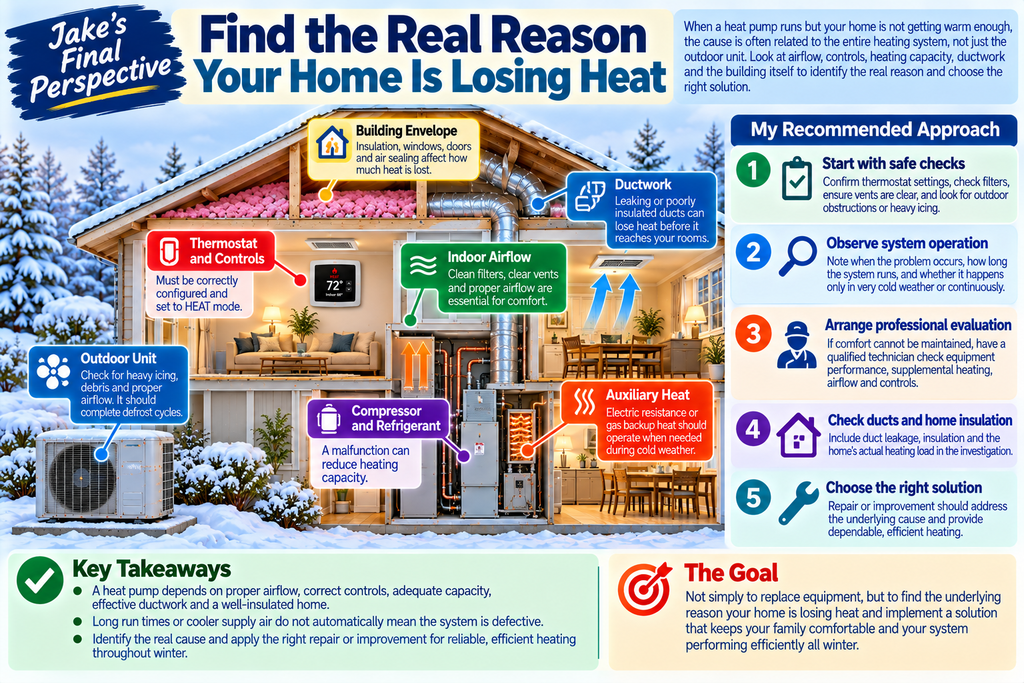
When a homeowner tells me their heat pump is running but the house is not getting warm enough, I look at the complete heating system rather than immediately blaming the outdoor unit. A heat pump depends on proper airflow, correctly configured controls, adequate heating capacity, effective ductwork, and a building that does not lose heat excessively.
My preferred troubleshooting process begins with safe homeowner checks and careful observation. If the thermostat setting cannot be maintained, a qualified technician should evaluate equipment performance, supplemental heating, airflow, and operating conditions. Where appropriate, the investigation should also include duct leakage, insulation, and the home’s actual heating load.
I would not recommend replacing a heat pump solely because it runs for long periods or delivers gentler supply air than a gas furnace. Equally, I would not dismiss a system that consistently fails to maintain indoor comfort. The objective is to identify the underlying cause and select a repair or improvement that delivers dependable, efficient heating throughout winter.
This article is published by The Furnace Outlet for general educational purposes and does not replace professional HVAC diagnosis, manufacturer instructions, or applicable safety requirements. Electrical repairs, refrigerant servicing, internal component testing, and equipment modifications should be performed by appropriately qualified professionals. Heating performance varies with equipment design, climate, installation quality, and building conditions. The Furnace Outlet publishes independent educational content; references to external organizations do not imply affiliation or endorsement.
© 2026 The Furnace Outlet. All rights reserved.