Newsletter Subscribe
Enter your email address below and subscribe to our newsletter

HVAC made simple
By Savvy Mavi — Savvy the Sustainability Expert | The Furnace Outlet
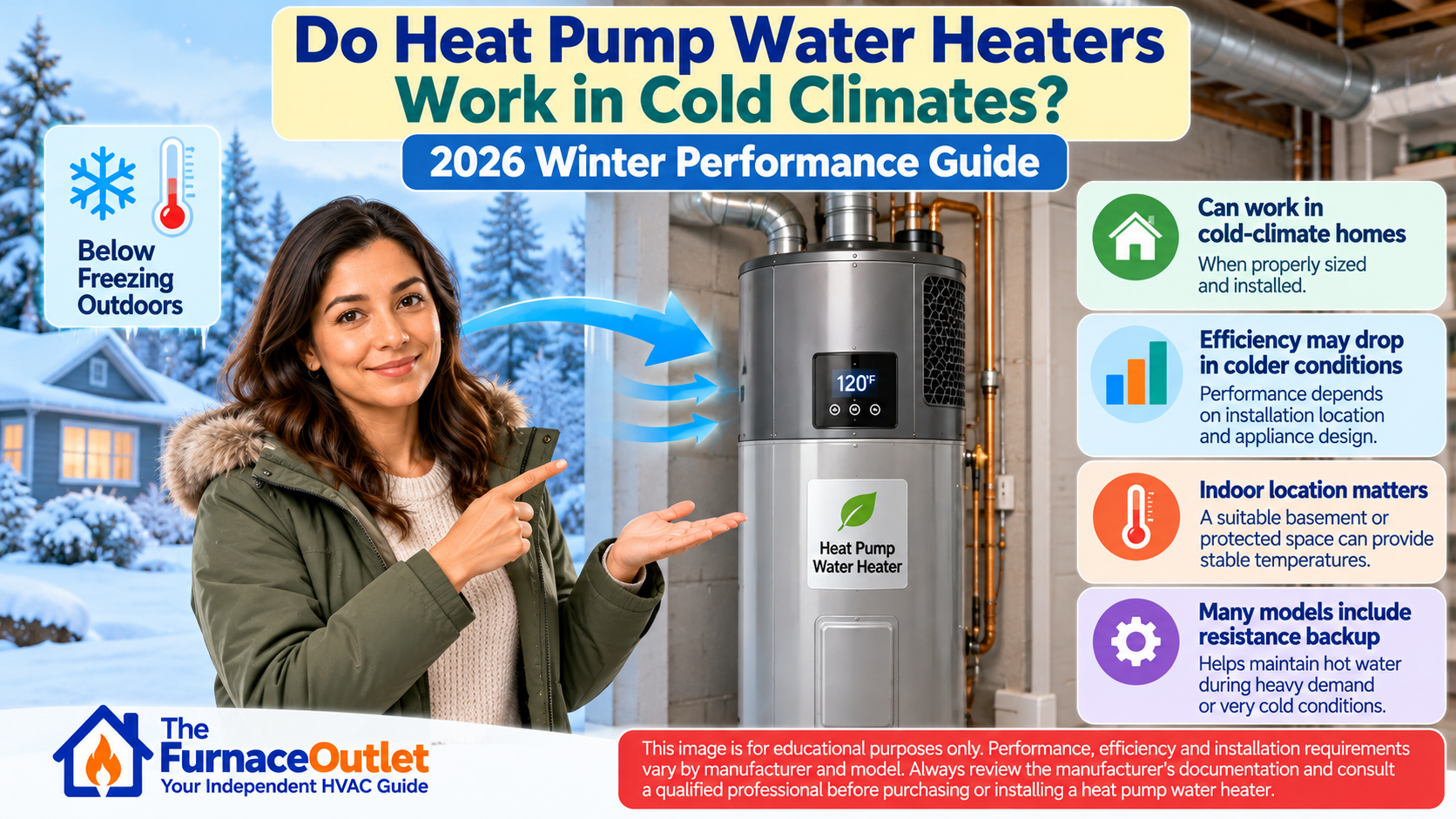
Heat pump water heaters have earned considerable attention for their ability to produce hot water while consuming substantially less electricity than conventional electric resistance water heaters. However, homeowners in northern states and other cold regions often have an important concern: Can a heat pump water heater still work efficiently when outdoor temperatures fall below freezing? The answer is yes, but performance depends on the appliance, its installation location, surrounding air temperature and household hot-water demand.
One of the biggest misunderstandings about heat pump water heaters is that they must operate directly in outdoor winter temperatures. Most conventional residential heat pump water heaters are installed indoors or in suitable protected spaces, where they extract heat from the surrounding air. Consequently, a home in Minnesota, Michigan or Maine can potentially use heat pump water heating successfully even when the outdoor temperature is well below freezing.
For me, the critical distinction is between outdoor climate and the actual temperature surrounding the water heater. A properly selected unit operating in a suitable basement can perform very differently from an identical appliance installed in an unheated garage exposed to extreme winter conditions.
Yes. Heat pump water heaters can operate successfully in cold-climate homes, provided their installation conditions meet the manufacturer’s specifications. Their efficiency may decline as surrounding air becomes colder, but cold outdoor weather does not automatically make the technology unsuitable.
A heat pump water heater uses a refrigeration cycle to transfer heat from air into stored water. Its compressor, evaporator, refrigerant and heat exchanger work together to move thermal energy rather than relying entirely on electric resistance elements.
Even relatively cool air contains thermal energy that a heat pump can extract within its designed operating range. However, extracting heat becomes more difficult as the air temperature decreases, and the equipment may need to operate longer or use supplemental heating.
Many hybrid models include electric resistance elements that can provide additional heating when conditions or demand require it. This helps maintain hot-water availability, although electricity consumption increases when resistance heating operates.
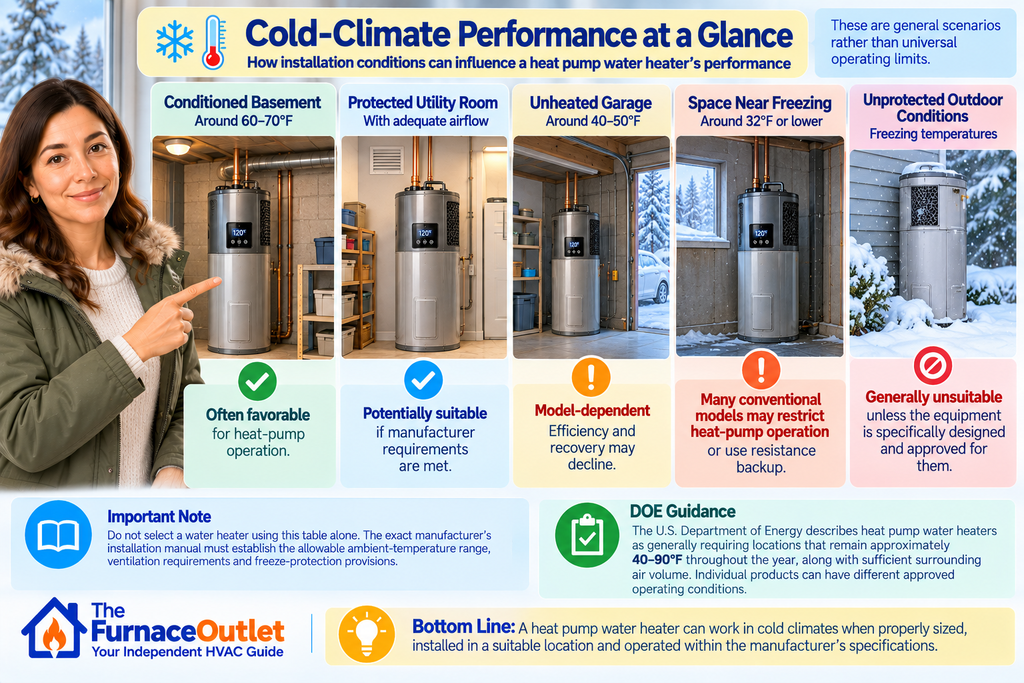
The following comparison illustrates how installation conditions can influence a conventional residential heat pump water heater. These are general scenarios rather than universal operating limits.
| Installation condition | Expected performance consideration |
|---|---|
| Conditioned basement around 60–70°F | Often favorable for heat-pump operation |
| Protected utility room with adequate airflow | Potentially suitable if manufacturer requirements are met |
| Unheated garage around 40–50°F | Model-dependent; efficiency and recovery may decline |
| Space near freezing | Many conventional models may restrict heat-pump operation or use resistance backup |
| Unprotected outdoor freezing conditions | Generally unsuitable unless the equipment is specifically designed and approved for them |
I would not select a water heater using this table alone. The exact manufacturer’s installation manual must establish the allowable ambient-temperature range, ventilation requirements and freeze-protection provisions.
The U.S. Department of Energy describes heat pump water heaters as generally requiring locations that remain approximately 40–90°F throughout the year, along with sufficient surrounding air volume. This is useful general guidance, but individual products can have different approved operating conditions.
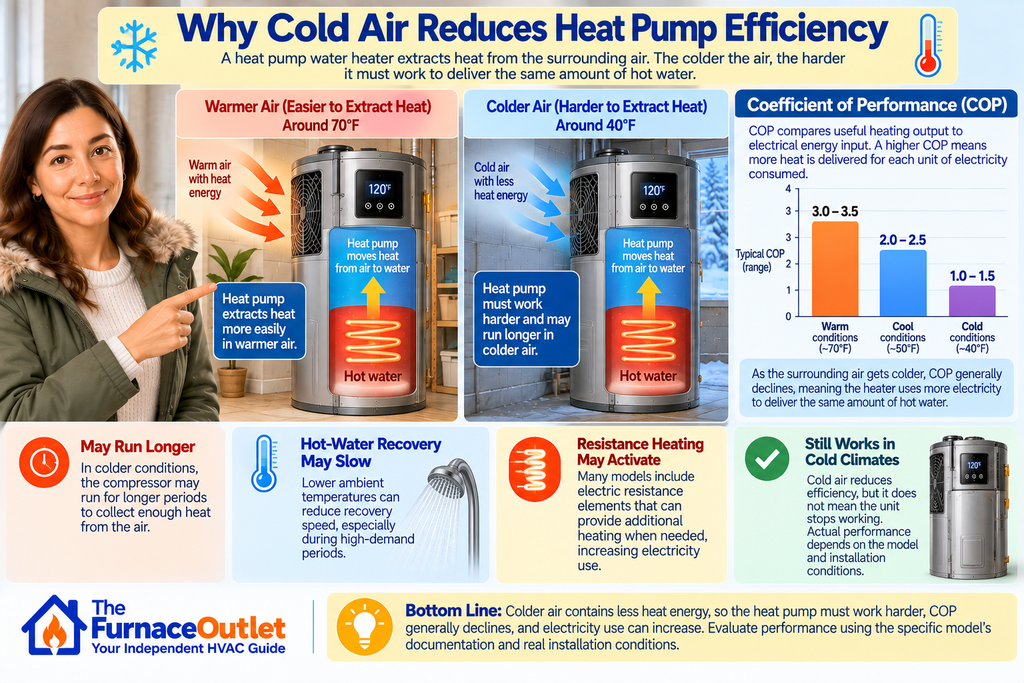
A heat pump water heater transfers energy from surrounding air into water. When the air is relatively warm, the refrigeration system can extract heat more easily. As ambient temperature decreases, the system generally has to work harder to deliver the same amount of useful heating.
This relationship affects the coefficient of performance, or COP, which compares useful heating output with electrical energy input. Under favorable conditions, a heat pump can transfer several units of heat for each unit of electricity consumed.
At lower ambient temperatures, COP generally declines. The compressor may run longer, hot-water recovery may slow and the appliance may activate supplemental resistance heating depending on its controls.
That does not mean the unit stops working whenever temperatures become cold. It means cold-weather efficiency must be evaluated using the appliance’s actual operating characteristics, rather than assuming its standardized efficiency rating remains constant in every environment.
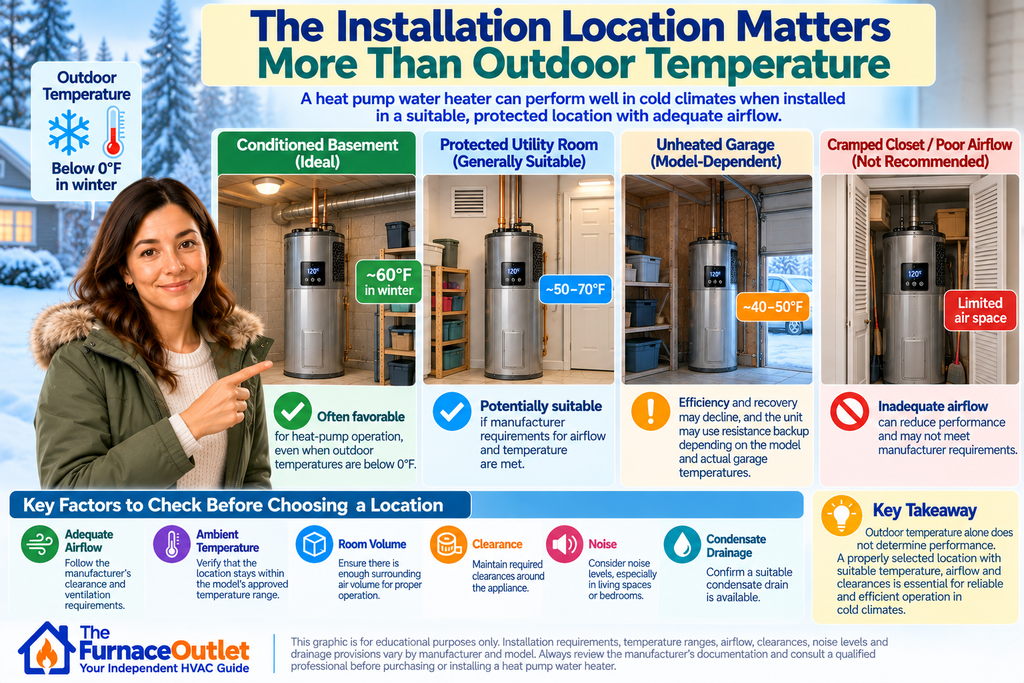
If I were evaluating a heat pump water heater for a cold-climate home, installation location would be one of my first considerations. A conditioned basement, appropriately ventilated utility room or other protected space may offer considerably more stable temperatures than an unheated garage.
A basement that remains around 60°F during winter can provide a relatively favorable operating environment even when outdoor temperatures fall below 0°F. In contrast, an unheated garage may experience temperatures near freezing, reducing efficiency or triggering resistance backup.
I would also consider the air volume available around the appliance. Heat pump water heaters need adequate airflow, and some manufacturers specify minimum room volumes or provide approved ducting arrangements for particular models.
Installing a unit in a cramped closet without meeting these requirements can reduce performance. I would always verify clearance, airflow, temperature, noise and condensate-drainage requirements before selecting a location.
Yes. A heat pump water heater removes heat from surrounding air, so its operation produces a cooling effect in the installation space. This can be beneficial during warm weather, particularly in a garage or utility area that tends to become excessively hot.
During winter, however, that cooling effect deserves additional attention. If the water heater operates inside a conditioned space, the home’s heating system may need to replace some of the heat removed from the room.
The overall energy impact depends on the home’s heating equipment. In a house heated by a high-efficiency heat pump, the interaction can differ from a house heated by electric resistance equipment, natural gas or another fuel.
For that reason, I would evaluate whole-home energy consumption, not merely the water heater’s electricity use. A heat pump water heater can remain an efficient choice in cold climates, but its interaction with space heating should be included in the assessment.
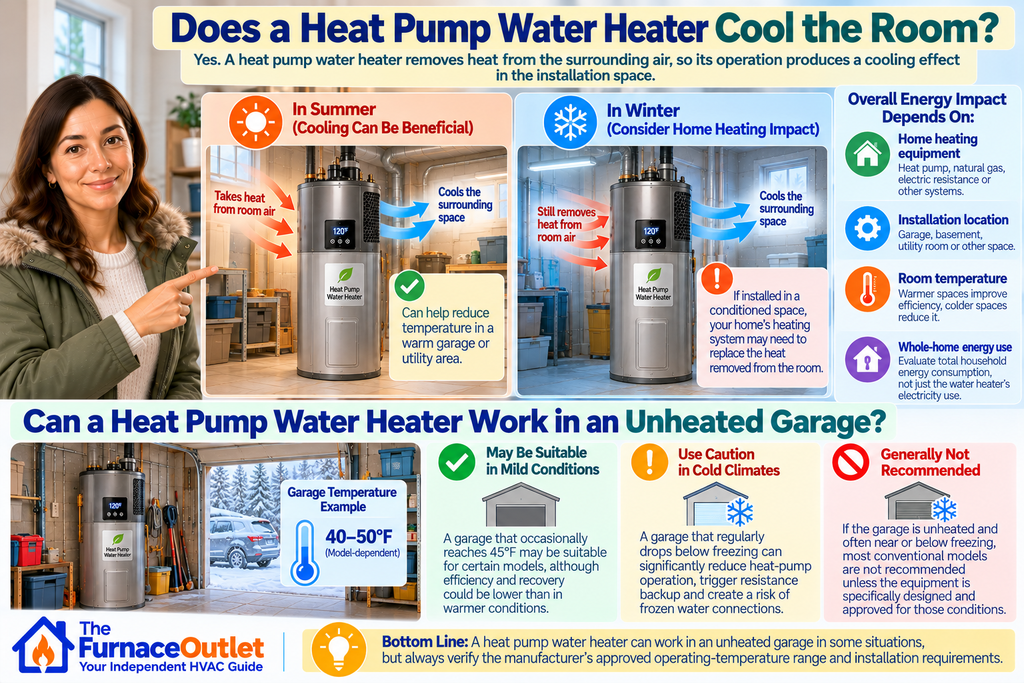
Possibly, but I would be cautious about recommending an unheated garage in a severe winter climate. The decisive question is whether the garage remains within the appliance’s approved operating-temperature range throughout the year.
A garage that occasionally reaches 45°F may be suitable for certain models, although heat-pump efficiency and recovery could be lower than in warmer conditions. A garage that regularly drops below freezing creates much greater concerns, including reduced heat-pump operation and the possibility of frozen water connections.
Some hybrid water heaters can use resistance heating when ambient conditions are unsuitable for heat-pump operation. However, that feature should not be interpreted as permission to install the appliance where its water-containing components or connected piping can freeze.
I would review actual winter garage temperatures and the specific model’s installation requirements before making the decision.
Cold climates create a second challenge beyond low ambient air temperature: incoming water can also become substantially colder during winter. Suppose the water heater must raise incoming water from 70°F to a storage temperature of 120°F. That requires a 50°F temperature rise. If incoming water falls to 40°F, the required temperature rise increases to 80°F.
For the same quantity of water, the second scenario requires approximately 60% more useful heating energy before accounting for equipment efficiency and other operating factors. This does not mean the home’s electricity bill automatically increases by 60%. Actual electricity consumption depends on the heater’s efficiency, household demand, standby losses and supplemental heating operation.
Nevertheless, it demonstrates why cold-climate sizing should account for winter inlet-water conditions rather than relying entirely on warm-weather performance.
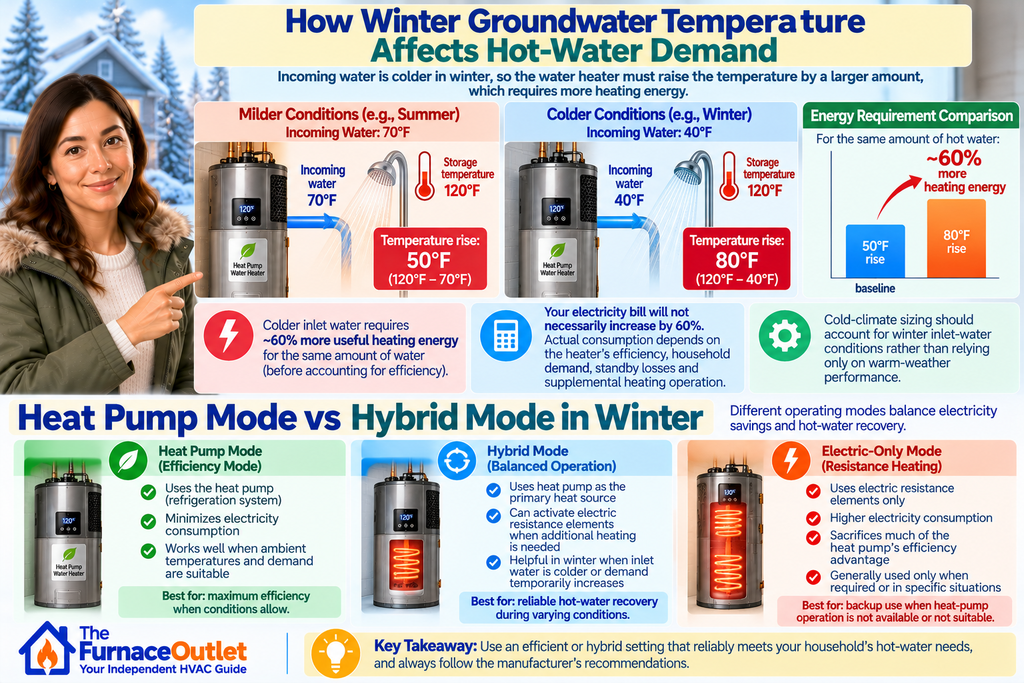
Many residential heat pump water heaters offer operating modes that balance electricity savings against hot-water recovery. In efficiency or heat-pump mode, the appliance prioritizes the refrigeration system, generally minimizing electricity consumption under suitable conditions.
Hybrid mode can activate electric resistance elements when additional heating is necessary. This may be particularly useful during winter, when colder inlet water increases the heating load or household demand temporarily exceeds the heat pump’s recovery capability.
Electric-only mode relies on resistance heating and therefore sacrifices much of the heat pump’s efficiency advantage. I would generally prefer an efficient or hybrid setting that reliably meets household demand, following the manufacturer’s recommendations.
I would consider tank capacity carefully, particularly for households with several people taking showers within a short period. Unlike a gas tankless heater that produces hot water continuously within its rated capacity, a typical integrated heat pump water heater stores heated water and replenishes it over time.
A larger storage tank can help accommodate peak demand while reducing the need for supplemental resistance heating. However, I would not automatically recommend the largest available model because purchase cost, physical dimensions, standby losses and installation requirements also matter.
The better approach is to compare tank capacity, first-hour rating, recovery performance and household usage patterns. A properly sized 65- or 80-gallon model may suit some high-demand families, while a smaller appliance may serve others efficiently.
Not every heat pump water heater uses the same design. Conventional integrated models typically extract heat from the air around the water heater, while certain split-system designs have a separate outdoor heat-pump unit connected to an indoor storage tank.
Some split systems are specifically engineered to extract heat from outdoor air at low temperatures. Their capabilities depend on the model, refrigerant system and manufacturer specifications.
I would therefore distinguish between an integrated hybrid water heater intended for a protected indoor location and a purpose-designed cold-climate split system. An outdoor-capable split system should not be confused with placing an ordinary indoor heat pump water heater outside.
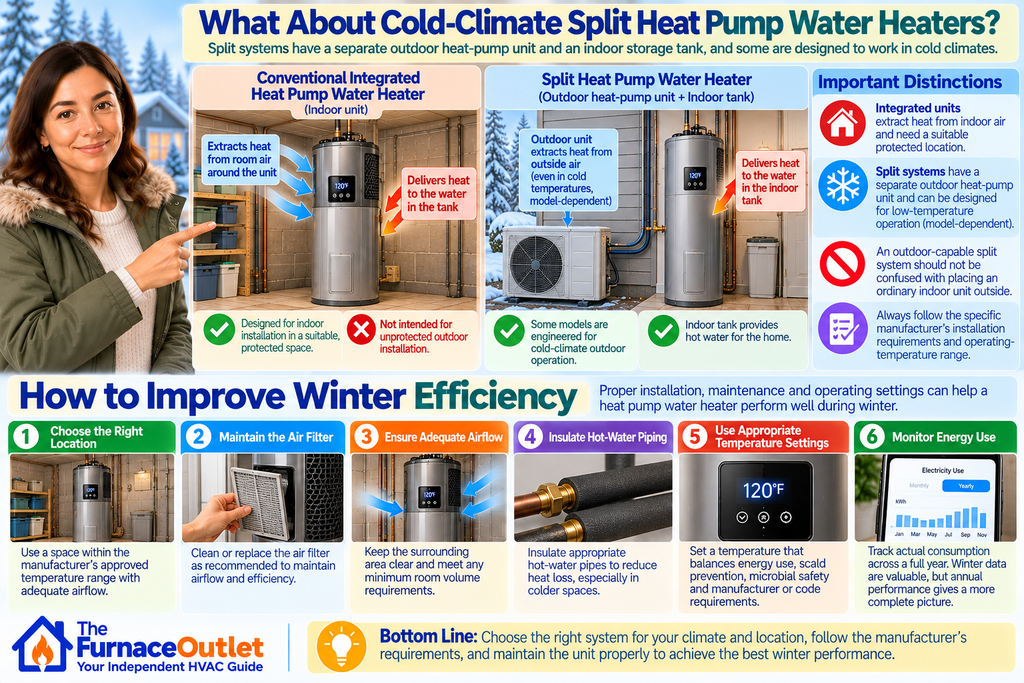
The first improvement I would make is selecting an installation location that remains within the manufacturer’s approved temperature range and provides sufficient airflow. A protected, appropriately designed space can help avoid unnecessary efficiency losses during winter.
I would also maintain the air filter according to the manufacturer’s instructions, prevent airflow obstructions, insulate appropriate hot-water piping and investigate leaks or excessive hot-water consumption. Storage-temperature settings should balance energy use, scald prevention, microbial safety and applicable requirements.
Where a manufacturer permits ducting, I would evaluate whether an approved arrangement could improve installation performance. However, ducting should never be improvised because airflow resistance, condensation, temperature limits and equipment specifications all matter.
Finally, I would monitor actual electricity consumption across an entire year. Winter data are valuable, but annual performance provides a more representative basis for judging operating costs.
A conventional integrated heat pump water heater should not be assumed suitable for a freezing installation space. Some equipment may use resistance backup at low ambient temperatures, while purpose-designed systems can have different capabilities. Always follow the exact manufacturer’s operating and freeze-protection requirements.
They can be excellent options when properly sized and installed in suitable locations. The state’s outdoor winter temperature alone does not determine performance; the temperature surrounding the appliance, incoming-water temperature and household demand are more relevant.
They can. Colder incoming water increases heating demand, while colder surrounding air can reduce heat-pump efficiency. Resistance backup may also increase consumption, depending on the appliance and operating conditions.
In many cold-climate homes, a suitable basement offers more stable temperatures than an unheated garage. However, basement installations can affect space-heating loads, so the best location depends on the home’s construction, heating system and manufacturer’s requirements.
Yes, provided the system is correctly sized for peak demand. I would compare storage capacity, first-hour rating, recovery performance and operating modes rather than choosing equipment based on efficiency alone.
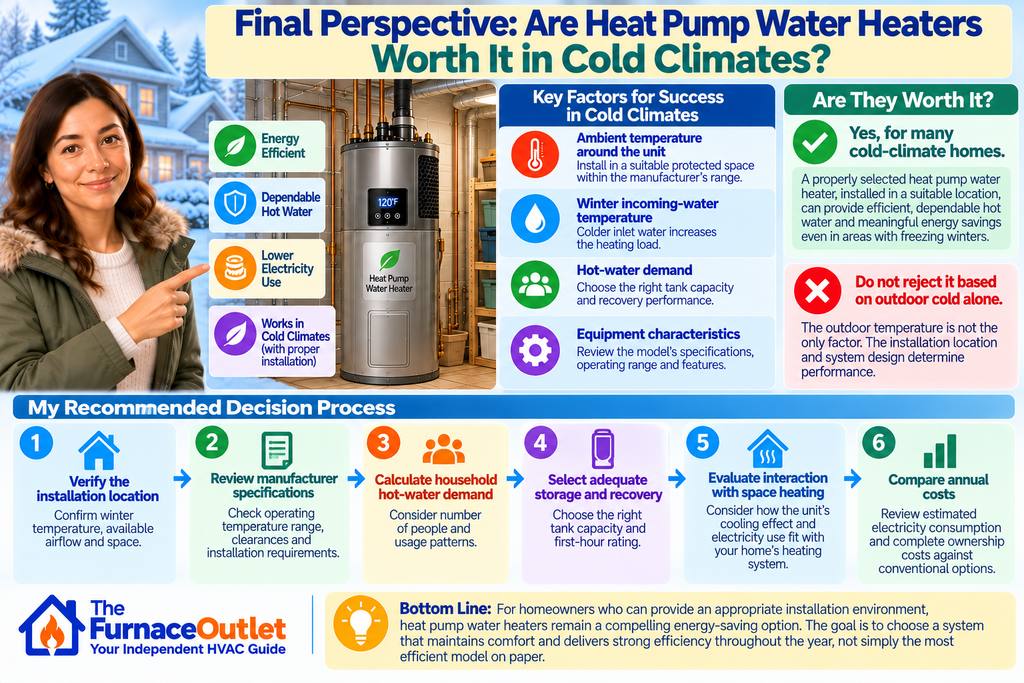
I would not reject heat pump water heating simply because a home experiences freezing winters. A properly selected heat pump water heater installed in a suitable protected space can provide efficient, dependable hot water in cold climates. The important factors are the actual ambient temperature around the appliance, winter incoming-water temperature, hot-water demand and the equipment’s operating characteristics.
My preferred decision process is to verify the installation location’s winter temperature, review manufacturer specifications, calculate household hot-water demand, select adequate storage and recovery capacity, and evaluate how the water heater interacts with the home’s space-heating system. I would then compare annual electricity consumption and complete ownership costs with conventional alternatives.
For homeowners who can provide an appropriate installation environment, heat pump water heaters remain a compelling energy-saving option. The objective is not simply to buy the most efficient model on paper, but to choose a system that maintains comfort and delivers strong efficiency throughout the year.
This article is intended for general educational purposes. Heat pump water heater performance, efficiency, ambient-temperature limits, freeze protection and installation requirements vary by manufacturer and model. Homeowners should consult the exact product documentation and qualified plumbing, HVAC and electrical professionals before purchasing or installing equipment.
The Furnace Outlet is an independent informational resource and is not affiliated with, endorsed by or sponsored by any manufacturer or organization mentioned. All product names and trademarks belong to their respective owners and are used solely for identification and educational purposes.