Newsletter Subscribe
Enter your email address below and subscribe to our newsletter

HVAC made simple
By Savvy Mavi — Savvy the Sustainability Expert | The Furnace Outlet
Heat pump water heaters are among the most energy-efficient options available for producing domestic hot water, but homeowners naturally want to know how much electricity they actually consume. A heat pump water heater still uses electricity, and its operating cost depends on household hot-water demand, local electricity rates, incoming-water temperature, installation conditions and the efficiency of the selected appliance.
What makes this technology different is that it does not rely primarily on electric resistance elements to generate heat. Instead, it uses a refrigeration cycle to move heat from the surrounding air into the water. Because transferring heat can require substantially less electricity than producing the same amount of heat through resistance heating, a well-installed heat pump water heater can deliver considerable energy savings.
When I compare water-heating options, I focus on annual electricity consumption in kilowatt-hours (kWh), the cost per kWh and the actual conditions in which the heater operates. These figures provide a much more useful picture of ownership cost than equipment wattage alone.
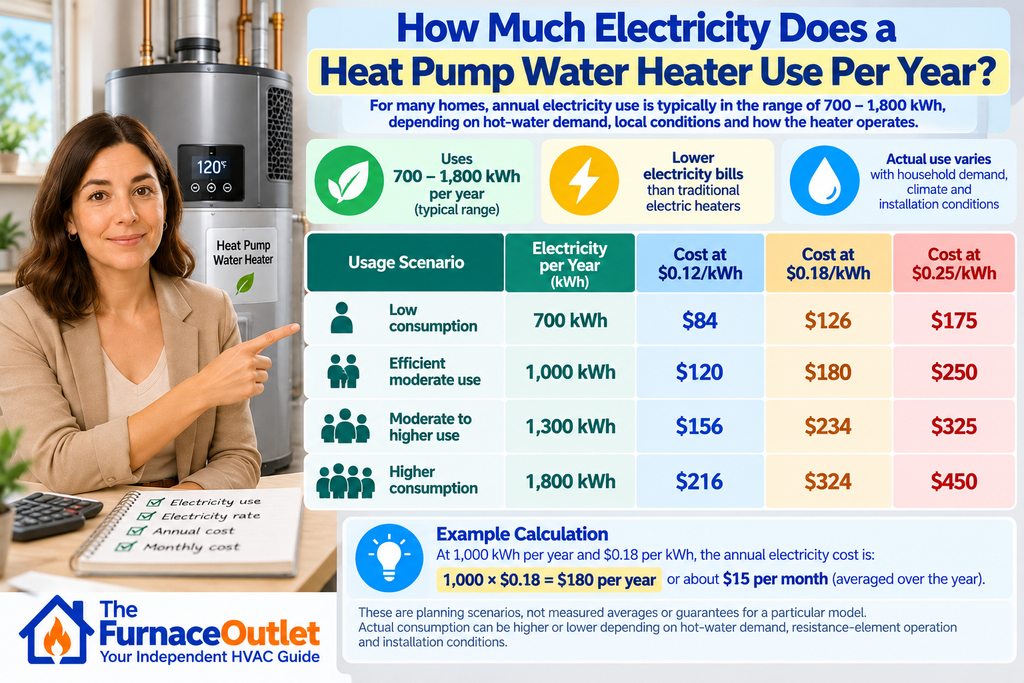
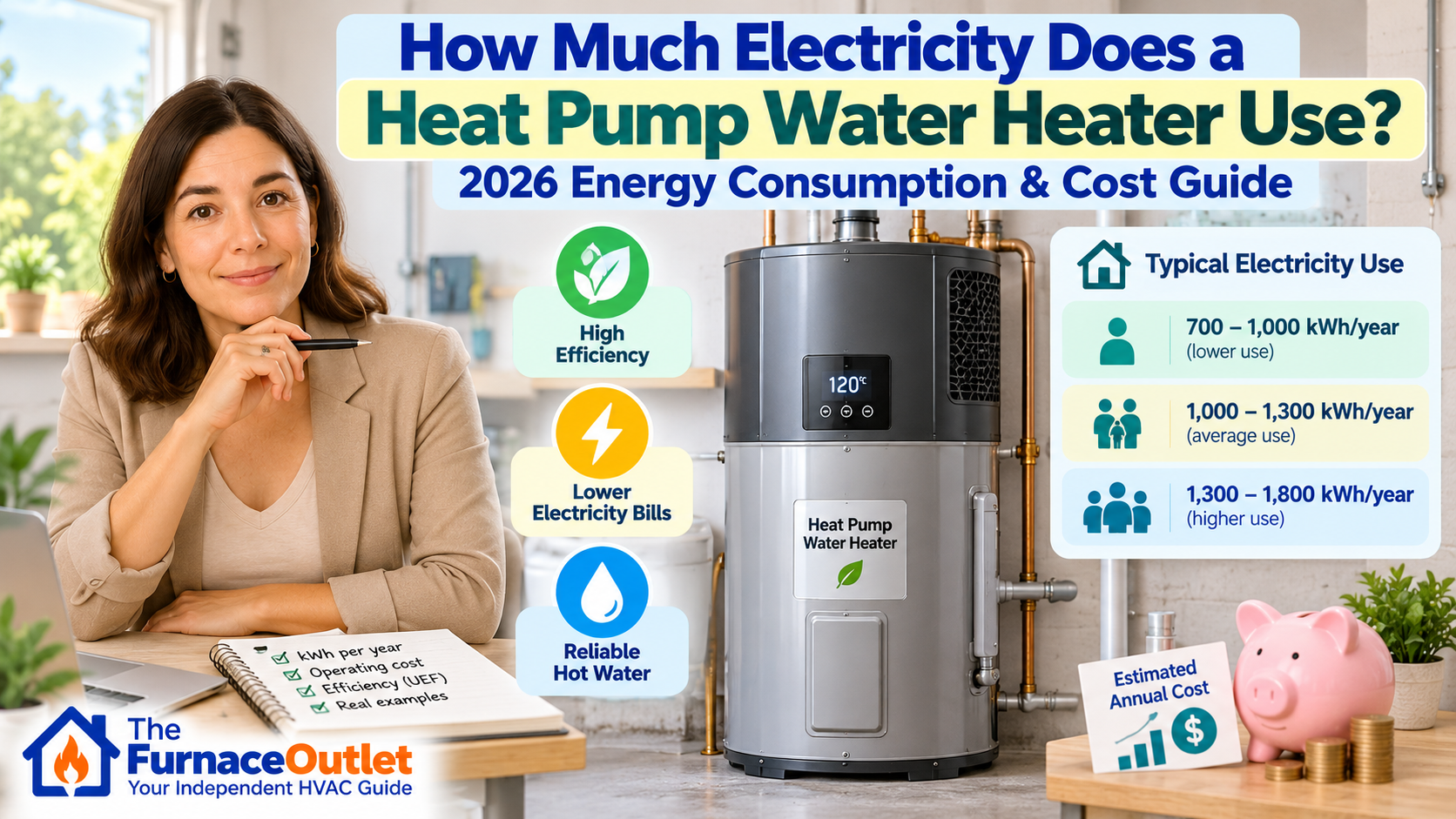
For initial budgeting, I would consider approximately 700–1,800 kWh per year a useful illustrative range for many residential heat pump water heater installations. Actual consumption can fall outside that range, particularly with unusually low or high hot-water demand, resistance-element operation or unfavorable installation conditions.
The following examples illustrate how annual electricity consumption translates into operating cost at different electricity prices. These are planning scenarios, not measured averages or guarantees for a particular model.
| Usage scenario | Electricity per year | At $0.12/kWh | At $0.18/kWh | At $0.25/kWh |
|---|---|---|---|---|
| Low consumption | 700 kWh | $84 | $126 | $175 |
| Efficient moderate use | 1,000 kWh | $120 | $180 | $250 |
| Moderate to higher use | 1,300 kWh | $156 | $234 | $325 |
| Higher consumption | 1,800 kWh | $216 | $324 | $450 |
The relationship is straightforward: annual electricity use × electricity price = approximate annual electricity cost. At 1,000 kWh annually and $0.18 per kWh, the heater would cost approximately $180 per year, or $15 per month averaged across the year. That calculation covers electricity consumption rather than installation, maintenance or other ownership expenses.
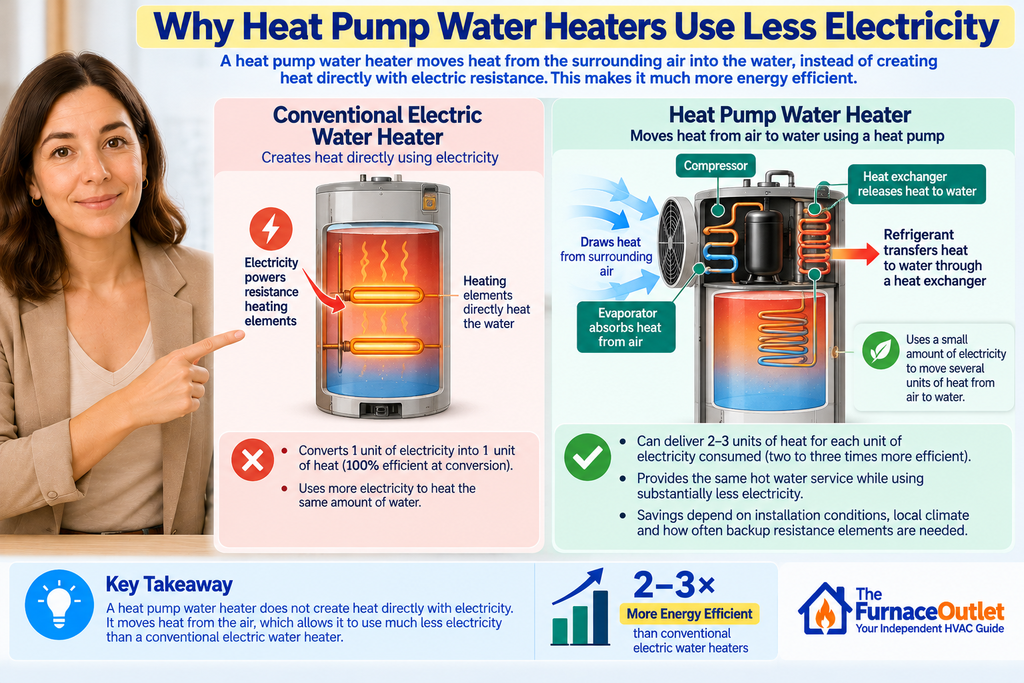
A conventional electric resistance water heater passes electricity through heating elements to produce heat. A heat pump water heater uses a compressor, refrigerant, evaporator and heat exchanger to collect heat from surrounding air and transfer it into the stored water.
This difference allows heat pump technology to deliver several units of heat for each unit of electrical energy consumed under suitable conditions. The U.S. Department of Energy explains that heat pump water heaters can be two to three times more energy efficient than conventional electric resistance water heaters.
I find that distinction particularly important because a heat pump water heater can deliver the same useful hot-water service while consuming substantially less electricity. However, the savings depend on how effectively the heat pump operates and how often backup resistance elements are needed.
The Uniform Energy Factor, or UEF, is a standardized efficiency metric used to compare water heaters. A higher UEF generally indicates that the appliance delivers more useful hot-water energy relative to the energy it consumes under the applicable test procedure.
For example, a heat pump water heater with a UEF of 3.5 is substantially more efficient under standardized conditions than an electric resistance water heater with a UEF near 0.95. This does not mean every household will experience precisely the same ratio in actual operation, because usage patterns, ambient conditions and operating modes influence performance.
I would compare UEF ratings among appropriately sized models and review their EnergyGuide labels for estimated annual electricity consumption. UEF helps explain efficiency, while annual kWh provides a more direct starting point for estimating the electricity bill.
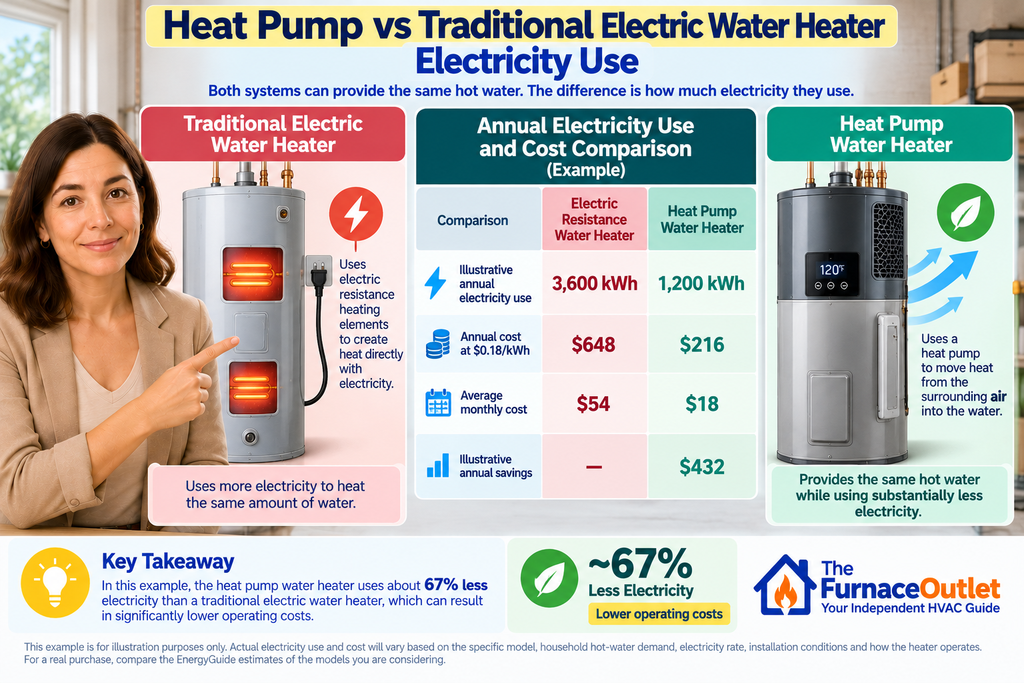
To illustrate the potential difference, imagine two appropriately sized water heaters serving comparable household demand. One is a conventional electric resistance heater using 3,600 kWh annually, while the other is a heat pump model using 1,200 kWh annually.
| Comparison | Electric resistance | Heat pump |
|---|---|---|
| Illustrative annual electricity | 3,600 kWh | 1,200 kWh |
| Annual cost at $0.18/kWh | $648 | $216 |
| Average monthly cost | $54 | $18 |
| Illustrative annual savings | — | $432 |
In this example, the heat pump water heater consumes approximately 67% less electricity. The calculation demonstrates the potential of the technology, but it should not be interpreted as a universal savings prediction.
For a real purchase, I would compare the EnergyGuide estimates of the specific models being considered and then adjust expectations for the household’s actual hot-water usage and electricity price.
To move beyond hypothetical numbers, I like to examine certified equipment data. ENERGY STAR lists the Rheem HPLD65-2RH heat pump water heater with a 4.05 UEF, a storage volume of 59 gallons and a standardized annual electricity consumption of 1,184 kWh. This is a useful real-product benchmark, although its certified test result should not be interpreted as the consumption of every heat pump water heater.
At an electricity price of $0.18 per kWh, 1,184 kWh would cost approximately $213 annually, or $17.76 per month. At $0.25 per kWh, the annual electricity cost would increase to $296. The appliance remains equally efficient in both calculations, but the financial result changes with the utility rate.
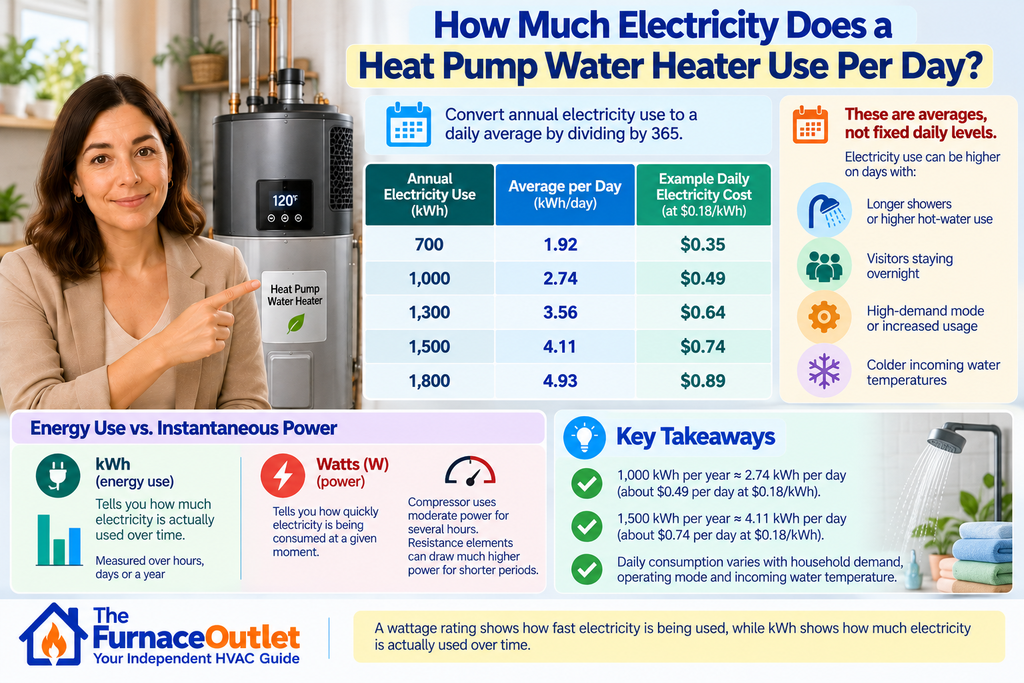
Annual electricity consumption can be converted into a daily average by dividing by 365. A heater consuming 1,000 kWh annually averages approximately 2.74 kWh per day, while a heater consuming 1,500 kWh annually averages about 4.11 kWh per day.
These are averages rather than fixed daily consumption levels. Electricity use can increase when family members take longer showers, visitors stay overnight, the water heater operates in high-demand mode or incoming water becomes colder.
I would also distinguish energy consumption from instantaneous electrical power. A heat pump water heater may operate for several hours using relatively modest compressor power, while its resistance heating elements, when activated, can draw much more power for shorter periods. A wattage rating tells you how quickly electricity is being consumed, while kWh tells you how much electricity was actually used.
Household size is one of the strongest influences on hot-water energy demand. More people generally mean more showers, handwashing, laundry and other hot-water use, although individual habits can create substantial differences between similarly sized households.
ENERGY STAR’s published savings comparison estimates annual electricity savings of approximately 1,880 kWh for a two-person household, 2,820 kWh for three people and 3,760 kWh for four people when switching from standard electric water heating under its assumptions. These are electricity savings, not total heat pump electricity consumption, and they illustrate how usage affects the potential benefit.
I would therefore select tank capacity and first-hour rating around the household’s actual peak hot-water needs. Choosing an efficient heater that repeatedly needs resistance backup to meet demand can reduce the expected savings.
Heat pump water heaters are available in several storage capacities, commonly including nominal 40-, 50-, 65- and 80-gallon classes. A larger tank can store more hot water and may help a household meet peak demand without relying as heavily on resistance heating.
However, a larger tank also has additional stored water and potentially different standby losses. I would not assume that an 80-gallon model automatically consumes more electricity than a 50-gallon model in every household, because efficiency, usage and operating modes also matter.
The correct comparison should consider storage capacity, first-hour rating, UEF and published annual kWh together. The goal is sufficient hot-water availability without paying unnecessarily for capacity the household does not need.
Heat pump water heaters draw heat from surrounding air, so installation location can materially affect performance. A warm, adequately ventilated space generally provides better conditions for heat-pump operation than a very cold, confined space.
DOE guidance describes favorable conditions around 40–90°F with adequate surrounding air volume, while emphasizing that the specific equipment’s requirements must be followed. In colder conditions, the appliance may operate less efficiently or rely more heavily on backup heating.
This is why I would carefully evaluate garages, basements, utility rooms and other potential locations. A heat pump water heater installed in a suitable space can perform very differently from an otherwise identical unit placed in an unsuitable enclosure.
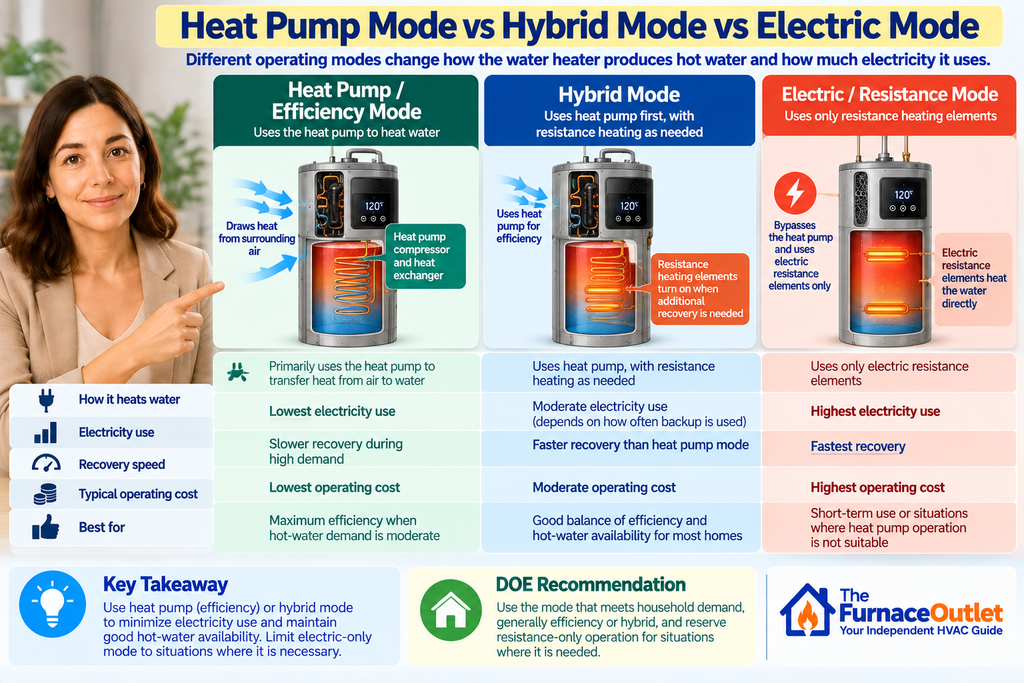
Operating mode can make a major difference to electricity consumption. Many residential heat pump water heaters provide several settings that prioritize either efficiency or faster hot-water recovery.
In heat pump or efficiency mode, the appliance primarily uses the refrigeration system to heat water. This generally minimizes electricity consumption but can result in slower recovery during periods of unusually heavy demand.
Hybrid mode allows the controls to use resistance heating when additional recovery is needed. This can provide a practical balance between efficiency and hot-water availability, although actual electricity use depends on how frequently the backup elements operate.
Electric-only or resistance mode bypasses much of the heat pump’s efficiency advantage. DOE recommends using the mode that meets household demand, generally efficiency or hybrid, while limiting resistance-only operation to situations where it is necessary.
Winter can increase electricity consumption for two reasons. Incoming water may be colder, requiring more energy to reach the selected storage temperature, while the air surrounding the appliance may also become colder, making heat extraction less favorable.
For example, heating water from 40°F to 120°F requires an 80°F rise, whereas heating water from 70°F to 120°F requires only a 50°F rise. For the same quantity of water, the colder inlet condition requires approximately 60% more useful heating energy before accounting for equipment efficiency.
That does not mean the household’s total electricity bill will necessarily increase by 60%. Actual consumption also depends on heat-pump efficiency, standby losses, usage patterns and resistance-element operation.
I would therefore evaluate annual performance rather than judging a heat pump water heater from one particularly cold week.
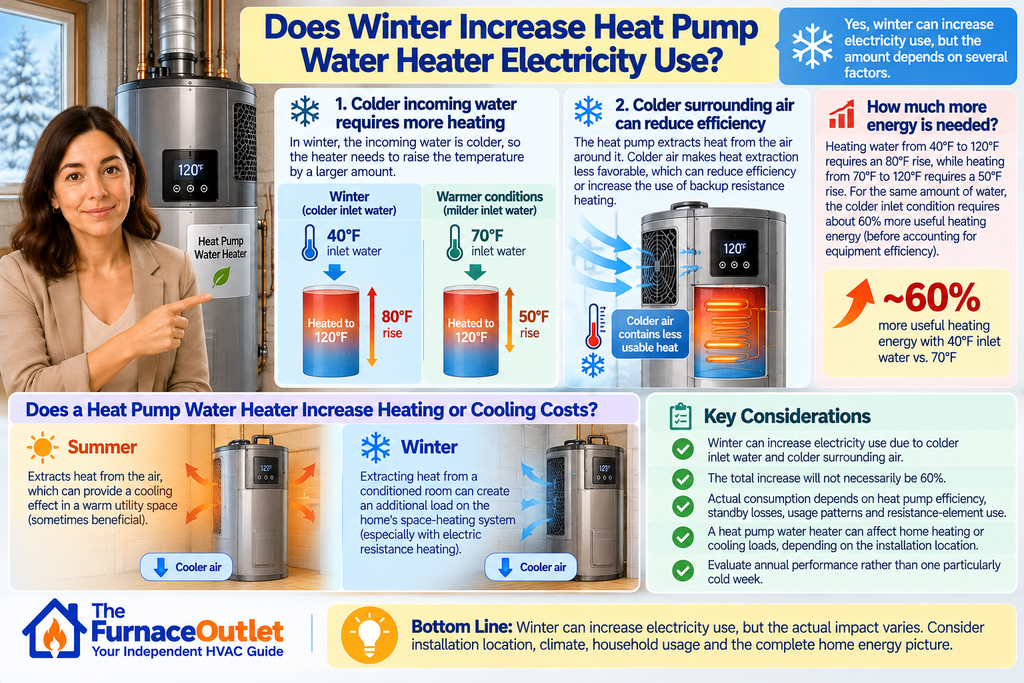
An important consideration is that a heat pump water heater extracts heat from the air around it. In summer, that cooling effect can sometimes be beneficial in a warm utility space. In winter, however, removing heat from a conditioned room can create an additional load on the home’s space-heating system.
The overall energy benefit depends on the location, climate and heating equipment. A heat pump water heater installed in a conditioned basement heated by an electric resistance system can have a different whole-house energy impact from one installed in a warm garage.
For this reason, I would not evaluate water-heater electricity consumption entirely in isolation when comparing complete household energy costs. The installation environment deserves attention, especially in cold climates.
The simplest method is to use the exact model’s EnergyGuide annual kWh estimate and multiply it by the electricity price you actually pay. For example, a heater with an estimated 1,250 kWh annual consumption and a rate of $0.20 per kWh would have an estimated electricity cost of $250 annually, or approximately $20.83 per month.
If your utility uses time-of-use pricing, the calculation can become more interesting. Electricity consumed during inexpensive off-peak hours may cost considerably less than electricity consumed during peak periods.
Some smart water heaters can schedule operation or participate in utility programs, potentially allowing more heating to occur during lower-cost periods. I would review the manufacturer’s controls and the utility’s actual tariff before assuming those savings will be available.
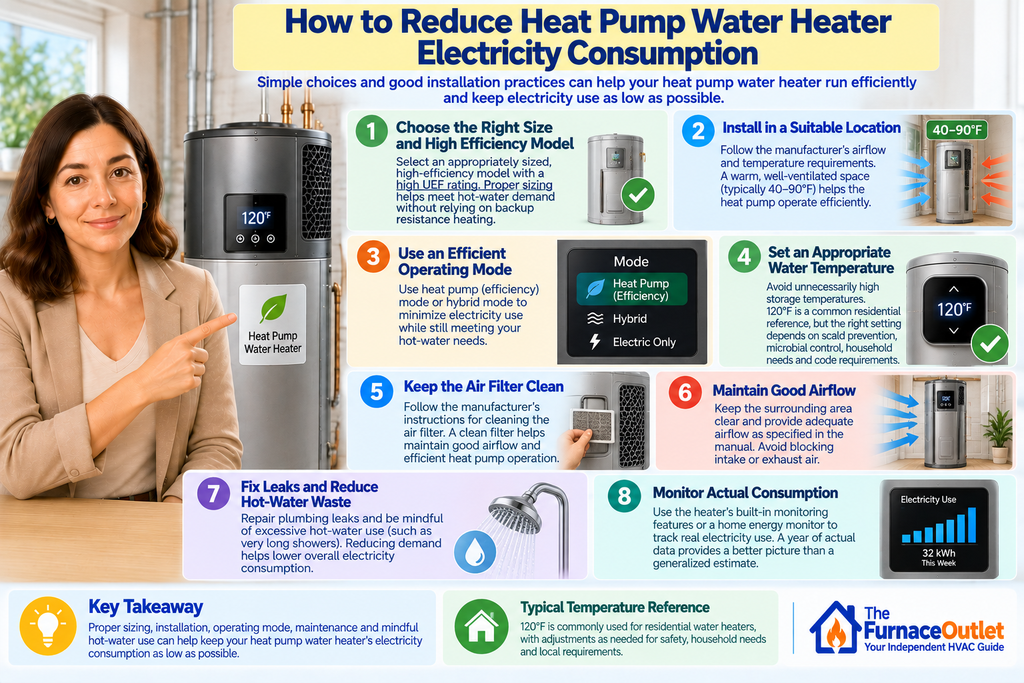
I would begin by selecting an appropriately sized, high-efficiency model and installing it in a location that meets the manufacturer’s airflow and temperature requirements. Proper sizing and installation help the appliance operate efficiently without unnecessary reliance on backup resistance heating.
After installation, I would use an efficient operating mode that still meets the household’s hot-water needs. I would also avoid unnecessarily high storage temperatures, follow the manufacturer’s instructions for air-filter cleaning, maintain appropriate airflow and address leaks or excessive hot-water use.
DOE’s water-heater guidance commonly uses 120°F as a residential temperature reference, but storage-temperature decisions should account for scald prevention, microbial-control considerations, household needs and applicable manufacturer or code requirements. A qualified installer can advise on suitable temperature settings and mixing-valve arrangements where needed.
Finally, I would monitor actual consumption where the appliance or an appropriate energy-monitoring system makes that possible. A year of real usage data can provide a better picture than a generalized estimate.
For an illustrative annual consumption of 700–1,800 kWh, average monthly electricity use would be approximately 58–150 kWh. Actual monthly consumption can vary considerably with hot-water demand, ambient temperature, operating mode and the appliance’s efficiency.
Usually, yes. Heat pump water heaters can be two to three times more energy efficient than conventional electric resistance models. ENERGY STAR estimates substantial electricity savings for households switching to certified heat pump technology, although actual savings depend on equipment, usage and electricity rates.
Not continuously at its full rated power. The compressor and other components operate as needed to maintain stored-water temperature and recover from hot-water use. The appliance also has standby and control-related consumption, so its total energy use is best measured in kWh over time.
Yes, provided the equipment is suitable for the installation conditions. Colder ambient air can reduce heat-pump performance, and some hybrid models may use resistance heating when necessary. The manufacturer’s operating-temperature limits and installation instructions should determine where the heater is installed.
Not necessarily. A larger tank can have greater standby losses but may also reduce the need for resistance backup during high-demand periods. Compare actual model efficiency, annual kWh estimates, storage capacity and first-hour rating rather than assuming that larger automatically means less efficient.
Yes. A heat pump water heater is an electrical appliance, so electricity generated by a household solar photovoltaic system can help offset its consumption. Actual savings depend on solar production, electricity tariffs, export arrangements and whether water-heating demand can be scheduled to coincide with solar generation.
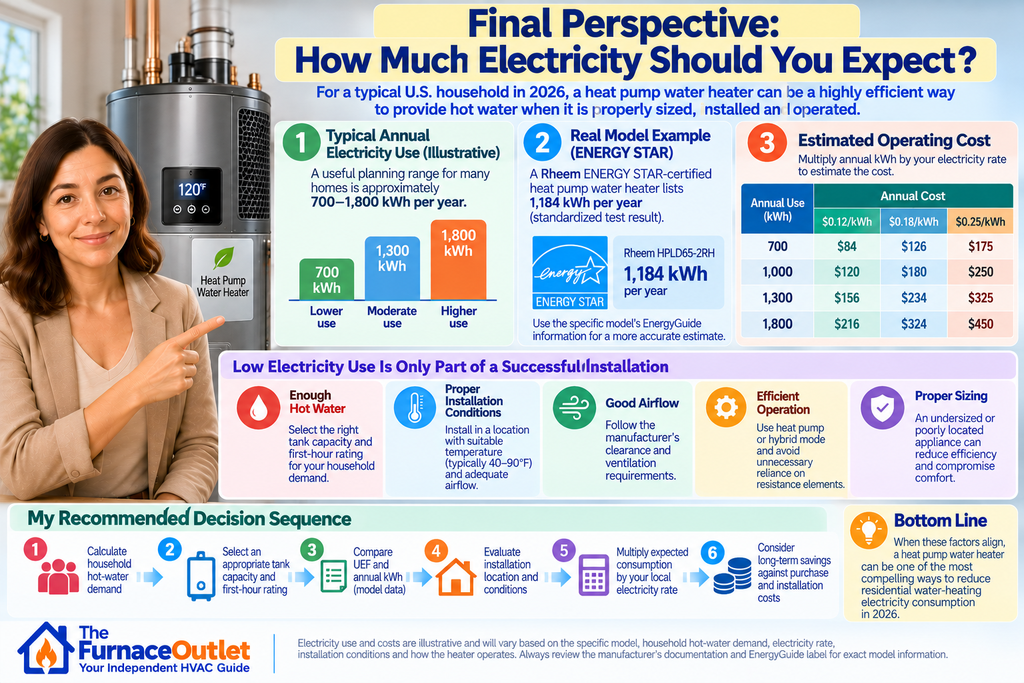
If I were evaluating a heat pump water heater for a typical U.S. household in 2026, I would begin with an illustrative electricity budget of approximately 700–1,800 kWh annually, then replace that broad estimate with the specific model’s EnergyGuide information. A real ENERGY STAR-certified Rheem model, for example, lists standardized consumption of 1,184 kWh annually, demonstrating how useful model-level data can be for estimating operating cost.
I would also remember that low electricity consumption is only one part of a successful installation. The heater must provide enough hot water, operate in an appropriate ambient-temperature range, receive adequate airflow and avoid unnecessary resistance-element operation. Choosing an undersized or poorly located appliance can compromise both comfort and efficiency.
My preferred decision sequence is to calculate household hot-water demand, select an appropriate tank capacity and first-hour rating, compare UEF and annual kWh, evaluate installation conditions, multiply expected consumption by the local electricity rate and then consider long-term savings against purchase and installation costs. When those factors align, heat pump water heating can be one of the most compelling ways to reduce residential water-heating electricity consumption.
This article is provided by The Furnace Outlet for general educational and informational purposes. Electricity-consumption estimates, operating costs and savings examples are illustrative unless identified as manufacturer-published or certified test data. Actual results depend on equipment specifications, household usage, electricity prices, installation conditions, operating modes and maintenance. Homeowners should review the exact manufacturer’s documentation and consult qualified professionals for electrical, plumbing and installation requirements.
The Furnace Outlet is an independent informational resource and is not associated with, endorsed by or affiliated with Rheem, ENERGY STAR, the U.S. Department of Energy or any manufacturer or organization mentioned. Product names, trademarks and logos remain the property of their respective owners and are referenced solely for identification and educational purposes.