Newsletter Subscribe
Enter your email address below and subscribe to our newsletter

HVAC made simple
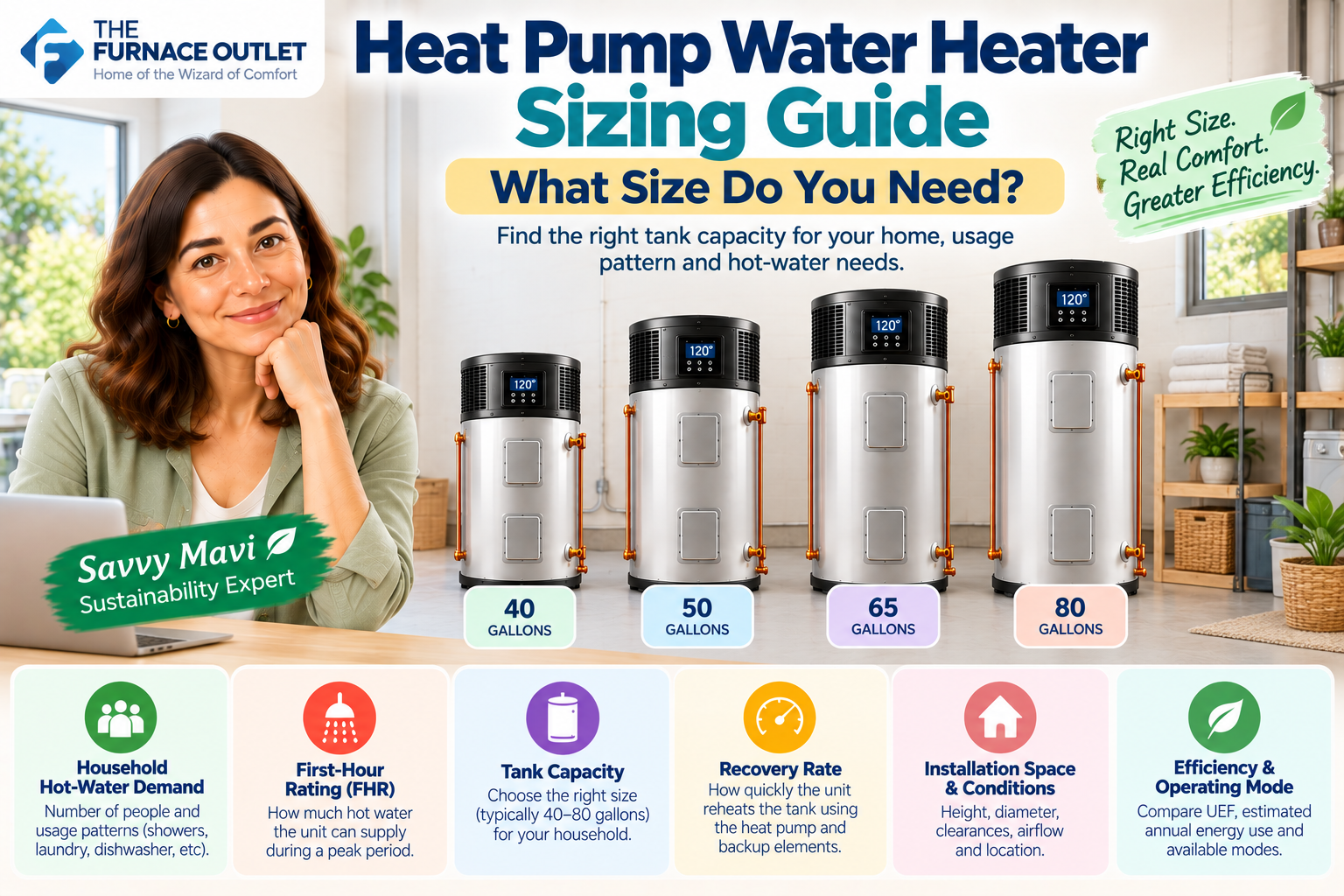
Choosing the right size heat pump water heater is about more than counting bedrooms or replacing a 50-gallon tank with another 50-gallon tank. Heat pump water heaters behave differently from conventional electric resistance tanks because their most efficient heating method—the heat pump itself—generally recovers hot water more gradually. That makes tank capacity, first-hour rating, household demand, recovery performance, operating mode, and usage patterns especially important.
From my sustainability perspective, sizing is also an efficiency decision. An undersized hybrid water heater may frequently call on its backup electric resistance elements to meet demand, reducing some of the energy-saving advantage that made the heat pump attractive in the first place. An unnecessarily oversized unit, however, can increase purchase cost and take up more space without providing meaningful benefits.
My goal is therefore not to tell every family of four to buy the same tank. I want to match the water heater to the way the household actually uses hot water.
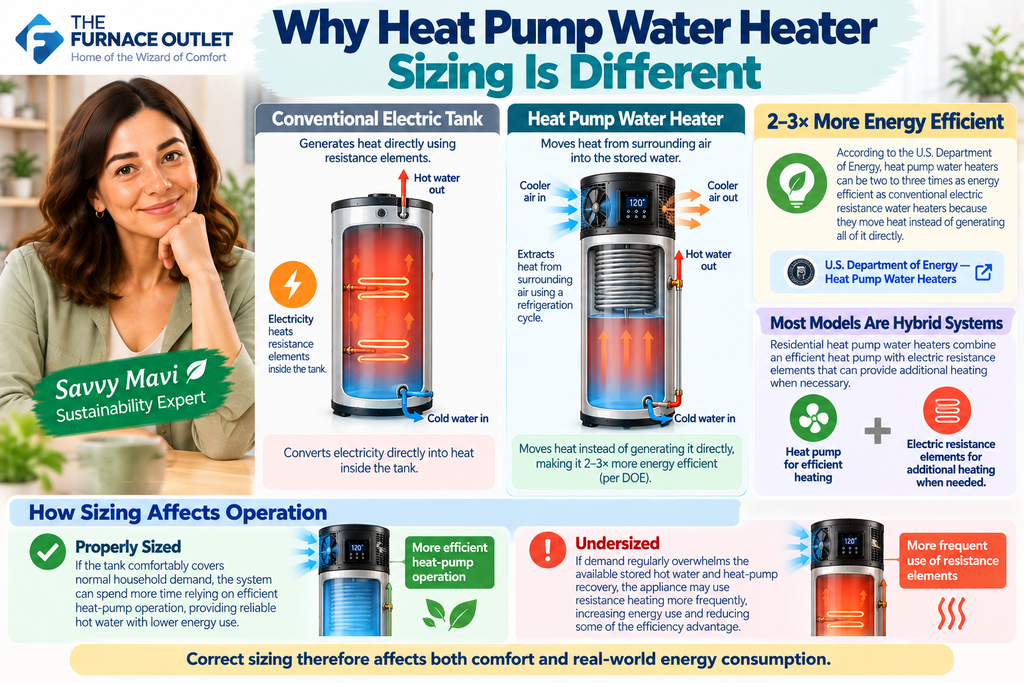
A conventional electric tank uses resistance heating elements to generate heat directly. A heat pump water heater primarily transfers heat from surrounding air into the stored water using a refrigeration cycle. According to the U.S. Department of Energy, heat pump water heaters can be two to three times as energy efficient as conventional electric resistance water heaters because they move heat instead of generating all of it directly.
U.S. Department of Energy — Heat Pump Water Heaters
Most residential models are hybrid systems. They combine an efficient heat pump with electric resistance elements that can provide additional heating when necessary. This gives homeowners both efficiency and additional recovery capability, but it also means sizing influences how the appliance operates.
If the tank comfortably covers normal household demand, the system can spend more time relying on efficient heat-pump operation. If demand regularly overwhelms the available stored hot water and heat-pump recovery, the appliance may use resistance heating more frequently. Correct sizing therefore affects both comfort and real-world energy consumption.
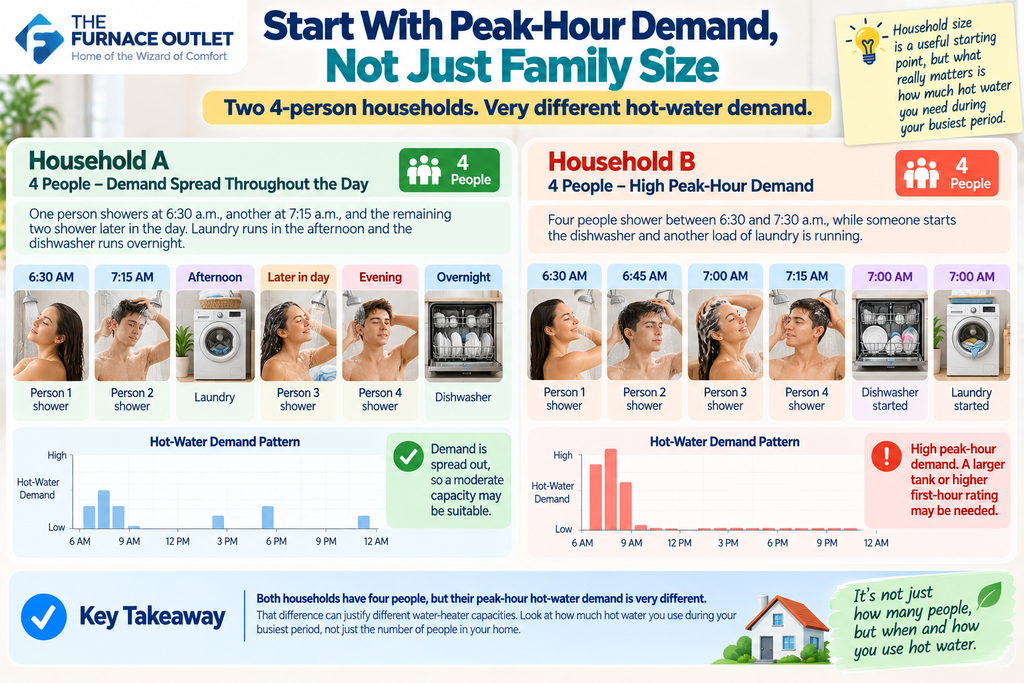
Household size is a useful starting point, but it should never be the entire sizing calculation. What really matters is how much hot water the household needs during its busiest period.
Imagine two four-person households. In the first home, one person showers at 6:30 a.m., another at 7:15, and the remaining two shower later in the day. Laundry runs in the afternoon and the dishwasher runs overnight. Their demand is relatively spread out.
The second household has four people showering between 6:30 and 7:30 a.m., while someone starts the dishwasher and another load of laundry is running. Both homes contain four people, but the second household has a much greater peak-hour hot-water demand.
That difference can justify different water-heater capacities.
One of the first numbers I would check after tank capacity is the First-Hour Rating, or FHR. This estimates how much hot water a storage water heater can supply during a high-demand hour beginning with a fully heated tank.
FHR combines the hot water already stored in the tank with the water heater’s ability to recover during that period. That makes it more useful than tank volume alone.
A 65-gallon water heater does not simply provide exactly 65 gallons of usable hot water and stop. As hot water leaves the tank, cold water enters and the heater begins replacing the lost heat. The amount it can deliver therefore depends on tank storage, heating capacity, controls, setpoint, incoming-water temperature, and other operating conditions.
ENERGY STAR recommends considering first-hour rating when selecting storage water heaters because it helps match the appliance to peak household demand.
ENERGY STAR — Water Heater Buying Guidance
When comparing heat pump water heaters, I would therefore place FHR beside tank capacity rather than treating gallons as the only sizing specification.
Residential integrated heat pump water heaters are commonly available in capacities around 40, 50, 65, and 80 gallons, although exact capacities and product offerings vary by manufacturer.
A 40-gallon model may work for a small household with modest, well-distributed hot-water demand. A 50-gallon unit can suit many smaller and moderate-demand households. Moving to approximately 65 gallons provides additional stored capacity for households with greater or more concentrated demand, while 80-gallon units can be attractive for larger families or homes where several hot-water uses regularly overlap.
These are not universal rules. The correct choice depends on the exact model’s FHR and recovery performance, not merely the number printed on the tank.
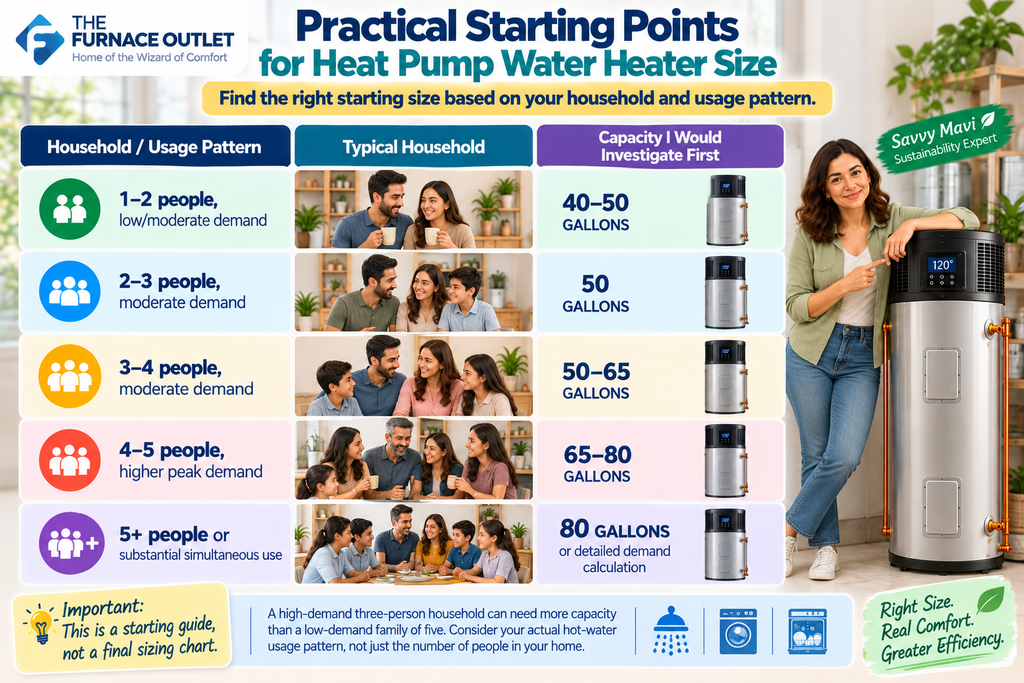
| Household / Usage Pattern | Capacity I Would Investigate First |
|---|---|
| 1–2 people, low/moderate demand | 40–50 gallons |
| 2–3 people, moderate demand | 50 gallons |
| 3–4 people, moderate demand | 50–65 gallons |
| 4–5 people, higher peak demand | 65–80 gallons |
| 5+ people or substantial simultaneous use | 80 gallons or detailed demand calculation |
I would treat this table as a screening tool, not a final sizing chart. A high-demand three-person household can need more capacity than a low-demand family of five.
A better approach is to identify the busiest hour of a typical day and list everything that uses hot water during that period.
Suppose a family expects three showers during the morning peak, along with some sink use. If those showers are relatively short and use efficient showerheads, the demand may be manageable for a properly selected 50- or 65-gallon model. If several long showers occur consecutively while laundry and dishwashing also consume hot water, a larger tank or higher-FHR model may be more appropriate.
Do not simply add fixture flow rates multiplied by time and assume every gallon is 100% hot water. Showers and faucets generally mix hot and cold water, so actual hot-water draw depends on supply temperature, desired outlet temperature, and incoming cold-water temperature.
For precise sizing, I would use the manufacturer’s sizing guidance or have a qualified professional calculate the home’s expected demand.
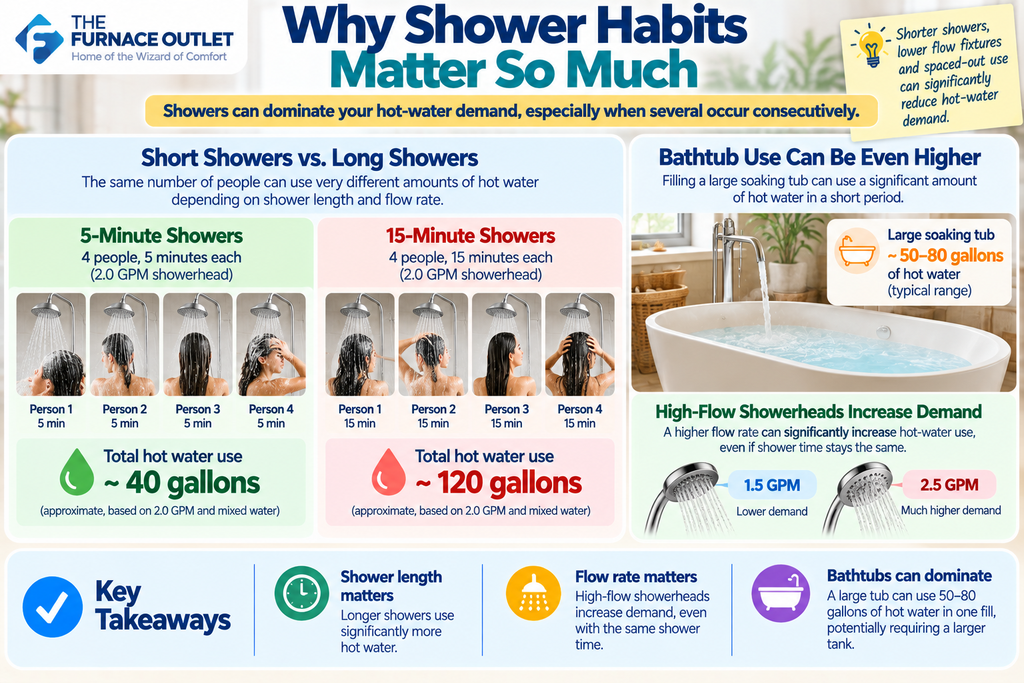
Showers can dominate residential hot-water demand, especially when several occur consecutively. A household where everyone takes five-minute showers has a completely different profile from one where family members routinely take 15- or 20-minute showers. High-flow showerheads increase demand further.
Large soaking tubs can be even more important. Filling a substantial bathtub can consume a large quantity of hot water in a short period, potentially making tank capacity more important than the number of people living in the house.
If your home contains a large bathtub that is regularly used, I would specifically include it in the sizing calculation rather than relying on a generic household-size recommendation.
This is one of the most practical decisions for many households. If a 50-gallon heat pump water heater comfortably meets the calculated peak demand and has an appropriate first-hour rating, I see little reason to automatically buy a larger tank. But if the household sits near the limit of the 50-gallon model, I would seriously compare a 65-gallon alternative.
The additional storage can provide a buffer during concentrated demand. More importantly from my efficiency perspective, greater stored capacity may sometimes allow the system to recover more gradually using heat-pump operation rather than requiring aggressive resistance-element assistance.
That does not mean that a 65-gallon model is inherently more efficient than a 50-gallon model. Actual performance depends on the specific products and how they are used. It means that properly matching storage to demand can help the water heater operate as intended.
An 80-gallon heat pump water heater becomes especially interesting for larger households and homes with substantial simultaneous hot-water demand. I would investigate an 80-gallon model when several people routinely shower within a short window, when large tubs are frequently used, when household schedules concentrate hot-water demand, or when the family has repeatedly run out of hot water with a smaller tank.
The trade-offs are straightforward. Larger equipment usually costs more, occupies more space, weighs more when filled, and may have different installation requirements. Buying 80 gallons simply because it sounds safer is not necessarily good design. The objective is to create an appropriate reserve without paying for capacity that the household will rarely use.
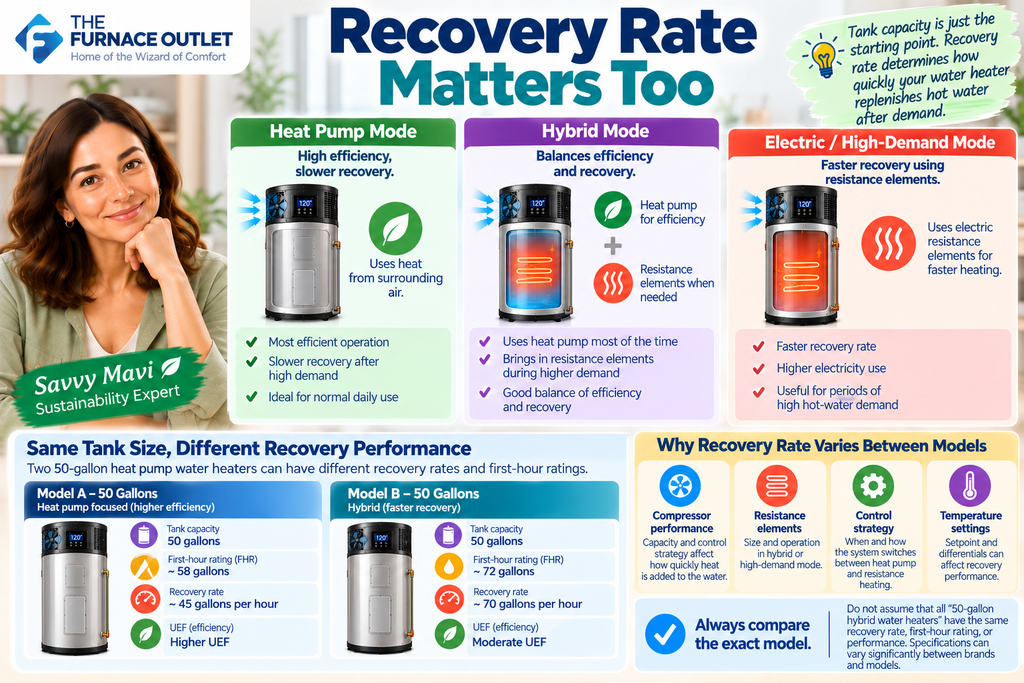
Tank capacity tells only part of the story because hot-water recovery determines how quickly the appliance can replenish usable heat after demand. Heat-pump-only operation generally emphasizes efficiency rather than maximum recovery speed. Hybrid modes can bring resistance elements into operation when greater heating capacity is required.
This is why two similarly sized heat pump water heaters can behave differently in the same household. Their compressors, resistance elements, control strategies, temperature settings, and operating modes can affect recovery and first-hour performance. Always compare the exact model, not merely two products described as “50-gallon hybrid water heaters.”
Many hybrid water heaters offer modes such as heat pump, efficiency, hybrid, electric-only, high-demand, or vacation operation. Names and control strategies vary by manufacturer.
An efficiency-focused mode may minimize resistance heating and reduce electricity consumption, but recovery can be slower after substantial hot-water use. Hybrid or high-demand operation may provide faster recovery by bringing resistance elements into the heating process.
An undersized water heater operated constantly in a high-demand mode may therefore perform very differently from a properly sized unit that spends most of its time in an efficiency-focused mode. I would size the appliance around normal household demand rather than deliberately buying too small and expecting backup resistance heating to compensate every day.
Incoming water temperature varies with climate, season, and plumbing conditions. Colder incoming water requires more energy to reach the desired storage temperature. That means a water heater serving a cold-climate home can face a greater temperature rise than the same unit installed where incoming water is warmer.
This does not mean everyone in a cold climate automatically needs an oversized tank, but it is another reason generic “number of people = number of gallons” formulas have limitations. The exact manufacturer’s performance information and operating-temperature requirements should always be considered.
A water heater can be perfectly sized for hot-water demand and still be wrong for the house. Integrated heat pump water heaters require appropriate airflow and have manufacturer-specified installation-space and clearance requirements. Because they extract heat from surrounding air, placing one in an unsuitable tiny enclosed closet can affect operation unless the installation uses manufacturer-approved ventilation or ducting arrangements.
They also produce condensate that must be properly managed. The installation must account for electrical requirements, plumbing connections, drainage, service access, ceiling height, tank dimensions, and the physical path required to move the appliance into position.
An 80-gallon unit that will not fit through the doorway is obviously not the right solution, regardless of what the sizing calculation says.
A modest increase in capacity can sometimes be reasonable with heat pump technology, particularly when it helps accommodate peak demand while allowing greater reliance on heat-pump operation. But I would distinguish between strategic sizing and excessive oversizing.
Moving from 50 to 65 gallons because household demand falls near the 50-gallon model’s performance limit can be sensible. Jumping to the largest product available without calculating demand is a different matter.
Larger tanks can have higher upfront costs, greater space requirements, and different standby characteristics. Compare the actual efficiency ratings and estimated annual energy use of the specific models rather than assuming larger automatically means better or worse.
One of the most common replacement approaches is also one of the weakest: “I have a 50-gallon water heater now, so I need another 50-gallon water heater.” Maybe you do, but the existing tank size does not prove it.
Your old water heater may have been oversized. It may have been undersized. Household occupancy may have changed. Your children may now be teenagers taking longer showers, or several family members may have moved out. You may have replaced fixtures with lower-flow alternatives or added a large bathtub.
The replacement project is an opportunity to calculate what the household needs today.
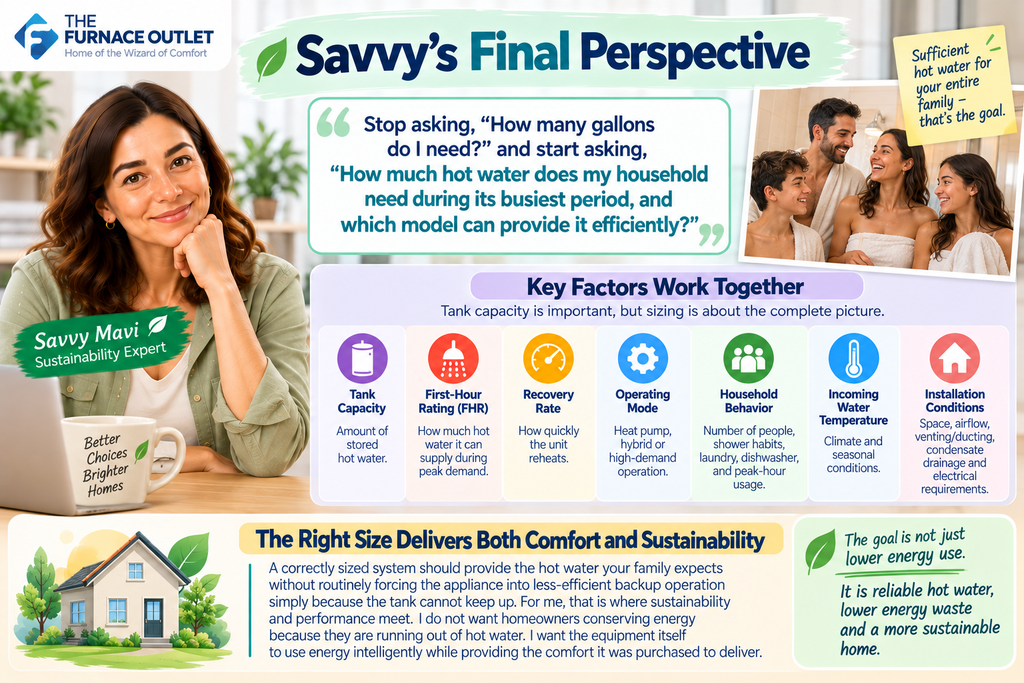
Before selecting a model, I would record the number of household members, typical shower duration, showerhead flow rates where known, whether showers occur consecutively, bathtub usage, laundry and dishwasher schedules, other major hot-water loads, and the busiest one-hour period.
I would then compare tank capacity, first-hour rating, recovery characteristics, UEF, estimated annual energy consumption, operating modes, electrical requirements, ambient operating range, installation clearances, airflow requirements, condensate drainage, ducting options where available, sound information, warranty, and complete installed cost.
Finally, I would verify every important specification using the exact model number. Manufacturers frequently offer multiple capacities and configurations within the same product family, and specifications can differ.
For a small household with modest demand, I would begin by investigating 40- and 50-gallon models. For three or four people, I would generally compare 50- and 65-gallon models, paying particular attention to peak demand and FHR. For four or five people with concentrated morning or evening demand, 65 or 80 gallons deserves serious consideration. For a larger household, frequent simultaneous use, or substantial bathtub demand, I would investigate 80 gallons and perform a more detailed sizing calculation.
Those ranges are intentionally flexible. I would rather have homeowners understand their demand than blindly follow a table.
It can be, particularly when hot-water use is moderate and distributed throughout the day. However, a four-person household with consecutive showers and overlapping laundry or dishwasher use may benefit from a 65-gallon model. Compare the exact unit’s first-hour rating against your household’s estimated peak-hour demand.
Not automatically. A 65-gallon model provides additional stored capacity, which can be useful for higher peak demand and may help reduce reliance on backup resistance heating in some households. If a 50-gallon model comfortably satisfies demand, the additional capacity may not be necessary.
I would consider 80 gallons for larger households, multiple consecutive showers, frequent simultaneous hot-water use, large tubs, or situations where additional stored capacity helps accommodate demand without excessive backup heating.
Oversizing can increase equipment cost and storage requirements, and efficiency varies by specific model. The goal should not be maximum tank size but sufficient capacity to meet demand while allowing efficient operation. Compare UEF and estimated annual energy consumption for the exact models being considered.
Not automatically. Recalculate household demand and compare the new heat pump model’s first-hour rating and recovery characteristics. Moving to a different capacity may make sense depending on your usage pattern.
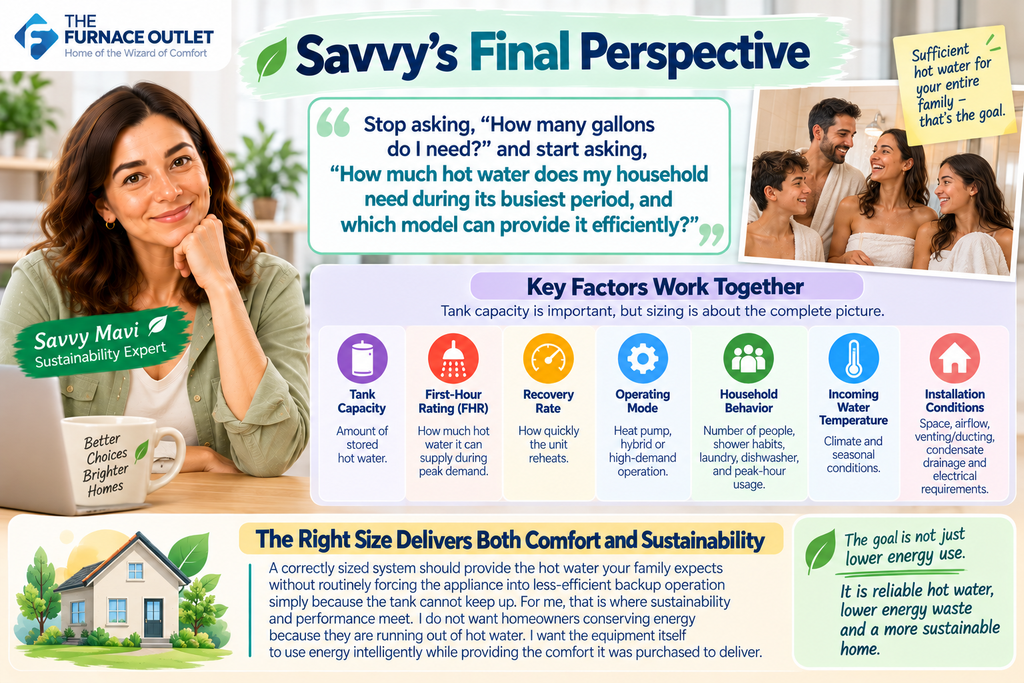
I think the best heat pump water-heater sizing strategy is to stop asking, “How many gallons do I need?” and start asking, “How much hot water does my household need during its busiest period, and which model can provide it efficiently?”
Tank capacity is important, but first-hour rating, recovery, operating mode, household behavior, incoming-water temperature, and installation conditions complete the picture. A correctly sized system should provide the hot water your family expects without routinely forcing the appliance into less-efficient backup operation simply because the tank cannot keep up.
For me, that is where sustainability and performance meet. I do not want homeowners conserving energy because they are running out of hot water. I want the equipment itself to use energy intelligently while providing the comfort it was purchased to deliver.
The Furnace Outlet is an independent informational and educational website. We are not affiliated with, associated with, endorsed by, sponsored by, or officially connected with any manufacturer, brand, retailer, utility, government agency, or other company referenced in this guide unless explicitly disclosed. Product and company names are used for identification and informational purposes only.
The sizing ranges in this article are general educational guidance and are not substitutes for manufacturer-specific sizing instructions or a professional assessment. Actual hot-water requirements depend on household usage, fixture flow rates, incoming-water temperature, setpoint, climate, installation conditions, and the performance characteristics of the exact water-heater model.
Before purchasing or installing a heat pump water heater, verify the manufacturer’s current documentation for the exact model number, including tank capacity, first-hour rating, UEF, electrical requirements, operating-temperature limits, airflow and room-volume requirements, clearances, condensate requirements, and installation instructions. Electrical and plumbing work should comply with applicable codes and be performed by appropriately qualified professionals where required.