Newsletter Subscribe
Enter your email address below and subscribe to our newsletter

HVAC made simple
Choosing a water heater used to feel relatively straightforward. You picked a tank size, decided between gas and electric, compared a few prices, and moved on. In 2026, I think homeowners should look at the decision very differently. Water heating represents a meaningful part of household energy consumption, and the equipment you choose can remain in your home for many years. That makes efficiency, operating cost, installation conditions, hot-water recovery, refrigerant technology, and long-term environmental impact increasingly important parts of the buying decision.
That is exactly why I find heat pump water heaters so interesting. Instead of relying primarily on electric resistance elements to create heat, a heat pump water heater uses electricity to move heat from the surrounding air into the water stored inside its tank. The U.S. Department of Energy describes heat pump water heaters as an energy-efficient alternative to conventional electric-resistance water heating and notes that they can be two to three times as efficient as conventional electric water heaters.
Most residential models are actually hybrid water heaters. They combine a heat-pump system with conventional electric resistance elements, allowing the appliance to prioritize efficient heat-pump operation while calling on resistance heating when additional recovery is needed. That combination is important because efficiency alone does not make a good water heater. A system also needs to provide enough hot water when your household actually needs it.
For me, that balance is the real appeal of a modern hybrid water heater. It can significantly reduce the amount of electricity required for routine water heating without asking homeowners to completely reinvent how they use hot water. However, heat pump water heaters are not automatically the best choice for every home. Tank capacity, first-hour rating, installation location, ambient temperature, noise, condensate management, electrical requirements, available space, climate, household demand, and installed cost all matter.
In this guide, I will explain how I would compare the best heat pump water heaters of 2026, what specifications deserve the most attention, where hybrid technology works particularly well, and where another water-heating technology may still make more sense.
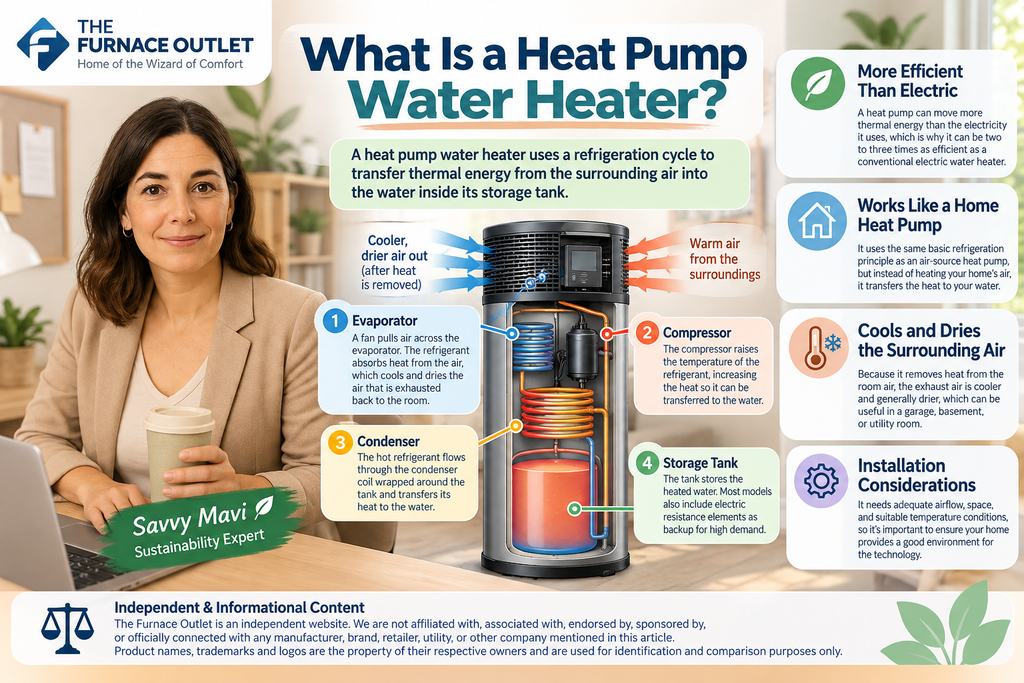
A heat pump water heater uses a refrigeration cycle to transfer thermal energy from the surrounding air into the water inside its storage tank. In simplified terms, the system pulls air across an evaporator, absorbs heat from that air into refrigerant, raises the refrigerant temperature through compression, and transfers that heat into the stored water.
That distinction matters because a conventional electric resistance water heater must convert electrical energy directly into heat. A heat pump can move more thermal energy than the electrical energy consumed by its compressor and fan, which is why the efficiency numbers can look dramatically better.
The Department of Energy explains that these systems operate on a principle similar to household air-source heat pumps, except the transferred heat is used to heat water rather than the home’s living space. DOE also notes that integrated units commonly combine the heat-pump components, storage tank, and backup resistance elements in one appliance.
This also explains something homeowners sometimes overlook: a heat pump water heater interacts with the room in which it is installed. Because it removes heat from surrounding air, the exhaust air is cooler and generally drier. In an appropriate garage, basement, utility room, or other suitable space, that effect may be useful. In a small conditioned closet, however, the installation may require careful consideration of airflow, ducting, temperature, and manufacturer-specified room-volume requirements.
I therefore would not shop for a heat pump water heater based solely on efficiency ratings. I would first determine whether the house provides a suitable environment for the technology.
The broader movement toward electrification has made heat pump technology increasingly important. Heat pumps are now being used not only for space heating and cooling but also for domestic water heating because they can deliver substantially more heat per unit of electricity consumed than conventional resistance technology.
DOE notes that heat pump water heaters run on electricity rather than natural gas and can reduce on-site direct emissions when replacing combustion water heating. The total emissions picture depends on the electricity supply serving the home, but the combination of electrification and much higher efficiency makes the technology particularly relevant to homeowners who want to reduce household fossil-fuel use.
From my sustainability perspective, that is much more meaningful than simply attaching a “green” label to an appliance. A sustainable product needs to perform its intended job reliably while reducing unnecessary resource consumption over years of operation. A water heater that saves energy but cannot meet a family’s morning shower demand is not a successful sustainability solution.
That is why 2026 buyers should evaluate heat pump water heaters as complete appliances rather than focusing on a single environmental metric.
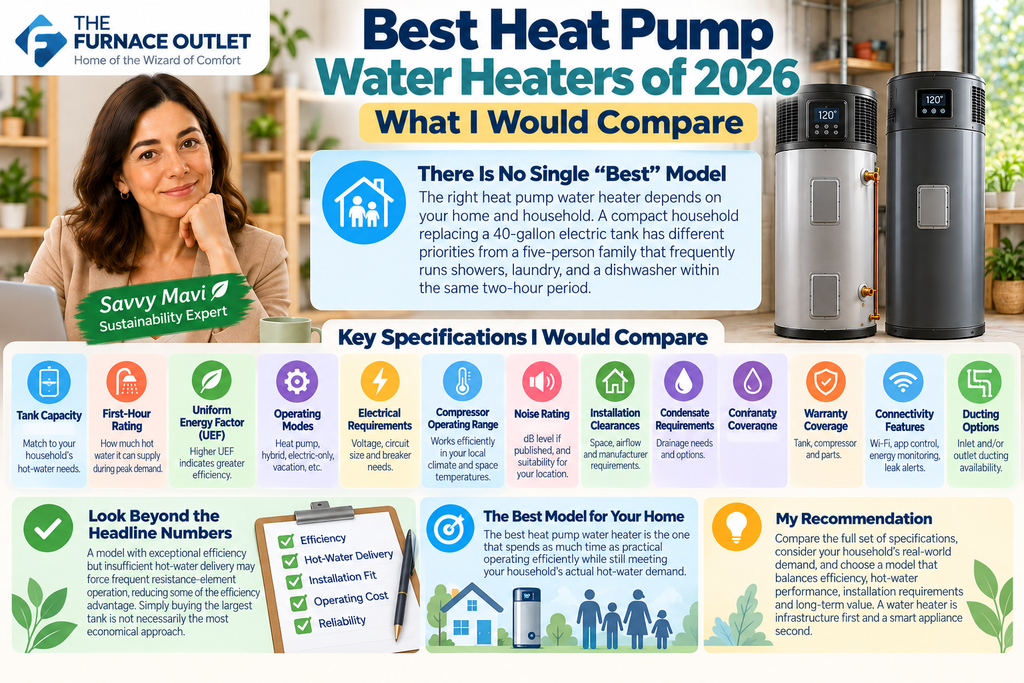
Rather than declaring that one model is universally the “best,” I prefer to compare heat pump water heaters according to the home and household they need to serve. A compact household replacing a 40-gallon electric tank has different priorities from a five-person family that frequently runs showers, laundry, and a dishwasher within the same two-hour period.
The first specifications I would record for every model are tank capacity, first-hour rating, Uniform Energy Factor, operating modes, electrical requirements, compressor operating range, noise rating if published, installation clearances, condensate requirements, warranty coverage, connectivity features, and available ducting options.
I would then look beyond the headline numbers. A model with exceptional efficiency but insufficient hot-water delivery may force frequent resistance-element operation, reducing some of the efficiency advantage. Conversely, simply buying the largest available tank is not necessarily the most economical approach.
The best heat pump water heater is therefore the one that spends as much time as practical operating efficiently while still meeting the household’s actual hot-water demand.
Tank size deserves more attention with a heat pump water heater than many shoppers initially expect. Conventional electric elements can deliver substantial heat relatively quickly. Heat-pump-only operation is generally slower, which means stored hot water becomes an important part of the system’s ability to handle peak demand.
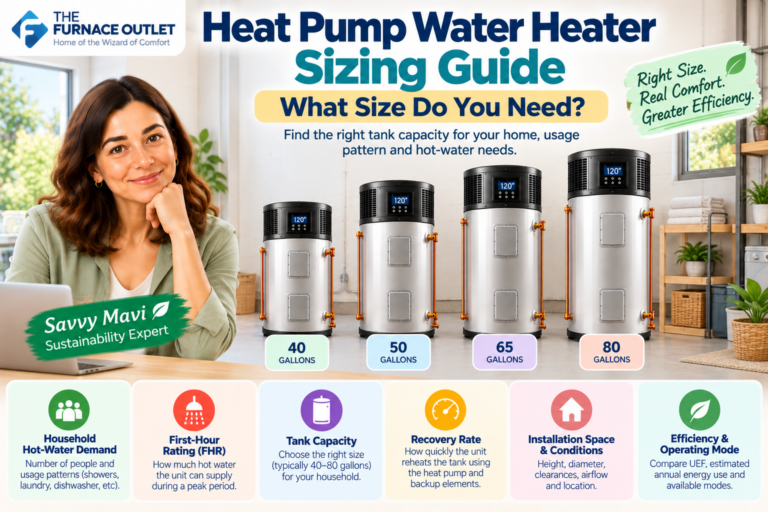
For smaller households with moderate water use, a 40- or 50-gallon model may be sufficient. A typical family may find a 50- or 65-gallon tank more comfortable, while larger households, homes with oversized tubs, simultaneous showers, or concentrated morning demand may benefit from a 65- or 80-gallon model.
I would not determine tank size from household population alone. Two four-person households can have completely different hot-water profiles. One may take short showers at different times of day, while another may have four showers between 6:30 and 8:00 a.m., followed immediately by laundry and dishwasher use. That is why tank capacity should always be considered together with first-hour rating.
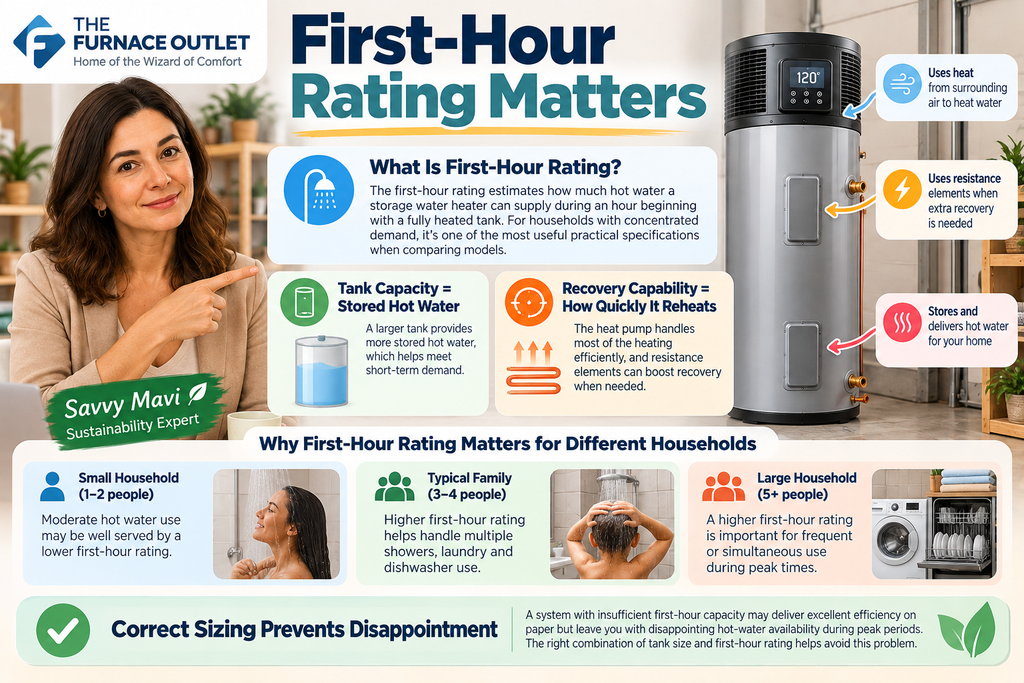
The first-hour rating estimates how much hot water a storage water heater can supply during an hour beginning with a fully heated tank. For households with concentrated demand, I consider this one of the most useful practical specifications available.
A large tank provides more stored hot water, while recovery capability determines how quickly the appliance can replace heat as that water is consumed. Hybrid systems can use their resistance elements when necessary to increase recovery, although doing so increases electricity consumption relative to heat-pump-only operation.
A homeowner who chooses a system with insufficient first-hour capacity may experience exactly the situation that gives heat pump water heaters an undeservedly bad reputation: excellent efficiency on paper but disappointing hot-water availability during peak periods. Correct sizing prevents much of that problem.
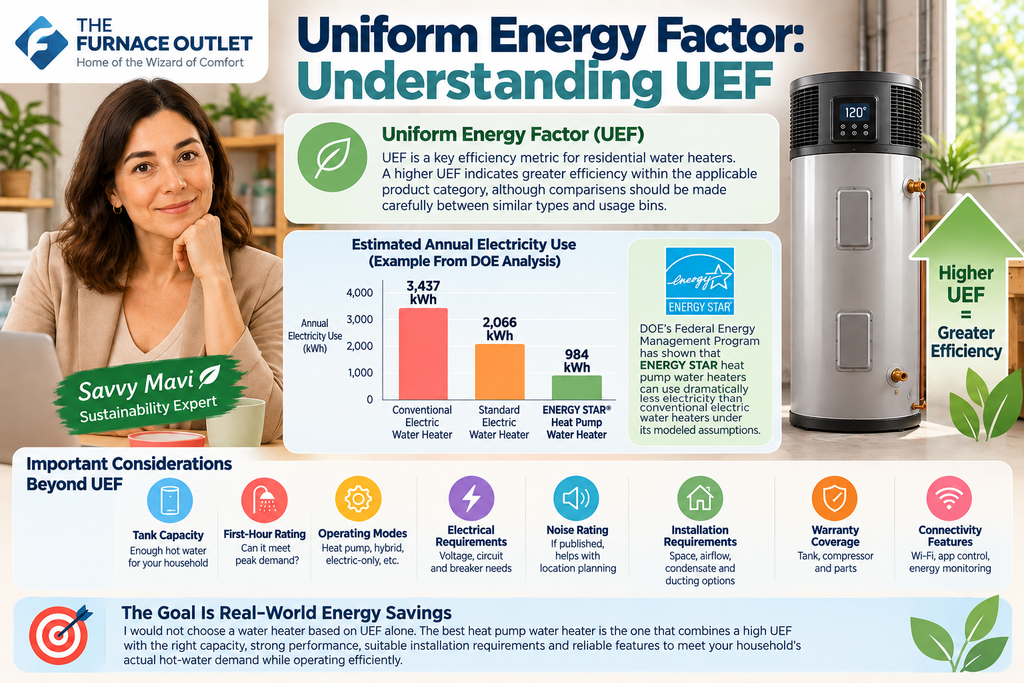
Uniform Energy Factor, or UEF, is one of the principal efficiency metrics used for residential water heaters. In general, a higher UEF indicates greater efficiency within the applicable product category, although comparisons should be made carefully between similar types and usage bins.
The efficiency advantage of heat pump technology can be substantial. DOE’s Federal Energy Management Program has published examples comparing ENERGY STAR heat pump water heaters with less-efficient conventional equipment and showing dramatically lower modeled annual electricity consumption for the heat-pump products under its assumptions.
I would still resist choosing a water heater from UEF alone. Efficiency is only one dimension of performance. I want a high UEF combined with sufficient capacity, appropriate installation requirements, dependable controls, good warranty support, and a realistic operating strategy for the household. In other words, the goal is not to win a specification contest. The goal is to reduce energy consumption in the actual home.
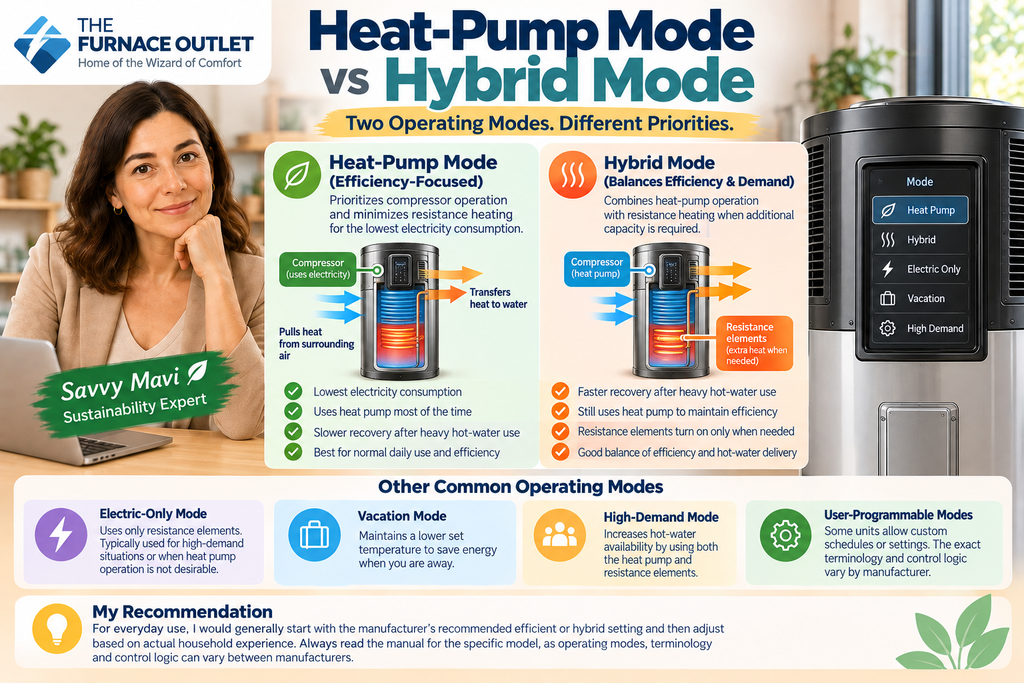
The operating modes are one of my favorite features of modern hybrid water heaters because they allow the appliance to respond differently to efficiency and demand priorities. In a heat-pump or efficiency-focused mode, the appliance generally prioritizes compressor operation and minimizes resistance heating. This can deliver the lowest electricity consumption but may provide slower recovery after heavy hot-water use.
Hybrid mode allows the controls to combine heat-pump operation with resistance heating when additional capacity is required. DOE describes the general hybrid strategy as maximizing heat-pump use while minimizing resistance-element use in order to balance efficiency with hot-water delivery.
Some units also offer electric-only, high-demand, vacation, or user-programmable modes. The exact terminology and control logic vary by manufacturer, so homeowners should read the manual for the specific model rather than assuming all hybrid systems behave identically. For everyday use, I would generally start with the manufacturer’s recommended efficient or hybrid setting and then adjust based on actual household experience.
For a household focused primarily on minimizing electricity consumption, I would prioritize a high-efficiency model with sufficient storage capacity to avoid unnecessary resistance-element operation.
This is where upsizing can sometimes produce an interesting efficiency benefit. A larger tank stores more hot water, potentially allowing the compressor more time to recover gradually instead of frequently relying on resistance elements during concentrated demand. That does not mean everyone should buy an 80-gallon water heater, but it does mean that the smallest acceptable tank is not necessarily the most energy-efficient choice in real-world operation.
I would compare estimated annual energy use, UEF, first-hour delivery, household demand, and operating-mode behavior together. The model with the highest UEF may not always produce the lowest real-world consumption if it repeatedly enters high-demand resistance heating.
For a larger family, I would prioritize usable hot-water capacity before chasing the highest possible efficiency number. A 65- or 80-gallon hybrid water heater can be particularly compelling because its larger thermal reserve can support several showers and other hot-water loads while allowing efficient heat-pump operation to handle much of the recovery. First-hour rating becomes especially important here. I would estimate the family’s busiest one-hour period and compare that demand against the rated performance of candidate systems.
Households should also consider scheduling. Laundry and dishwashing do not necessarily have to coincide with everyone’s morning showers. Smart controls and timers can sometimes help shift flexible hot-water demand to periods when the tank has had time to recover. Efficiency is not only about buying better technology. It is also about using that technology intelligently.
Replacing a conventional electric resistance tank is one of the situations where a heat pump water heater can make particularly strong sense. The home already uses electricity for water heating, so the project may avoid some of the complications associated with switching from combustion equipment.
However, electrical compatibility should still be verified. Different heat pump water heaters can have different voltage, circuit, breaker, and installation requirements, and some newer products are specifically designed to expand retrofit options.
The installation location also deserves attention. If the existing electric tank sits in a cramped closet without adequate airflow, simply placing a heat pump water heater in the same spot may not satisfy the new appliance’s requirements. A successful retrofit therefore starts with both electrical and physical evaluation.
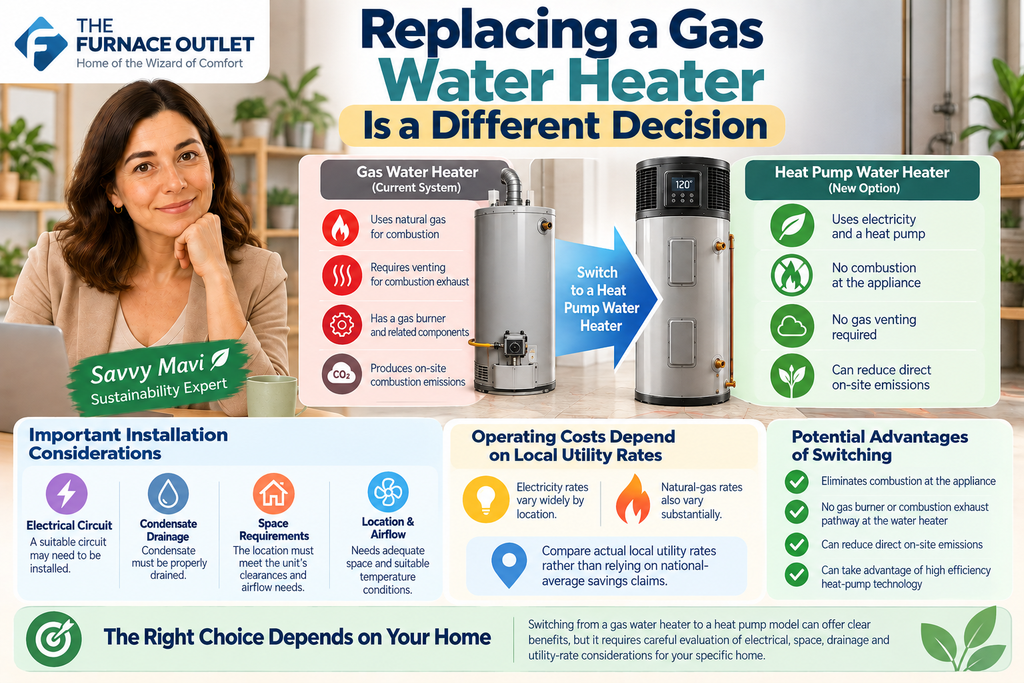
Switching from a gas tank to a heat pump water heater can eliminate combustion at the appliance and reduce direct on-site emissions, which I find attractive from an electrification standpoint. It can also eliminate the need for normal operation of a gas burner and its associated combustion exhaust pathway at that water heater. However, this conversion can require additional work. A suitable electrical circuit may need to be installed, condensate drainage must be addressed, and the available space must satisfy the selected heat pump water heater’s requirements.
Operating-cost comparisons are also location-dependent. Electricity and natural-gas rates vary substantially, so a heat pump water heater’s large efficiency advantage does not translate into the same dollar savings everywhere. I would compare actual local utility rates rather than relying on a national-average savings claim.
Heat pump water heaters need access to a suitable source of heat. Because they extract thermal energy from surrounding air, installation conditions influence both performance and comfort. Garages, basements, utility rooms, and other sufficiently large spaces can work well when they remain within the manufacturer’s permitted temperature range. Smaller enclosed areas may require louvered doors, transfer grilles, ducting, or another manufacturer-approved arrangement.
The cooling effect also matters. Removing heat from a garage during warm weather may be welcome. Removing heat from conditioned indoor space during winter means the home’s heating system may indirectly replace some of that heat. This interaction does not automatically make indoor installation inefficient, but it belongs in a complete analysis.
Like an air conditioner or dehumidifier, a heat pump water heater can produce condensate as moisture in the air condenses on the cold evaporator surface. That water needs somewhere to go. Depending on the installation, the solution might involve a nearby floor drain, condensate drain line, condensate pump, or another method approved by the manufacturer and applicable code.
I would consider condensate routing before buying the appliance rather than discovering the problem after the old water heater has already been removed. Good sustainable design is usually less about flashy technology and more about getting basic details right.
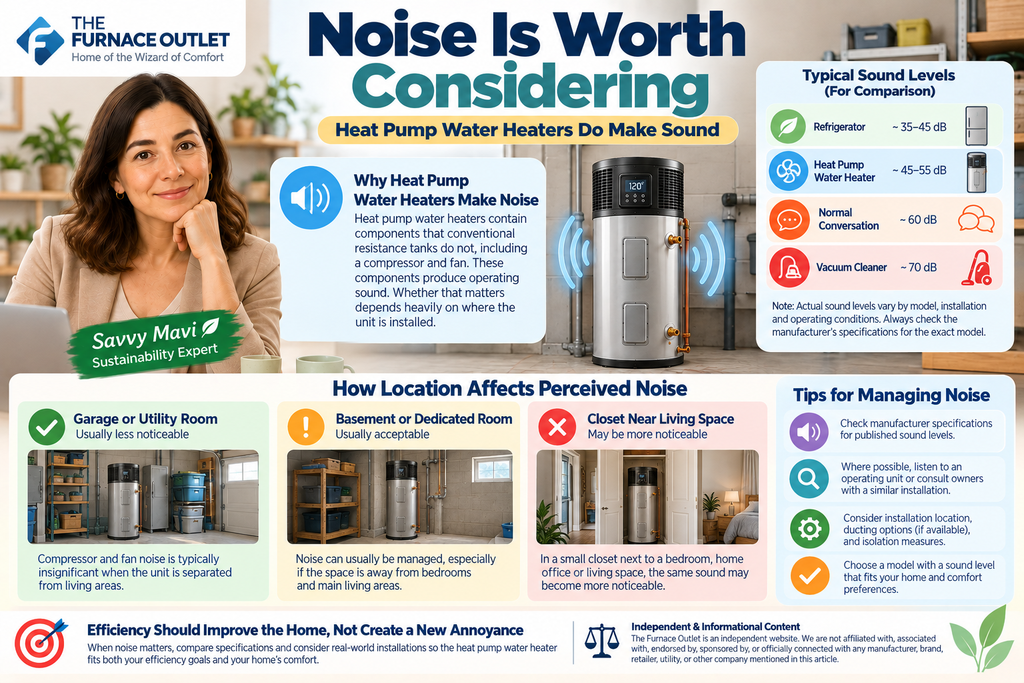
Heat pump water heaters contain components that conventional resistance tanks do not, including a compressor and fan. They therefore produce operating sound. Whether that matters depends heavily on location. In a garage or utility room separated from living areas, compressor and fan noise may be insignificant. In a closet next to a bedroom, home office, or living space, the same sound may become more noticeable.
Manufacturers may publish sound information for particular models. When noise matters, I would compare those specifications and, where possible, listen to an operating unit or consult owners with a similar installation. Efficiency should improve the home, not create a new annoyance.
One interesting side effect of a heat pump water heater is that it cools and dehumidifies the surrounding air while operating. In a warm garage or humid basement, that can be a welcome secondary benefit. The appliance is not a substitute for properly designed air conditioning or dedicated moisture control, but the effect can improve conditions in some spaces.
In a cold basement or conditioned room during winter, however, cooling may be less desirable. Ducted configurations available on certain models can change how intake and exhaust air interact with the building. This is another reason I prefer thinking of a heat pump water heater as part of the house rather than as an isolated appliance.
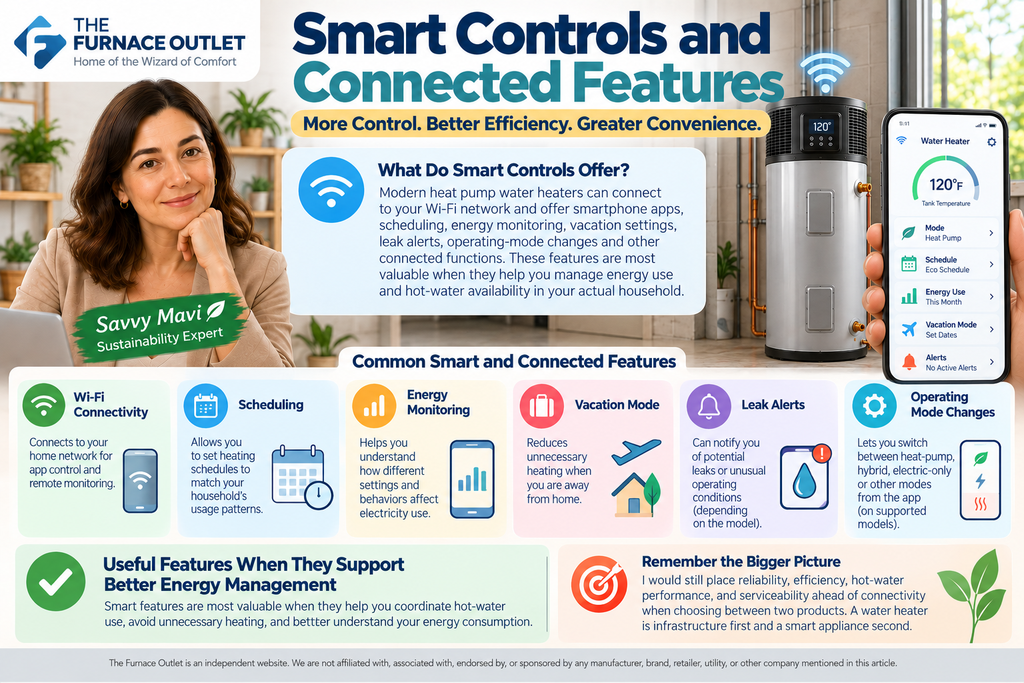
Modern hybrid water heaters increasingly offer Wi-Fi connectivity, smartphone apps, scheduling, energy monitoring, vacation settings, leak alerts, operating-mode changes, and other connected functions. I consider these features useful when they support better energy management rather than simply adding another app to your phone.
Scheduling can allow households to coordinate recovery with predictable demand. Vacation mode can reduce unnecessary heating when the house is empty. Energy monitoring can help homeowners understand how different settings and behaviors affect consumption.
I would still place reliability, efficiency, hot-water performance, and serviceability ahead of connectivity when choosing between two products. A water heater is infrastructure first and a smart appliance second.
If I were replacing a conventional electric resistance tank and had a suitable installation location, a heat pump water heater would be high on my shortlist. The fundamental advantage is efficiency. Conventional resistance elements generate heat directly from electricity, whereas the heat pump moves thermal energy from surrounding air. DOE says heat pump water heaters can be two to three times as efficient as conventional electric resistance water heaters.
The conventional tank still has advantages. It is generally simpler, can have a lower upfront equipment cost, has fewer mechanical components, and does not cool the surrounding room in the same way. The better long-term decision depends on installation cost, electricity rates, expected hot-water demand, equipment life, maintenance, and how long the homeowner expects to remain in the property.
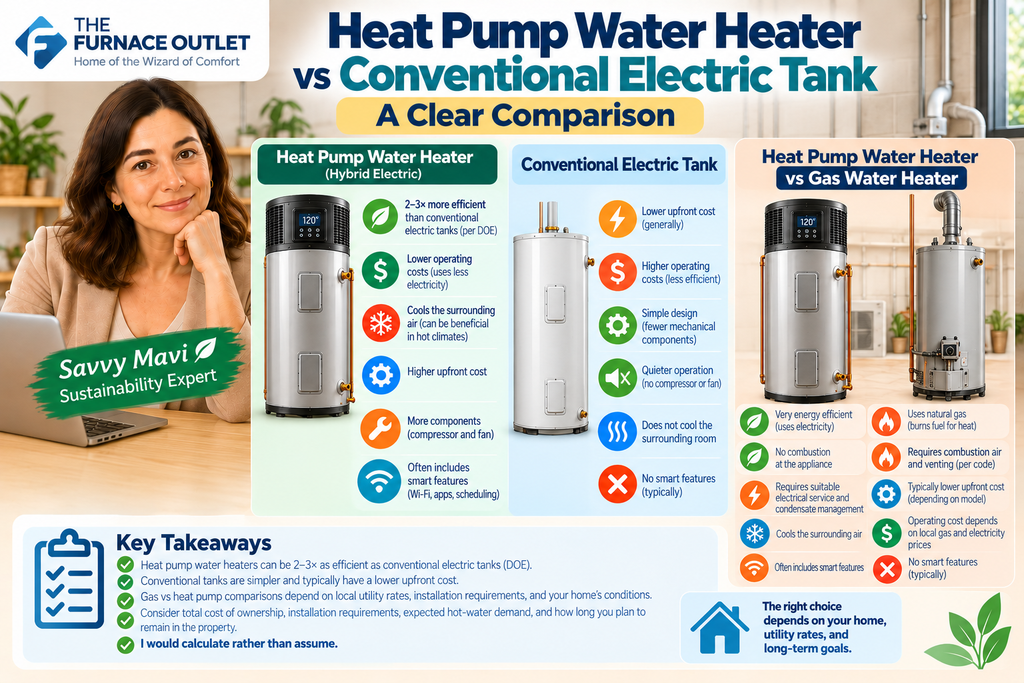
This comparison is more complicated because the technologies use different energy sources. A gas water heater creates heat by burning fuel, while a heat pump water heater uses electricity to transfer heat. The heat pump avoids combustion at the appliance and can be highly energy-efficient, but the financial comparison depends on local gas and electricity prices.
Installation conditions also differ. Gas equipment requires appropriate combustion-air and venting arrangements according to the appliance and code. A heat pump water heater requires appropriate electrical service, airflow, ambient conditions, and condensate management.
For homeowners pursuing broader household electrification, the heat pump option can fit naturally into that strategy. For homes with inexpensive gas, limited electrical capacity, or an unsuitable heat-pump installation space, the economics can look different.
I would calculate rather than assume.
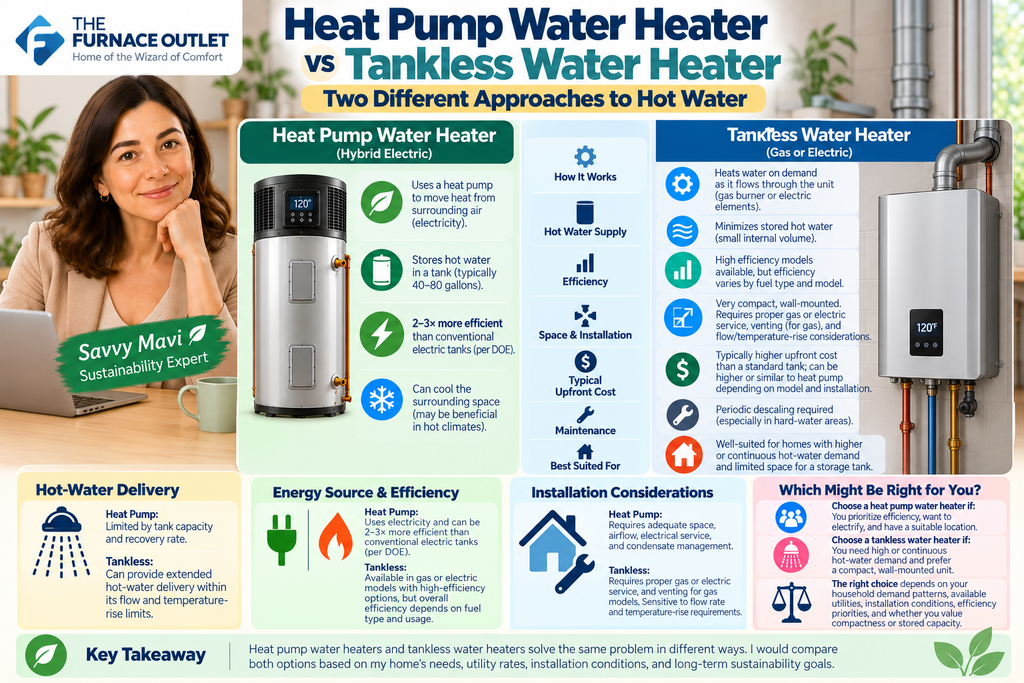
These two technologies solve the water-heating problem in very different ways. A tankless system minimizes stored hot water and heats water as it flows through the appliance. A heat pump water heater generally relies heavily on storage because moving heat efficiently takes time.
For my sustainability priorities, a properly sized heat pump water heater is particularly attractive when the goal is efficient electrification, but I would never pretend that one technology fits every home.
The answer depends on what it replaces, household water use, climate, installation conditions, electricity price, operating mode, setpoint, tank size, and the frequency with which backup resistance elements operate.
DOE’s published procurement analysis illustrates just how large the difference can be under standardized assumptions. In one FEMP comparison, an ENERGY STAR heat pump water heater was modeled at 984 kWh annually versus 3,437 kWh for the less-efficient comparison model. Those figures should not be treated as a promise for an individual household, but they demonstrate why the technology attracts so much attention.
For a homeowner, I would use the model’s EnergyGuide information and rated energy consumption together with the home’s actual electricity rate to estimate annual operating cost. That produces a much more useful number than a generic percentage-savings claim.
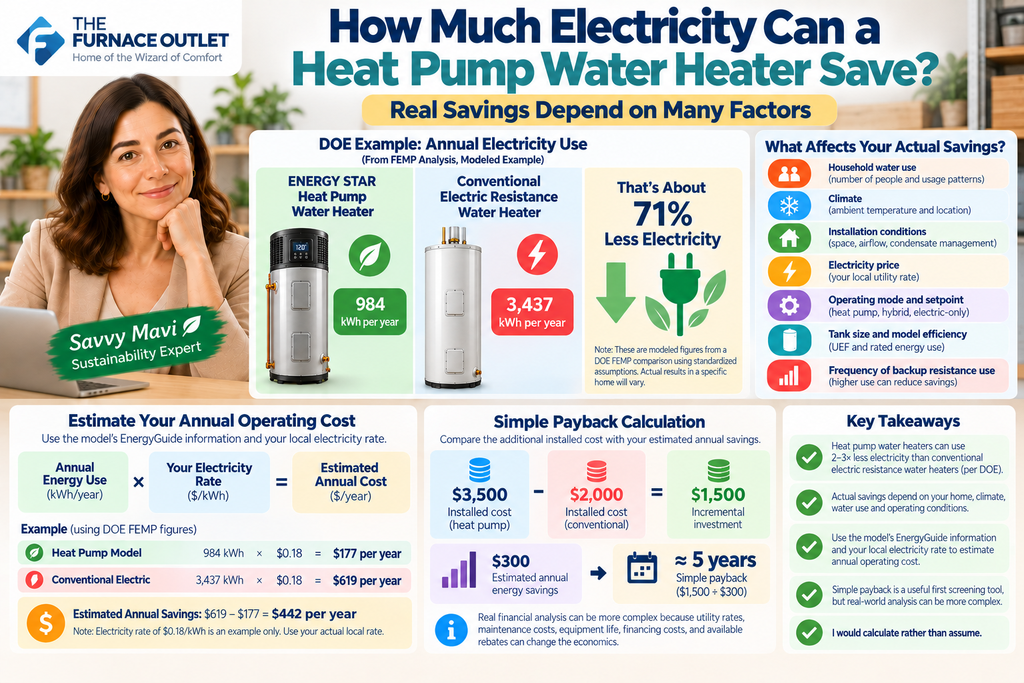
A basic payback calculation begins with the additional installed cost of the heat pump water heater compared with the alternative you would otherwise purchase. If a conventional system would cost $2,000 installed and the heat pump system costs $3,500, the incremental investment is $1,500. If the new system saves an estimated $300 per year in energy, simple payback would be approximately five years.
Real financial analysis can be more complicated because utility rates change, equipment may have different maintenance costs and useful lives, financing has a cost, and available rebates can alter the upfront price. Still, simple payback is a useful first screening tool.
This is an area where homeowners need particularly current information. Incentive programs can change, and federal, state, utility, and local programs do not necessarily follow the same schedules or eligibility requirements.
A major federal change is especially important for a 2026 article. The IRS states that the Energy Efficient Home Improvement Credit cannot be claimed for qualifying property placed in service after December 31, 2025. Heat pump water heaters previously fell within a separate annual credit category, but buyers should not assume that the former federal Section 25C credit remains available for a 2026 installation.
State, local, utility, and other programs may still provide incentives, and program availability can vary by location, income, equipment qualification, and installation date. I would therefore verify current incentives before purchasing rather than relying on an article, contractor advertisement, or rebate figure published in an earlier year.
Heat pump water heaters are efficient, but they are not maintenance-free. Because the system moves air across an evaporator, many models include an air filter that needs periodic inspection and cleaning. Condensate drainage should remain unobstructed, and the surrounding area should not become blocked in a way that interferes with required airflow.
The water-storage side also deserves the same attention that applies to other tank water heaters. Depending on the product and local water conditions, manufacturer-recommended maintenance may include inspection of the anode system, flushing or sediment management, temperature-and-pressure relief valve checks, and other procedures. I always recommend following the specific maintenance schedule in the owner’s manual because designs differ.
Buying an efficient water heater does not make water chemistry disappear. Hard water can contribute to mineral accumulation, while corrosive water conditions can influence tank and plumbing longevity. The appropriate response depends on actual water quality rather than assumptions.
If a home has known hard-water problems, I would consider water quality as part of the water-heater project. However, water treatment should itself be properly designed. Automatically installing a treatment system without understanding the water chemistry is not necessarily the best approach. Protecting an efficient appliance helps preserve both performance and the environmental value of keeping equipment in service longer.
They can be, but installation location becomes particularly important. A heat pump water heater installed in a space that remains within its specified operating range can continue to perform efficiently even when outdoor temperatures are cold. A unit installed in an unconditioned area that becomes too cold may operate differently, rely more heavily on backup resistance heating, or encounter manufacturer-defined operating limitations.
This is why climate-zone discussions should not stop at the outdoor design temperature. What matters is the actual environment around the appliance throughout the year. A basement in a cold-climate home may remain relatively moderate even when outdoor temperatures are far below freezing. An exposed garage may behave very differently.
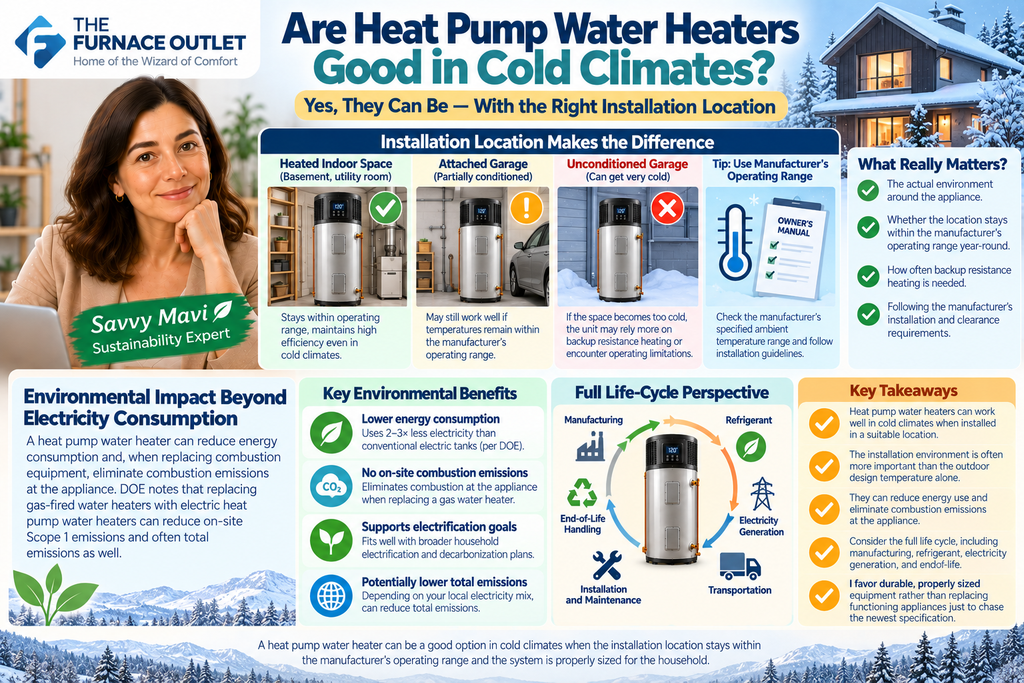
I want to broaden the sustainability conversation beyond the electricity bill. A heat pump water heater can reduce energy consumption and, when replacing combustion equipment, eliminate combustion emissions at the appliance. DOE specifically notes that replacing gas-fired water heaters with electric heat pump water heaters can reduce on-site Scope 1 emissions and often total emissions as well.
The broader environmental footprint still includes manufacturing, refrigerant, electricity generation, transportation, installation, maintenance, and end-of-life handling. That is why I favor durable, properly sized equipment rather than encouraging homeowners to replace functioning appliances simply to chase the newest efficiency specification. Sustainability includes using fewer resources over the full life of the system.
Heat pump water heaters require refrigerant to move thermal energy, which means refrigerant choice is part of their environmental profile. Different products can use different refrigerants, and refrigerant technologies continue to evolve. When comparing models, environmentally conscious buyers can check the manufacturer’s published refrigerant type and charge rather than assuming all heat pump water heaters are identical.
However, I would not evaluate a product solely from refrigerant global-warming potential. Charge size, leak prevention, efficiency, expected service life, serviceability, recovery practices, and end-of-life refrigerant handling also influence environmental impact. The greener system is ultimately the one that combines responsible refrigerant technology with excellent efficiency and a long, useful operating life.
I would be particularly enthusiastic about a heat pump water heater when replacing an electric resistance tank in a home with a suitable garage, basement, utility room, or other installation space. I would also strongly consider one during a broader electrification project, particularly when a homeowner is moving away from fossil-fuel appliances and already planning electrical upgrades.
For households with predictable demand, sufficient storage, and the ability to operate primarily in efficient heat-pump modes, the technology can provide an excellent combination of performance and energy reduction. The more closely the house matches the technology, the more compelling the choice becomes.
I would consider alternatives when the installation space is extremely constrained, ambient temperatures are unsuitable, condensate disposal is impractical, electrical upgrades make the project disproportionately expensive, or the household’s hot-water demand cannot be served comfortably by an appropriately sized available product.
I might also hesitate if the appliance must be installed immediately beside a noise-sensitive room and suitable acoustic or ducting solutions are unavailable. Sustainability should never become a reason to force the wrong technology into the wrong building. The objective is to select the most efficient practical solution for the specific home.
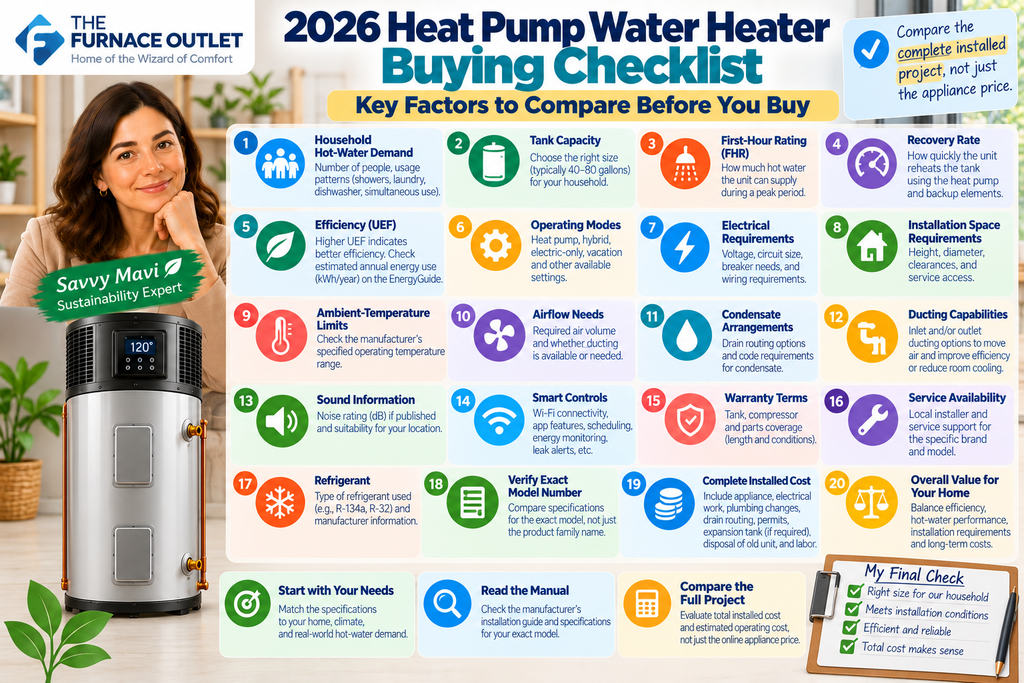
When I compare hybrid water heaters, I begin with household hot-water demand and tank capacity, then check first-hour rating and recovery characteristics. After that I compare UEF, estimated annual energy use, available operating modes, electrical requirements, installation-space requirements, ambient-temperature limits, airflow needs, condensate arrangements, ducting capabilities, sound information, smart controls, warranty terms, service availability, refrigerant, and complete installed cost.
I would also verify the precise model number rather than relying on a product-family name. Manufacturers can sell multiple capacities and configurations under similar branding, and efficiency, electrical requirements, first-hour rating, and installation specifications can differ between them.
Finally, I would compare the complete installed project rather than the appliance price displayed online. Electrical work, plumbing changes, drain routing, permits, expansion tanks where required, disposal of the old heater, and other installation costs can materially change the economics.
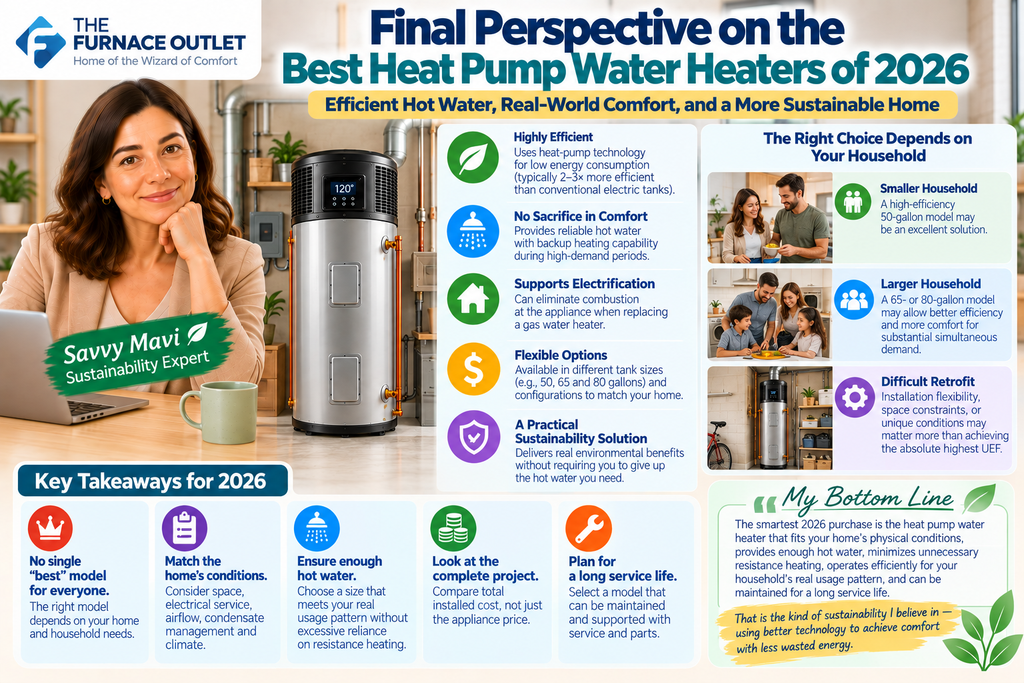
Heat pump water heaters are one of the residential technologies that make me genuinely optimistic about practical electrification. They do not require homeowners to sacrifice hot water in the name of sustainability. Properly selected and installed, they use heat-pump technology for highly efficient routine water heating while retaining backup heating capability for periods when demand exceeds what the compressor alone can comfortably supply.
I would not crown a single hybrid model as universally best without knowing the household it needs to serve. For a smaller household, a properly sized high-efficiency 50-gallon system may be an excellent solution. For a family with substantial simultaneous demand, moving to a 65- or 80-gallon model may allow more efficient operation and better comfort. For a difficult retrofit, installation flexibility may matter more than achieving the absolute highest UEF.
The smartest 2026 purchase is therefore not necessarily the model with the largest tank, highest efficiency number, most app features, or lowest purchase price. It is the system that fits the home’s physical conditions, provides enough hot water, minimizes unnecessary resistance heating, operates efficiently for the household’s real usage pattern, and can be maintained for a long service life.
That is the kind of sustainability I believe in: not sacrificing performance for an environmental label, but using better technology to achieve comfort with less wasted energy.
For many households, particularly those replacing conventional electric resistance water heaters, a heat pump water heater can be an excellent efficiency upgrade. Whether it is financially worthwhile depends on installed cost, electricity rates, hot-water consumption, available incentives, installation conditions, and how long the system remains in service. I recommend comparing estimated annual operating costs and complete installed prices rather than comparing equipment prices alone.
The terms are frequently used interchangeably because many residential heat pump water heaters are hybrid systems. They use a heat pump as the efficient primary heating method while incorporating electric resistance elements that can provide additional heating when demand is high or when operating conditions require it. The precise control strategy varies by manufacturer and model.
There is no universally correct tank size based only on family size. A 50-gallon model may serve some four-person households well, while households with concentrated shower use or other substantial simultaneous hot-water demand may benefit from 65 gallons or more. Tank volume should be evaluated together with first-hour rating and the household’s actual peak-hour demand.
They can, just like storage water heaters of other types, if demand exceeds available stored hot water and recovery capacity. Correct sizing is therefore critical. Hybrid systems can use resistance heating to improve recovery during high demand, although frequent resistance operation reduces some of the energy-saving advantage.
Garages can be excellent locations when the space, temperature range, airflow, clearances, and other conditions comply with the manufacturer’s requirements and local code. The cooling effect may even be welcome during warm weather. Cold-climate garages require additional consideration because winter temperatures can affect heat-pump operation.
Heat pump operation can generate condensate, so the installation needs an appropriate condensate-management method. Depending on the location and manufacturer’s instructions, that might involve gravity drainage, a condensate pump, or another approved arrangement.
They produce more mechanical sound than a basic electric resistance tank because they use a compressor and fan. Whether that is noticeable depends on the model and installation location. Noise deserves particular consideration when the water heater will be near bedrooms, offices, or frequently occupied living spaces.
Yes, in many homes, but the conversion requires careful planning. Electrical service, circuit requirements, installation space, airflow, condensate drainage, plumbing, and local code requirements should all be evaluated. The economics should also be calculated using local electricity and gas prices.
Homeowners should be careful with older information on this subject. Current IRS instructions state that the Energy Efficient Home Improvement Credit is not available for qualifying property placed in service after December 31, 2025. Therefore, buyers should not assume the previous federal heat-pump water-heater credit applies to a 2026 installation. State, local, utility, or other incentive programs may have different eligibility periods and should be checked separately.
DOE educational material states that heat pump water heaters can be two to three times as efficient as conventional electric resistance water heaters because they primarily move heat rather than generating it directly. Actual household energy use will depend on the appliance, climate, installation, water demand, temperature settings, and operating mode.
As Savvy Mavi, I approach water heating from a sustainability-first perspective, but sustainability does not mean accepting weaker performance or choosing technology simply because it sounds greener. My goal is to understand how much energy a system uses, how well it serves the household, what resources it requires over its lifetime, and whether its efficiency improvements make practical and financial sense.
Heat pump water heaters fit that philosophy exceptionally well when the application is right. They demonstrate that reducing household energy consumption does not necessarily require giving up comfort. The best outcome comes from matching efficient technology with thoughtful sizing, correct installation, sensible operating settings, and long-term maintenance.
For readers who want to explore the underlying technical and efficiency information, I recommend starting with the U.S. Department of Energy’s Building Science Education material on heat pump water heaters and DOE’s Federal Energy Management Program information on efficient residential water heating. The Department of Energy also provides broader information on heat pump water heaters and their role in reducing direct building emissions. U.S. Department of Energy — Heat Pump Water Heaters DOE — Purchasing Energy-Efficient Residential Water Heaters DOE Federal Energy Management Program — Heat Pump Water Heaters
For current federal tax information, homeowners should consult the IRS directly rather than relying on older articles that still describe incentives that were available through 2025. The current Form 5695 instructions state that the Energy Efficient Home Improvement Credit ended for property placed in service after December 31, 2025. IRS — Form 5695 Instructions and Current Residential Energy Credit Information
The Furnace Outlet provides this article for general educational and informational purposes. Water-heater sizing, efficiency, operating cost, installation requirements, electrical requirements, plumbing requirements, condensate disposal, ventilation or airflow requirements, and expected performance vary by product, home, climate, water quality, local utility rates, and household usage. Always consult the installation manual and technical documentation for the exact model being considered.
Water heaters involve electricity, pressurized hot water, plumbing connections, temperature-and-pressure safety devices, and, when replacing combustion equipment, potentially gas and venting systems. Installation, alteration, diagnosis, and repair should comply with applicable manufacturer instructions, building codes, electrical codes, plumbing codes, permit requirements, and other local regulations. Work requiring licensed professionals should be performed by appropriately qualified contractors.
Energy-consumption and savings figures in this guide are illustrative and should not be interpreted as guaranteed savings for a particular household. Actual results depend on hot-water consumption, incoming-water temperature, ambient temperature, electricity rates, operating mode, setpoint, installation conditions, maintenance, and other variables.
Tax credits, rebates, utility incentives, efficiency requirements, and government programs can change. Information about incentives should always be verified with the relevant government agency, utility, program administrator, or qualified tax professional before making a purchasing decision. The Furnace Outlet does not provide tax, legal, electrical, plumbing, engineering, or financial advice.
Product specifications can also change during a model year. Before purchasing or installing any heat pump water heater, verify the exact model number, current manufacturer documentation, efficiency certification, electrical requirements, tank capacity, first-hour rating, installation clearances, operating-temperature limits, warranty conditions, and other applicable specifications.
The Furnace Outlet is an independent informational and educational website. We are not affiliated with, associated with, endorsed by, sponsored by, or officially connected with any manufacturer, brand, retailer, utility, government agency, or other company mentioned in this article, unless an association is expressly disclosed.
Any company names, brand names, product names, trademarks, logos, and registered trademarks referenced in this guide remain the property of their respective owners and are used solely for identification, comparison, and informational purposes. Their inclusion does not imply endorsement of The Furnace Outlet by those companies or endorsement of those companies or products by The Furnace Outlet.
Our comparisons and recommendations are based on publicly available product specifications, manufacturer documentation, government and industry resources, efficiency information, and our independent editorial assessment at the time of publication. Product specifications, pricing, availability, warranties, efficiency ratings, refrigerants, features, and model lineups may change, so readers should verify current information directly with the manufacturer or an authorized seller before purchasing.
The Furnace Outlet may use affiliate links in some articles. If a reader purchases a product through an eligible affiliate link, we may receive a commission at no additional cost to the reader. Affiliate relationships do not determine which products we include, how products are evaluated, or the conclusions presented in our editorial content.