Newsletter Subscribe
Enter your email address below and subscribe to our newsletter

HVAC made simple

Choosing between a 9,000 BTU and a 12,000 BTU mini split can look straightforward when you first start shopping. Nine thousand BTUs sounds appropriate for a smaller room, while 12,000 BTUs seems like the logical choice for a larger one. That basic idea is useful, but it leaves out many of the factors that actually determine how much heating and cooling a room requires.
As a preliminary screening range, I generally think of a 9,000 BTU mini split for roughly 250 to 450 square feet and a 12,000 BTU mini split for roughly 400 to 600 square feet under reasonably typical residential conditions. Those ranges deliberately overlap because square footage is not an HVAC load calculation. A well-insulated 450-square-foot bedroom and a poorly insulated 450-square-foot sunroom can require very different amounts of cooling, even though their floor areas are identical.
ENERGY STAR makes the same broader point in its ductless-system guidance: properly sized equipment is essential for comfort and performance, and equipment that is either too large or too small can struggle to meet the needs of the intended space. ENERGY STAR recommends having the home’s heating and cooling requirements determined using a Manual J load calculation rather than selecting equipment from room area alone.
The obvious difference is nominal capacity. A 9K mini split has a nominal capacity of approximately 9,000 BTU per hour, while a 12K system is commonly described as a one-ton mini split because one ton of nominal cooling capacity corresponds to 12,000 BTU per hour.
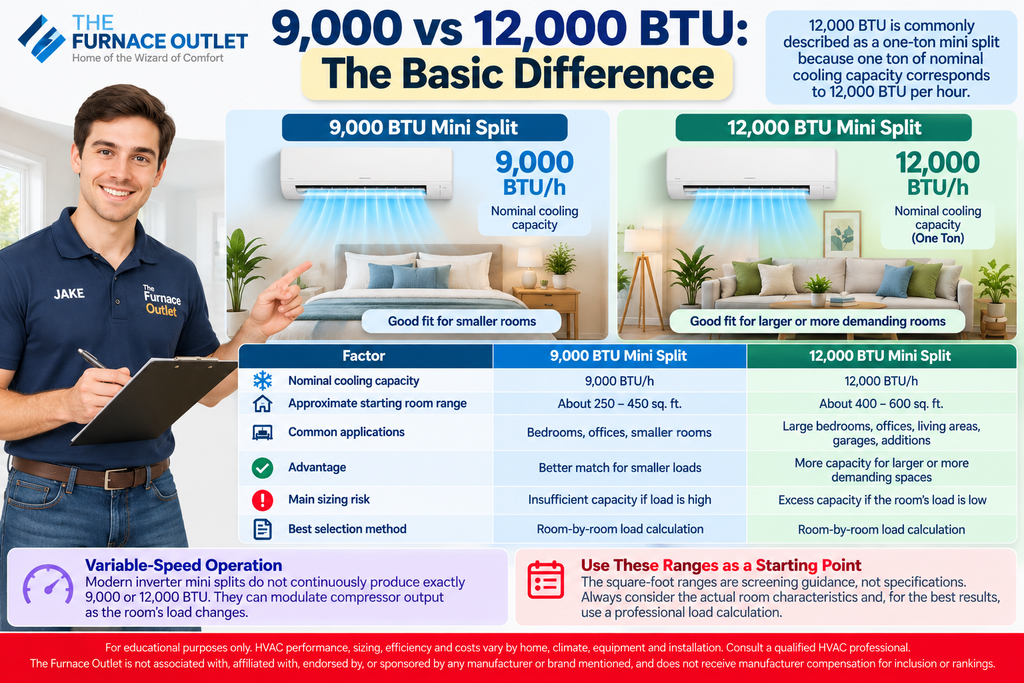
That does not mean a modern inverter mini split continuously produces exactly 9,000 or 12,000 BTU whenever it operates. Variable-speed equipment can modulate compressor output as the room’s load changes. The minimum and maximum operating capacities of the specific equipment can therefore be almost as important as the nominal number printed on the product description.
For initial planning, however, this comparison provides a useful starting point:
| Factor | 9,000 BTU Mini Split | 12,000 BTU Mini Split |
|---|---|---|
| Nominal cooling capacity | 9,000 BTU/h | 12,000 BTU/h |
| Approximate starting room range | About 250–450 sq. ft. | About 400–600 sq. ft. |
| Common applications | Bedrooms, offices, smaller rooms | Large bedrooms, offices, living areas, garages, additions |
| Advantage | Better match for smaller loads | More capacity for larger or more demanding spaces |
| Main sizing risk | Insufficient capacity if load is high | Excess capacity if the room’s load is low |
| Best selection method | Room-by-room load calculation | Room-by-room load calculation |
I would treat these square-foot ranges as screening guidance rather than specifications. Neither range overrides the performance data for the actual equipment or the calculated load of the room.
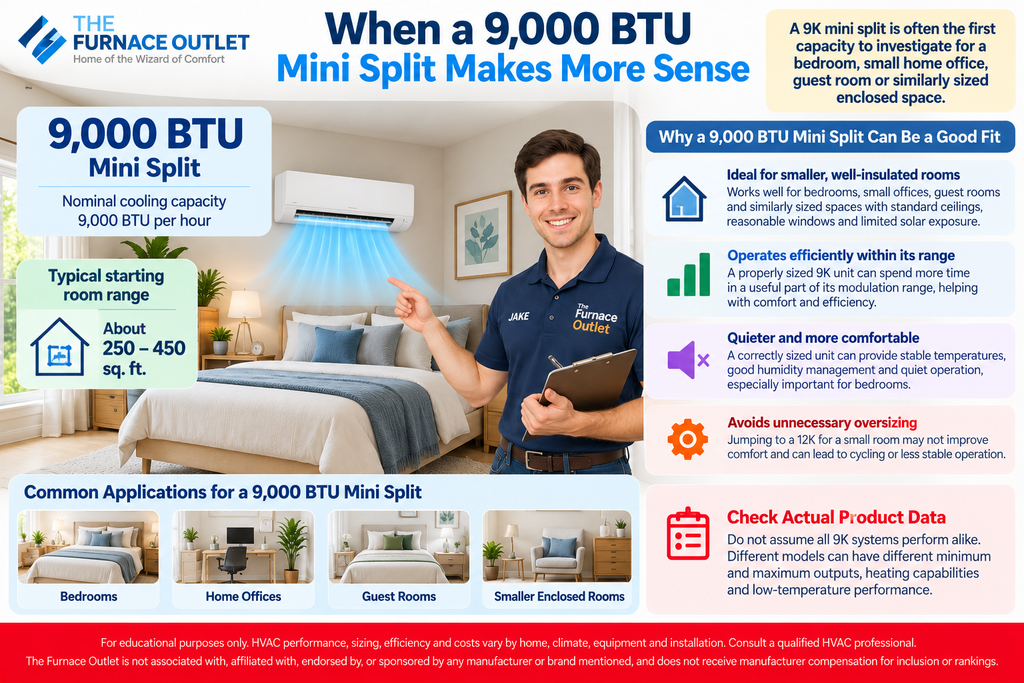
A 9K mini split is often the first capacity I would investigate for a conventional bedroom, smaller home office, guest room or similarly sized enclosed space. If the room has standard ceilings, good insulation, reasonable windows and limited solar exposure, jumping automatically to 12K simply to provide a safety margin may not improve comfort.
One advantage of correctly matching a smaller system to a smaller load is that the equipment can spend more time operating within a useful part of its modulation range. Inverter technology makes modern mini splits far more adaptable than traditional fixed-capacity air conditioners, but every inverter system still has minimum and maximum operating limits.
A well-selected 9K unit can therefore be preferable to an unnecessarily large 12K system in a small bedroom. This can be particularly important where quiet nighttime operation, humidity management and stable temperatures are priorities.
I would still check the manufacturer’s actual capacity data rather than assuming all 9K systems perform alike. Two products carrying the same nominal capacity can have different minimum outputs, maximum outputs, heating capabilities and low-temperature performance.
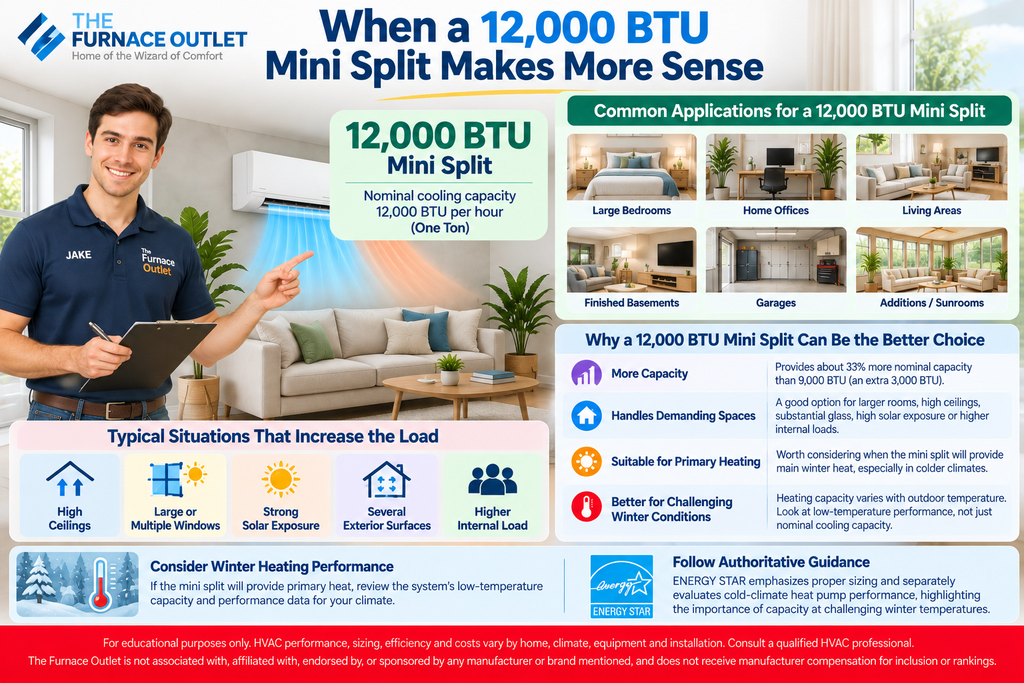
Once a room becomes larger or thermally more demanding, 12K becomes increasingly worth considering. Large bedrooms, substantial home offices, finished basements, open living areas, workshops, garages and additions are common examples where one-ton ductless equipment may make sense.
The extra 3,000 BTU of nominal capacity represents about 33% more nominal capacity than 9,000 BTU, so the difference is meaningful. That additional capacity can become valuable when a room has high ceilings, substantial glass, significant solar exposure, several exterior surfaces or a higher internal load.
A 12K unit may also deserve closer consideration when the mini split will provide primary heating. Heating requirements can exceed cooling requirements in some climates, and heat-pump output changes as outdoor conditions change. The nominal cooling capacity alone therefore cannot tell you whether a system will adequately heat the space during winter.
ENERGY STAR’s current heat-pump guidance specifically emphasizes proper sizing, while its cold-climate criteria separately evaluate low-temperature performance. This reinforces an important point: capacity at challenging winter temperatures matters when a mini split is expected to serve as the primary heat source.

This is where the decision becomes particularly interesting because a room around 400 square feet can fall into the practical consideration range for either capacity.
Suppose you have a 400-square-foot bedroom with an eight-foot ceiling, excellent insulation, efficient windows and limited afternoon sun. A properly selected 9K inverter mini split could potentially be an excellent match. Installing 12K simply because someone said that more BTUs provide better cooling would miss the point of proper sizing.
Now imagine another 400-square-foot room with a vaulted ceiling, substantial west-facing glass, poor insulation and strong afternoon solar gain. That room may have a substantially greater cooling load and could move the decision toward 12K.
The floor dimensions did not change. The heat gain did.
That is why the 400-to-450-square-foot territory should not automatically be assigned to either capacity. It is better viewed as an overlap zone where room characteristics become especially important.
Most simplified square-foot recommendations work best for rooms with conventional residential ceiling heights. A 350-square-foot room with an eight-foot ceiling is not thermally identical to a 350-square-foot room with a twelve-foot or fourteen-foot vaulted ceiling.
Higher ceilings increase room volume and can also accompany architectural features such as large windows and greater exterior wall area. Those factors can increase the heating or cooling requirement.
I would therefore be more cautious about choosing 9K near the upper end of its approximate range when the room has unusually high ceilings. At the same time, I would not automatically jump to 12K based on ceiling height alone because insulation, climate, glazing and other factors still matter.
Windows can dramatically change the load of a room. Their size, orientation, glazing characteristics and shading all influence solar heat gain.
A room with several large west-facing windows can experience substantial heat gain during late afternoon, exactly when outdoor temperatures may already be high. A similar room on another side of the house with smaller shaded windows could require less cooling.
This is one reason sunrooms are particularly difficult to size with a square-foot chart. A 300-square-foot sunroom surrounded by glass could potentially have a higher cooling load than a much larger conventional room.
ACCA’s Manual J methodology explicitly considers fenestration and design conditions rather than reducing the calculation to floor area. It also accounts for infiltration, opaque surfaces and internal loads, among other factors.
A well-insulated room retains conditioned air more effectively because heat transfer through the building envelope is reduced. Air sealing also matters because uncontrolled outdoor air entering through gaps and penetrations adds to the heating and cooling load.
These factors become particularly important when comparing 9K and 12K equipment for converted garages, older additions, attics and workshops. A homeowner may conclude that the room requires a larger mini-split when part of the real problem is a weak thermal envelope.
Before increasing equipment capacity, I would investigate whether insulation and air sealing improvements could reduce the underlying load. Improving the building envelope can produce benefits regardless of which mini-split brand or capacity you eventually install.
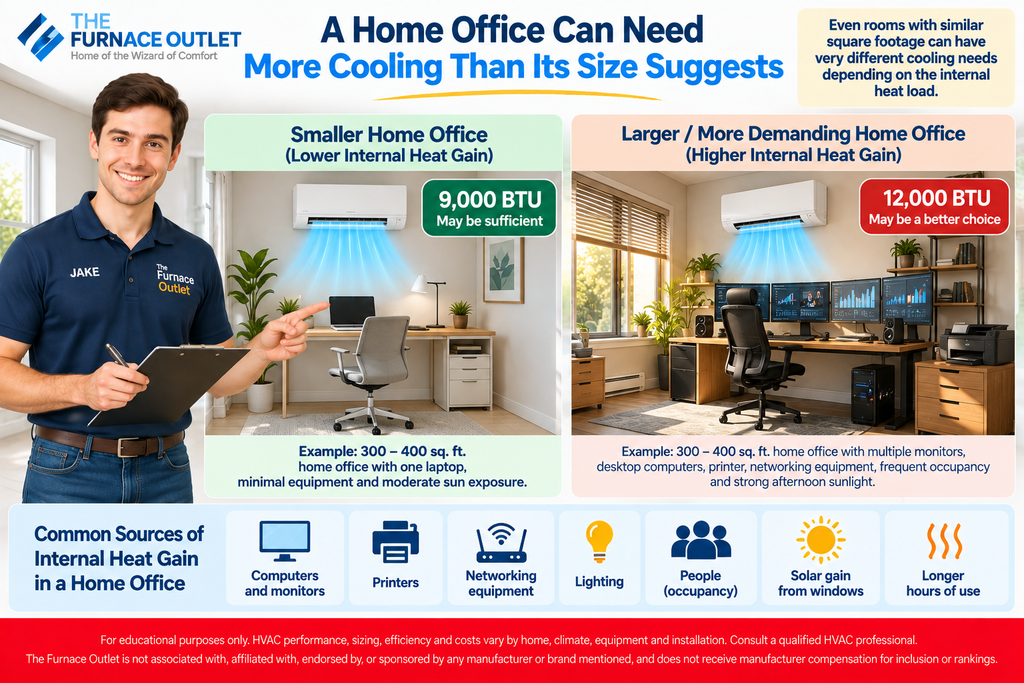
Home offices provide a useful example of why internal heat gain matters. Computers, monitors, printers, networking equipment, lighting and people all release heat into the room. A modest office with one laptop may behave much like a bedroom. A larger office containing several monitors, powerful computers and other electronics can have a noticeably higher internal load.
If the office is also occupied throughout the working day and receives strong afternoon sunlight, the difference becomes even more significant. In that situation, 12K may warrant consideration even when a simple floor-area chart places the room near the overlap between 9K and 12K.
If you are buying a heat-pump mini split primarily for air conditioning and only occasional shoulder-season heating, cooling load may dominate the decision. If the equipment will provide primary winter heating, I would evaluate the decision differently.
Heat-pump heating capacity varies with outdoor temperature, and different mini splits retain capacity differently as temperatures fall. Two 12K systems can therefore perform very differently in cold weather, just as two 9K systems can.
ENERGY STAR’s current cold-climate criteria require qualifying heat pumps to meet defined low-ambient performance thresholds, including a coefficient of performance of at least 1.75 at 5°F and at least 70% capacity retention at 5°F relative to the specified 47°F capacity measurement. Those criteria demonstrate why homeowners in colder regions should look beyond the nominal 9K or 12K label and examine published low-temperature performance.
If winter heating matters, compare the system’s available heating capacity at temperatures relevant to your climate against the calculated heating load of the room.
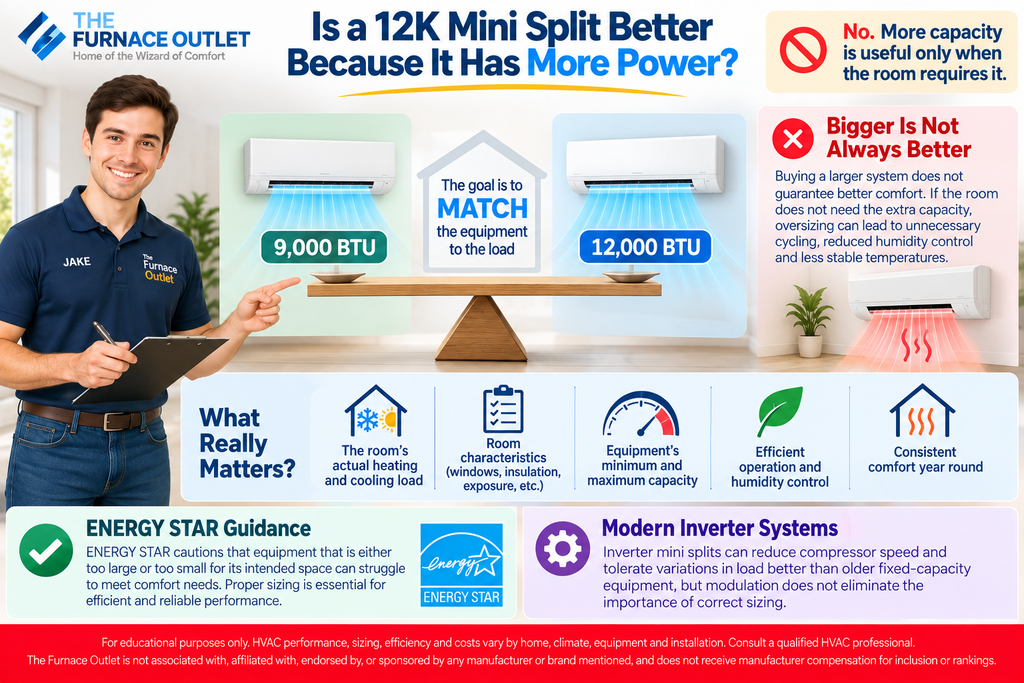
No. More capacity is useful only when the room requires it. One of the most persistent HVAC misconceptions is that buying a larger system provides a useful reserve and therefore guarantees better comfort. In reality, the objective is to match equipment performance to the load.
ENERGY STAR cautions that equipment that is either too large or too small for its intended space can struggle to meet comfort needs. Modern inverter systems can reduce compressor speed and therefore tolerate variations in load better than older fixed-capacity equipment, but modulation does not eliminate the importance of correct sizing.
If the calculated load is comfortably within the capabilities of a suitable 9K system, choosing 12K solely because it is larger is not automatically an upgrade.
An undersized mini split may operate at or near high output for long periods during peak weather and still fail to maintain the desired indoor temperature. During extreme summer conditions, the room may remain warmer than the thermostat setting. During winter, an undersized heat pump may fall behind as the heating requirement increases.
Long runtimes by themselves are not evidence of undersizing. Variable-speed heat pumps are designed to operate for extended periods, often at reduced capacity, and steady operation can provide excellent comfort.
The warning sign is different: the equipment reaches high output and still cannot satisfy the room’s calculated or actual load under conditions it was selected to handle.

Oversizing creates a different set of concerns. Although an inverter-driven 12K mini split can reduce compressor speed as the load falls, it cannot modulate indefinitely. Every system has a minimum operating capability.
If the room routinely requires less capacity than the equipment can comfortably deliver at its minimum output, the system may cycle rather than settling into long, stable operation. Depending on conditions and equipment behavior, unnecessary oversizing can also work against temperature stability and moisture management.
This is another reason I like looking at the minimum rated capacity when comparing specific mini splits. Nominal capacity tells only part of the story.
Once you narrow the decision to 9K or 12K, compare the actual indoor/outdoor combinations being offered. Look at cooling capacity, heating capacity, minimum and maximum output, SEER2, EER2, HSPF2, low-temperature heating data, indoor sound levels, electrical requirements and warranty conditions.
ACCA’s equipment-selection guidance reinforces this approach. Manual S is intended to help select appropriate heating and cooling equipment based on calculated loads, local climate, construction specifications and manufacturer performance data.
This is much more useful than deciding that every 400-square-foot room gets 9K and every 500-square-foot room gets 12K.

When the room sits clearly within an easy application, a rough sizing range can be useful during early research. When you are near the boundary between 9K and 12K, however, I would rather calculate than guess.
ACCA’s Manual J is the ANSI-recognized residential methodology for determining HVAC equipment sizing loads. It considers design conditions, windows, opaque building surfaces, infiltration and internal loads rather than relying on floor area alone.
A room-by-room calculation gives you a defensible heating and cooling requirement. That result can then be used with ACCA Manual S and manufacturer performance data to evaluate appropriate equipment.
For a professionally installed system that you expect to use for years, that is a much better foundation than guessing between two capacities.
For a smaller conventional bedroom or office with good insulation and moderate exposure, I would begin by investigating 9K equipment. As the room moves toward roughly 400 square feet and beyond, I would look increasingly closely at both 9K and 12K options and let the calculated load and actual equipment performance determine the answer.
For larger rooms approaching 500 to 600 square feet, 12K will generally be the more logical capacity to investigate first, but even that should not be treated as automatic. A very efficient space may have a surprisingly low load, while a difficult room may require more capacity than its square footage suggests.
For garages, sunrooms, vaulted rooms, additions, spaces with extensive glass and applications where the mini split will provide primary heating in a cold climate, I would avoid selecting either size from a square-foot chart alone.

The difference between a 9,000 and 12,000 BTU mini split is not simply that one is for a small room and the other is for a large room. The real question is whether the system’s available cooling and heating capacity matches the actual load of your particular space.
As an initial guide, roughly 250–450 square feet can be a useful starting range for investigating 9K, while roughly 400–600 square feet can be a useful starting range for investigating 12K. The overlap is intentional because insulation, ceiling height, windows, solar exposure, air leakage, internal heat, climate and winter heating requirements can move the correct choice in either direction.
If your room falls comfortably into one category and has conventional construction, the rough ranges can help narrow your search. If you are sitting near the 9K-versus-12K boundary, don’t solve the uncertainty by automatically buying the larger unit. Have the load calculated, examine the performance data for the exact equipment and choose the capacity that fits the room rather than the capacity that simply sounds safer.
For further technical reading, I recommend ENERGY STAR’s Ductless Heating & Cooling guidance, ENERGY STAR’s Air-Source Heat Pump guidance, ACCA Manual J Residential Load Calculation, ACCA’s Manual S and Technical Manuals guidance, and ENERGY STAR’s current heat-pump performance criteria. These provide authoritative background on proper sizing, load calculations, equipment selection and cold-climate heat-pump performance.
Editorial & HVAC Disclaimer: This content is for educational purposes only. HVAC performance, sizing, efficiency and costs vary by home, climate, equipment and installation. Approximate square-foot ranges are preliminary screening guidance and are not substitutes for a professional load calculation. The Furnace Outlet is not associated with, affiliated with, endorsed by, or sponsored by any manufacturer or brand mentioned and does not receive manufacturer compensation for inclusion or rankings. Verify current equipment specifications and consult a qualified HVAC professional when selecting or installing HVAC equipment.