Newsletter Subscribe
Enter your email address below and subscribe to our newsletter

HVAC made simple
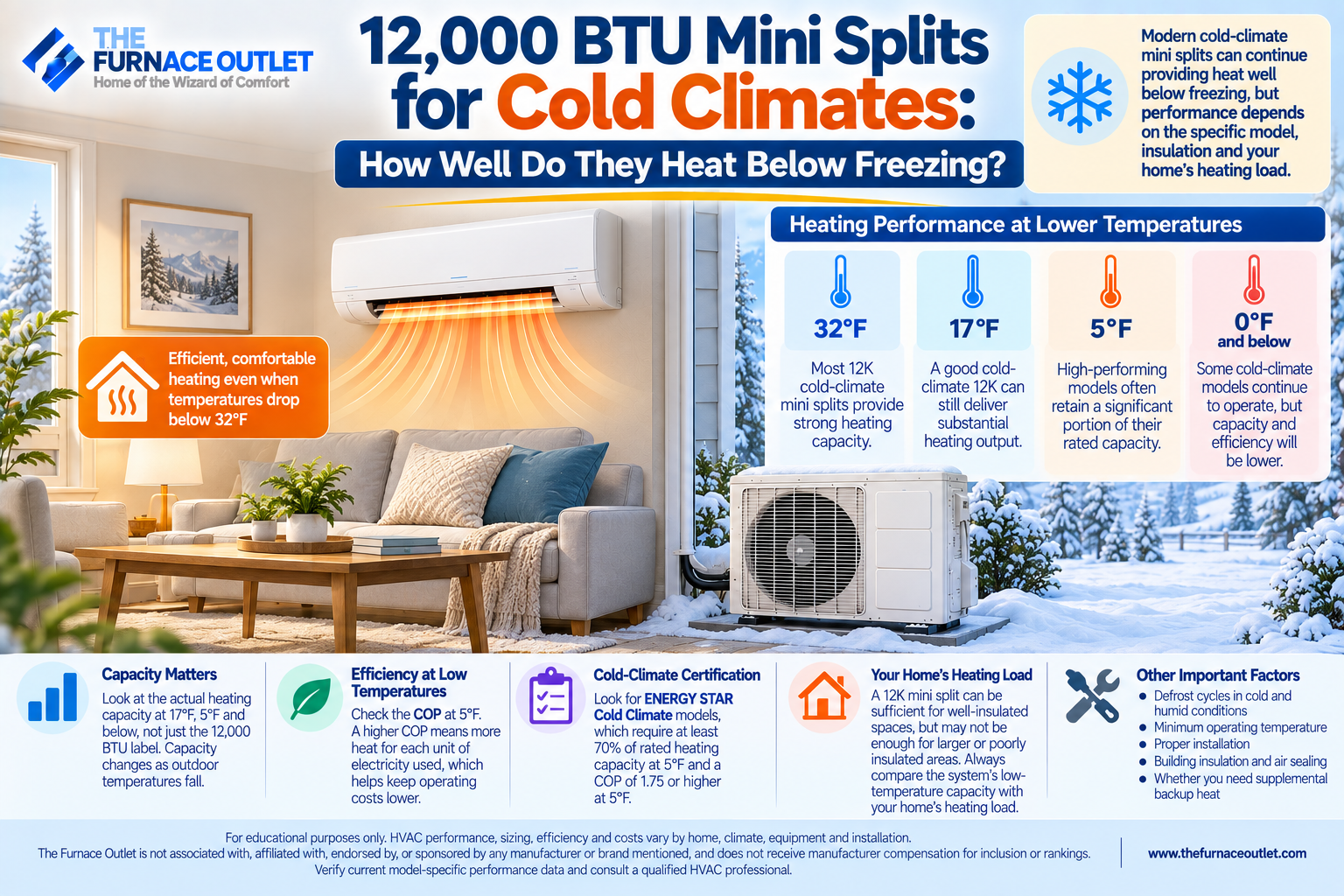
A 12,000 BTU mini split can provide impressive winter heating, including at temperatures well below freezing, but there is an important qualification: not every 12K mini split is a cold-climate heat pump. Two systems carrying the same 12,000 BTU label can behave very differently as outdoor temperatures fall.
When I evaluate a one-ton mini split for a cold climate, I therefore look beyond its nominal capacity, SEER2 and even HSPF2. I want to know how much heating capacity the specific system can actually deliver at 17°F, 5°F and, where relevant, temperatures below 0°F. I also want to know its coefficient of performance, or COP, at low temperatures, its minimum operating temperature, its defrost behavior and whether the calculated heating load of the room remains within the equipment’s capabilities at the local winter design condition.
That distinction is what separates choosing a mini split that merely operates in cold weather from selecting one that can realistically heat the space when winter becomes severe.
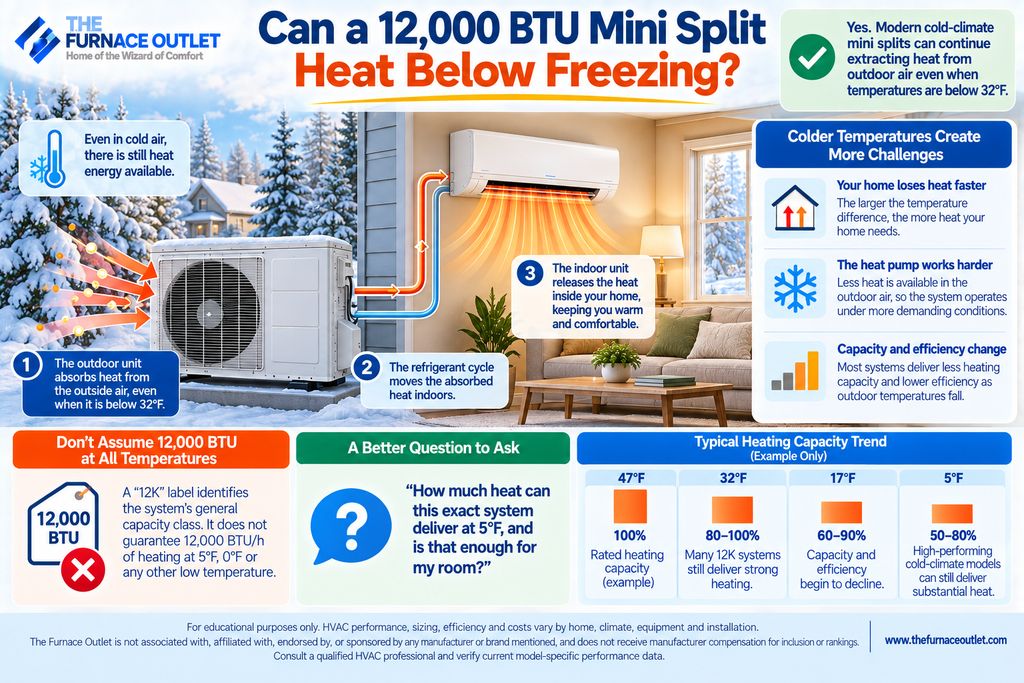
Yes. Modern cold-climate inverter heat pumps can continue extracting heat from outdoor air when the temperature is below 32°F. Outdoor air may feel extremely cold to us, but it still contains thermal energy that a heat pump can absorb and transfer indoors.
The challenge is that the system’s operating conditions become progressively more demanding as outdoor temperatures fall. The building loses heat faster, while the heat pump’s available capacity and efficiency can change. Consequently, the question should not simply be, “Will this mini split run at 5°F?” The better question is, “How much heat can this exact system deliver at 5°F, and is that enough for my room?”
This is why I would never assume that a 12K label guarantees 12,000 BTU/h of heating at every outdoor temperature. The nominal number identifies the system’s general capacity class; low-temperature performance data tells you much more about winter capability.
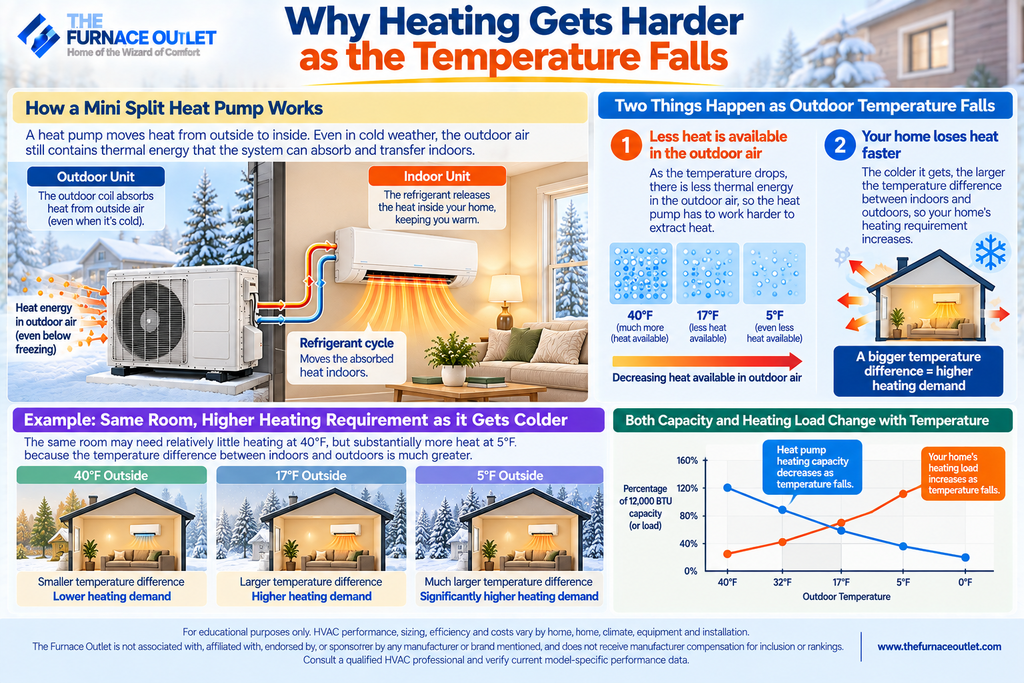
A heat pump works by moving heat rather than producing all of its heat through electric resistance. During winter, the outdoor coil absorbs heat from outside air, and the refrigerant circuit transfers that energy indoors.
As the outdoor temperature drops, two things happen at the same time. First, the amount of heat available in the outdoor air decreases and the heat pump has to work under more challenging conditions. Second, the home’s heating requirement generally increases because the temperature difference between indoors and outdoors becomes greater.
Imagine a room that requires relatively little heating when it is 40°F outside. The same room might require substantially more heat at 5°F. Whether a 12K mini split remains sufficient therefore depends on how its available heating capacity intersects with the building’s rising heating load.
This relationship is fundamental to cold-climate sizing. The heat pump’s capacity changes with temperature, and so does the home’s load.
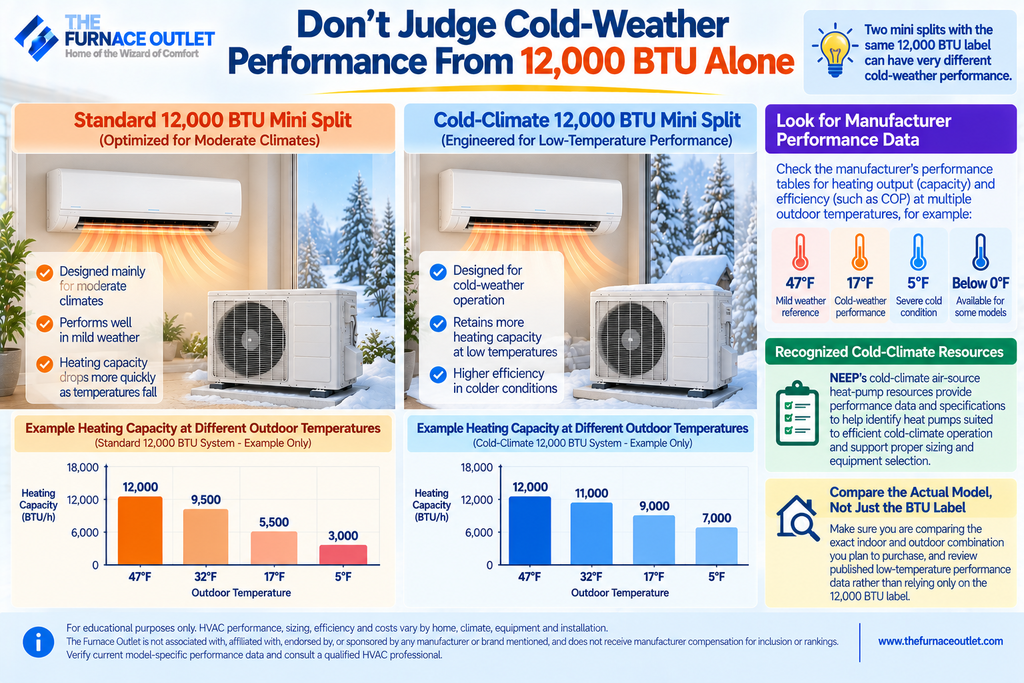
Suppose two products are both advertised as 12,000 BTU mini splits. One may be a conventional heat pump primarily optimized for moderate climates, while another may be specifically engineered for cold-weather operation.
At mild temperatures, both systems might appear perfectly capable. At 5°F, however, their available heating capacities and efficiencies could be considerably different. One system may retain a large percentage of its warmer-weather heating capacity, while another may lose considerably more.
This is why I would look for manufacturer performance tables showing heating output at multiple outdoor temperatures. Depending on the available documentation, you may find performance data at temperatures such as 47°F, 17°F and 5°F, with some cold-climate products providing additional information below 0°F.
NEEP’s cold-climate air-source heat-pump resources were specifically developed to make this kind of performance information more useful for sizing and equipment selection. NEEP explains that its specification is intended to identify heat pumps suited to efficient cold-climate operation and help practitioners ensure equipment can serve the load throughout the ambient-temperature range.
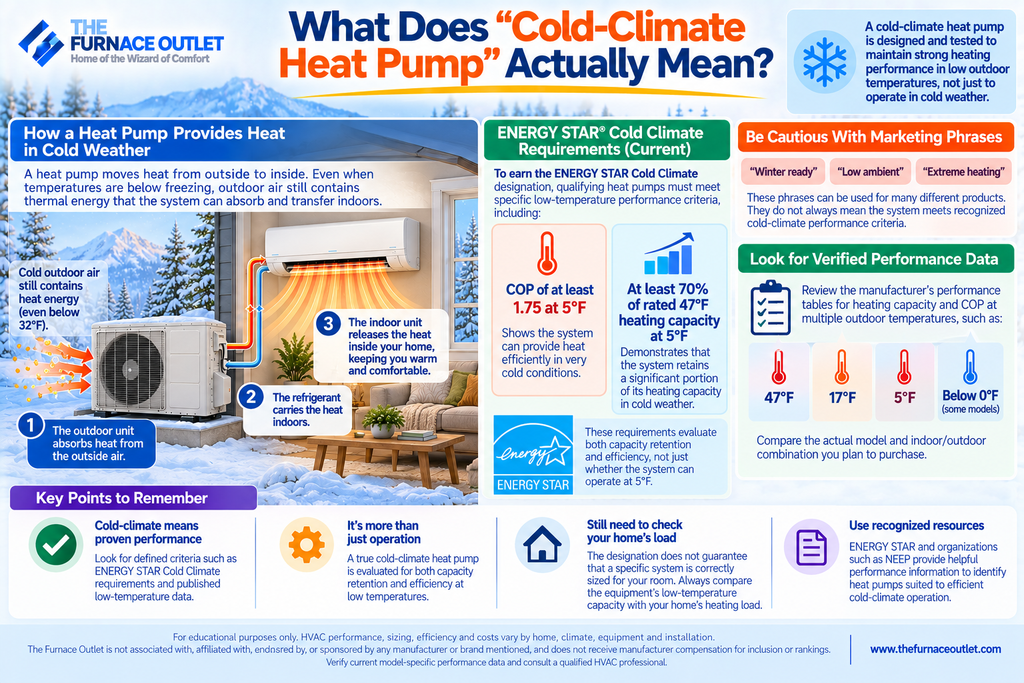
I would be careful with marketing phrases such as “winter ready,” “low ambient” or “extreme heating.” A more useful approach is to look for recognized cold-climate performance criteria and certified or documented performance.
ENERGY STAR’s current cold-climate requirements provide a helpful benchmark. To earn the ENERGY STAR Cold Climate designation, qualifying heat pumps must demonstrate a COP of at least 1.75 at 5°F and provide at least 70% of their specified 47°F heating capacity at 5°F, measured according to the applicable test procedure.
Those requirements are particularly useful because they evaluate more than whether the compressor can physically operate at 5°F. They examine both capacity retention and efficiency.
That does not mean equipment failing to carry a particular designation cannot work in cold conditions, nor does the designation guarantee that a specific 12K system is correctly sized for your room. It provides a meaningful performance benchmark that can be combined with the building’s calculated heating load.
For cold-climate applications, I consider the 5°F heating capacity one of the most useful specifications available. Suppose a 12K-class mini split has a nominal heating capacity measured under much milder conditions. Knowing that number alone does not tell me whether it can keep a bedroom, garage or addition comfortable during a severe cold spell.
I want to compare the manufacturer’s published capacity at 5°F with the room’s calculated heating requirement at or near the local winter design temperature. If the room requires more heat than the system can provide under those conditions, the fact that the product is called “12,000 BTU” does not solve the problem.
Likewise, if a well-insulated room has a relatively modest heating load, a high-performing cold-climate 12K system could potentially remain sufficient even when the outdoor temperature is substantially below freezing.
Cold-climate sizing is therefore a load-versus-capacity comparison, not a BTU-label comparison.
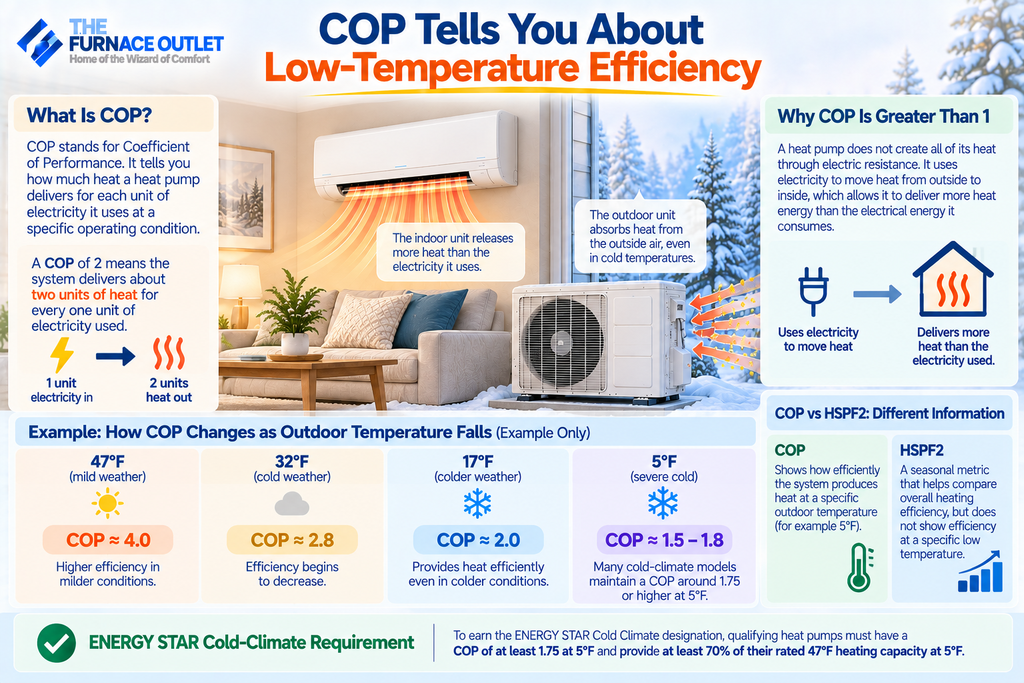
Capacity tells us whether the heat pump can produce enough heat. COP helps tell us how efficiently it produces that heat at a particular operating condition.
COP stands for Coefficient of Performance. A COP of 2, conceptually, means the system delivers approximately two units of heat for every equivalent unit of electrical energy supplied under the specified operating condition.
A COP greater than 1 is possible because the heat pump is primarily using electricity to transfer heat rather than converting electricity directly into heat through resistance.
COP generally becomes especially useful when evaluating cold-climate specifications because HSPF2 is a seasonal metric. HSPF2 can help compare seasonal heating efficiency, but it does not by itself tell you exactly how efficiently the equipment operates during a particular severe outdoor condition.
ENERGY STAR’s requirement of a COP of at least 1.75 at 5°F for its cold-climate designation illustrates why low-temperature COP deserves attention alongside seasonal ratings.
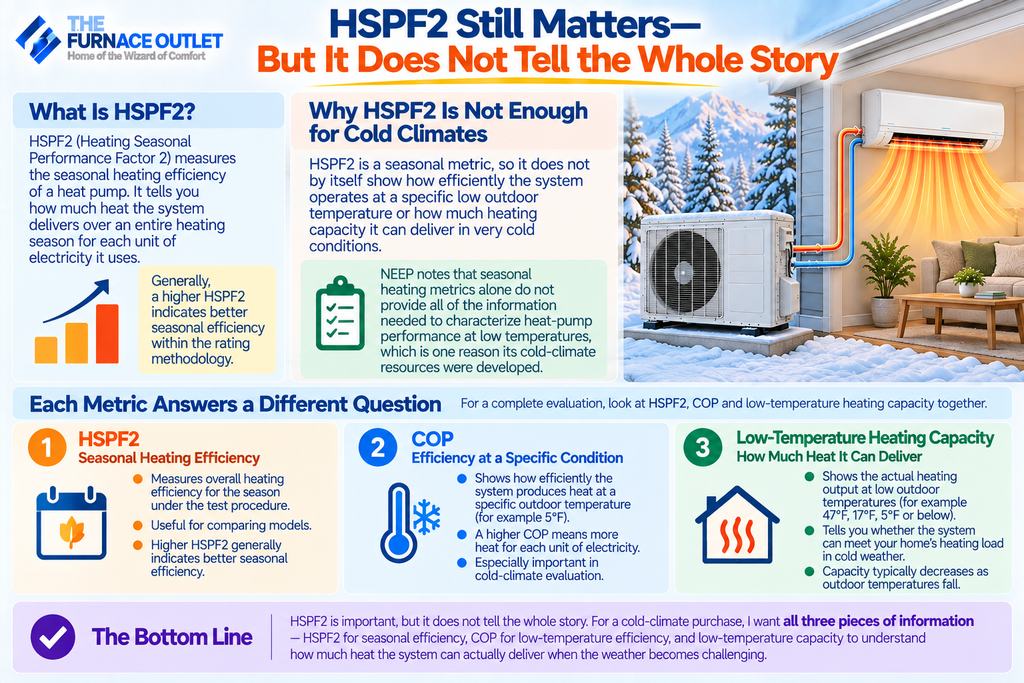
HSPF2, or Heating Seasonal Performance Factor 2, is useful for comparing rated seasonal heating efficiency. Generally, a higher HSPF2 indicates better seasonal efficiency within the rating methodology.
For cold climates, however, I would never stop at HSPF2. NEEP notes that seasonal heating metrics alone do not provide all of the information needed to characterize heat-pump performance at low temperatures, which is one reason its cold-climate specification and performance-data resources were developed.
Think of the specifications as answering different questions. HSPF2 helps you understand seasonal heating efficiency, COP helps describe efficiency at specific conditions, and low-temperature capacity tells you how much heat the system can actually deliver when the weather becomes challenging.
For a cold-climate purchase, I want all three pieces of information.
The 17°F performance point is particularly useful because it gives us a clearer picture of what happens after temperatures have moved well below freezing but before reaching the more demanding 5°F condition. A capable cold-climate mini split may still provide substantial heating capacity at 17°F. A less capable system may show a more significant reduction relative to its performance at milder conditions.
I would therefore compare the available heating capacity at 17°F against the home’s expected heating requirement at approximately that temperature. This begins to reveal whether the heat pump has comfortable capacity headroom or whether the building load is catching up with the equipment. The same exercise can then be repeated at 5°F and, where appropriate, at lower temperatures using manufacturer or recognized cold-climate performance data.
NEEP’s cold-climate sizing tools are designed around this concept of matching a particular heat pump’s capacity against a home’s heating and cooling loads across seasonal outdoor temperatures.
Some modern cold-climate mini splits are designed to continue operating below 0°F, and certain product families publish performance information at extremely low outdoor temperatures. However, I would avoid turning a manufacturer’s advertised “operates down to” temperature into a sizing specification.
There is an important difference between minimum operating temperature and useful heating capacity. A system might technically continue operating at a very low temperature while providing less heating capacity than your room requires. Conversely, another system could retain enough capacity at that temperature to remain an effective primary heat source.
When subzero heating matters, look for manufacturer-expanded performance tables and recognized cold-climate performance data. NEEP maintains a cold-climate product list specifically intended to provide equipment and performance information that can help designers, contractors and consumers evaluate systems for cold-weather applications.
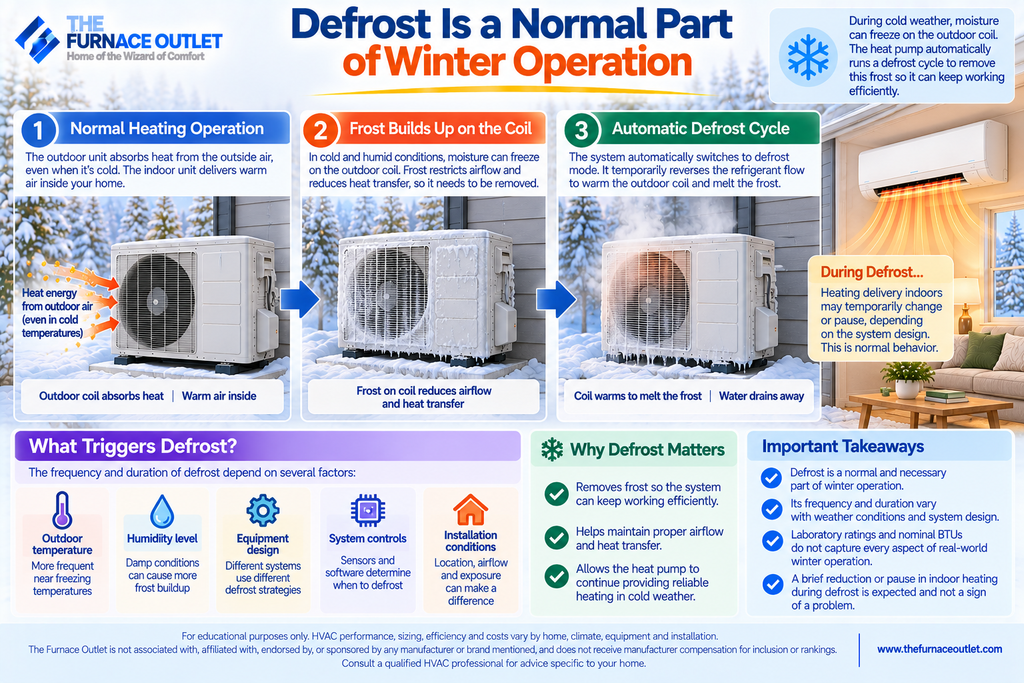
Cold-weather heat-pump operation introduces another factor that homeowners sometimes mistake for a malfunction: defrost. During heating operation, the outdoor coil becomes cold as it absorbs heat from outside air. Under appropriate temperature and humidity conditions, moisture can freeze on the coil. Frost accumulation restricts airflow and interferes with heat transfer, so the heat pump periodically needs to remove it.
Modern systems automatically initiate a defrost cycle when required. During defrost, heating delivery indoors may temporarily change or pause depending on system design. The frequency and duration of defrost depend on outdoor temperature, humidity, equipment design, controls and installation conditions. A damp day around freezing can create different frosting conditions from a colder but much drier day.
This is another reason laboratory ratings and nominal BTUs cannot describe every aspect of real-world winter operation.
Cold-climate heat-pump selection is not only about the equipment. The building envelope can determine whether one ton is comfortably sufficient or seriously undersized. A well-insulated bedroom with modern windows, controlled air leakage and limited exterior exposure may have a manageable heating load even during cold weather. A similarly sized room with weak insulation, old windows and substantial air leakage can require far more heat.
Garages, workshops, sunrooms, additions and converted attics deserve particular attention because their thermal envelopes can differ substantially from the main house. Before moving automatically from 12K to a larger mini split, I would investigate obvious envelope deficiencies. Improving attic insulation, air sealing or other weak points may reduce the heating load while improving comfort regardless of which HVAC system is installed.
You may see charts suggesting that a 12,000 BTU mini split serves a particular square-foot range. Those charts can help with preliminary shopping, but they become increasingly unreliable when the mini split will provide primary heating in a cold climate.
A 500-square-foot room in a mild climate and a 500-square-foot room experiencing severe winter temperatures can have very different heating loads. Even two rooms in the same city can differ because of insulation, windows, air leakage, ceiling height, orientation and exposure.
For serious cold-climate applications, I would use a room-by-room Manual J heating and cooling load calculation, followed by equipment selection using actual manufacturer performance data.
ACCA’s Manual S guidance specifically addresses selecting equipment according to local climate, construction characteristics, calculated loads and manufacturer performance information. Its latest guidance also includes expanded sizing considerations for variable-capacity heat pumps.
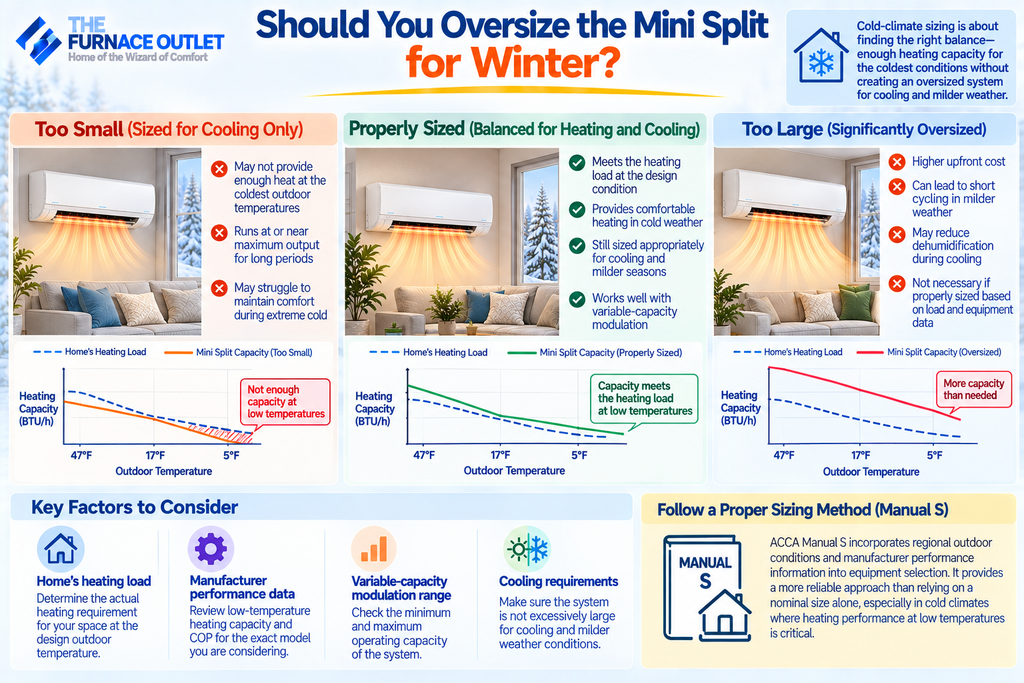
This is where cold-climate heat-pump design becomes more nuanced. If you size exclusively around cooling load, the equipment may not necessarily provide enough capacity at the winter design condition. If you dramatically oversize for the coldest hours of the year, however, you can create an unnecessarily large system for cooling and milder weather.
Variable-capacity equipment provides more flexibility because the compressor can modulate, but it still has minimum and maximum operating limits. I would therefore avoid simply jumping from 12K to 18K because the winters are cold. Instead, compare the heating load at the design condition with the low-temperature capacity of the actual equipment and evaluate the system’s modulation range and cooling requirements as well.
Manual S specifically incorporates regional outdoor conditions and manufacturer performance information into equipment selection rather than relying on nominal size alone.
Whether backup heat is necessary depends on the building, climate, heat-pump capacity and design strategy. A properly sized cold-climate mini split may be capable of carrying the entire heating load for a particular zone through the relevant design conditions. In other situations, supplemental heat may be intentionally retained for unusually severe weather, equipment outages or periods when the building’s heating requirement exceeds available heat-pump capacity.
The important point is to make this a design decision, not an assumption.
If the system will be your only source of heat, low-temperature capacity deserves even more scrutiny. If another heating system remains available, the designer has more flexibility in determining how much of the peak heating load the mini split needs to cover.
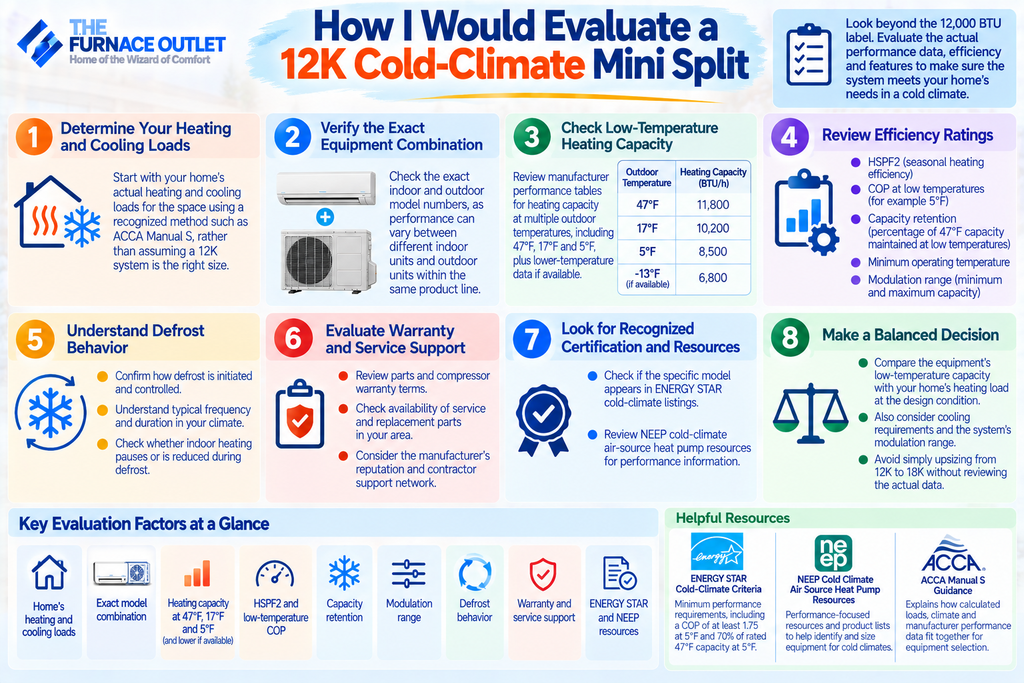
When comparing 12,000 BTU mini splits for a cold region, I would begin by confirming the room’s heating and cooling loads rather than assuming one ton is correct. I would then compare the exact indoor/outdoor equipment combination and examine heating capacity at 47°F, 17°F and 5°F, plus lower-temperature data when the local climate makes it relevant.
I would check HSPF2 for seasonal heating efficiency, COP at low temperatures, capacity retention, minimum operating temperature, modulation range and manufacturer-expanded performance information. I would also investigate defrost behavior, warranty, service support and whether the specific combination appears in recognized certification or cold-climate performance resources.
For genuinely cold locations, the ENERGY STAR heat-pump criteria and NEEP Cold Climate Air Source Heat Pump resources are particularly valuable starting points. ENERGY STAR provides defined cold-climate qualification criteria, while NEEP provides a performance-oriented resource intended to help distinguish and size cold-climate equipment.
For sizing and equipment selection, ACCA Manual S guidance explains how calculated loads, climate and manufacturer performance data fit together.
A good 12,000 BTU cold-climate mini split can continue providing useful and efficient heat well below freezing. What I would never assume, however, is that every 12K system provides the same winter performance simply because the capacity label is identical.
The specifications I care about most are the actual heating capacity at low outdoor temperatures, capacity retention, low-temperature COP, HSPF2, operating range and modulation capability. Those numbers then need to be compared with the room’s calculated heating load.
If a 12K system can meet that load at the relevant winter design conditions while maintaining appropriate cooling performance during summer, one ton may be entirely adequate. If its low-temperature capacity falls below the heating requirement, you need to reconsider the equipment, the building envelope, the sizing strategy or supplemental heat.
That is the practical way to answer whether a 12K mini split can handle a cold winter: don’t ask only how cold the equipment can operate—ask how much heat it can deliver when your home needs it most.
Editorial & HVAC Disclaimer: This content is for educational purposes only. HVAC performance, sizing, efficiency and costs vary by home, climate, equipment and installation. Low-temperature operating limits do not by themselves establish that equipment can satisfy a home’s heating load. The Furnace Outlet is not associated with, affiliated with, endorsed by, or sponsored by any manufacturer or brand mentioned and does not receive manufacturer compensation for inclusion or rankings. Verify current model-specific performance data and consult a qualified HVAC professional for load calculations, equipment selection and installation