Newsletter Subscribe
Enter your email address below and subscribe to our newsletter

HVAC made simple
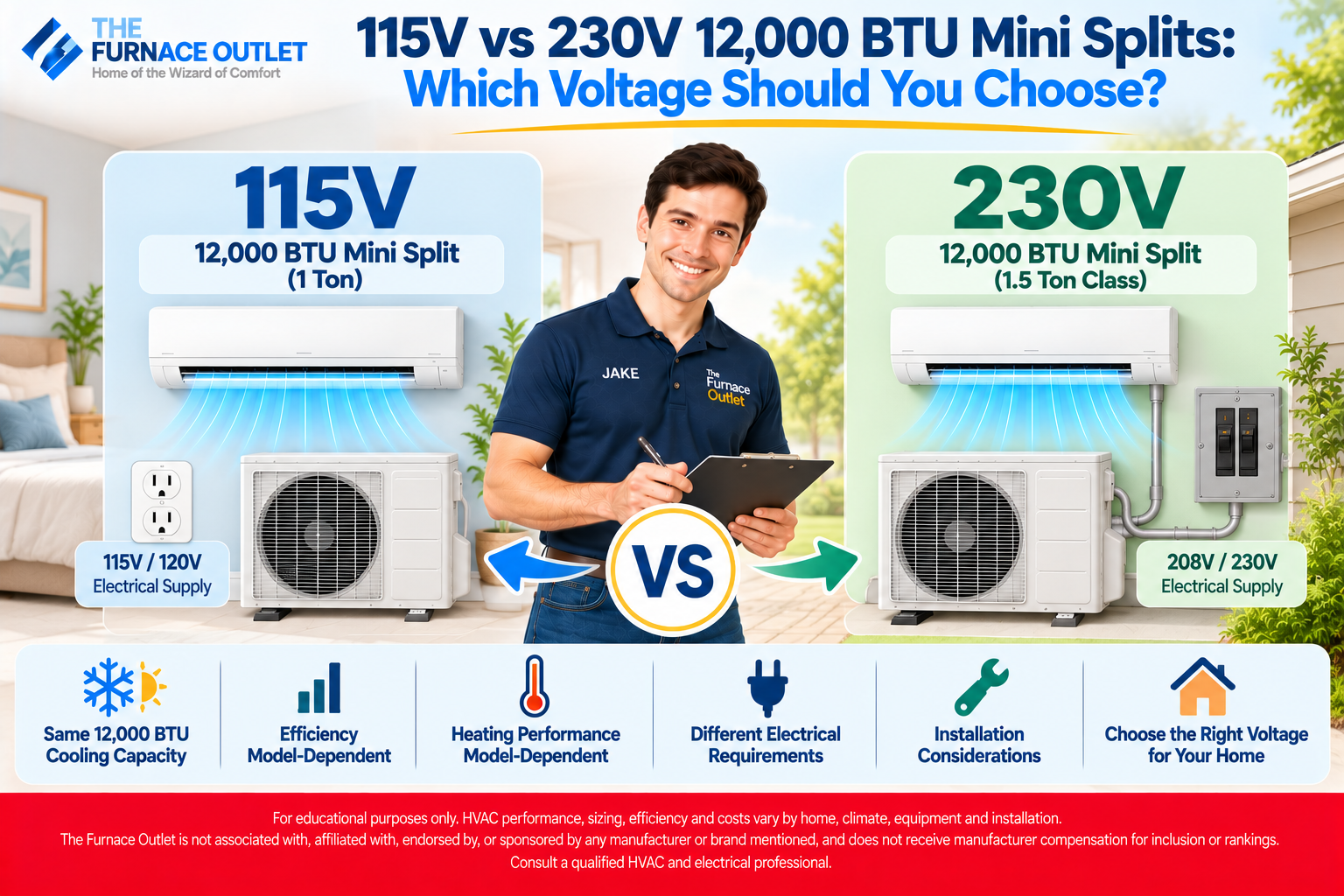
When shopping for a 12,000 BTU mini split, one specification can create more confusion than almost anything else: 115V versus 230V. You can find one-ton mini splits designed for either electrical supply, and at first glance it may seem that voltage should tell you which system is more powerful, more efficient or better suited to your room. In reality, voltage is primarily an electrical and installation consideration, not a substitute for evaluating HVAC performance.
A 12,000 BTU mini split can potentially deliver appropriate heating and cooling whether it operates on approximately 115/120 volts or 208/230 volts. The important question is whether the particular model provides the capacity, efficiency, low-temperature performance and modulation range your room requires. Once you establish that, voltage becomes part of determining whether the equipment is compatible with the home’s electrical system and what work will be necessary to install it safely.
For many U.S. homeowners, a 115V system can be attractive when the electrical requirements are modest and the installation conditions favor that voltage. A 230V system may make more sense when suitable 240V service is available, when the manufacturer’s electrical specifications require it, or when you want access to a broader selection of equipment. Neither voltage should automatically be declared the winner without looking at the actual system and installation.
In a typical U.S. residence, everyday receptacles and lighting commonly operate on nominal 120V circuits, while larger electrical loads often use nominal 240V circuits. Mini-split manufacturers may describe their equipment as 115V, 208/230V, 220V or similar terminology depending on the product and documentation.
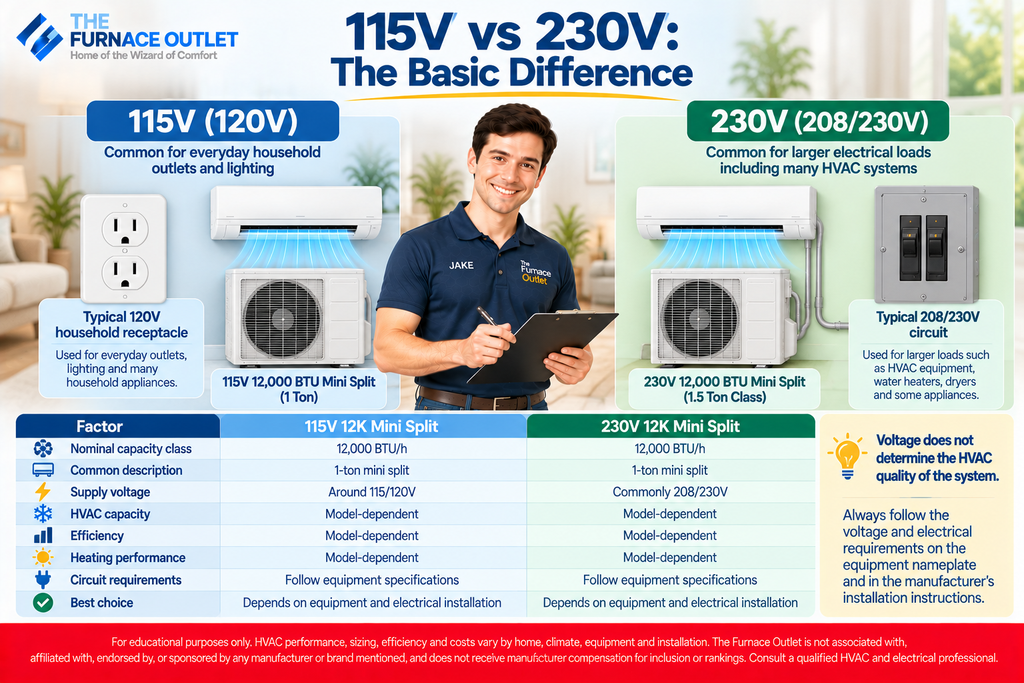
For this article, I will use 115V and 230V because those descriptions appear frequently in mini-split specifications. The important thing is to follow the voltage and electrical requirements printed on the equipment nameplate and in the manufacturer’s installation instructions rather than assuming that all systems in a voltage category are wired identically.
| Factor | 115V 12K Mini Split | 230V 12K Mini Split |
|---|---|---|
| Nominal capacity class | 12,000 BTU/h | 12,000 BTU/h |
| Common description | 1-ton mini split | 1-ton mini split |
| Supply voltage | Around 115/120V | Commonly 208/230V |
| HVAC capacity | Model-dependent | Model-dependent |
| Efficiency | Model-dependent | Model-dependent |
| Heating performance | Model-dependent | Model-dependent |
| Circuit requirements | Follow equipment specifications | Follow equipment specifications |
| Best choice | Depends on equipment and electrical installation | Depends on equipment and electrical installation |
The table highlights the point I want homeowners to remember: voltage does not determine the HVAC quality of the system. You still have to compare the actual equipment.

Not simply because it operates at 230V. If you are comparing two nominal 12,000 BTU systems, both belong to the same general one-ton capacity class regardless of their supply voltage. A 230V electrical supply does not magically turn a 12K mini split into an 18K system. Likewise, choosing 115V does not automatically mean accepting weaker cooling.
The actual capacity can still differ substantially between models. Modern inverter systems have operating ranges rather than one fixed output, so one 12K system might have different minimum and maximum cooling or heating capacities from another nominally identical 12K model.
That is why I would compare the manufacturer’s expanded performance information, certified ratings and matched indoor/outdoor combination rather than deciding that the higher-voltage unit must be more capable.
This is another common assumption I would avoid. Voltage by itself does not tell you the seasonal HVAC efficiency of a mini split.
For equipment comparison, look at ratings such as SEER2, EER2 and HSPF2, along with the system’s certified performance data. Two 12K systems using different supply voltages can have different efficiency ratings because compressor design, heat exchangers, fans, controls, refrigerant circuit design and many other engineering factors affect performance.
ENERGY STAR’s guidance for ductless heating and cooling emphasizes selecting appropriately sized equipment and evaluating the system as an HVAC product rather than reducing the decision to a single specification. ENERGY STAR also recommends that contractors verify proper sizing through a Manual J calculation.
So if one 115V system has better verified efficiency than a particular 230V system, I would not reject it simply because it operates at the lower voltage. Compare the actual systems.
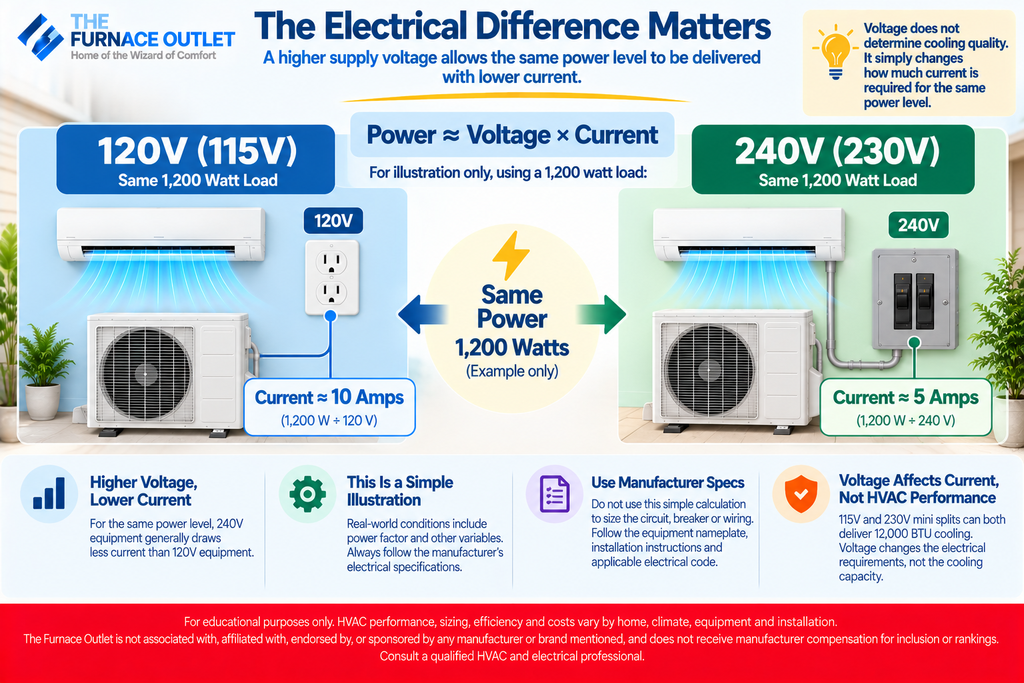
Although voltage does not determine cooling quality, it certainly matters electrically. For approximately the same power level, a higher supply voltage generally allows the equipment to draw less current than would be required at a lower voltage.
The basic electrical relationship helps explain the principle: Power ≈ Voltage × Current
For illustration only, imagine an electrical load consuming 1,200 watts. Ignoring power factor and other real-world considerations, 1,200 watts at 120 volts corresponds to approximately 10 amps, while the same 1,200 watts at 240 volts corresponds to approximately 5 amps.
That does not mean you should use this simple arithmetic to size the mini split’s circuit, breaker or wiring. HVAC equipment has manufacturer-specified electrical requirements, and the actual installation must follow the equipment nameplate, installation instructions and applicable electrical code. The example simply explains why higher-voltage equipment can deliver comparable electrical power at lower current.
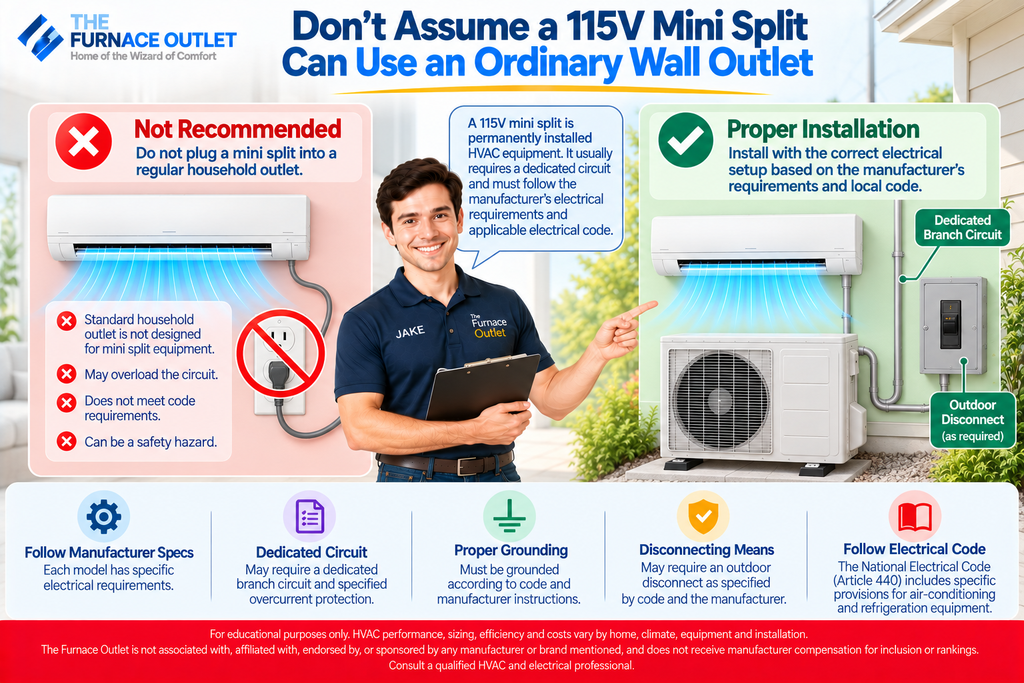
This is probably the most important misconception to address. Seeing “115V” on a mini split does not automatically mean you can treat it like a television, lamp or portable appliance and plug it into whichever household receptacle happens to be nearby.
Mini splits are permanently installed HVAC equipment, and their electrical requirements vary by model. Depending on the equipment and applicable code, the installation can involve a dedicated branch circuit, specified overcurrent protection, grounding, an outdoor disconnect and other requirements.
The National Electrical Code contains specific provisions for air-conditioning and refrigeration equipment, including disconnecting means and other installation requirements. NFPA materials concerning Article 440 also address air-conditioning and refrigeration equipment and associated electrical provisions.
For that reason, I would never buy a 115V mini split on the assumption that the electrical portion of the project consists of finding an available receptacle. Have the electrical requirements reviewed before ordering the equipment.
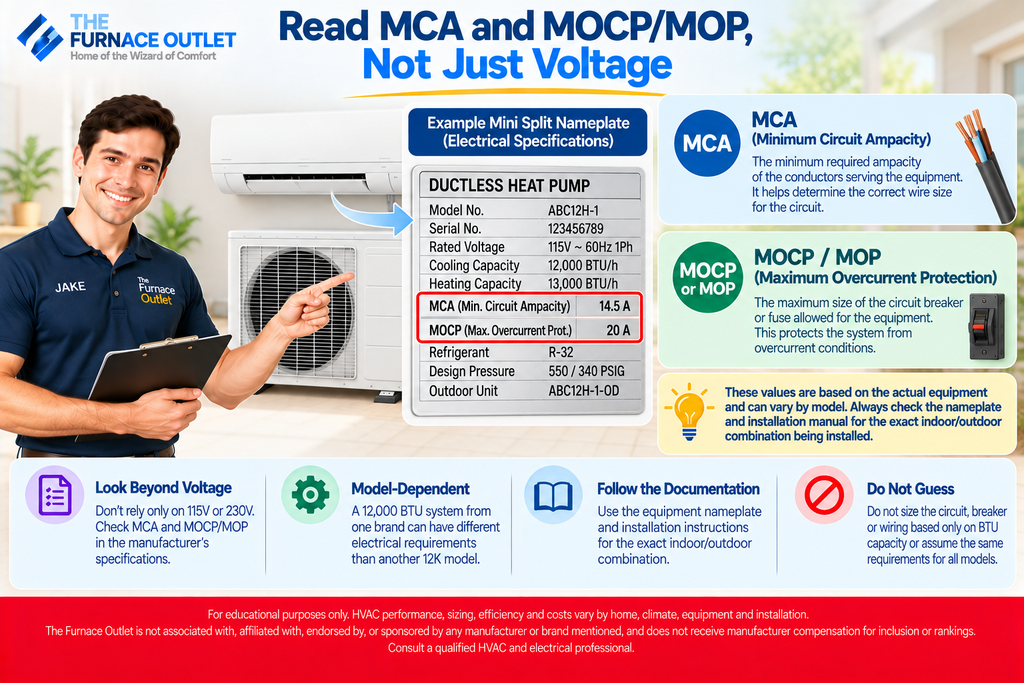
When I review mini-split specifications, I want to see more than “115V” or “230V.” Two particularly useful electrical specifications are commonly listed as MCA and MOCP or MOP, although terminology can vary.
MCA means Minimum Circuit Ampacity. It helps determine the minimum required ampacity of the conductors serving the equipment. MOCP means Maximum Overcurrent Protection, while some documentation uses MOP, or Maximum Overcurrent Protection rating, to describe the permitted upper limit for the protective device.
These values are important because they are based on the requirements of the actual equipment. You should not determine the circuit requirements merely by looking at the mini split’s nominal BTU capacity or by guessing from its voltage.
A 12K system from one product family can have different electrical requirements from another 12K system. Always check the nameplate and installation documentation for the exact indoor/outdoor combination being installed.
A 115V 12,000 BTU mini split can be attractive when the model itself meets your heating and cooling requirements and the electrical installation can properly accommodate it.
This may be particularly appealing for certain bedrooms, home offices, garages, workshops, additions and other single-zone applications where a one-ton load is appropriate. Some homeowner-oriented or DIY-style product lines also offer 115V configurations, which can make them attractive during early shopping.
The potential advantage is not that 115V produces better HVAC performance. Rather, the existing electrical infrastructure may sometimes make the installation more straightforward. That determination should come from someone who understands the circuit capacity and the manufacturer’s requirements, not simply from seeing an ordinary 120V receptacle in the room.
If the existing circuit is already serving lights, receptacles or other equipment, that does not mean it can or should serve the mini split. The actual branch-circuit requirements must be verified.

A 230V 12K mini split can be an excellent choice where the home has appropriate electrical capacity and a compliant circuit can be provided. This voltage is common across many residential HVAC products, and you will encounter a substantial selection of ductless systems designed around 208/230V power.
If I were planning a permanent professionally installed system, I would not avoid 230V merely because it may require electrical work. The electrical installation is one component of a system that may operate for many years, so I would prioritize choosing equipment that provides the performance characteristics I want.
That might include strong low-temperature heating, a broad modulation range, high efficiency, low indoor sound levels, good service support and the appropriate indoor-unit configuration. If the system that best matches the room happens to require 230V, I would rather provide the correct electrical infrastructure than compromise the HVAC selection solely to stay with 115V.
Before ordering either system, determine what electrical service is actually available at the installation location. An electrician or qualified installer can evaluate the electrical panel, available breaker positions, existing circuits, conductor requirements and the path between the panel and outdoor equipment. Local electrical requirements and permitting practices can also affect the installation.
A nearby electrical panel can sometimes make a new circuit relatively straightforward. A finished home where the equipment is far from the panel may involve more labor. Detached garages, workshops and additions can present their own electrical considerations. This is why the cheapest mini split in an online listing is not necessarily the least expensive completed project. Equipment price and installed cost are different things.

It is important to keep electrical selection separate from HVAC sizing. If your room requires approximately 12,000 BTU of properly selected capacity, do not move to a smaller or larger system simply because its voltage seems more convenient.
ENERGY STAR states that HVAC equipment that is too large or too small can struggle to meet the home’s comfort needs and recommends that contractors determine appropriate sizing using Manual J.
ACCA identifies Manual J as the ANSI-recognized standard for producing residential HVAC equipment sizing loads. Its methodology considers design conditions, fenestration, opaque building surfaces, infiltration, internal loads and other characteristics rather than relying on square footage alone.
My preferred sequence is therefore straightforward: determine the load first, select appropriate HVAC equipment second, and then make sure the electrical system can properly support that equipment.
Once you have narrowed the search to 12K equipment, compare 115V and 230V models on their complete specifications rather than voltage alone.
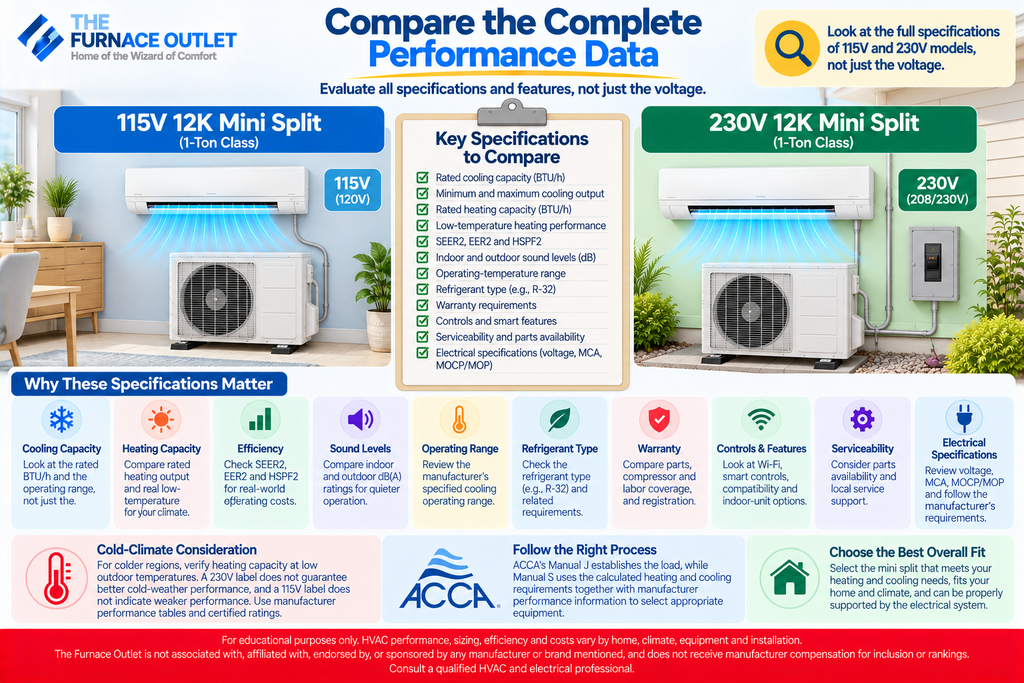
I would review rated cooling capacity, minimum and maximum cooling output, rated heating capacity, low-temperature heating performance, SEER2, EER2, HSPF2, indoor and outdoor sound levels, operating-temperature range, refrigerant type, warranty requirements, controls, serviceability and electrical specifications.
For cold-climate applications, I would pay particular attention to heating capacity at low outdoor temperatures. A 230V label does not prove better cold-weather performance, and a 115V label does not prove worse performance. Manufacturer performance tables and certified ratings should answer that question.
ACCA’s residential design framework reinforces this approach. Manual J establishes the load, while equipment selection under Manual S uses the calculated heating and cooling requirements together with manufacturer performance information. ACCA’s system-design review materials specifically describe Manual S equipment selection as being based on loads and OEM performance data.
Voltage deserves even more attention when homeowners are considering DIY equipment. Some DIY mini splits are engineered to simplify portions of the refrigerant-side installation, but that does not mean every part of the project becomes a homeowner electrical job.
Pre-charged or quick-connect refrigerant lines address a different part of the installation. They do not eliminate electrical requirements.
A homeowner may be comfortable mounting the indoor unit, preparing the wall penetration and installing line-set covers while still hiring a licensed electrician for the branch circuit, disconnect and final electrical connections. That hybrid approach can preserve some DIY savings without treating electrical work casually.
The exact division of work depends on the equipment, local rules, permits and homeowner skill level. Always follow the manufacturer’s installation instructions and applicable electrical requirements.
Sometimes it can be less expensive, but I would not assume that before the electrical system has been evaluated. If an appropriate circuit already exists or can be provided easily, a 115V installation might be relatively straightforward. If the circuit is inadequate, shared with other loads, improperly located or otherwise unsuitable, additional electrical work may still be required.
Likewise, a 230V installation does not automatically mean a huge electrical expense. If the panel has capacity and the equipment is installed nearby, providing the required circuit may be quite manageable. Get the electrical requirements checked before purchasing the equipment if installation cost is a major factor in your decision.
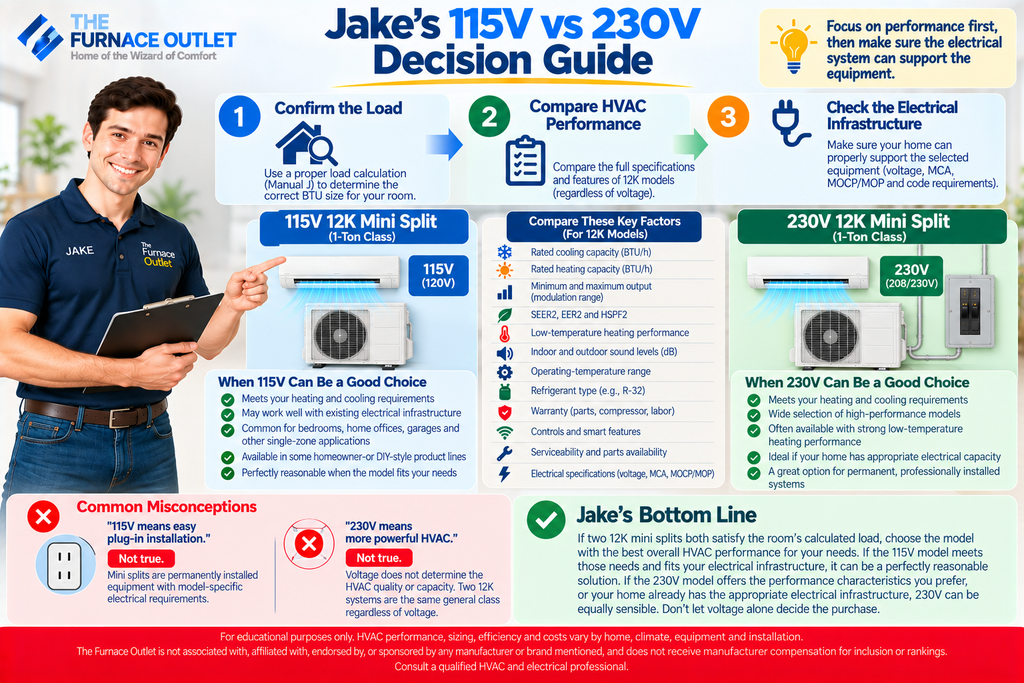
If two 12K mini splits both satisfy the room’s calculated load, I would first compare their HVAC performance. I would look at modulation range, cooling efficiency, heating performance, low-temperature capacity, sound, warranty, controls and serviceability before allowing voltage to decide the purchase.
If the 115V model meets all of those requirements and fits the home’s electrical infrastructure well, there is no reason to reject it simply because it uses lower voltage. For a bedroom, office, garage or other one-ton application, it can be a perfectly reasonable solution.
If the 230V model offers the performance characteristics you prefer, or the property already has appropriate electrical infrastructure for it, 230V can be equally sensible. I would not choose the 115V alternative merely to avoid having an electrician provide the electrical supply that the better-suited equipment requires.
Most importantly, I would never interpret 115V as “easy plug-in installation” or 230V as “more powerful HVAC.” Those shortcuts oversimplify two separate decisions.
For a 12,000 BTU mini split, the choice between 115V and 230V should come after you establish what the room actually needs. Both voltage classes can support one-ton ductless equipment, and voltage alone does not determine cooling capacity, seasonal efficiency, comfort, sound or cold-weather heating capability.
Choose the mini split based on its actual performance and its ability to satisfy the calculated load. Then examine its electrical specifications, including voltage, MCA, maximum overcurrent protection and manufacturer installation requirements, and determine what is necessary to supply it correctly.
For some projects, a 115V system may fit the electrical situation particularly well. For others, a 230V system may provide the better equipment choice or integrate naturally with the available electrical infrastructure. Neither voltage deserves a universal recommendation.
The best installation is the one where the room load, HVAC equipment and electrical system all match. That combination matters far more than choosing a mini split because one voltage sounds simpler or the other sounds more powerful.
For further technical reading, homeowners and installers can review ENERGY STAR’s Ductless Heating & Cooling guidance, ACCA Manual J Residential Load Calculation guidance, ACCA’s Technical Manuals overview, and the NFPA National Electrical Code resources. These provide authoritative background on ductless HVAC sizing, residential load calculations, system design and electrical safety.
Editorial & HVAC Disclaimer: This article is for educational purposes only. HVAC performance, sizing, efficiency, electrical requirements and installation costs vary by home, climate, equipment and installation. Electrical work must comply with the equipment manufacturer’s instructions and applicable national and local codes. The Furnace Outlet is not associated with, affiliated with, endorsed by, or sponsored by any manufacturer or brand mentioned and does not receive manufacturer compensation for inclusion or rankings. Consult qualified HVAC and electrical professionals where appropriate.