Newsletter Subscribe
Enter your email address below and subscribe to our newsletter

HVAC made simple
Mark Callahan – the expert installer
A furnace is one of the longest-serving mechanical systems in a home, so it is understandable that homeowners want a simple answer to one question: How long should my furnace last? Unfortunately, furnace life is not determined by age alone. Two furnaces installed in the same year can have very different service histories depending on sizing, installation quality, maintenance, climate, operating hours, airflow and how well the entire HVAC system was designed.
As a broad planning guideline, many gas furnaces can remain in service for roughly 15 to 20 years, and some properly installed and maintained systems operate longer. ENERGY STAR recommends considering replacement when a furnace or boiler is more than 15 years old, particularly when comfort, efficiency or repair problems are developing.
I would therefore treat 15 or 20 years as a decision point rather than an expiration date. A 17-year-old furnace that is safe, reliable and performing properly does not automatically need replacement. At the same time, repeatedly repairing an aging furnace simply because it can still be repaired is not always the best long-term decision.
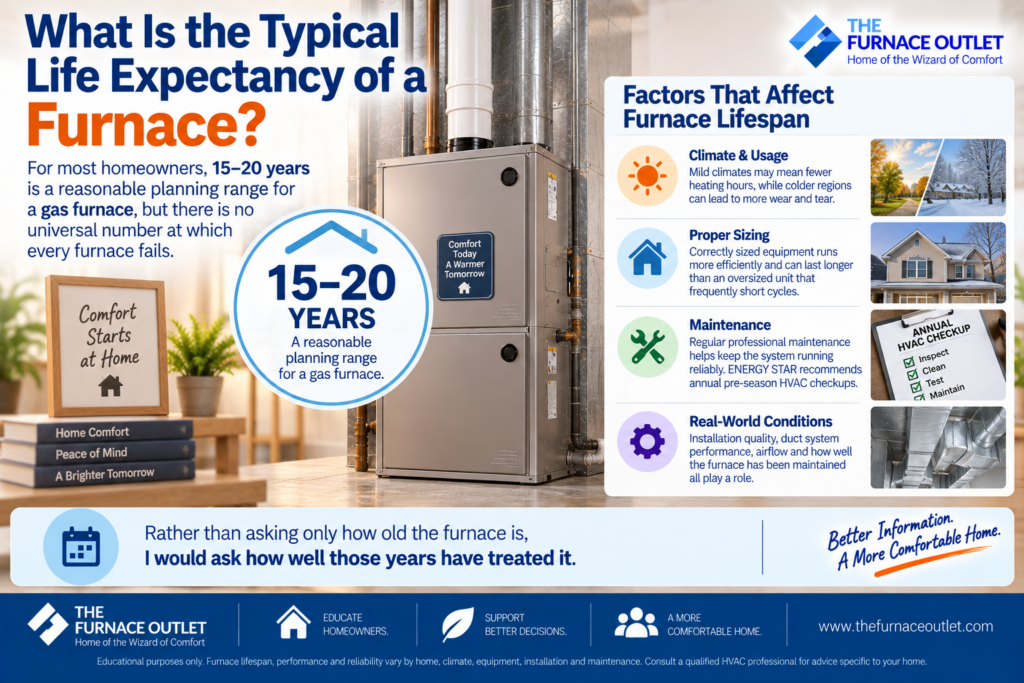
For most homeowners, 15–20 years is a reasonable planning range for a gas furnace, but there is no universal number at which every furnace fails. The actual lifespan depends heavily on how the equipment operates in the real house.
A furnace in a relatively mild climate may accumulate fewer annual heating hours than the same equipment installed in a region with long, severe winters. Likewise, properly sized equipment operating through an appropriate duct system can experience very different conditions from an oversized furnace that frequently short cycles.
Maintenance also matters. ENERGY STAR recommends annual pre-season HVAC checkups and specifically identifies items such as electrical connections, controls, condensate drainage and other system components that should be inspected as part of professional maintenance. Rather than asking only how old the furnace is, I would ask how well those years have treated it.
Age matters because mechanical and electrical components accumulate operating hours and heating cycles. But age by itself does not tell me whether a furnace has been reliable or whether it is likely to remain reliable. A 12-year-old furnace with a history of repeated repairs, poor airflow and overheating concerns may deserve more attention than an 18-year-old furnace that has been professionally maintained and continues to operate normally.
Several factors can influence long-term furnace reliability, including the original installation, equipment sizing, airflow, filter maintenance, duct-system resistance, thermostat configuration, maintenance history and operating environment. The relationship between these factors is why I hesitate to describe any furnace as having an exact predetermined lifespan.
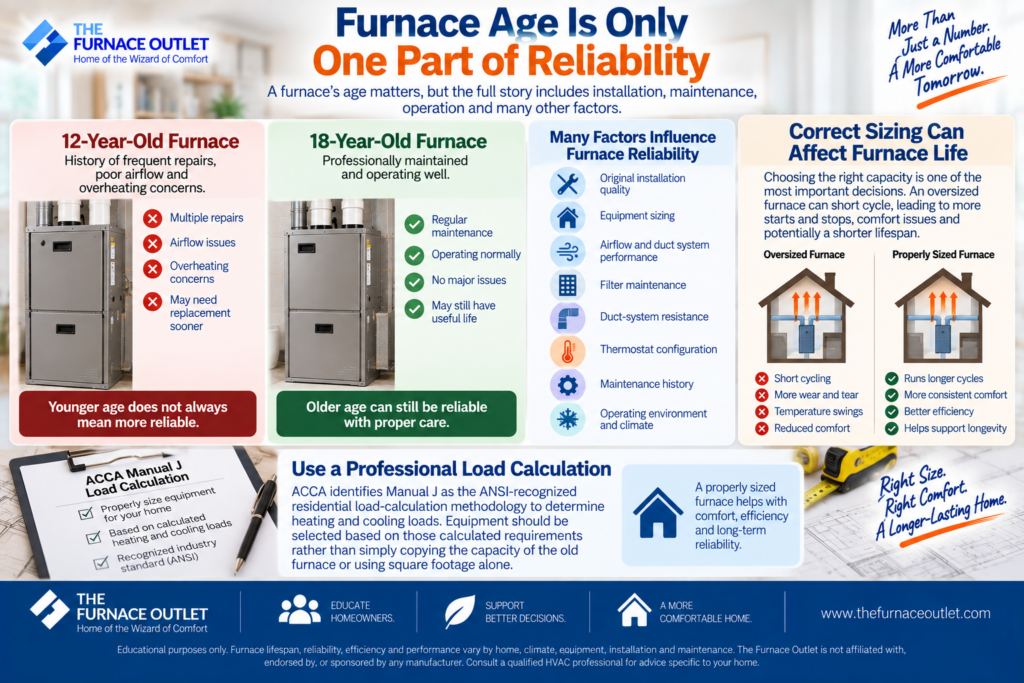
One of the most important decisions affecting a furnace happens before the equipment is even installed: choosing the correct capacity. An oversized furnace can satisfy the thermostat quickly and shut down, only to restart when the home cools again. This repeated short cycling can increase the number of starts and stops while also contributing to temperature swings and comfort problems.
ACCA identifies Manual J as the ANSI-recognized residential load-calculation methodology used to determine heating and cooling loads. Equipment should then be selected based on those calculated requirements rather than simply copying the capacity of the old furnace or using square footage alone. If I were evaluating furnace longevity, I would therefore want to know not only the age of the equipment but whether it was properly sized for the house in the first place.
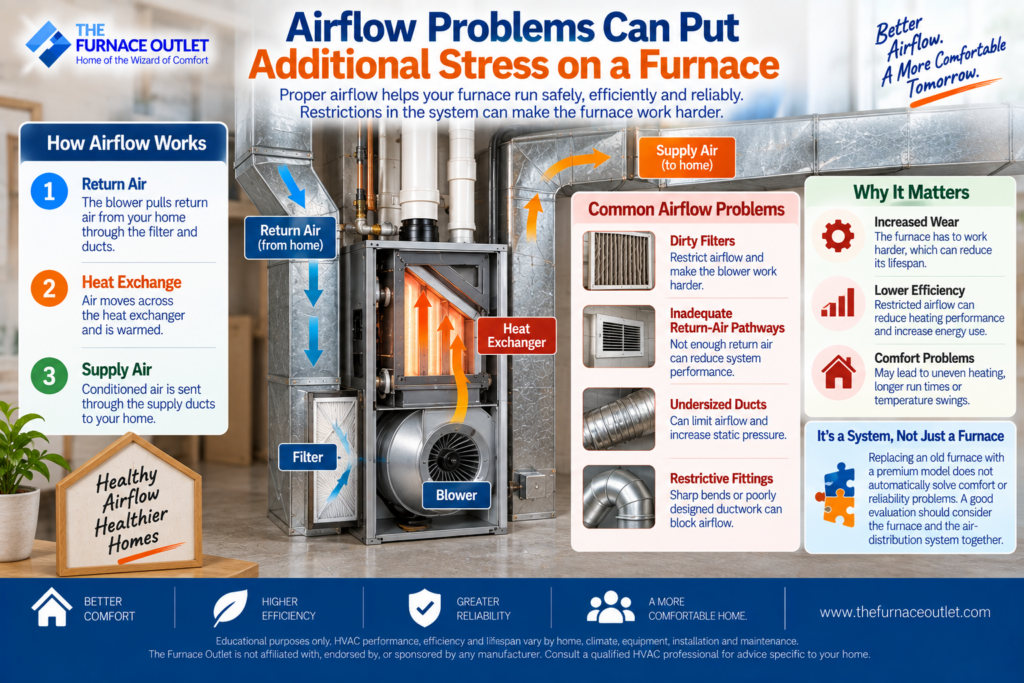
A furnace needs airflow to transfer heat effectively into the home. The blower pulls return air through the system, moves it across the heat exchanger and sends conditioned air through the supply ducts. Restrictions caused by dirty filters, inadequate return-air pathways, undersized ducts, restrictive fittings or other airflow problems can interfere with proper system operation.
This is also why replacing an old furnace with a premium model does not automatically solve comfort or reliability problems. If the underlying duct system remains inadequate, the new furnace can inherit some of the same operating conditions. A good replacement evaluation should therefore consider the furnace and the air-distribution system together.
Regular maintenance is worthwhile because it gives a qualified technician an opportunity to inspect the system, identify developing issues and verify that important components are operating properly. ENERGY STAR recommends annual pre-season HVAC checkups and notes that contractors should inspect electrical connections, controls and condensate drainage, among other items.
Filters also deserve attention throughout the heating season. A badly restricted filter can reduce airflow, while the appropriate replacement schedule depends on filter type, system use, household conditions and manufacturer guidance. However, maintenance should not be presented as a guarantee that a furnace will reach a particular age. Components still wear, operating conditions differ and unexpected failures occur. Maintenance improves the opportunity for reliable operation; it does not create a guaranteed lifespan.
A furnace contains multiple mechanical, electrical and combustion-related components, so there is no single part that fails first in every system. Depending on the equipment, service issues can involve ignition components, flame-sensing components, inducer assemblies, blower motors or controls. Condensing furnaces also incorporate condensate-management components and additional venting considerations.
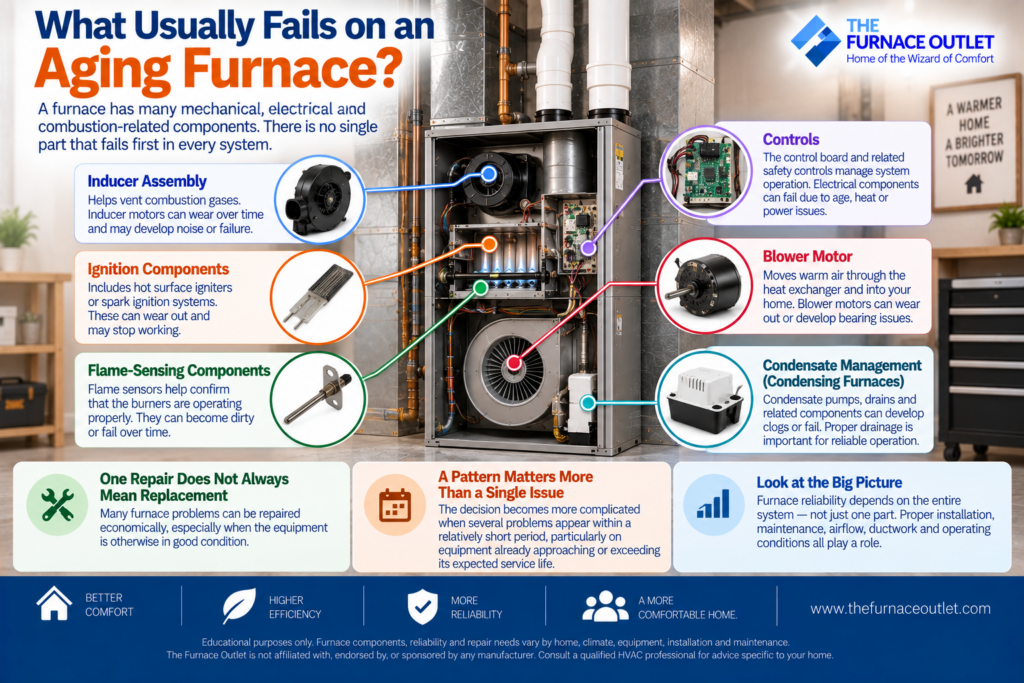
A single component failure does not necessarily mean the furnace needs replacement. Many furnace problems can be repaired economically, especially when the equipment is otherwise in good condition. The decision becomes more complicated when several problems begin appearing within a relatively short period, particularly on equipment already approaching or exceeding its expected service life. That pattern tells me more than one isolated repair.
The furnace heat exchanger separates combustion gases from the air being circulated through the home. Its condition is therefore much more significant than a cosmetic cabinet issue or a routine service component. If a qualified HVAC professional identifies a suspected heat-exchanger problem, I would want the diagnosis properly verified and documented rather than relying on a vague statement that the furnace is simply “old.”
Combustion safety is one reason furnaces should be inspected by qualified professionals rather than diagnosed solely from symptoms homeowners can see or hear. Homeowners should also have working carbon-monoxide alarms installed according to applicable local requirements and manufacturer instructions. The U.S. Consumer Product Safety Commission recommends CO alarms on every level of the home and outside sleeping areas.
A suspected combustion or carbon-monoxide problem is a safety issue, not merely a furnace-age issue.
One repair does not make an old furnace unreliable. What gets my attention is when repairs begin becoming a pattern. Imagine a furnace that needs an ignition repair one winter, an inducer-related repair the next and blower or control work shortly afterward. Each individual repair may be reasonable, but together they can change the economics of continuing to invest in the existing equipment.
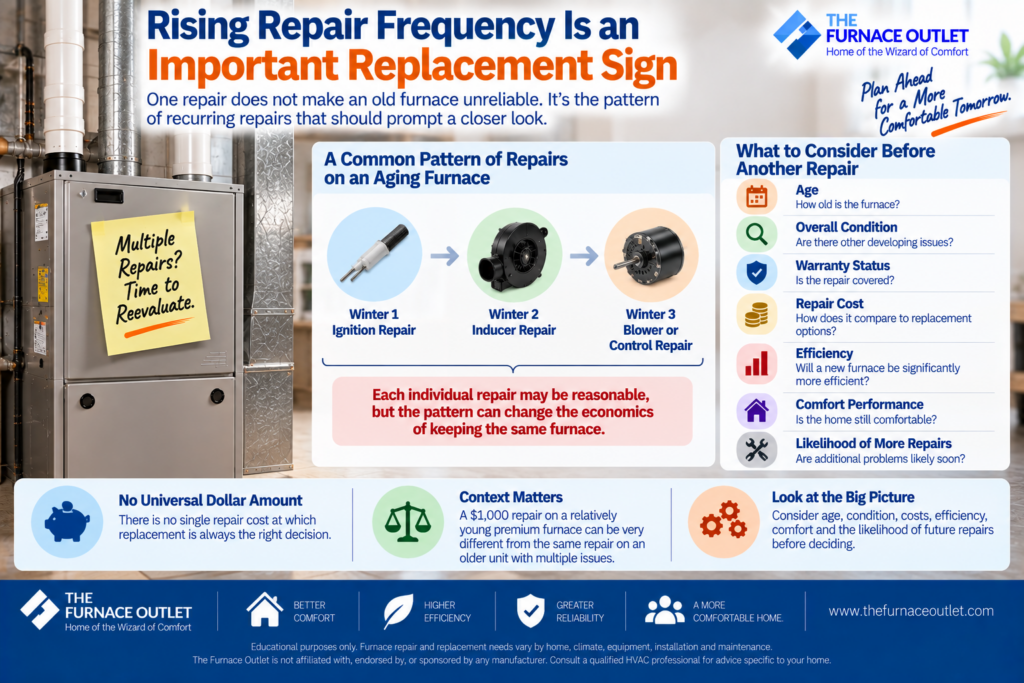
At that point, I would compare the cost of the proposed repair with the furnace’s age, overall condition, warranty status, efficiency, comfort performance and likelihood of additional repairs. There is no universal dollar amount at which replacement automatically becomes correct. A $1,000 repair on a relatively young premium furnace can represent a very different decision from the same repair on an aging system with several other developing problems.
If some rooms suddenly become uncomfortable while others remain warm, homeowners often blame the furnace immediately. Sometimes the furnace is involved, but uneven heating can also result from duct leakage, balancing problems, inadequate return airflow, insulation differences or changes elsewhere in the home.
Similarly, unusually long heating cycles or frequent cycling deserve investigation but should not automatically be interpreted as evidence that the furnace has reached the end of its life. A technician should determine why the system is behaving differently before recommending replacement. Replacing the furnace without identifying an underlying duct or building-envelope problem can leave the homeowner with an expensive new furnace and much of the old comfort problem.
Increasing energy bills are another reason homeowners begin thinking about furnace replacement, but utility bills require context. Weather varies from year to year, fuel prices change and household thermostat habits can change. A colder winter can increase natural-gas consumption even if the furnace itself has not deteriorated dramatically.
If energy use appears unusually high, compare similar weather periods where possible and have the HVAC system evaluated. Air leakage, duct problems, controls, maintenance issues and furnace performance can all contribute. A new high-efficiency furnace may reduce fuel consumption compared with an older lower-efficiency model, but the savings are specific to the home, climate, fuel cost, equipment and installation.
Furnaces are not silent, and different equipment produces different operating sounds. What matters is often a change from the furnace’s normal behavior. New rattling, grinding, squealing, buzzing or unusually loud startup noises deserve investigation. Some noises may result from relatively minor service issues, while others can indicate components that require attention.
I would not diagnose the problem from the sound alone. Instead, consider a persistent new noise as a reason to have the equipment inspected. The same principle applies to unusual cycling behavior, unexplained shutdowns or repeated service-code events.
Warranty coverage is another area where homeowners should read the details rather than relying on a headline such as “10-Year Warranty” or “Lifetime Warranty.” A furnace can have different warranty terms for different components. Manufacturers may provide one term for covered parts and another for the heat exchanger. Registration requirements, original-owner provisions, transfer rules and other conditions can also affect coverage.
Even when a replacement part is covered, labor may not be included. Diagnostic charges, refrigerant-related work on connected cooling equipment, shipping or other installation costs may also be treated differently depending on the warranty and contractor agreement. That is why I recommend keeping the furnace model and serial numbers, installation invoice, warranty documentation, registration confirmation and maintenance records together. When comparing new furnaces, read the actual written warranty for the exact model rather than comparing only marketing statements.
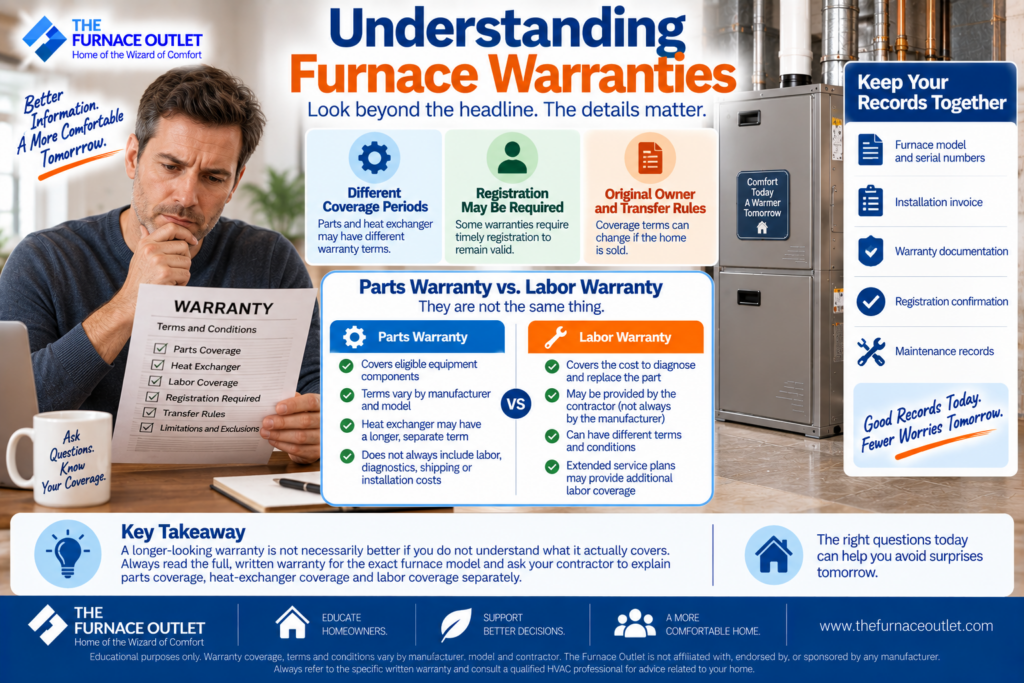
This distinction surprises many homeowners. A manufacturer parts warranty generally addresses eligible equipment components according to the manufacturer’s terms. The labor required to diagnose the problem, remove the failed component and install the replacement may be covered separately—or not covered at all.
Contractors can also offer their own labor warranties, while extended service plans may provide additional coverage under separate terms. When requesting a furnace proposal, I would ask the contractor to explain manufacturer parts coverage, heat-exchanger coverage and labor coverage separately. A longer-looking warranty is not necessarily better if you do not understand what it actually covers.
ENERGY STAR suggests considering replacement when a furnace or boiler is more than 15 years old. I interpret that as a useful planning milestone, not a command to remove functioning equipment on its fifteenth birthday.
Once a furnace enters that age range, I would become more deliberate about monitoring its condition and repair history. Homeowners can start researching replacement options before an emergency occurs, learn whether the existing ductwork needs modifications and obtain proposals while they still have time to compare them carefully. Planning ahead can also prevent the uncomfortable situation of making a major HVAC purchase during a severe cold spell when the furnace has completely failed.

When deciding between another repair and replacement, I would consider several factors together: age, repair history, current repair cost, overall condition, safety, efficiency, comfort, warranty coverage and expected future ownership of the home. A relatively inexpensive repair on an otherwise reliable furnace can make excellent sense. An expensive repair on a very old furnace with additional problems may be harder to justify.
Replacement can also create an opportunity to correct problems that have existed for years. The contractor can perform a proper load calculation, evaluate ductwork and static pressure, select appropriate furnace capacity and make sure the furnace integrates correctly with the home’s air conditioner or heat pump. That opportunity is valuable, but only if the new system is designed and installed properly.
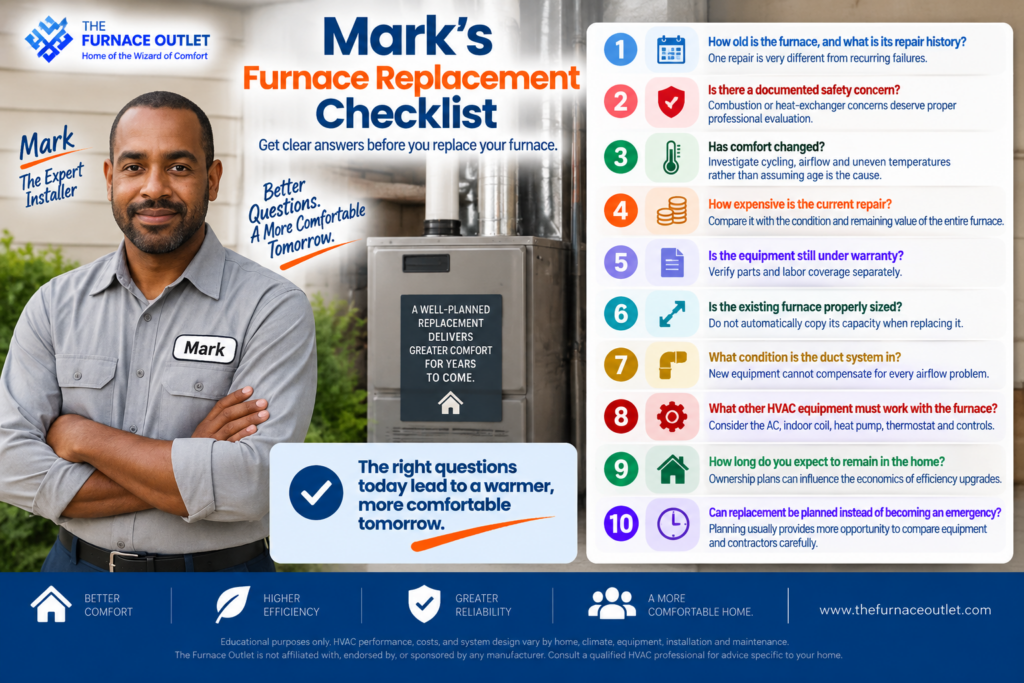
Before I would recommend replacing an aging furnace, I would want answers to a few practical questions:
These questions provide a much better foundation for a replacement decision than furnace age by itself.
If your furnace is approaching 15 to 20 years old, I would begin treating replacement as something to plan for, not necessarily something to do immediately. A well-maintained older furnace that is safe, comfortable and reliable may still have useful service life. Conversely, a younger furnace with chronic installation, airflow or reliability problems may deserve attention much sooner.
Watch for the pattern rather than one isolated symptom. Increasing repair frequency, declining comfort, unusual cycling or noise, expensive component failures and documented safety concerns become more meaningful when several appear together.
Most importantly, do not wait until replacement day to think about sizing and system design. A new furnace should not simply be a newer version of whatever was there before. Have the home’s heating load evaluated, confirm airflow and duct conditions, select equipment appropriate to that load and make sure the furnace is compatible with the rest of the HVAC system. A furnace’s age tells you how long it has been installed. Its condition, installation, maintenance history and operating environment tell you much more about whether it is time for a replacement.
Best Furnaces of 2026: Gas Furnace Brands & Models Compared – The Furnace Outlet
For replacement guidance and signs that an HVAC system may need attention, see ENERGY STAR’s Heating & Cooling guidance and its HVAC maintenance guidance. For professional residential load calculations, see ACCA Manual J. For carbon-monoxide alarm guidance, see the U.S. Consumer Product Safety Commission.
Editorial Disclosure & Educational Disclaimer: The Furnace Outlet is an independent educational resource and is not associated with, affiliated with, endorsed by or sponsored by any manufacturer or brand referenced in our content. We do not receive manufacturer compensation for inclusion or rankings. Furnace lifespan, reliability, efficiency, warranty coverage and replacement needs vary by equipment, installation, climate, maintenance and operating conditions. Warranty terms should always be verified for the specific model and owner. Combustion, heat-exchanger and carbon-monoxide concerns should be evaluated promptly by a qualified HVAC professional.