Newsletter Subscribe
Enter your email address below and subscribe to our newsletter

HVAC made simple

By Samantha Reyes — the Smart Shopper
Replacing a central air conditioner is one of those home purchases where the first question is usually simple: “How much is this going to cost?” Unfortunately, the answer is not nearly as simple. Two homeowners can buy systems with the same nominal tonnage and still receive quotes that differ by thousands of dollars because equipment efficiency, compressor technology, installation complexity, ductwork and local labor costs are different.
For a useful 2026 benchmark, recent consumer cost research puts a typical professionally installed central air conditioner broadly in the $4,000–$10,500 range, with some premium or complicated projects costing considerably more. This Old House’s September 2026 analysis reports an average central-AC installation cost of about $8,460, with a cited low-to-high range of approximately $6,345–$10,575. Another 2026 installation guide gives a broader $4,000–$8,000 range for central AC.
Those numbers are useful for setting expectations, but I would never use a national average to decide whether a contractor’s proposal is reasonable. What matters is what you’re actually getting for the money.
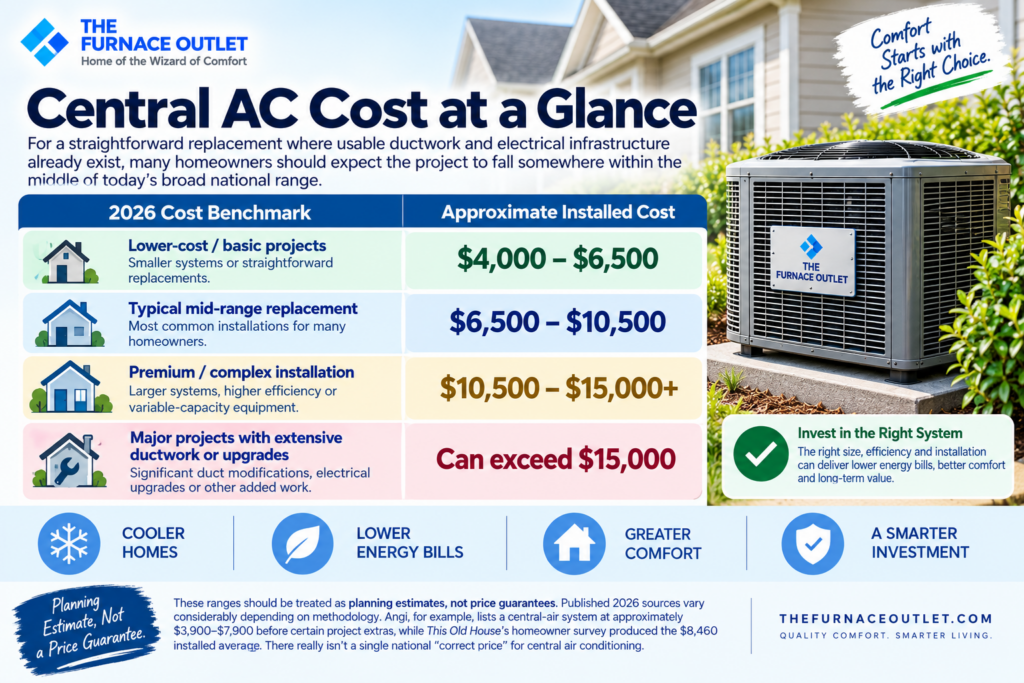
For a straightforward replacement where usable ductwork and electrical infrastructure already exist, many homeowners should expect the project to fall somewhere within the middle of today’s broad national range. Larger systems, premium variable-capacity equipment and installations requiring significant modifications can move substantially above it.
| 2026 Cost Benchmark | Approximate Installed Cost |
|---|---|
| Lower-cost/basic projects | $4,000–$6,500 |
| Typical mid-range replacement | $6,500–$10,500 |
| Premium/complex installation | $10,500–$15,000+ |
| Major projects with extensive ductwork or upgrades | Can exceed $15,000 |
These ranges should be treated as planning estimates, not price guarantees. Published 2026 sources themselves vary considerably depending on methodology. Angi, for example, lists a central-air system at approximately $3,900–$7,900 before certain project extras, while This Old House’s homeowner survey produced the $8,460 installed average.
That variation tells us something important: there really isn’t a single national “correct price” for central air conditioning.
A central-AC quote includes much more than the metal cabinet sitting outside your house. The outdoor condenser is paired with indoor equipment, and the job can involve refrigerant piping, electrical work, drainage, controls, equipment removal, permits, installation materials, labor, startup and commissioning.
This is why an online equipment price shouldn’t be compared directly with a contractor’s installed proposal. Equipment cost and installed-system cost are two different numbers. Labor alone can be substantial. In This Old House’s 2026 homeowner research, 72% of respondents who replaced central AC reported installation labor rates between $100 and $250 per hour. Accessibility and installation difficulty can push labor requirements higher.
As a homeowner, I care less about how a contractor divides equipment and labor internally than whether the final proposal clearly identifies the equipment being installed and everything included in the price.
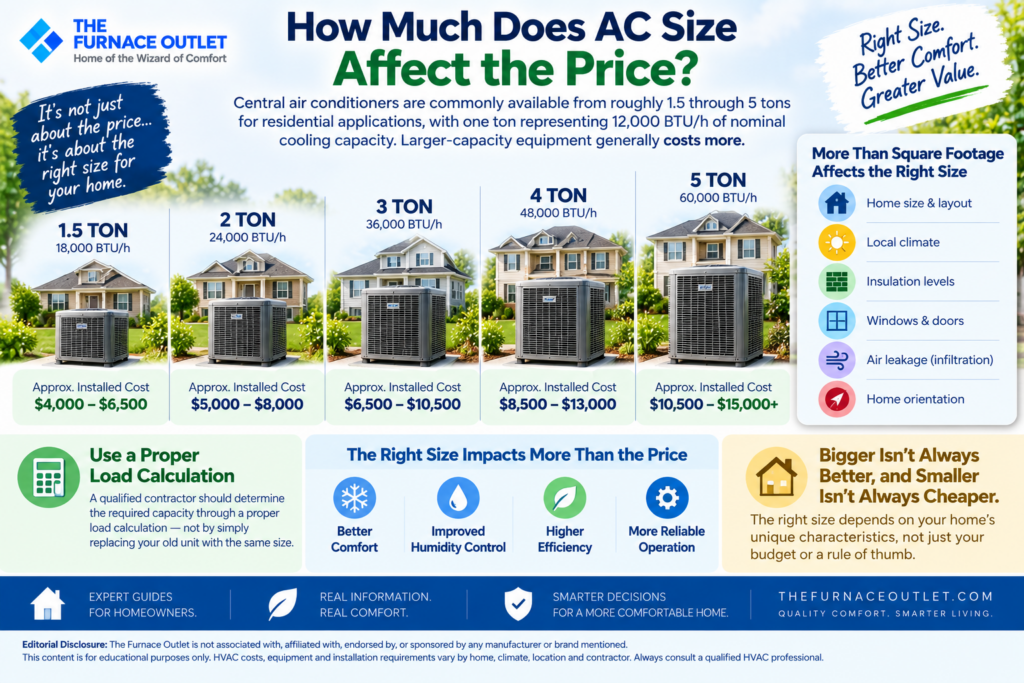
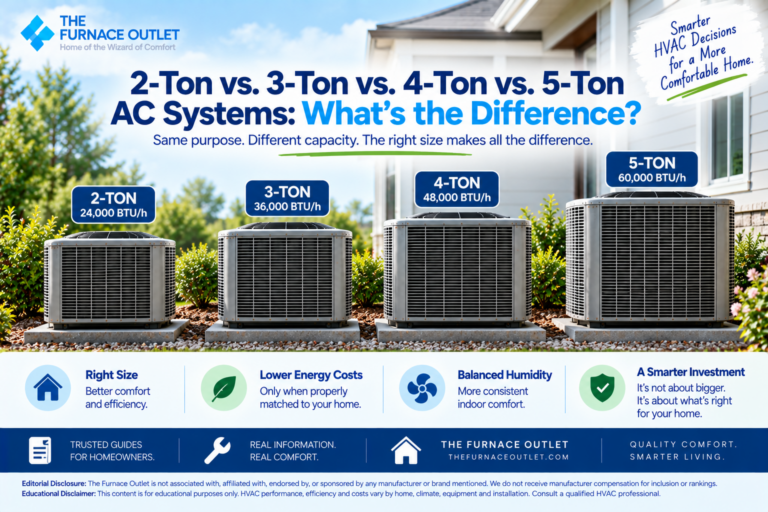
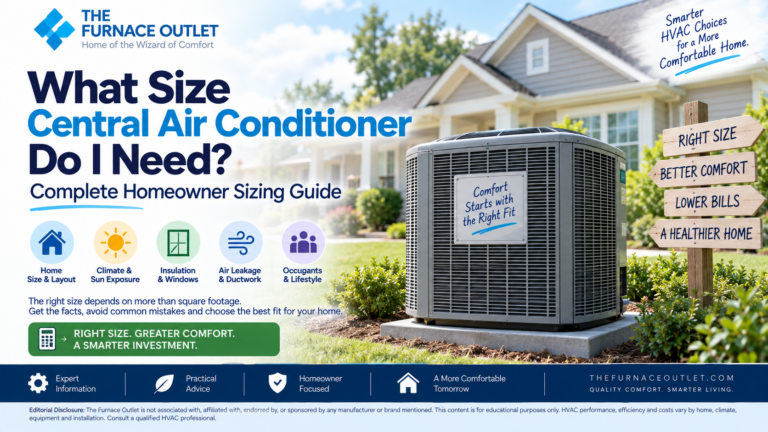
Central air conditioners are commonly available from roughly 1.5 through 5 tons for residential applications, with one ton representing 12,000 BTU/h of nominal cooling capacity. Larger-capacity equipment generally costs more, but tonnage should never be selected according to the homeowner’s budget or the contractor’s guess. A 2-ton system isn’t automatically appropriate for a small house, nor is a 5-ton system automatically correct for a large one. Climate, insulation, windows, air leakage, orientation and numerous other characteristics influence the home’s cooling load.
That is why I would want a contractor to determine the required capacity through a proper load calculation rather than simply saying, “You currently have a 4-ton unit, so we’ll install another 4-ton.” Proper sizing affects the purchase price, but more importantly, it affects comfort, humidity control, efficiency and equipment operation.
After determining the required capacity, one of the biggest equipment decisions is efficiency. In 2026, homeowners should be comparing SEER2 and EER2 ratings, not the older SEER and EER metrics used on previous generations of equipment. Higher-efficiency systems usually cost more because achieving those ratings may require better heat exchangers, advanced motors, sophisticated controls and more capable compressor technology. That additional investment can reduce electricity consumption, but the highest available SEER2 isn’t automatically the best financial choice.
The value of additional efficiency depends on climate, electricity prices, cooling hours, the price difference between systems and how long you expect to own the home. I would ask the contractor to show me the installed-price difference between two efficiency levels and estimate the realistic annual operating-cost difference. That makes the upgrade much easier to evaluate.
Compressor technology can create a substantial price difference even between systems of the same tonnage.
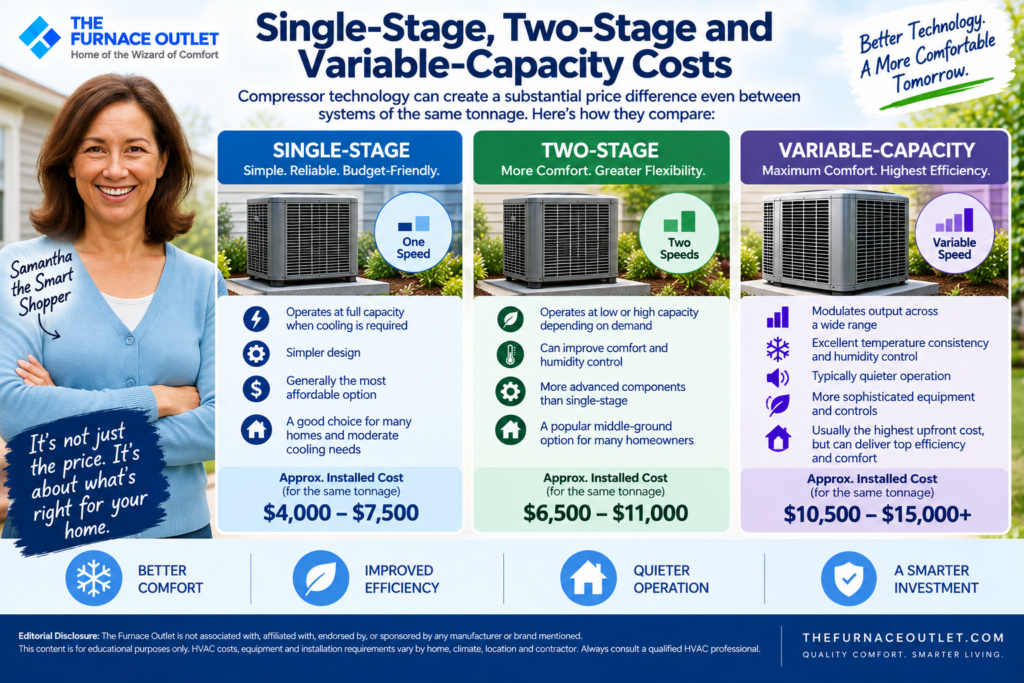
A single-stage air conditioner essentially operates at full compressor output when cooling is required. These systems are generally simpler and usually occupy the more affordable end of a manufacturer’s product lineup.
A two-stage system can operate at more than one capacity level, allowing it to spend more time at a lower output when the full capacity isn’t needed. This can improve comfort and humidity management under appropriate conditions.
A variable-capacity system can modulate output across a much wider operating range. Premium systems may provide excellent temperature consistency, quieter operation and higher efficiency, but the equipment and controls are more sophisticated and typically cost considerably more.
I wouldn’t pay for variable-capacity technology simply because it is the most expensive option. I would pay for it when its efficiency, comfort, noise and control benefits justify the additional installed cost for my particular home.
One pricing mistake I see homeowners make is focusing almost entirely on the outdoor condenser. A split central-air system works as a matched combination of outdoor and indoor equipment. The evaporator coil, air handler or furnace blower can influence capacity and efficiency. A contractor shouldn’t promise a particular SEER2 rating based solely on the outdoor unit’s marketing literature.
Ask for the model numbers of the indoor and outdoor components and, where applicable, the AHRI Certified Reference Number for the proposed combination. The AHRI Directory can be used to verify certified equipment combinations and their ratings. That becomes particularly important when you’re paying a premium for higher efficiency.
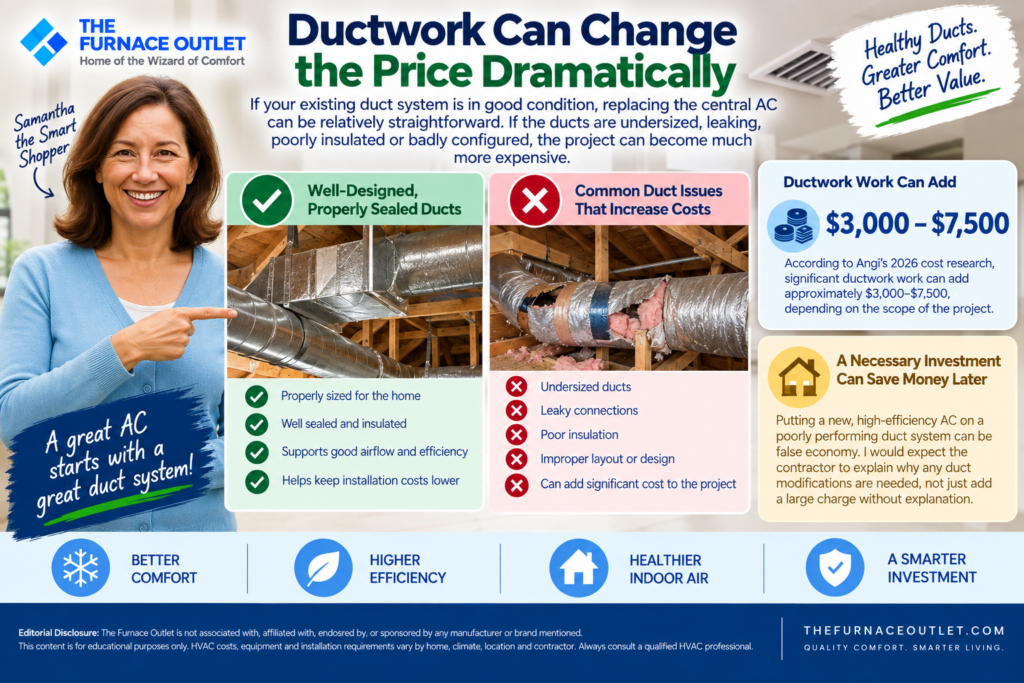
If your existing duct system is in good condition, replacing the central AC can be relatively straightforward. If the ducts are undersized, leaking, poorly insulated or badly configured, the project can become much more expensive. Angi’s 2026 cost research estimates that significant ductwork work can add approximately $3,000–$7,500, depending on the scope of the project.
I wouldn’t automatically reject a higher proposal because it includes necessary duct improvements. Putting expensive new equipment on a badly performing duct system can be false economy. On the other hand, I would expect the contractor to show me why modifications are necessary rather than simply adding a large ductwork charge without explanation.
The advertised system price isn’t necessarily the finished project price. Depending on the home and jurisdiction, the installation may involve permits, electrical upgrades, a new disconnect, thermostat replacement, condensate-drain modifications, equipment pads, refrigerant-line work, old-equipment disposal or structural changes.
Angi’s 2026 HVAC replacement breakdown, for example, estimates permits at roughly $250–$400 and a replacement thermostat at around $120–$260, while major optional improvements can add substantially more. This is why I prefer an itemized, all-in proposal. If Contractor A quotes $7,800 and Contractor B quotes $9,000, the cheaper proposal isn’t really cheaper if another $1,800 of necessary work appears after installation begins.
Brand can affect equipment cost, but I wouldn’t shop for central air conditioning the same way I shop for a television. The contractor and installation are too important.
This Old House’s 2026 survey illustrates how much prices can vary: weighted homeowner-reported central-AC replacement averages ranged from roughly $7,353 for GE to $10,069 for Lennox, while reported averages for Carrier and Trane were approximately $8,121 and $8,666 respectively. Those numbers shouldn’t be interpreted as fixed brand price lists because size, efficiency, location and installation complexity also differed among projects. I would rather have appropriately sized mid-range equipment installed by an excellent contractor than premium equipment installed carelessly.
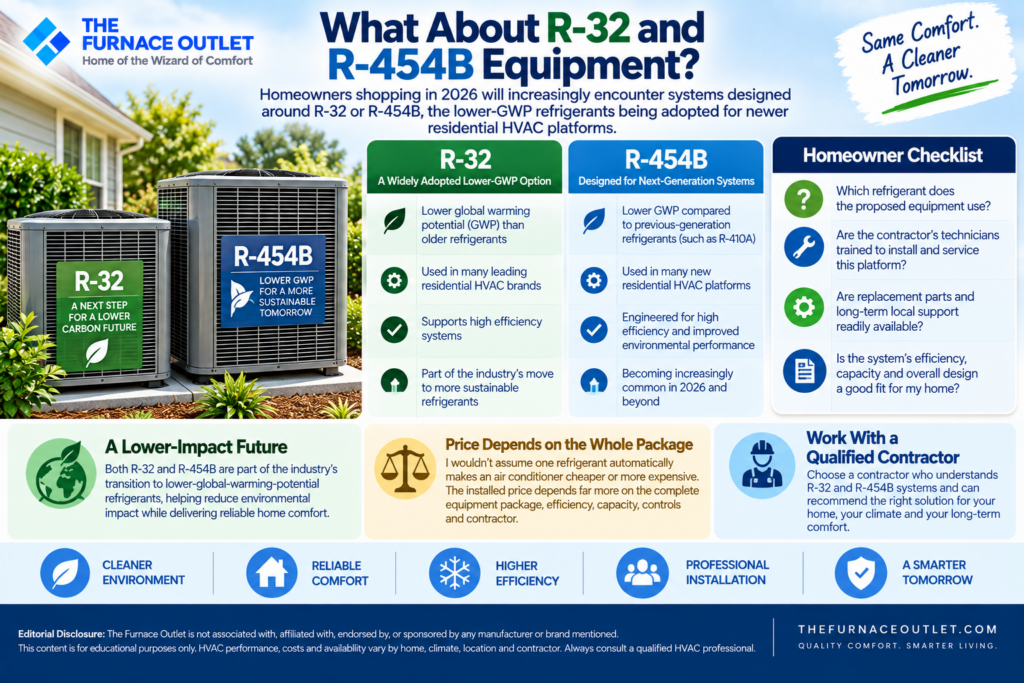
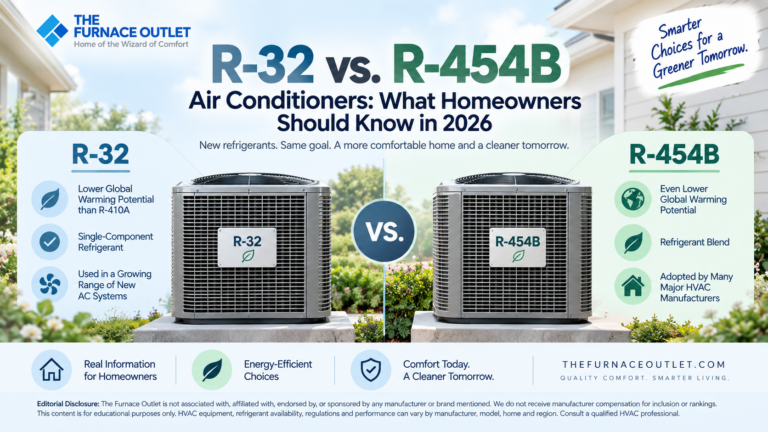
Homeowners shopping in 2026 will increasingly encounter systems designed around R-32 or R-454B, the lower-GWP refrigerants being adopted for newer residential HVAC platforms.
I wouldn’t assume one refrigerant automatically makes an air conditioner cheaper or more expensive. Manufacturers have different product architectures, and the installed price depends far more on the complete equipment package, efficiency, capacity, controls and contractor.
Instead, I would ask which refrigerant the proposed equipment uses, whether the contractor’s technicians are trained to install and service that platform, and whether replacement parts and long-term local support are readily available.
Getting multiple proposals is useful only if you’re comparing equivalent systems. Three contractors can quote “3-ton central AC” while proposing completely different equipment and installation scopes.
| Compare | What I Would Look For |
|---|---|
| Cooling capacity | Properly calculated requirement |
| Outdoor equipment | Exact model number |
| Indoor equipment | Exact matched coil/air handler |
| Efficiency | Certified SEER2 and EER2 |
| Compressor | Single-, two-stage or variable-capacity |
| Refrigerant | R-32 or R-454B |
| Ductwork | Inspection and required modifications |
| Installation | Materials, labor and commissioning |
| Warranty | Equipment and labor coverage |
| Final price | Complete installed cost |
I would also ask what happens after installation. A quality contractor should commission the equipment, verify airflow and refrigerant charge according to manufacturer procedures, test operation and explain the controls.
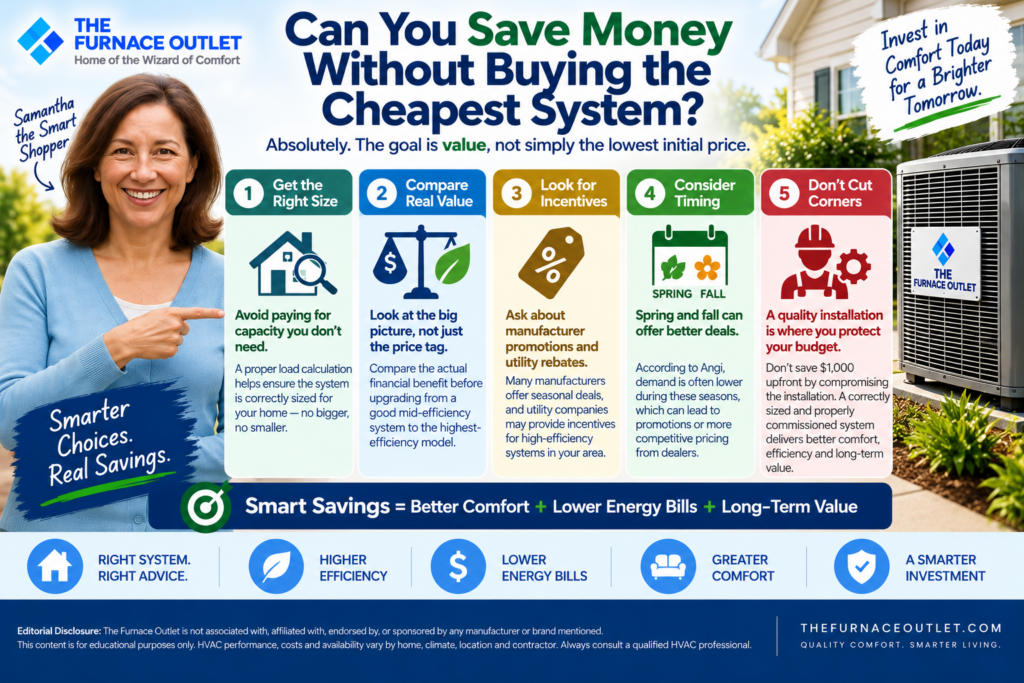
Absolutely. The goal is value, not simply the lowest initial price. First, avoid paying for capacity your home doesn’t need. Second, compare the actual financial benefit before jumping from a good mid-efficiency system to the highest-efficiency model. Third, ask about legitimate manufacturer promotions and qualifying utility incentives available in your area.
Timing can sometimes matter as well. Angi reports that spring and fall can provide opportunities for HVAC savings when demand is lower or dealers are moving inventory, although actual promotions vary by contractor and market. Most importantly, don’t save $1,000 upfront by compromising the installation. A correctly sized and properly commissioned system is where I would protect the budget.
Before signing a proposal, I would want to know why the recommended system costs what it costs. The contractor should be able to explain the home’s calculated cooling load, equipment capacity, exact indoor and outdoor model numbers, SEER2 and EER2 ratings, compressor technology, refrigerant, ductwork requirements, electrical work, permits, warranty coverage and commissioning procedures.
I would also ask whether the quoted amount is genuinely the complete installed price and what circumstances could result in additional charges. That one question can make competing quotes much easier to understand.
The most useful number isn’t the price of the condenser. It is the complete price of putting the right air-conditioning system into your home and making it perform correctly. In 2026, that could mean spending around $6,500 on a relatively straightforward system or well above $10,000 for premium equipment and a more complicated installation. Instead of asking only, “How much does a central AC cost?”, I would ask, “What exactly am I getting for this price, and why is this system right for my home?”
That shift turns price shopping into value shopping—and for a system you may rely on through many summers, that is the comparison that matters.
— Samantha Reyes, the Smart Shopper
The Furnace Outlet | THEFURNACEOUTLET.COM
Editorial Disclosure: The Furnace Outlet is not associated with, affiliated with, endorsed by, or sponsored by any manufacturer or brand mentioned. We do not receive manufacturer compensation for inclusion or rankings.
Educational Disclaimer: Cost figures are general U.S. planning estimates and can vary substantially by location, equipment, home, contractor, market conditions and installation requirements. Obtain detailed quotes from qualified HVAC professionals before making purchasing decisions.