Newsletter Subscribe
Enter your email address below and subscribe to our newsletter

HVAC made simple
By Samantha Reyes — the Smart Shopper
If you’re shopping for a new central air conditioner in 2026, there is a good chance you’ll encounter two refrigerant names that were barely part of the average homeowner’s vocabulary a few years ago: R-32 and R-454B. Some manufacturers have built their newest residential systems around R-32, while others have chosen R-454B. Predictably, that has created plenty of online discussion about which refrigerant is “better.”
As a homeowner, I wouldn’t allow that debate to dominate my air-conditioner purchase. Refrigerant matters, but it is only one part of a complete HVAC system. The equipment still needs to be properly sized, efficiently designed, correctly matched with the indoor equipment and professionally installed. A well-designed R-32 system can be an excellent choice, and so can a well-designed R-454B system.
The useful question isn’t simply “Is R-32 better than R-454B?” It is “What do these refrigerants mean for the equipment I’m considering, and what should I know before buying it?”
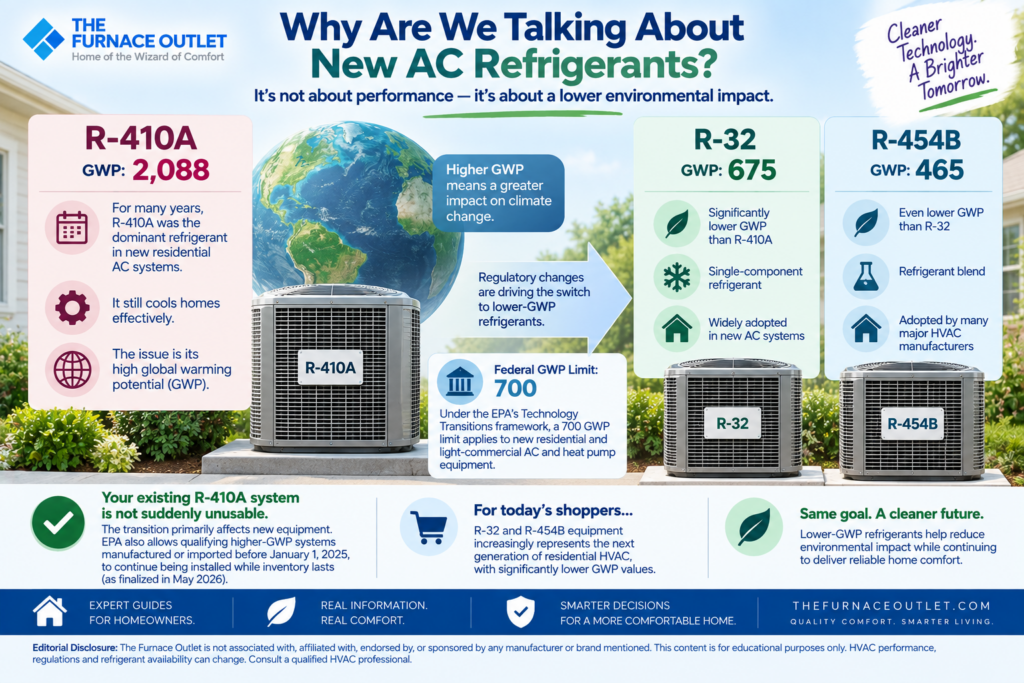
For many years, R-410A was one of the dominant refrigerants used in new residential central air conditioners and heat pumps in the United States. The problem isn’t that R-410A suddenly stopped being capable of cooling homes. The issue is its relatively high global warming potential, or GWP.
EPA’s GWP reference table lists R-410A at 2,088. Under the federal Technology Transitions framework, a 700 GWP limit applies to the relevant new residential and light-commercial air-conditioning and heat-pump equipment category. These requirements have pushed manufacturers toward refrigerants with substantially lower GWP values.
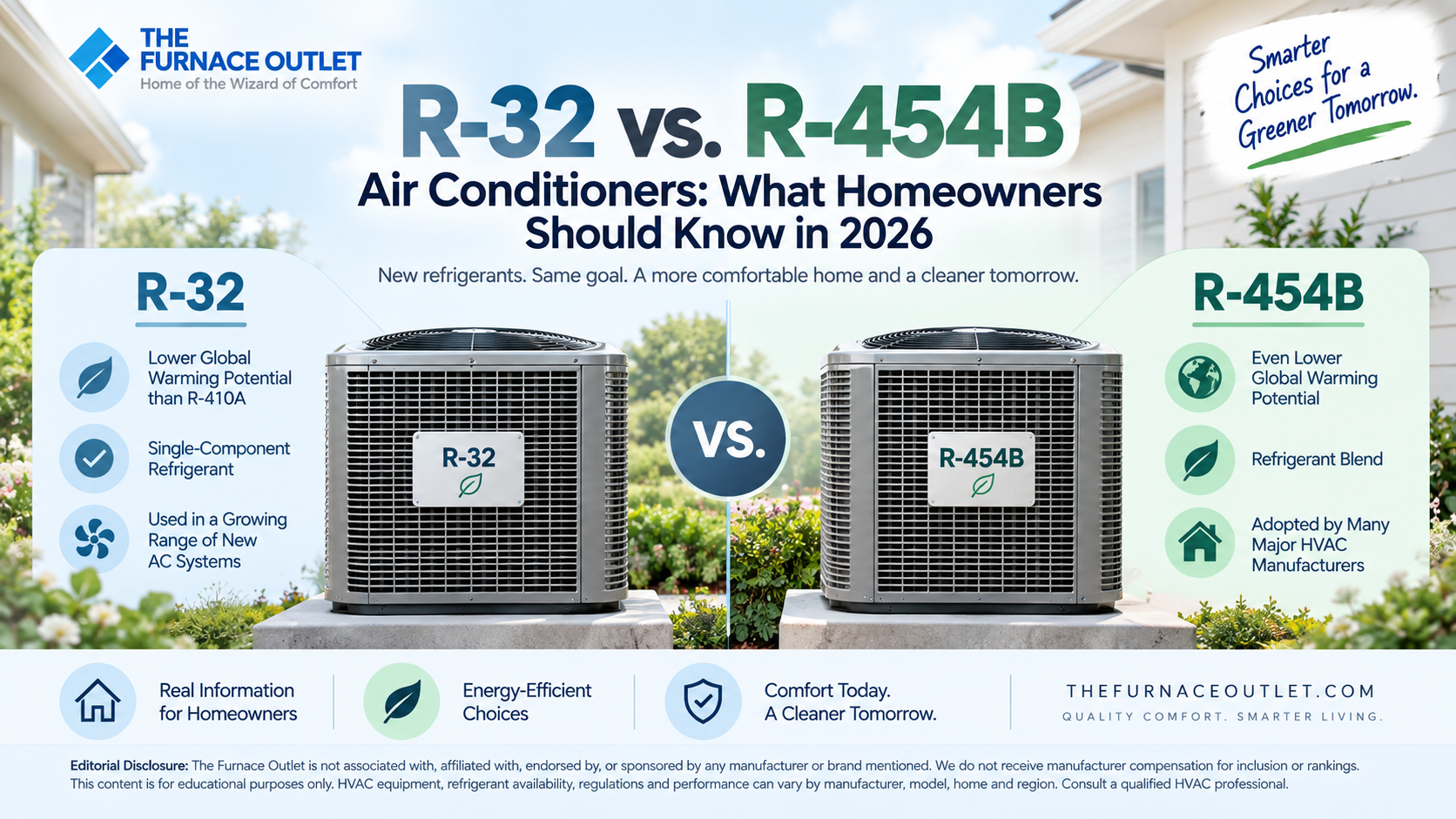
Two of the most prominent alternatives are R-32 and R-454B. EPA lists R-32 with a GWP of 675 in its SNAP information, while its current Technology Transitions reference table lists R-454B at 465. Both therefore fall below the 700-GWP threshold applicable to the category.
The transition is important, but homeowners should understand what it does not mean. Your existing R-410A air conditioner did not suddenly become unusable simply because manufacturers are transitioning to new refrigerants. The rules primarily influence new equipment and the refrigerants around which future product platforms are being designed.
EPA also finalized changes in May 2026 allowing qualifying residential and light-commercial systems using refrigerants above the 700-GWP limit, where the specified components were manufactured or imported before January 1, 2025, to continue being installed while that inventory remains available.
For someone shopping today, however, R-32 and R-454B equipment increasingly represents the new generation of residential HVAC.
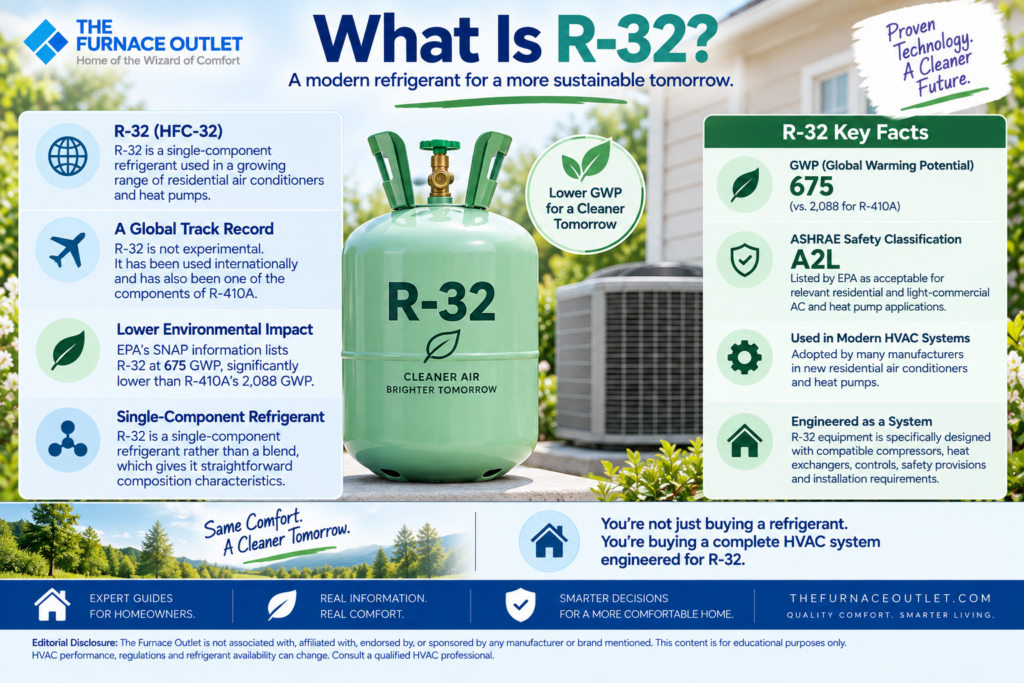
R-32, or HFC-32, is a single-component refrigerant that is now being used in a growing range of residential air-conditioning and heat-pump equipment. It is not an experimental refrigerant invented solely for the current U.S. transition; R-32 has already been used internationally and has also been one of the components of R-410A.
From an environmental-policy perspective, its most obvious advantage over R-410A is its substantially lower GWP. EPA’s SNAP information lists R-32 at 675 GWP, compared with 2,088 for R-410A. EPA classifies R-32 as A2L and lists it as acceptable for relevant residential and light-commercial air-conditioning applications subject to specified use conditions.
Because R-32 is a single-component refrigerant rather than a blend, it also has straightforward refrigerant composition characteristics. That distinction is technically interesting, although I wouldn’t turn it into a deciding factor without considering the equipment around it.
As a homeowner, what matters more is that an R-32 air conditioner has been specifically engineered for R-32. The compressor, heat exchangers, controls, safety provisions and installation requirements form part of the complete system. You are buying an R-32 HVAC system, not simply buying a container of refrigerant.
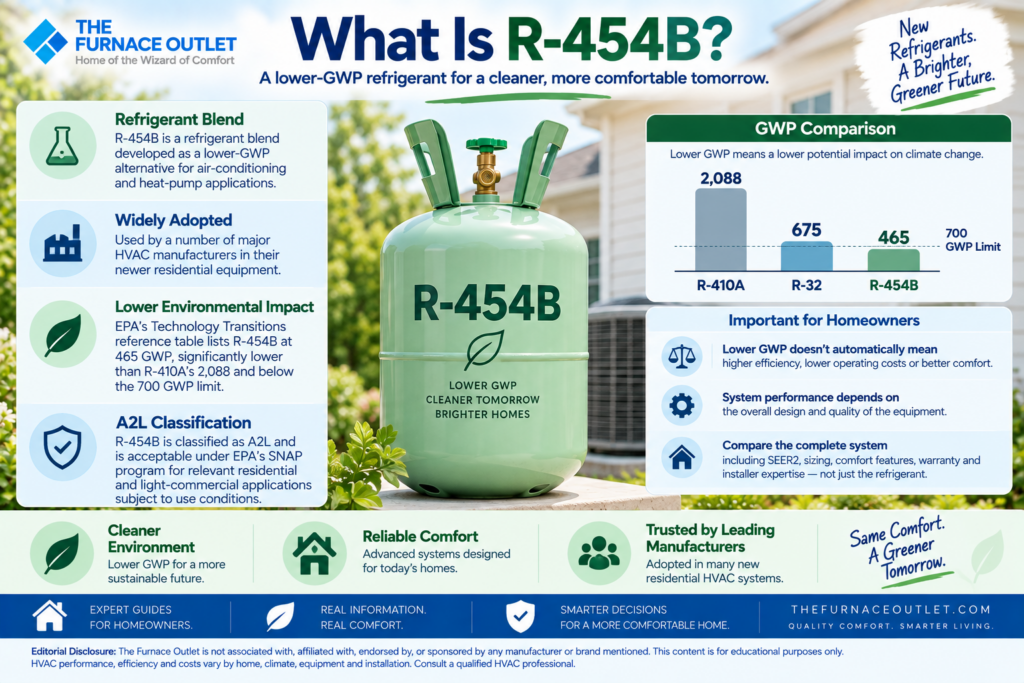
R-454B is a refrigerant blend developed as another lower-GWP alternative for air-conditioning and heat-pump applications. It has been adopted by a number of major HVAC manufacturers as the refrigerant platform for their newer residential equipment.
EPA’s current Technology Transitions reference table gives R-454B a GWP of 465, substantially below both R-410A’s 2,088 and the 700 limit applying to the relevant new residential/light-commercial equipment category. Like R-32, R-454B carries an A2L safety classification and is acceptable under EPA’s SNAP program for relevant applications subject to use conditions.
The lower GWP number gives R-454B an environmental metric advantage over R-32 when GWP alone is being compared: 465 versus 675 using the EPA values discussed above. But this is exactly where I would caution homeowners against turning one specification into the entire purchasing decision.
A lower refrigerant GWP does not automatically mean the air conditioner has a higher SEER2 rating, costs less to operate, is quieter, lasts longer or will provide better comfort. Those characteristics depend on the design and performance of the complete HVAC system.
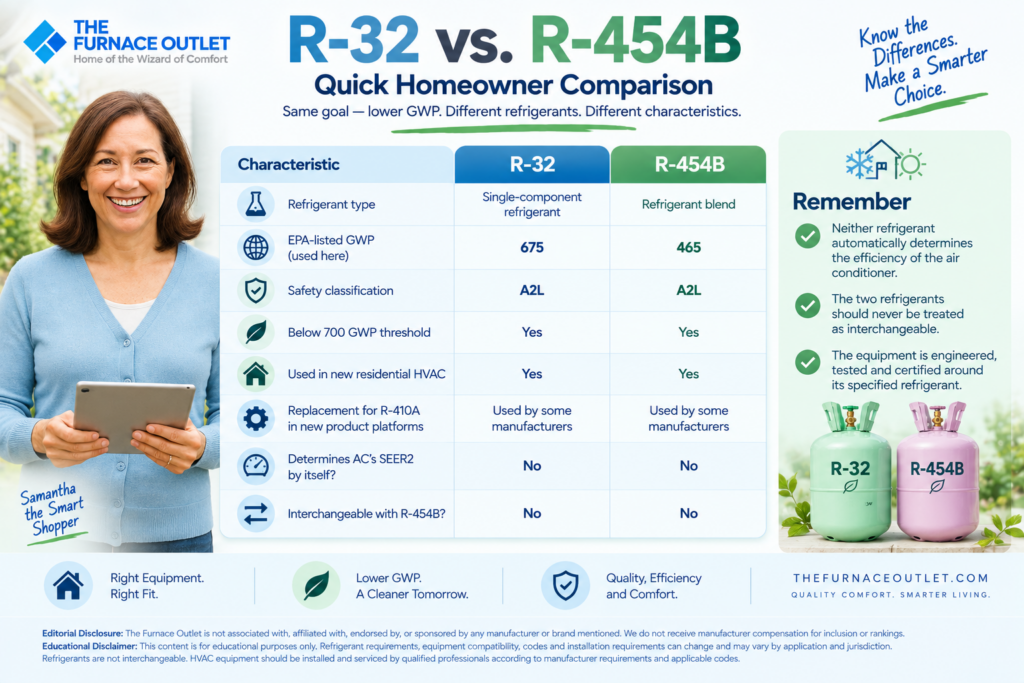
The differences become easier to understand when we separate refrigerant characteristics from equipment characteristics.
| Characteristic | R-32 | R-454B |
|---|---|---|
| Refrigerant type | Single-component refrigerant | Refrigerant blend |
| EPA-listed GWP used here | 675 | 465 |
| Safety classification | A2L | A2L |
| Below 700 GWP threshold | Yes | Yes |
| Used in new residential HVAC | Yes | Yes |
| Replacement for R-410A in new product platforms | Used by some manufacturers | Used by some manufacturers |
| Determines AC’s SEER2 by itself? | No | No |
| Interchangeable with R-454B? | No | No |
The last two rows may be the most important ones for homeowners. Neither refrigerant automatically determines the efficiency of the air conditioner, and the two refrigerants should never be treated as interchangeable.
The equipment is engineered, tested and certified around its specified refrigerant.
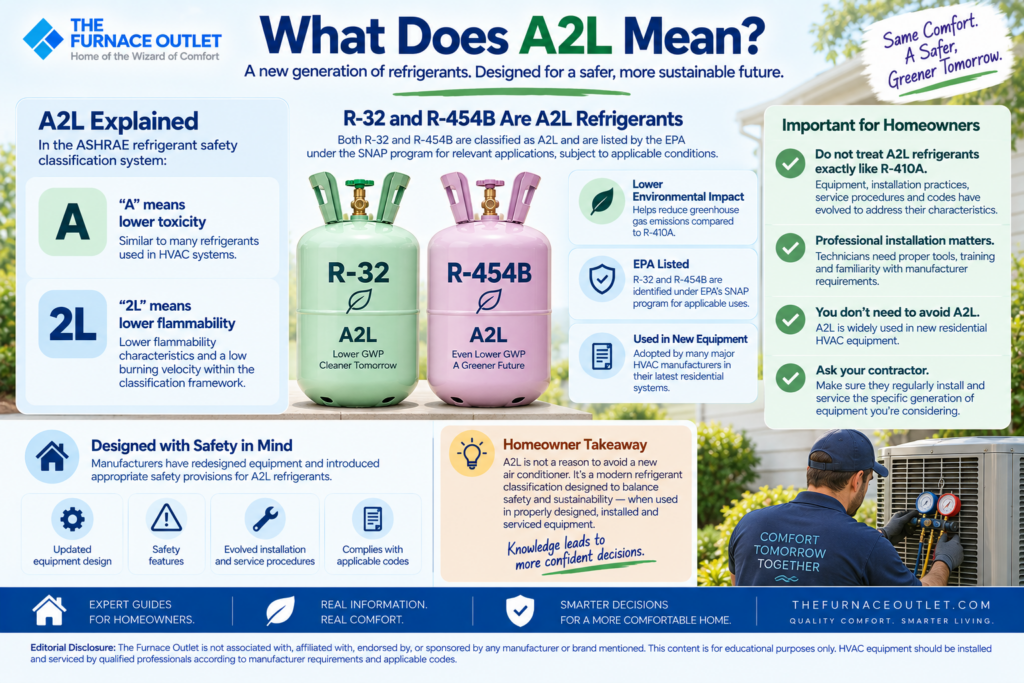
This is probably the part of the refrigerant transition that causes homeowners the most concern. Both R-32 and R-454B are classified as A2L refrigerants. EPA’s SNAP information identifies both with that classification and subjects their use to applicable conditions.
In the ASHRAE refrigerant safety classification system, the “A” relates to lower toxicity classification, while “2L” identifies refrigerants with lower flammability characteristics and a low burning velocity within the classification framework.
The important homeowner takeaway is not to treat A2L refrigerants exactly like R-410A. Equipment, installation practices, service procedures and applicable codes have evolved to address their characteristics. Manufacturers have consequently redesigned equipment and introduced appropriate safety provisions for these refrigerants.
That is one reason professional installation matters so much during this transition. An HVAC technician working on newer equipment needs appropriate tools, procedures, training and familiarity with the manufacturer’s requirements.
I wouldn’t avoid an air conditioner simply because it uses an A2L refrigerant. I would, however, ask whether the contractor regularly installs and services the specific generation of equipment I’m considering.
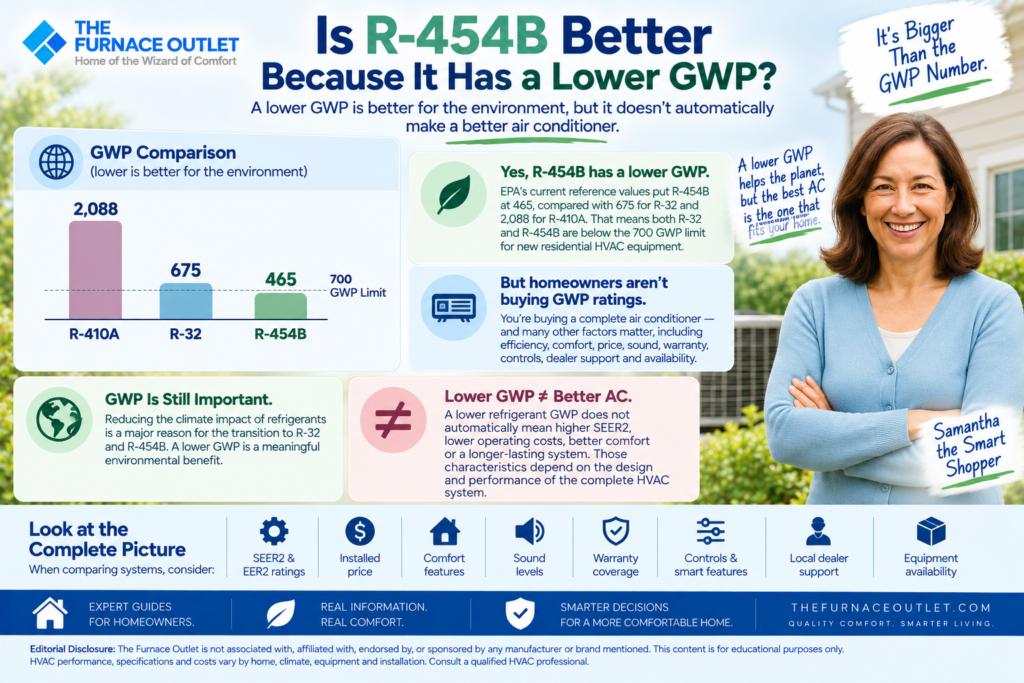
If the comparison is limited strictly to the GWP figures cited above, R-454B has the lower number. EPA’s current reference values put R-454B at 465 versus 675 for R-32 and 2,088 for R-410A. But homeowners aren’t buying GWP ratings. They’re buying air conditioners.
Suppose you are comparing an excellent R-32 variable-capacity system with an excellent R-454B variable-capacity system. Their installed prices, SEER2 ratings, EER2 ratings, sound levels, warranties, controls, dealer support and equipment availability could all differ. Those differences may matter much more to your day-to-day ownership experience than the difference between the refrigerants’ GWP figures.
GWP is still meaningful because reducing the climate impact of refrigerants is a major reason the transition is occurring. I simply wouldn’t transform “lower GWP” into “better air conditioner.” Those are different conclusions.
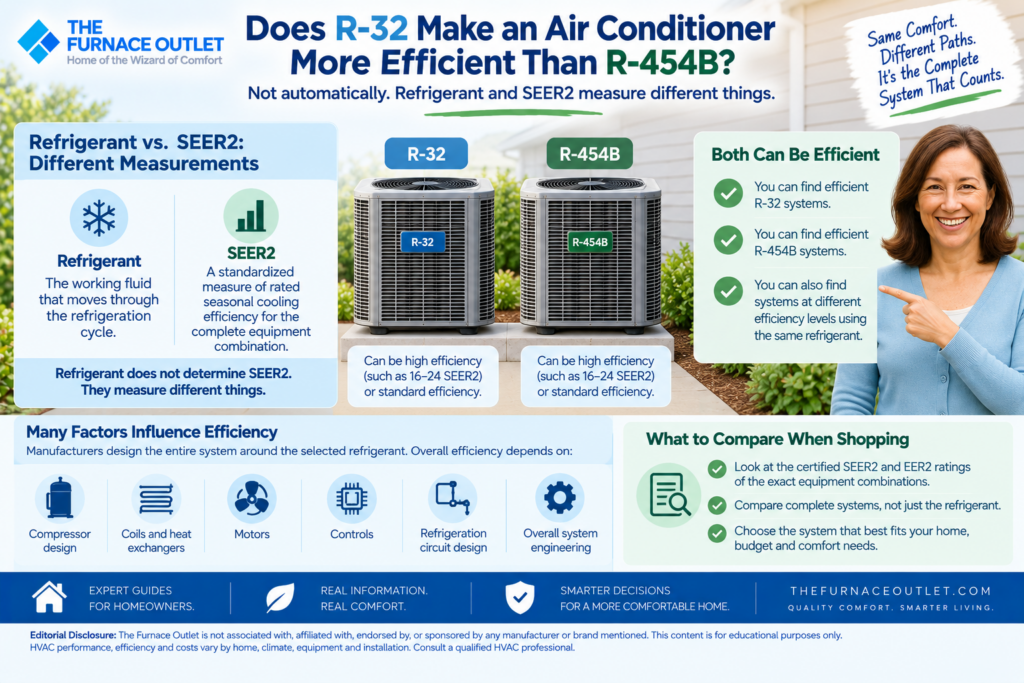
Not automatically, and this distinction is important. Refrigerant and SEER2 measure entirely different things. Refrigerant is the working fluid moving through the refrigeration cycle. SEER2 is a standardized measure of rated seasonal cooling efficiency for the complete equipment combination.
Manufacturers design compressors, coils, motors, controls and refrigeration circuits around their selected refrigerants. The resulting system can then achieve a particular efficiency level. This means you can encounter efficient R-32 systems and efficient R-454B systems. You can also encounter equipment at different efficiency levels using the same refrigerant.
If efficiency matters to you, compare the certified SEER2 and EER2 ratings of the exact equipment combinations rather than trying to predict efficiency from the refrigerant printed on the nameplate. That approach gives you a meaningful system-to-system comparison.
No. This is one area where I would want homeowners to be extremely clear. An air conditioner designed for R-32 should use the refrigerant specified for that equipment, while an R-454B system should be operated and serviced according to its own manufacturer requirements. These are different refrigerants with different properties, and homeowners should never assume one can simply be substituted for the other.
The same principle applies when replacing an older R-410A system. A new R-32 or R-454B condenser is not simply a refrigerant swap for the old outdoor unit. The complete equipment configuration needs to be compatible and properly matched. When obtaining replacement quotes, ask the contractor to specify the outdoor unit, indoor coil or air handler, refrigerant and certified system combination. That gives you a much clearer picture than a proposal that simply says “3-ton AC replacement.”
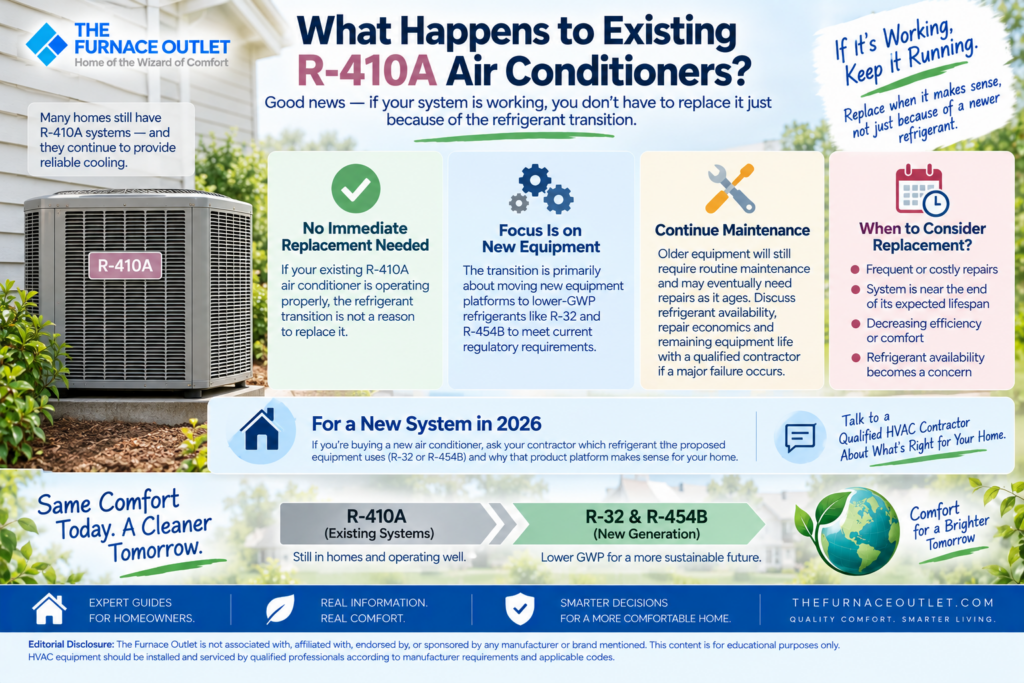
The arrival of R-32 and R-454B does not mean every functioning R-410A air conditioner needs to be replaced. If your existing system is operating properly, the refrigerant transition by itself is not a reason I would rush out and buy a new air conditioner. The transition is principally about moving new equipment platforms toward refrigerants that meet current regulatory requirements.
Older equipment will still require maintenance and eventually may require repair. As these systems age, homeowners should discuss refrigerant availability, repair economics and remaining equipment life with a qualified contractor if a major failure occurs. That is a very different decision from replacing a perfectly functional system simply because a newer refrigerant exists. For homeowners buying a new system in 2026, however, I would expect the contractor to explain which refrigerant the proposed equipment uses and why that product platform makes sense for the installation.
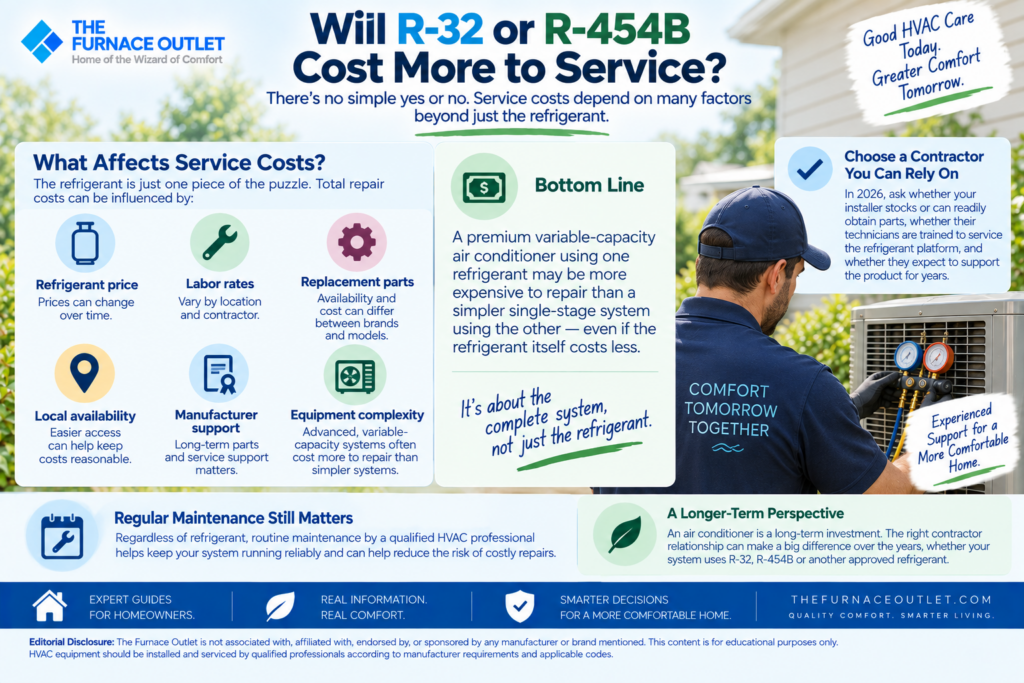
This is difficult to answer universally because future service cost depends on much more than the refrigerant itself. Refrigerant prices can change, but labor rates, replacement parts, local availability, manufacturer support and the complexity of the equipment can have an even larger effect on repair bills. A premium variable-capacity air conditioner filled with one refrigerant may be more expensive to repair than a simpler single-stage system using the other, even if the refrigerant itself happens to cost less.
In 2026, I would therefore pay attention to local contractor familiarity and product support. Ask whether the installer stocks or can readily obtain parts for the equipment, whether its technicians are trained to service the refrigerant platform and whether the company expects to support the product for years rather than simply install it today. The contractor relationship matters because an air conditioner is likely to need routine maintenance and potentially repairs during a service life measured in years.
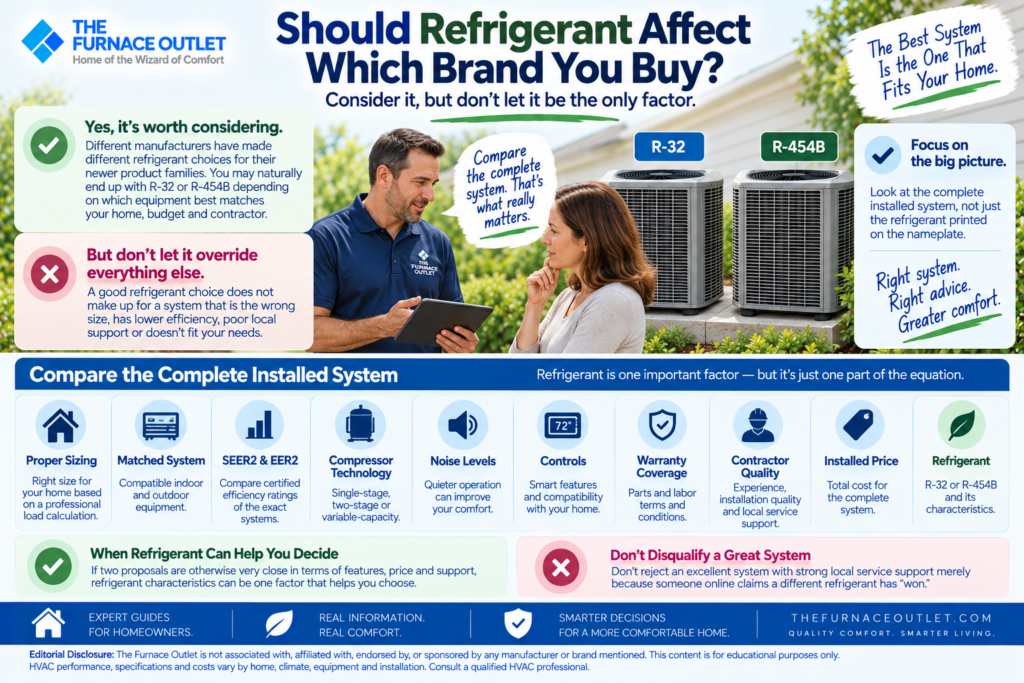
I would consider it, but I wouldn’t allow refrigerant preference to force me into equipment that is otherwise a poor fit. Different manufacturers have made different refrigerant choices for their newer product families. That means you may naturally end up with R-32 or R-454B depending on which equipment best matches your home, budget and contractor.
I would compare the complete installed systems. That means looking at proper sizing, matched indoor and outdoor equipment, SEER2 and EER2, compressor technology, noise, controls, warranty coverage, contractor quality and installed price. Refrigerant belongs on that list, but it doesn’t need to sit above everything else. If two proposals were otherwise very close, refrigerant characteristics could become one factor that helps me decide. But I would not reject an excellent system with strong local service support merely because somebody online declared that the competing refrigerant had “won.”
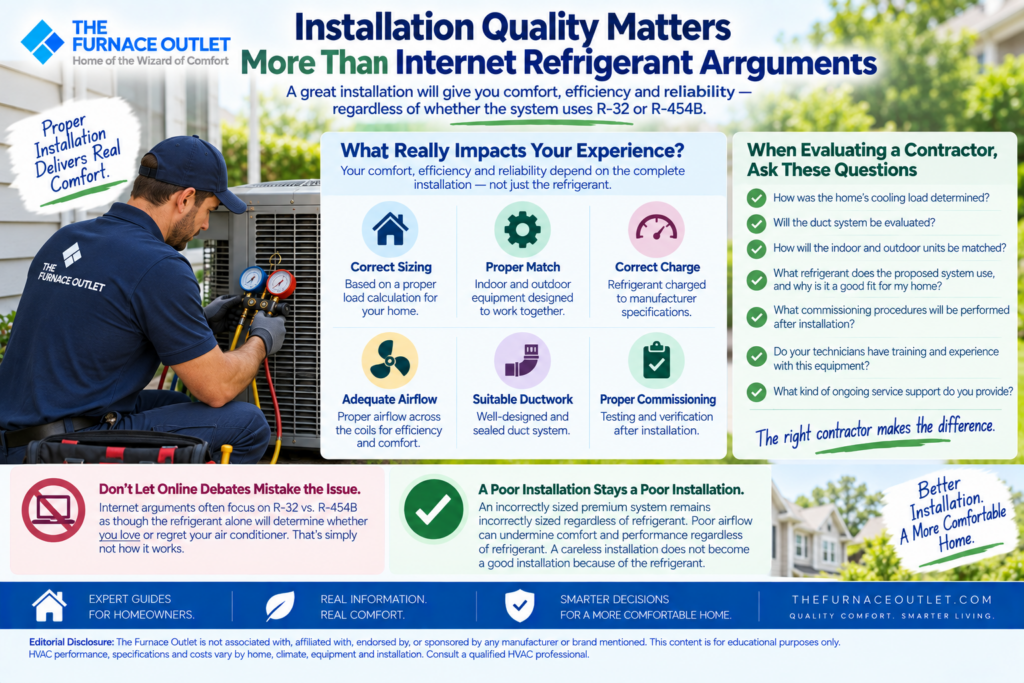
This is where I think homeowners can save themselves a lot of unnecessary anxiety. Online debates often compare R-32 and R-454B as though the refrigerant alone will determine whether you love or regret your air conditioner. Your actual experience is far more likely to be influenced by whether the equipment was correctly sized, properly matched, charged and commissioned, supplied with adequate airflow and connected to suitable ductwork.
An incorrectly sized premium system remains incorrectly sized regardless of refrigerant. Poor airflow can undermine comfort and performance regardless of refrigerant. A careless installation does not become a good installation because the equipment happens to use the refrigerant you preferred. I would therefore spend at least as much time evaluating the contractor as I spend researching the equipment. Ask how the home’s cooling load was determined, whether the duct system was evaluated and what commissioning procedures will be performed after installation.
When comparing new air conditioners, I would want the refrigerant discussion to be specific enough to inform the purchase without distracting from the rest of the system.
| Ask Your Contractor | Why It Matters |
|---|---|
| Does this system use R-32 or R-454B? | Identifies the equipment’s refrigerant platform |
| Is the complete system designed for that refrigerant? | Confirms equipment compatibility |
| Are your technicians trained on this equipment? | Helps establish installation and service experience |
| What are the exact SEER2 and EER2 ratings? | Compares efficiency independently of refrigerant |
| What is the AHRI Certified Reference Number? | Helps verify the matched equipment combination |
| Is the compressor single-stage, two-stage or variable-capacity? | Explains how the system manages cooling demand |
| How was my cooling load determined? | Confirms appropriate sizing |
| Has my ductwork and airflow been evaluated? | Identifies potential system-performance problems |
| What parts and labor warranties apply? | Clarifies long-term ownership protection |
| Who will service this equipment after installation? | Establishes local support for the system |
If the contractor can answer these questions clearly, I would feel far more confident than I would after hearing a sales pitch focused entirely on why one refrigerant is supposedly superior to the other.
The transition from R-410A toward lower-GWP refrigerants is one of the most important changes occurring in residential HVAC, and homeowners buying equipment in 2026 should understand it. R-32 and R-454B both satisfy the central objective of moving substantially below R-410A’s GWP, although their characteristics and GWP values are not identical.
What I would not do is turn refrigerant selection into a contest that overshadows the air conditioner itself. I would rather own a properly sized, efficiently designed and carefully installed R-32 system than a poorly selected R-454B system, and I would make exactly the same statement with the refrigerants reversed.
Ask which refrigerant you’re buying and understand what it means. Then move on to the questions that determine how the system will actually perform in your home: Is it the right size? What are its certified SEER2 and EER2 ratings? Is the indoor equipment properly matched? Is the ductwork adequate? What warranty am I receiving? And does the contractor have experience installing and servicing this equipment?
For me, that is the smart-shopper approach to the refrigerant transition. Understand the refrigerant, but buy the complete system.
— Samantha Reyes, the Smart Shopper
For homeowners who want to explore the regulatory and technical background further, the EPA Technology Transitions HFC Restrictions explains the applicable GWP limits, the EPA GWP Reference Table provides refrigerant GWP values, and the EPA SNAP residential and light-commercial AC refrigerant listings provide information on refrigerant acceptability and use conditions. EPA also maintains an overview of the transition to lower-GWP residential AC alternatives.
The Furnace Outlet | THEFURNACEOUTLET.COM
Editorial Disclosure: The Furnace Outlet is not affiliated with, endorsed by, or sponsored by any manufacturer or brand mentioned. We do not receive manufacturer compensation for inclusion or rankings.
Educational Disclaimer: This guide is for educational purposes only. Refrigerant requirements, equipment compatibility, codes and installation requirements can change and may vary by application and jurisdiction. Refrigerants are not interchangeable. HVAC equipment should be installed and serviced by qualified professionals according to manufacturer requirements and applicable codes.