Newsletter Subscribe
Enter your email address below and subscribe to our newsletter

HVAC made simple
By Samantha Reyes — Samantha the Smart Shopper
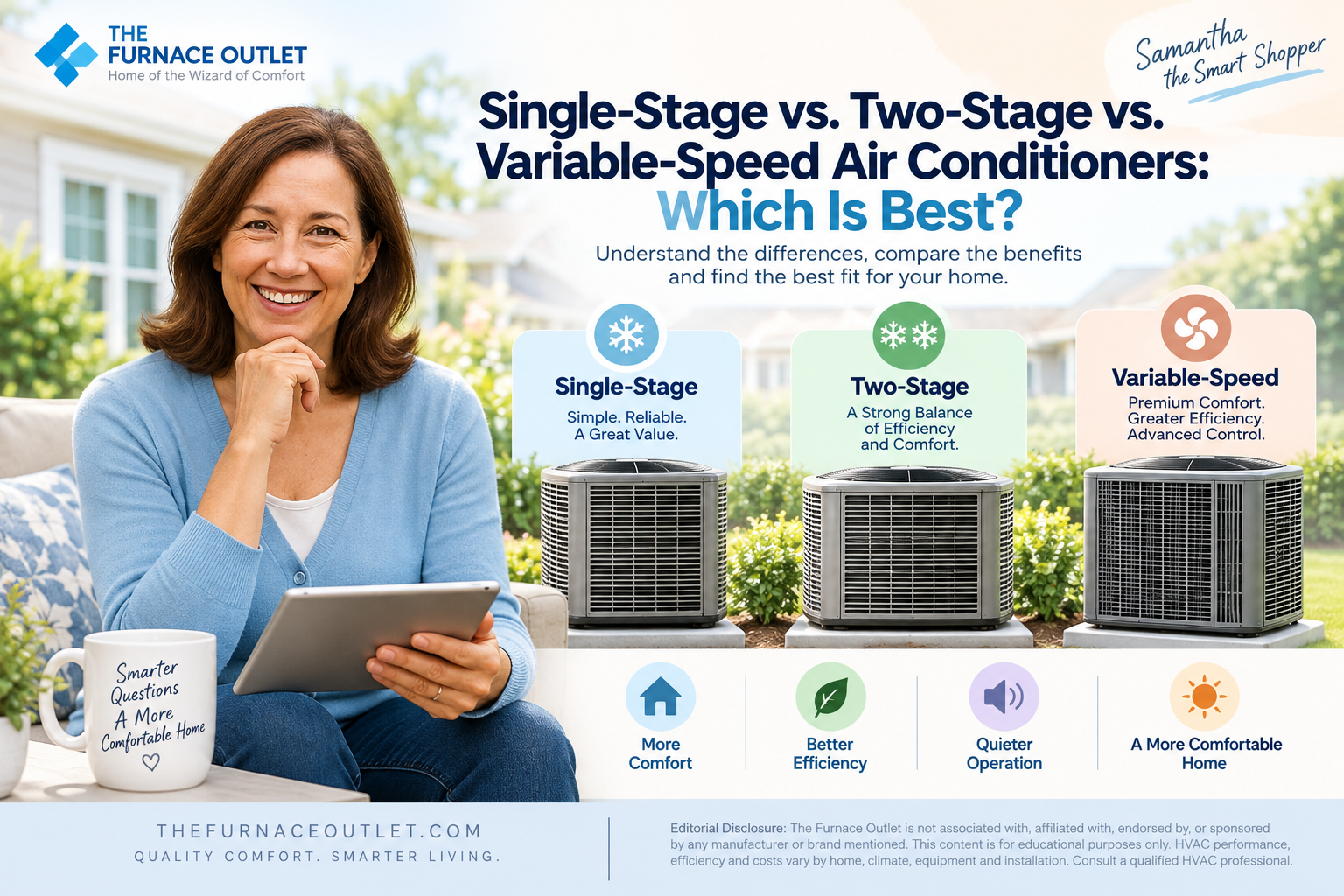
When I first started comparing central air conditioners, I assumed the biggest decisions would be brand, size and efficiency. Then I started seeing terms such as single-stage, two-stage and variable-speed everywhere. At first, they sounded like technical details that a contractor should worry about. They are not. The way an air conditioner controls its cooling capacity can affect how your home feels, how quietly the system operates, how well it manages humidity and how much you ultimately spend.
The easiest way to understand the difference is to think about driving a car. A single-stage air conditioner is somewhat like having an accelerator that is either fully pressed or released. A two-stage system gives you a lower and higher setting. Variable-capacity equipment can make much finer adjustments as conditions change.
That doesn’t automatically make the most sophisticated system the best purchase. A simpler air conditioner can be an excellent choice for one home, while another household may genuinely benefit from variable-capacity technology. The goal is to understand what you are paying for.
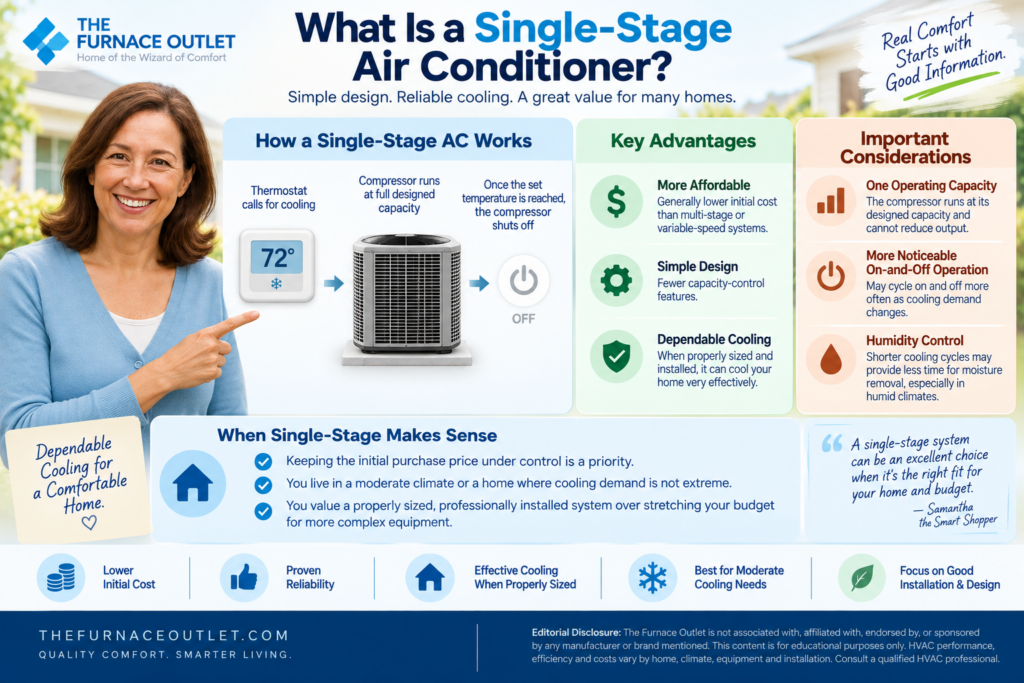
A single-stage air conditioner has one primary compressor operating capacity. When your thermostat calls for cooling, the compressor operates at its designed capacity. Once the thermostat is satisfied, the compressor shuts off. That simplicity is one of its biggest advantages. Single-stage equipment is generally positioned toward the more affordable end of a manufacturer’s central AC lineup and typically has fewer capacity-control features than more sophisticated systems.
For a homeowner primarily concerned with getting dependable cooling at a reasonable initial price, that can be attractive. A properly sized single-stage system can cool a home very effectively. There is nothing inherently inferior about choosing one simply because newer technologies exist.
The trade-off is that your cooling demand is not always the same. Your home may need substantial cooling at 4 p.m. on an extremely hot afternoon but much less on a mild morning. A single-stage compressor cannot reduce its primary operating capacity to closely follow those changing loads. This can lead to more noticeable on-and-off operation. In humid climates, shorter cooling cycles may also provide less opportunity for moisture removal than longer cycles from appropriately designed staged or variable-capacity systems.
I would seriously consider single-stage equipment when keeping the initial purchase price under control is a priority, particularly in a moderate climate or a home where cooling demand is not extreme.
I would also rather buy a correctly sized, professionally installed single-stage system than stretch my budget for sophisticated equipment while neglecting ductwork, airflow or installation quality.
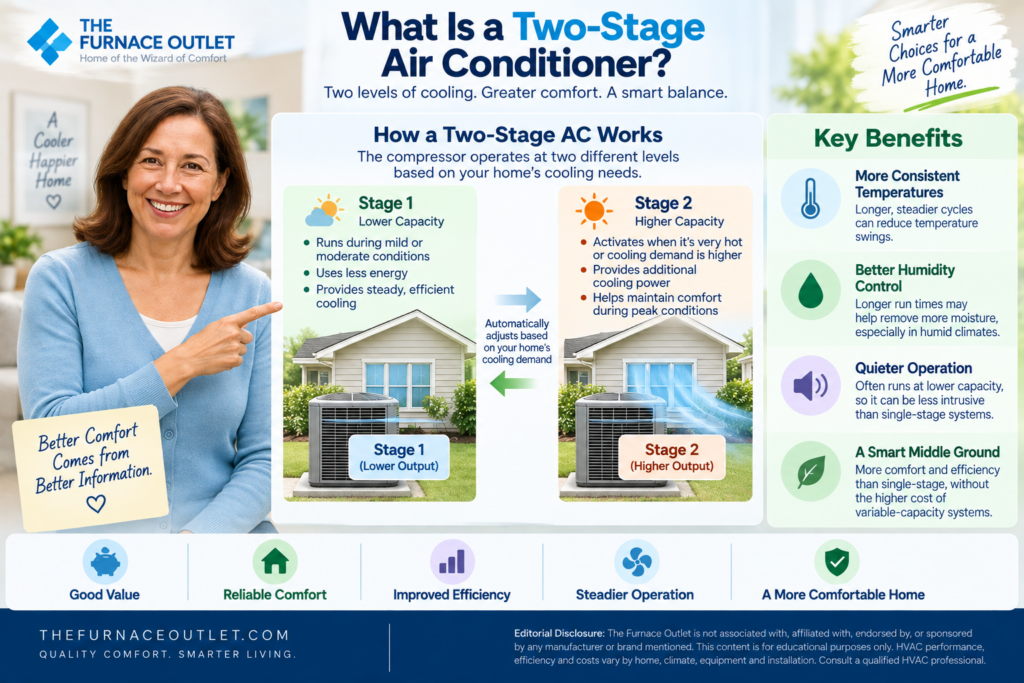
A two-stage air conditioner gives the compressor two operating levels rather than one. The exact capacities depend on the equipment, but conceptually there is a lower stage for moderate cooling demand and a higher stage when the home requires additional cooling. This seemingly simple difference can change the way the system operates. During many ordinary summer conditions, the air conditioner may be able to satisfy the home while operating at its lower stage. When outdoor temperatures rise or the cooling load increases, the system can move to its higher stage.
The result can be longer, steadier cooling cycles compared with equipment that repeatedly operates at full capacity and shuts down. Those longer cycles can help reduce temperature swings and may improve humidity removal in humid conditions. Lower-stage operation can also make the system feel less intrusive because the compressor and airflow may not need to operate at maximum output every time cooling is required.
For many homeowners, this is why two-stage equipment represents an interesting middle ground. You gain some of the comfort advantages of capacity modulation without necessarily paying for the most sophisticated variable-capacity technology.
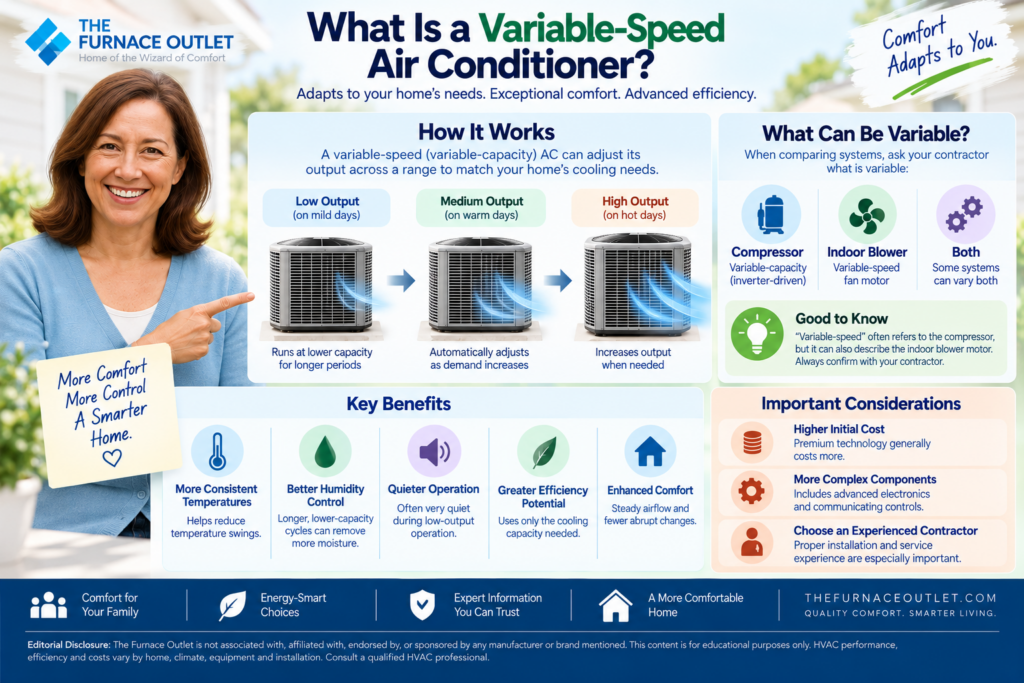
This is where terminology can become confusing. When people say variable-speed air conditioner, they are often referring to a system using a variable-capacity or inverter-driven compressor that can adjust cooling output across a range rather than operating at only one or two fixed capacities. Technically, “variable-speed” can also describe indoor blower motors, so when comparing systems I would ask the contractor exactly what is variable: the compressor, the indoor blower, or both.
A variable-capacity compressor can increase or decrease output as the home’s cooling requirements change. Instead of repeatedly turning on at full capacity, the system may spend long periods operating at relatively low output and increase capacity when conditions demand it. That operating style can produce some of the best comfort characteristics available from residential central AC equipment. Longer, lower-capacity cycles can maintain more consistent indoor temperatures, reduce abrupt changes in airflow and improve moisture removal under suitable conditions.
Premium variable-capacity systems can also be remarkably quiet during low-output operation. But sophistication comes at a price. Variable-capacity systems generally cost more initially and can incorporate proprietary electronics, communicating controls and more complex components. That makes the quality and experience of the installing contractor especially important.
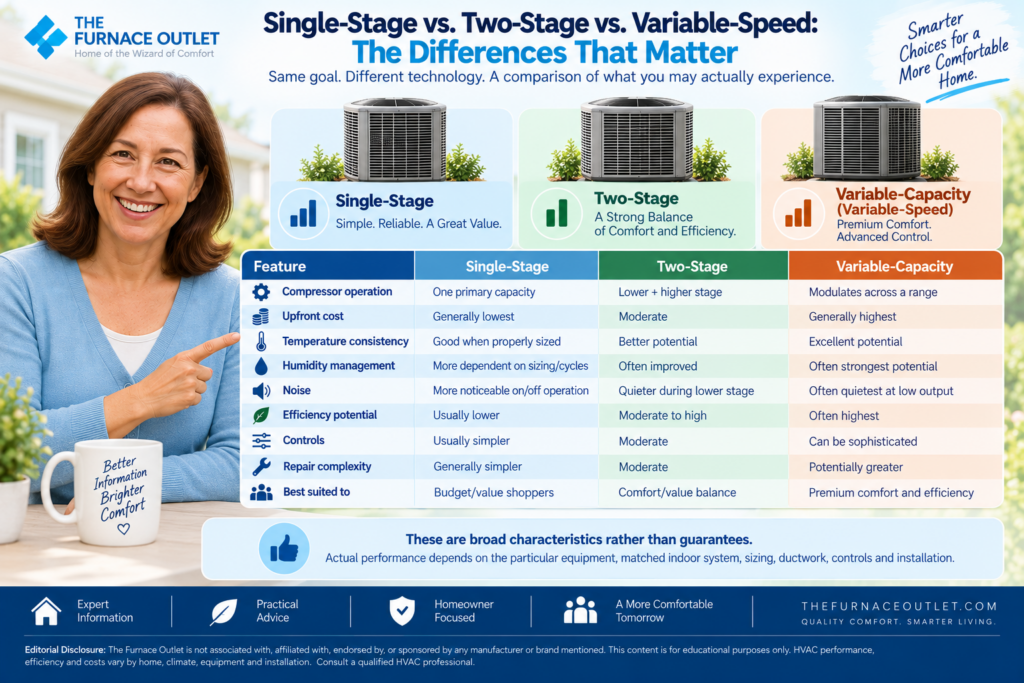
Instead of concentrating only on the technology, I find it more useful to compare what homeowners may actually experience.
| Feature | Single-Stage | Two-Stage | Variable-Capacity |
|---|---|---|---|
| Compressor operation | One primary capacity | Lower + higher stage | Modulates across a range |
| Upfront cost | Generally lowest | Moderate | Generally highest |
| Temperature consistency | Good when properly sized | Better potential | Excellent potential |
| Humidity management | More dependent on sizing/cycles | Often improved | Often strongest potential |
| Noise | More noticeable on/off operation | Quieter during lower stage | Often quietest at low output |
| Efficiency potential | Usually lower | Moderate to high | Often highest |
| Controls | Usually simpler | Moderate | Can be sophisticated |
| Repair complexity | Generally simpler | Moderate | Potentially greater |
| Best suited to | Budget/value shoppers | Comfort/value balance | Premium comfort and efficiency |
These are broad characteristics rather than guarantees. Actual performance depends on the particular equipment, matched indoor system, sizing, ductwork, controls and installation.
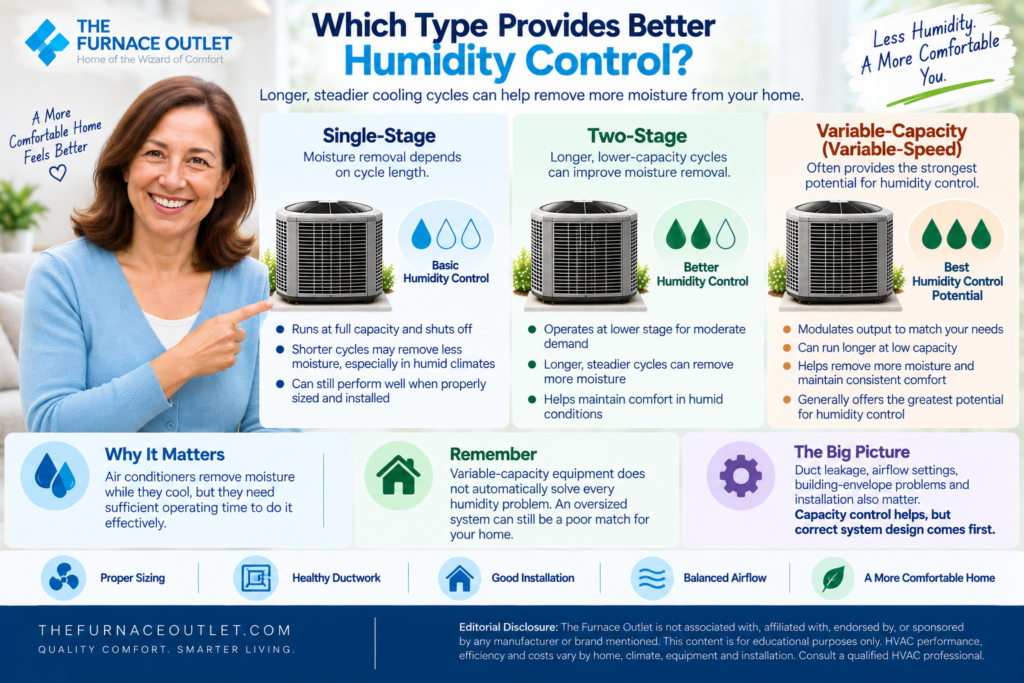
If I lived in a hot, humid climate, this would be high on my list of questions. Air conditioners remove moisture while they cool, but they need sufficient operating time to do it effectively. A correctly designed two-stage or variable-capacity system can often operate for longer periods at reduced output instead of rapidly satisfying the thermostat and shutting down.
That longer operation can support better moisture removal. However, buying variable-capacity equipment does not magically solve every humidity problem. An oversized premium system can still be a poor match for the home. Duct leakage, airflow settings, building-envelope problems and installation also matter.
Capacity control helps, but correct system design comes first.
Variable-capacity equipment generally has the greatest potential for quiet operation because it can spend substantial time operating below maximum output. Two-stage equipment can offer a similar advantage while operating in its lower stage. Single-stage equipment may produce a more noticeable transition because it moves between off and its operating capacity.
But don’t compare compressor technology alone. Manufacturer sound ratings, outdoor-unit design, fan technology, indoor airflow, equipment location and installation can all affect what you actually hear. If noise is particularly important—perhaps the condenser sits near a patio or bedroom—ask for the published sound data for the specific models you are comparing.
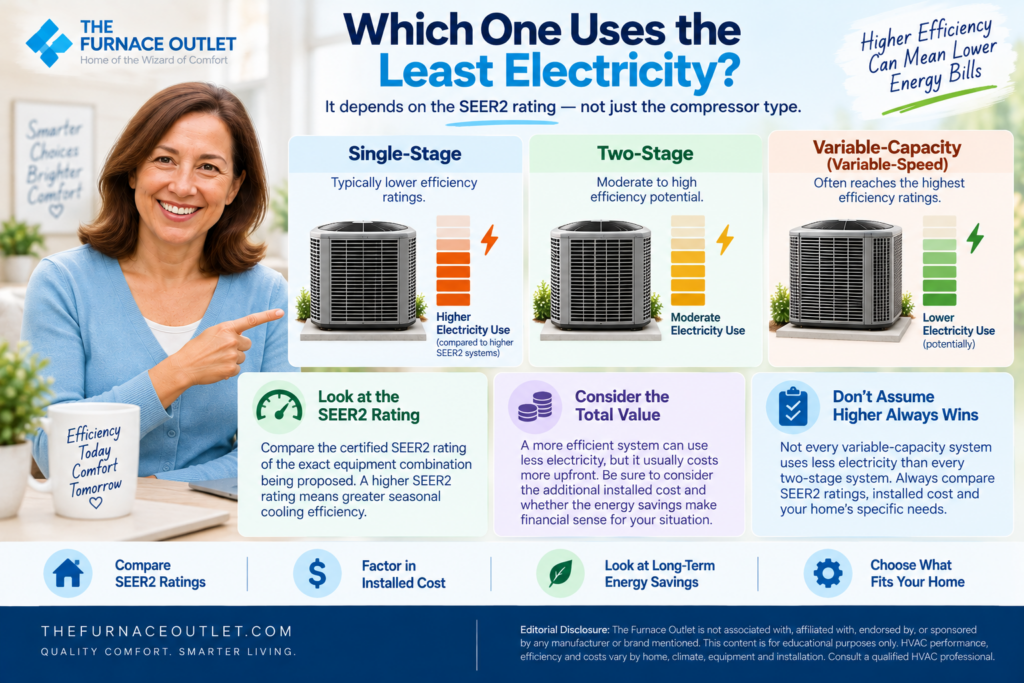
Variable-capacity systems frequently appear toward the higher end of manufacturer efficiency ranges, but compressor type and efficiency rating are not the same thing.
This is where SEER2 becomes useful. Rather than assuming every variable-capacity system must use less electricity than every two-stage system, compare the certified SEER2 rating of the exact equipment combinations being proposed.
A higher SEER2 rating represents greater rated seasonal cooling efficiency. However, as I explained in our Central AC SEER2 Ratings Explained guide, higher efficiency should still be considered alongside the additional installed cost. You can have a system that uses less electricity but costs so much more initially that the energy savings alone take many years to recover the upgrade price.
This is probably the most important warning in this comparison. Suppose your home actually requires approximately three tons of cooling capacity under design conditions. Installing an oversized four-ton variable-capacity system simply because it can modulate does not automatically make oversizing a good idea.
Variable-capacity technology provides flexibility, but it should not be used as an excuse to skip proper load calculations. The contractor should evaluate the home’s cooling requirements using an accepted sizing methodology such as ACCA Manual J, along with the duct system and airflow requirements. If one contractor carefully evaluates your home and recommends a properly sized two-stage system while another recommends an oversized premium system based primarily on square footage, I would pay far more attention to the first contractor’s methodology than to the second system’s impressive specification sheet.
This is an area where the simplest system can have an advantage. Single-stage equipment generally uses relatively straightforward compressor control. Variable-capacity systems can incorporate inverter electronics, sophisticated control boards, sensors and communicating thermostats.
That doesn’t mean advanced systems are unreliable. It means there may be more specialized technology involved when diagnosis or repair becomes necessary.
Before buying premium equipment, I would ask whether the contractor routinely services that particular product family, how readily replacement components are available locally, what the manufacturer’s parts warranty covers and what labor warranty the installer provides. A fantastic air conditioner is considerably less fantastic when the only technician familiar with it is two hours away.
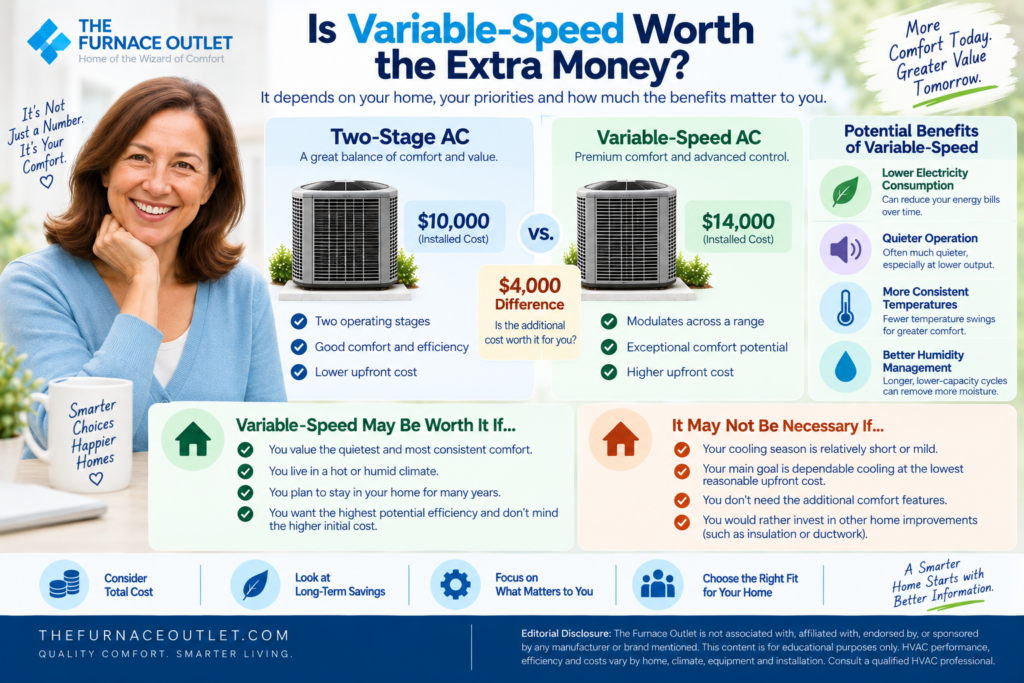
For some households, absolutely. For others, probably not. Imagine a properly installed two-stage system costs $10,000 while a comparable premium variable-capacity system costs $14,000. The question isn’t whether the $14,000 system is technologically superior. It probably is.
The question is whether the additional $4,000 creates enough value for you. Part of that value might come from lower electricity consumption. But much of it may come from quieter operation, smaller temperature swings, improved humidity management and more refined comfort.
If those improvements matter greatly to your household and you expect to remain in the home for many years, paying more can be perfectly rational. If your cooling season is short and you mainly want dependable cooling at the lowest reasonable ownership cost, premium modulation may provide benefits you simply don’t value enough to justify the price.
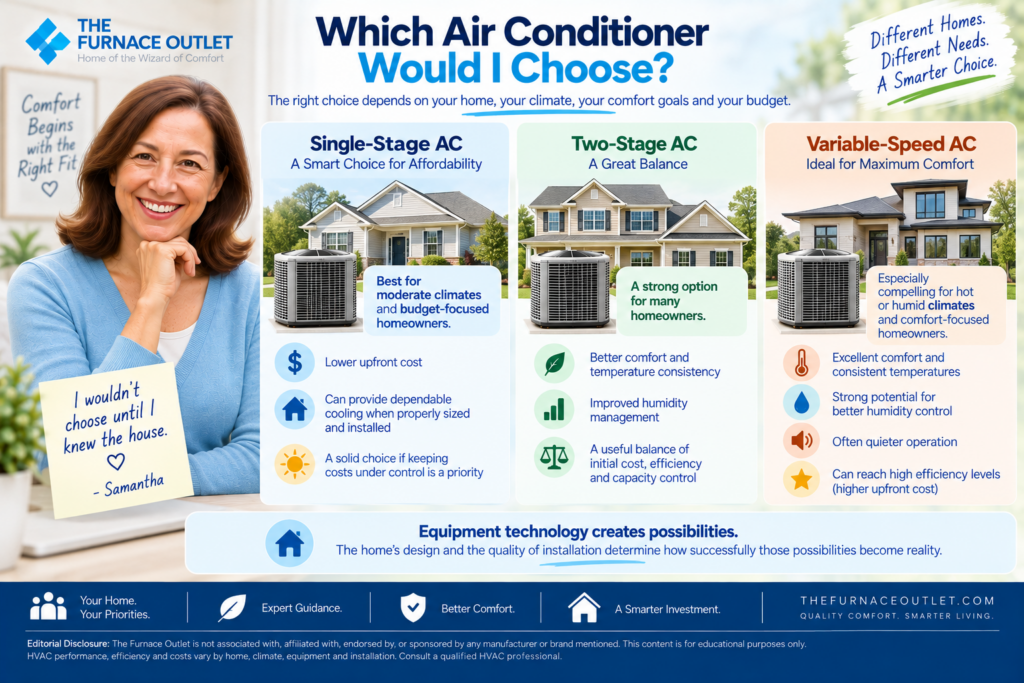
I wouldn’t choose until I knew the house. For a homeowner prioritizing affordability in a relatively moderate climate, I would be perfectly comfortable considering a good single-stage system, provided it was correctly sized and installed. For many homeowners who want better comfort without moving all the way to flagship pricing, I think two-stage equipment deserves particularly close attention. It can provide a useful balance between initial cost, efficiency and improved capacity control.
For a household in a hot or humid climate, or someone particularly sensitive to temperature swings and noise, variable-capacity equipment becomes much more compelling. It can provide excellent comfort while also reaching high efficiency levels. The important word is can. Equipment technology creates possibilities. The home’s design and the quality of installation determine how successfully those possibilities become reality.
When comparing contractor proposals, I would want more than “good, better, best” labels. I would ask:
| Question | Why It Matters |
|---|---|
| Is the compressor single-stage, two-stage or variable-capacity? | Confirms what technology you are actually buying |
| Is the indoor blower variable-speed? | Compressor and blower terminology can be confused |
| What is the certified SEER2 rating? | Allows a meaningful efficiency comparison |
| What is the AHRI reference number? | Helps verify the matched equipment combination |
| How was the cooling load calculated? | Proper sizing is essential |
| Has the ductwork been evaluated? | Airflow affects comfort and performance |
| What are the published sound ratings? | Important if quiet operation matters |
| What additional controls are required? | Premium systems may use communicating thermostats |
| What is the complete installed price? | Shows the real upgrade cost |
| What parts and labor warranties apply? | Helps evaluate long-term ownership |
| Do you routinely service this system? | Particularly important with sophisticated equipment |
A good contractor should be able to explain why a particular technology makes sense for your home, rather than simply telling you that the most expensive option is the best.
There is a natural temptation when comparing HVAC equipment to assume that single-stage is basic, two-stage is better and variable-speed is best. Technically, that progression describes increasing capacity-control sophistication, but it doesn’t automatically describe the smartest purchasing decision.
The best air conditioner is the one that fits your home, climate, comfort expectations and budget. I would start with proper sizing and ductwork. Once those fundamentals are addressed, I would compare the complete installed cost of single-stage, two-stage and variable-capacity options that are genuinely appropriate for the house.
Then I would ask myself what the extra money is buying. If it buys energy savings that make sense, excellent. If it buys quieter operation, better humidity management and steadier temperatures that my family will appreciate every summer, those benefits have value too. But if I am paying thousands more for technology that will make little practical difference in my home, I would rather keep the money.
Don’t buy the most sophisticated air conditioner simply because you can. Buy the level of technology whose benefits you understand and will actually use.
That, to me, is the smarter way to shop.
— Samantha Reyes, Samantha the Smart Shopper
The Furnace Outlet | THEFURNACEOUTLET.COM
Editorial Disclosure: The Furnace Outlet is not affiliated with, endorsed by, or sponsored by any manufacturer or brand mentioned. We do not receive manufacturer compensation for inclusion or rankings.
Educational Disclaimer: HVAC performance, sizing, efficiency, comfort and operating costs vary by home, climate, equipment, ductwork and installation. Consult a qualified HVAC professional and verify current equipment specifications before purchasing.
To enable screen reader support, press Ctrl+Alt+Z To learn about keyboard shortcuts, press Ctrl+slash
Banner hidden