Newsletter Subscribe
Enter your email address below and subscribe to our newsletter

HVAC made simple
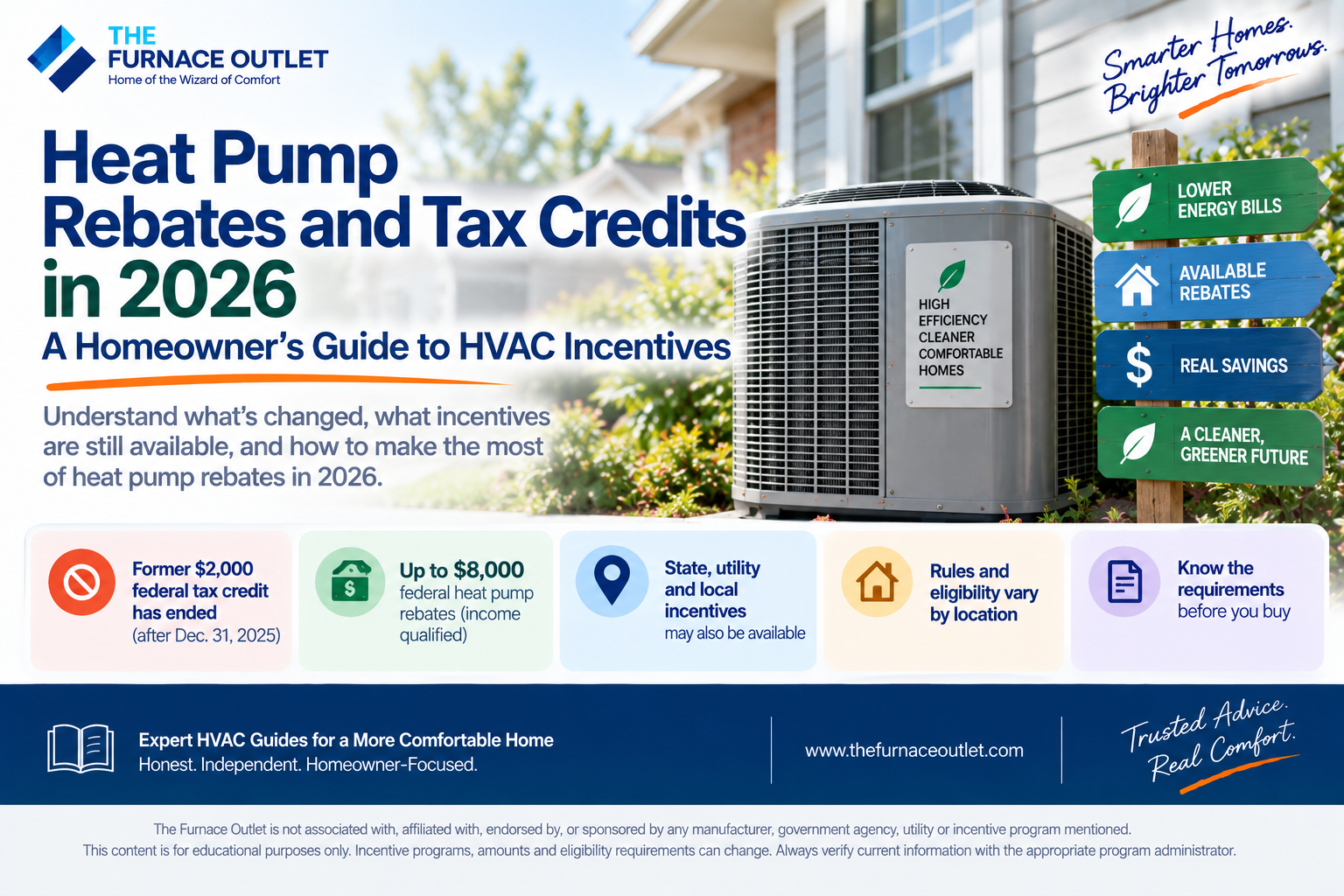
If you have been researching heat pumps online, there is a good chance you have seen statements such as “Get a $2,000 federal heat-pump tax credit” or “Save up to $8,000 on a new heat pump.” In 2026, those two statements need very different explanations. The old federal Energy Efficient Home Improvement Credit under Section 25C is no longer available for heat pumps placed in service after December 31, 2025. That is an important change, because a lot of older HVAC articles, contractor pages and buying guides still reference the previous $2,000 heat-pump tax credit. The IRS is explicit that the credit does not apply to property placed in service after December 31, 2025.
However, that does not mean heat-pump incentives disappeared in 2026. Federal Home Energy Rebate programs are still being administered through participating states, territories and Tribes, and an eligible ENERGY STAR-certified heat pump may qualify for substantial rebates. Utilities, states and local governments may also offer their own programs.
The trick is understanding which program applies to your household, your location and the exact equipment you plan to install. That is what I want to sort out in this guide.
— Jake Lawson, HVAC Specialist | The Furnace Outlet
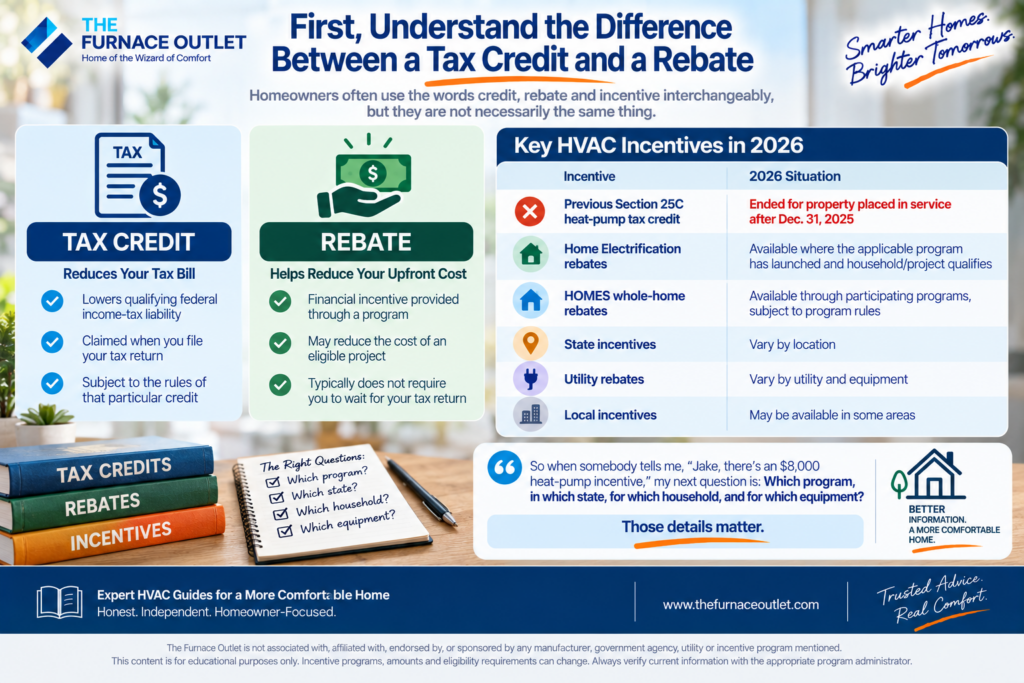
Homeowners often use the words credit, rebate and incentive interchangeably, but they are not necessarily the same thing. A tax credit generally reduces qualifying federal income-tax liability when you file your return, subject to the rules of that particular credit. A rebate, on the other hand, is a financial incentive provided through a program and may reduce the cost of an eligible project without requiring you to wait for your federal income-tax return.
That distinction is especially important in 2026 because the incentive landscape has changed.
| Incentive | 2026 Situation |
|---|---|
| Previous Section 25C heat-pump tax credit | Ended for property placed in service after Dec. 31, 2025 |
| Home Electrification rebates | Available where the applicable program has launched and household/project qualifies |
| HOMES whole-home rebates | Available through participating programs, subject to program rules |
| State incentives | Vary by location |
| Utility rebates | Vary by utility and equipment |
| Local incentives | May be available in some areas |
So when somebody tells me, “Jake, there’s an $8,000 heat-pump incentive,” my next question is: Which program, in which state, for which household, and for which equipment?
Those details matter.
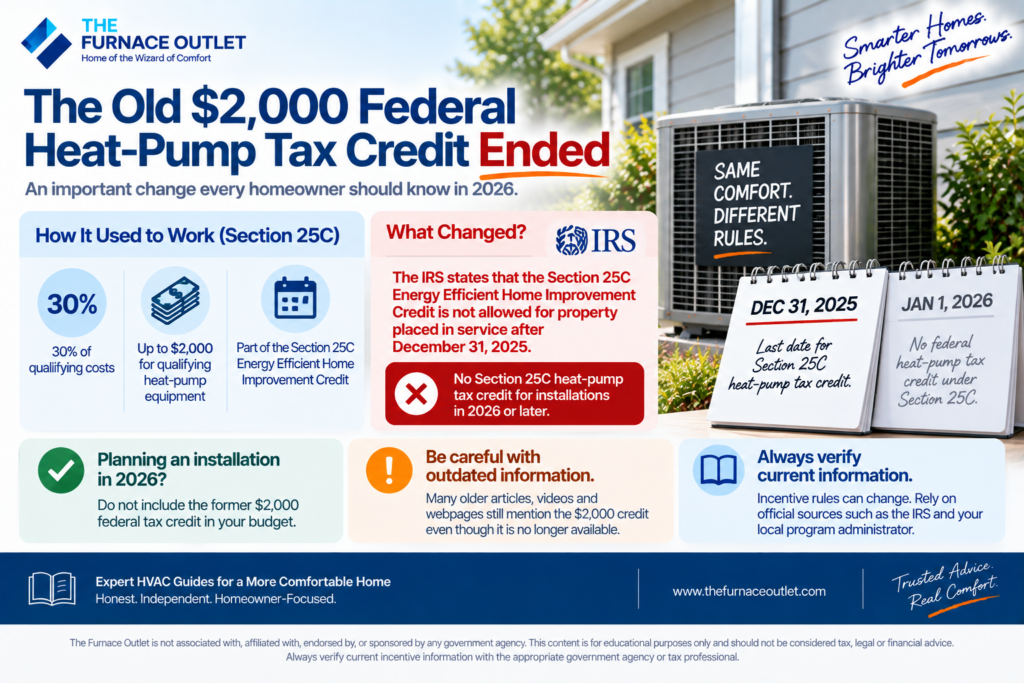
This is probably the most important correction homeowners need to understand in 2026. Under the previous Section 25C Energy Efficient Home Improvement Credit, qualifying heat pumps could receive a federal tax credit equal to 30% of qualifying costs, subject to a special annual limit of up to $2,000 for certain heat-pump equipment. But the law changed.
The IRS states that the Section 25C Energy Efficient Home Improvement Credit is not allowed for property placed in service after December 31, 2025. That means if you install a qualifying heat pump in 2026, you should not build your project budget around receiving that former $2,000 federal credit. I emphasize this because older information does not automatically disappear from the internet when tax law changes. You may still find articles, videos and contractor webpages describing the previous credit as though it were currently available. For a homeowner buying equipment in 2026, that information is outdated.
Do not let anyone include the former Section 25C $2,000 heat-pump tax credit in your 2026 savings calculation unless current IRS guidance changes.
As of this guide, it ended for property placed in service after December 31, 2025.
This is where the 2026 picture becomes more interesting. The Department of Energy’s Home Energy Rebates initiative includes two major programs: Home Electrification and Appliance Rebates, sometimes referred to by the program acronym HEEHR, and Home Owner Managing Energy Savings (HOMES) Rebates.
These are not the same as the expired Section 25C federal income-tax credit. They are rebate programs administered through states, territories and Tribes, which means availability, launch status, implementation details and eligible products can vary depending on where you live. DOE specifically advises homeowners to check their locality’s program status. That local administration is one of the most important concepts in this article. There isn’t one universal 2026 checkout button where every American homeowner purchases a heat pump and automatically receives the same rebate.
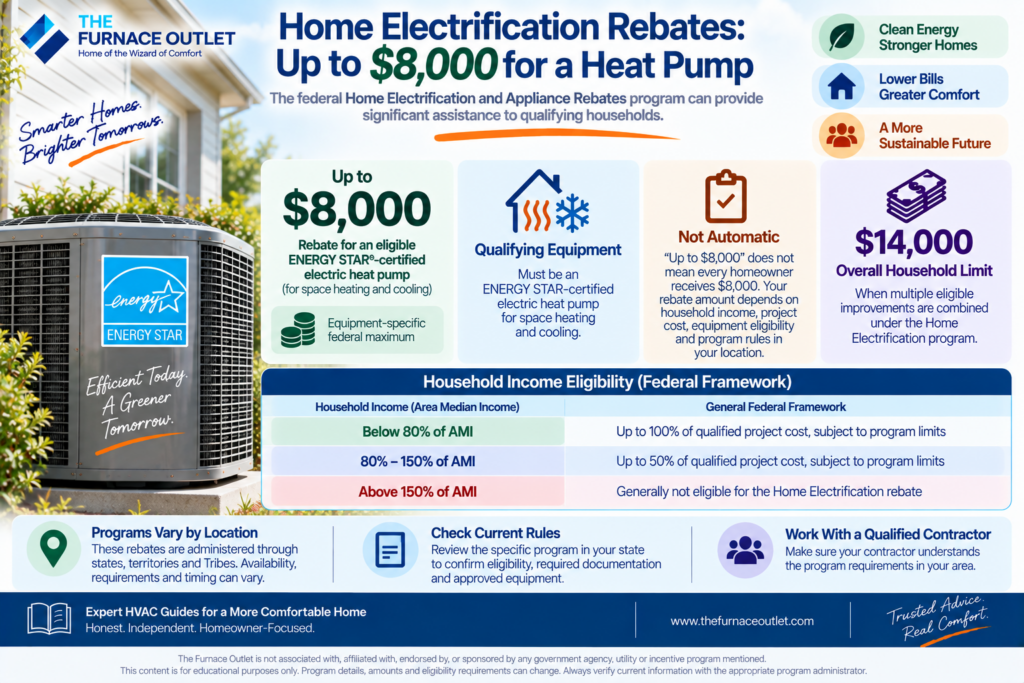
The Home Electrification and Appliance Rebates program can provide particularly substantial assistance to qualifying households. Under the federal program framework, an eligible ENERGY STAR-certified electric heat pump for space heating and cooling can qualify for a rebate of up to $8,000.
But “up to $8,000” is not the same as saying:
Every homeowner receives $8,000.
They don’t. Household income, project cost, equipment eligibility and the rules of the program operating in your location all matter.
The federal framework divides eligibility using Area Median Income (AMI).
| Household income | General federal framework |
|---|---|
| Below 80% of AMI | Up to 100% of qualified project cost, subject to program limits |
| 80%–150% of AMI | Up to 50% of qualified project cost, subject to program limits |
| Above 150% of AMI | Generally not eligible for the Home Electrification rebate |
For a qualifying heat pump, the equipment-specific federal maximum is $8,000. There is also an overall household limit of $14,000 under the federal Home Electrification framework when multiple eligible improvements are combined.
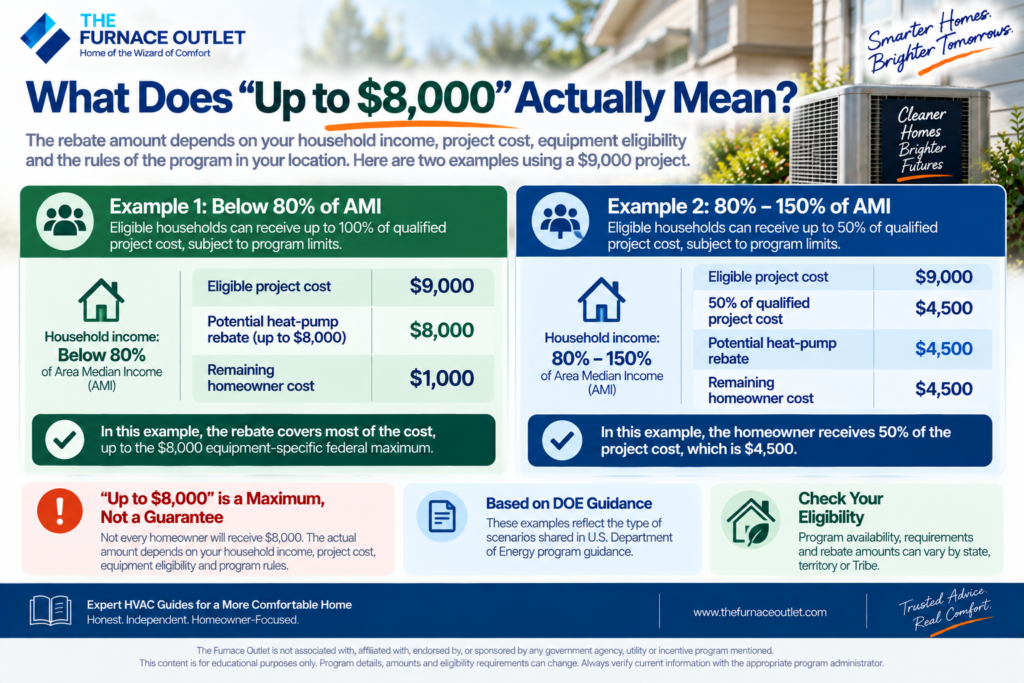
Here’s a simple example. Suppose an eligible household below 80% of its Area Median Income has an eligible heat-pump project costing $9,000.
Under DOE’s example framework:
DOE actually uses this type of example in its program guidance. Now imagine a household between 80% and 150% of AMI with the same $9,000 qualifying project.
Because that income category is generally limited to 50% of qualified project costs, the potential rebate in DOE’s example becomes:
The $8,000 figure is therefore a maximum, not a guaranteed payment. That distinction should appear in every responsible discussion of these rebates.
Unlike the old federal tax credit, these rebates are administered locally. Your state, territory or Tribe determines how its program operates within the federal framework, including which products qualify and how homeowners access the incentive. DOE maintains information that homeowners can use to check their locality’s program status.
This creates a situation where two homeowners purchasing similar heat pumps in different states may encounter very different incentive experiences. One program may already be accepting applications. Another may have different procedures or implementation details. That is why I would check incentives before signing the HVAC contract, not after installation.
You want to know whether the program requires preapproval, specific contractors, particular equipment, income verification, an energy assessment or other documentation before work begins. Do not assume you can install the equipment first and sort out the rebate later.
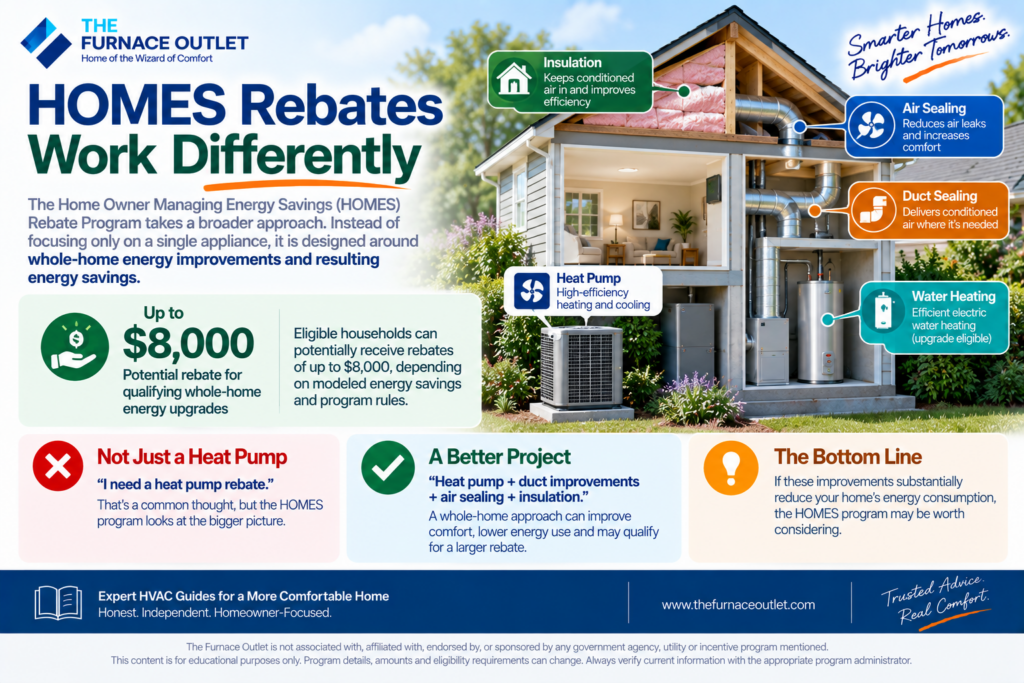
The second major federal program is the Home Owner Managing Energy Savings, or HOMES, Rebate Program. This program takes a broader approach. Instead of focusing only on purchasing a particular appliance, HOMES is designed around whole-home energy improvements and resulting energy savings. Eligible projects can involve heating and cooling equipment along with improvements such as insulation, air sealing, water heating and duct sealing.
DOE states that eligible households can potentially receive rebates of up to $8,000 for qualifying whole-home upgrades, depending on factors including modeled energy savings and program rules. This distinction matters.
A homeowner might initially think: “I need a heat pump rebate.”
But the better project may actually be: heat pump + duct improvements + air sealing + insulation.
If those improvements substantially reduce the home’s energy consumption, a whole-home program may deserve consideration.
This connects directly with something I emphasize throughout our heat-pump guides: the equipment is only one part of the system. Imagine installing a sophisticated variable-speed heat pump in a house with substantial duct leakage and poor attic insulation. The new equipment may be excellent, but you are asking it to overcome problems elsewhere in the building.
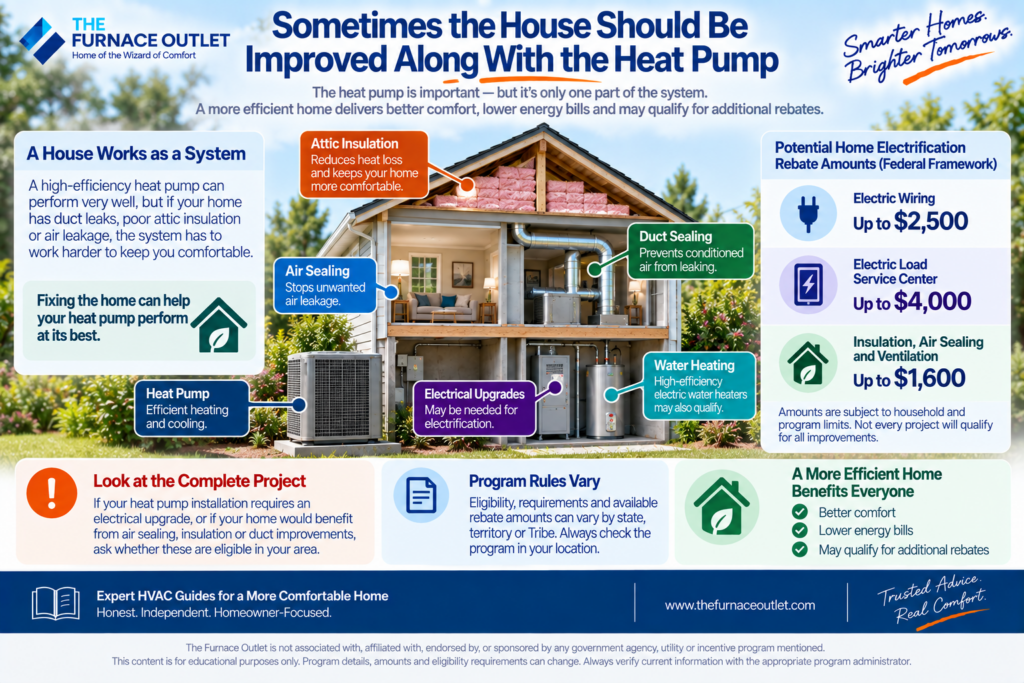
Federal rebate programs recognize this broader picture. Under the Home Electrification framework, qualifying improvements can include more than the heat pump itself. Federal maximums include amounts such as up to $2,500 for eligible electric wiring, up to $4,000 for an eligible electric load service center and up to $1,600 for eligible insulation, air sealing and ventilation, subject to household and program limits. That does not mean every heat-pump project automatically receives those additional amounts.
It means homeowners should investigate the complete project. If installing a heat pump requires an electrical upgrade or the house would benefit substantially from air sealing, ask whether those improvements are eligible under the program available in your area.
This is an expense homeowners sometimes overlook. Suppose you are replacing fossil-fuel heating with a heat pump and your existing electrical panel or wiring cannot adequately support the new equipment.
The HVAC quote can suddenly become an HVAC plus electrical project. Under the federal Home Electrification framework, qualifying households may potentially receive rebates toward eligible electrical improvements, including the limits mentioned above.
Again, local program rules matter. Before approving a proposal, I would ask the HVAC contractor whether electrical modifications are required and get those costs identified separately. That makes it easier to determine whether an incentive applies.
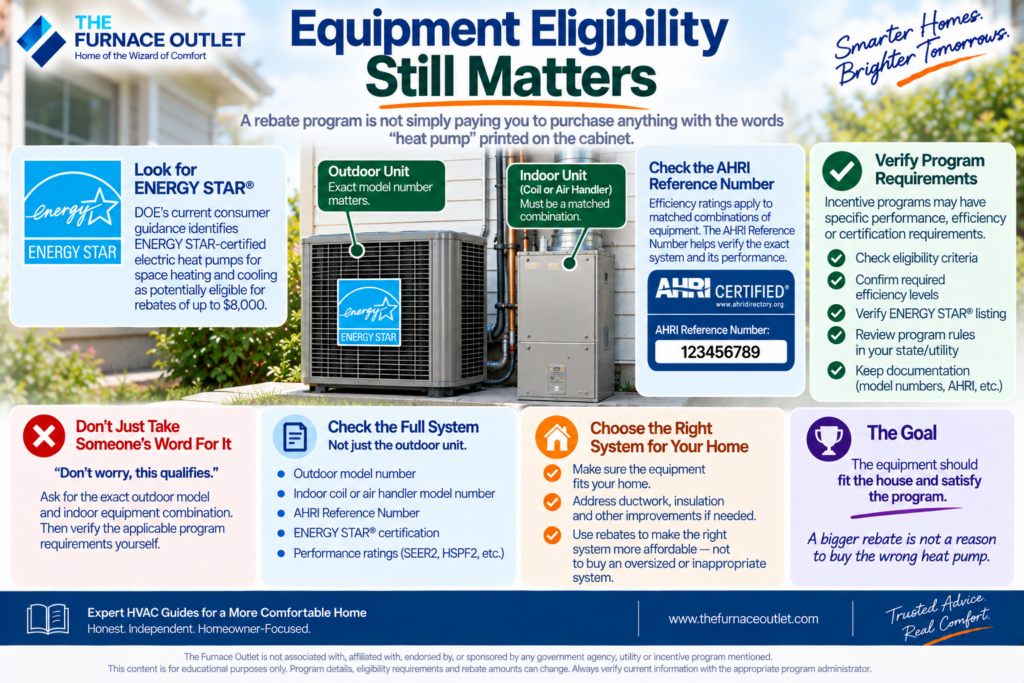
A rebate program is not simply paying you to purchase anything with the words heat pump printed on the cabinet. DOE’s current consumer guidance identifies ENERGY STAR-certified electric heat pumps for space heating and cooling as potentially eligible for Home Electrification rebates of up to $8,000.
That means I would never rely solely on a contractor saying:
“Don’t worry, this qualifies.”
Ask for the exact outdoor model and indoor equipment combination being proposed.
Then verify the applicable program requirements. This is another reason the AHRI Reference Number we discussed in our heat-pump brand guide is useful. Efficiency ratings apply to matched combinations of equipment, and incentive programs may impose specific performance or certification requirements. The equipment should fit the house and satisfy the program. Don’t reverse that order by buying an inappropriate heat pump simply because it carries a larger rebate.
This is one of the easiest traps to fall into. Imagine Contractor A proposes an appropriately sized system for $10,000 and Contractor B proposes a much more expensive system for $17,000. If the second contractor talks constantly about an $8,000 rebate, the $17,000 proposal may suddenly feel inexpensive.
But the correct question is still: What is my final eligible project cost, what incentive am I actually approved for, and which system is the better fit for my house?
A rebate does not transform unnecessary equipment into a good investment. I would evaluate the project first — Manual J load, equipment capacity, cold-weather performance, ducts, controls, warranty, installation quality and total price — and then apply available incentives. Choose the right system first. Use the incentive to make the right system more affordable.
Federal Home Energy Rebates are only part of the picture. Depending on where you live, there may also be incentives from state energy agencies, electric utilities, municipal utilities, local governments or regional efficiency programs.
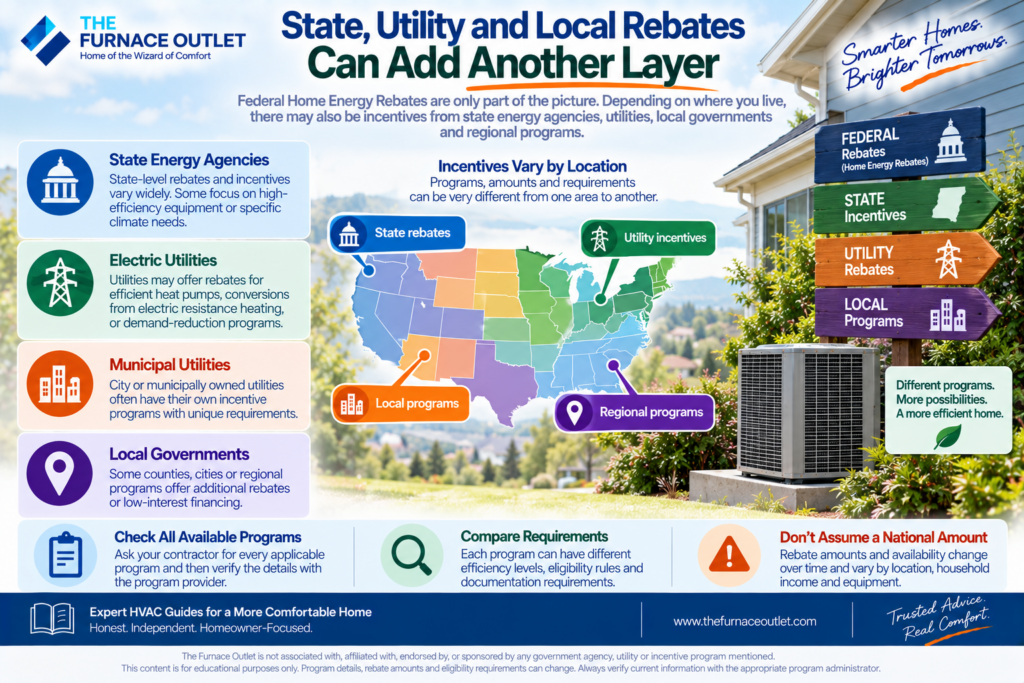
Those programs can have completely different requirements. One utility may require specific efficiency levels. Another may provide a rebate for converting from electric resistance heating. A program in a colder region might emphasize cold-climate heat-pump performance. Some incentives may be restricted by household income or building type.
Because these programs change, I would not put a national dollar amount on them. Instead, I would ask the contractor for every applicable program and then independently verify the requirements with the organization providing the incentive.
Homeowners understandably want to combine every available incentive.
Different programs can have rules about combining incentives, calculating project cost, determining household contributions or preventing multiple rebates from paying for the same expense. The answer can also depend on how a particular state or utility has designed its program.
So I would never write: $8,000 federal rebate + $2,000 utility rebate + $1,500 state rebate = $11,500 guaranteed savings.
Instead, verify stacking rules before calculating the final project economics. Your contractor may help identify programs, but the program administrator should be the authority on eligibility.
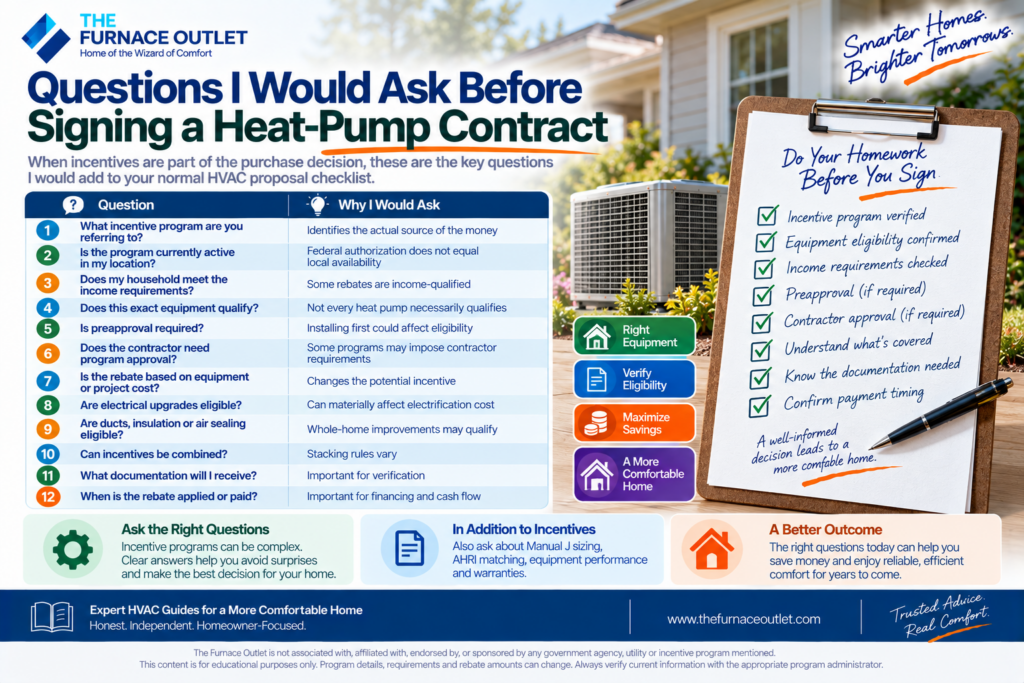
When incentives are part of the purchase decision, I would add these questions to the normal HVAC proposal checklist:
| Question | Why I Would Ask |
|---|---|
| What incentive program are you referring to? | Identifies the actual source of the money |
| Is the program currently active in my location? | Federal authorization does not equal local availability |
| Does my household meet the income requirements? | Some rebates are income-qualified |
| Does this exact equipment qualify? | Not every heat pump necessarily qualifies |
| Is preapproval required? | Installing first could affect eligibility |
| Does the contractor need program approval? | Some programs may impose contractor requirements |
| Is the rebate based on equipment or project cost? | Changes the potential incentive |
| Are electrical upgrades eligible? | Can materially affect electrification cost |
| Are ducts, insulation or air sealing eligible? | Whole-home improvements may qualify |
| Can incentives be combined? | Stacking rules vary |
| What documentation will I receive? | Important for verification |
| When is the rebate applied or paid? | Important for financing and cash flow |
I would want those answers in addition to the normal questions about Manual J sizing, AHRI matching, equipment performance and warranties.
Whenever government incentives become large, advertising tends to become aggressive. You may see language such as: “Government pays for your new heat pump.”
For some income-qualified households participating in particular programs, rebates can indeed cover a substantial portion of an eligible project. But that does not make a heat pump universally free. There are eligibility limits, project-cost limits, household-income rules, equipment requirements and local program procedures. DOE’s federal framework itself demonstrates how household contribution changes depending on income and project cost. I would therefore be cautious about any contractor or lead-generation website promising a specific rebate before asking where you live, what equipment is being installed and whether you meet the program’s requirements.
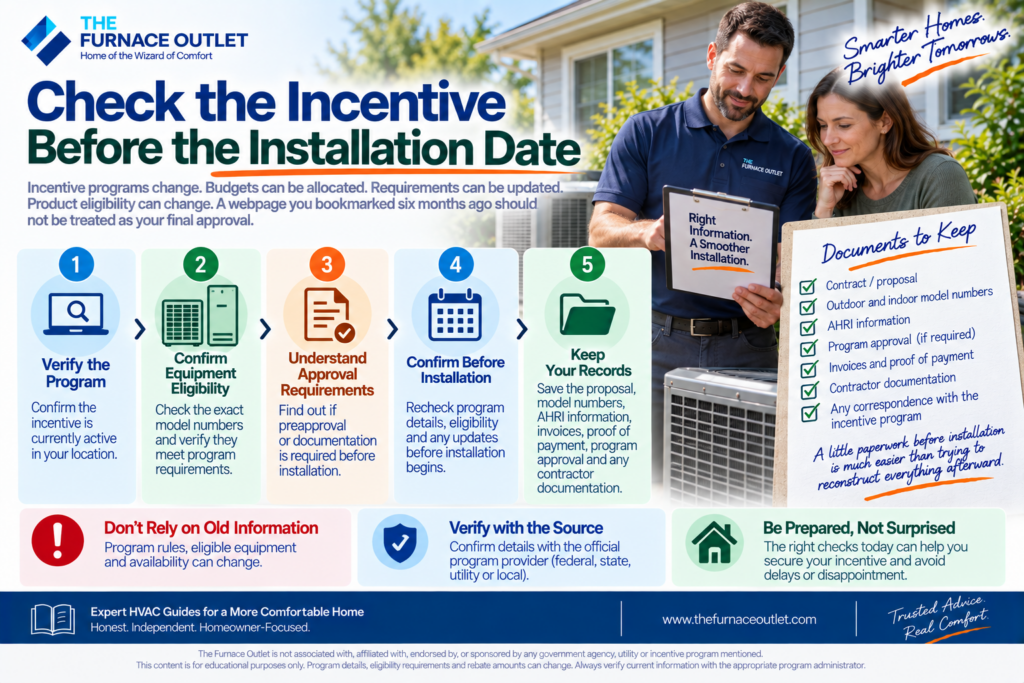
This is another practical lesson worth emphasizing. Incentive programs change. Budgets can be allocated. Requirements can be updated. Product eligibility can change. Local programs can open or modify procedures. That means a webpage you bookmarked six months ago should not be treated as your final approval.
And before installation begins, confirm whether the program requires any approval or documentation beforehand. I would keep copies of the proposal, model numbers, AHRI information, invoices, proof of payment, program approval and any contractor documentation. A little paperwork before installation is much easier than trying to reconstruct everything afterward.
Geothermal systems deserve a separate note because they historically fell under the Residential Clean Energy Credit, Section 25D, rather than the same rules that applied to conventional air-source heat pumps under Section 25C. But that federal credit changed too. The IRS states that the Residential Clean Energy Credit is not available for expenditures made after December 31, 2025.
So homeowners should not assume that installing a geothermal heat pump in 2026 automatically provides the previous 30% federal residential clean-energy credit. State, utility or other programs may still exist, but those need to be researched separately.
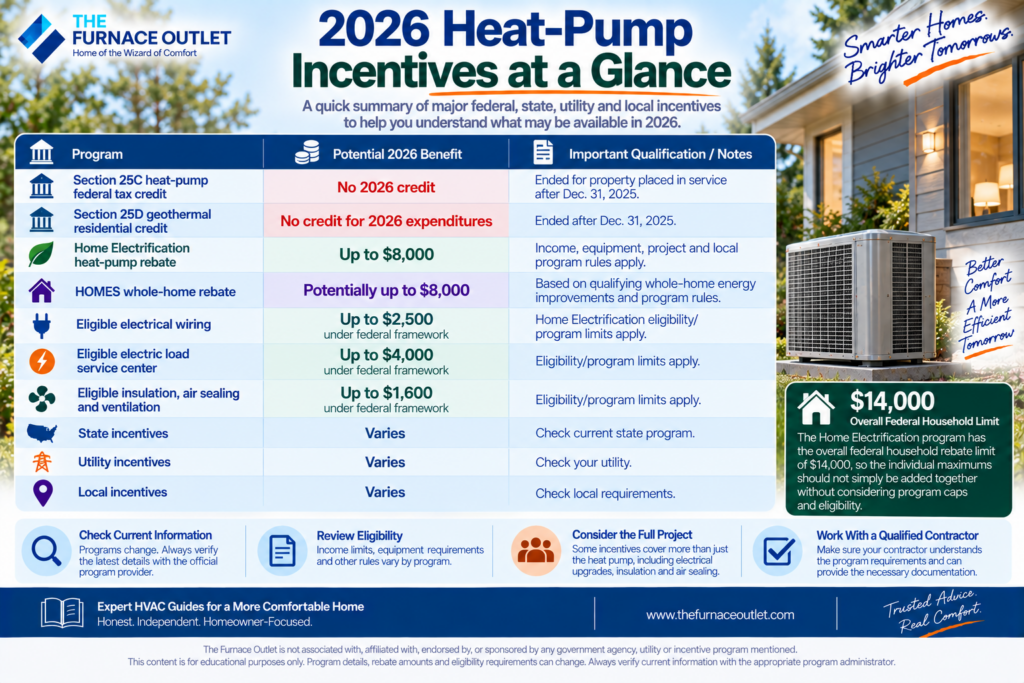
Here is the simplified picture I would keep in mind:
| Program | Potential 2026 Benefit | Important Qualification |
|---|---|---|
| Section 25C heat-pump federal tax credit | No 2026 credit | Ended for property placed in service after Dec. 31, 2025 |
| Section 25D geothermal residential credit | No credit for 2026 expenditures | Ended after Dec. 31, 2025 |
| Home Electrification heat-pump rebate | Up to $8,000 | Income, equipment, project and local program rules apply |
| HOMES whole-home rebate | Potentially up to $8,000 | Based on qualifying whole-home energy improvements/program rules |
| Eligible electrical wiring | Up to $2,500 under federal framework | Home Electrification eligibility/program limits apply |
| Eligible electric load service center | Up to $4,000 under federal framework | Eligibility/program limits apply |
| Eligible insulation/air sealing/ventilation | Up to $1,600 under federal framework | Eligibility/program limits apply |
| State incentives | Varies | Check current state program |
| Utility incentives | Varies | Check your utility |
| Local incentives | Varies | Check local requirements |
The Home Electrification program also has an overall federal household rebate limit of $14,000, so the individual maximums should not simply be added together without considering program caps and eligibility.
If I were replacing the heat pump in my own house in 2026, I would start with the house rather than the rebate. First, I would determine what the home actually needs. That means understanding the heating and cooling loads, existing ductwork, electrical capacity and any insulation or air-sealing problems.
Then I would identify the appropriate equipment. Only after that would I investigate every incentive available for that project. Why? Because chasing the maximum rebate can lead homeowners toward equipment they do not need or projects that are more expensive than necessary. The incentive should improve the economics of a good HVAC decision. It should not make the decision for you.
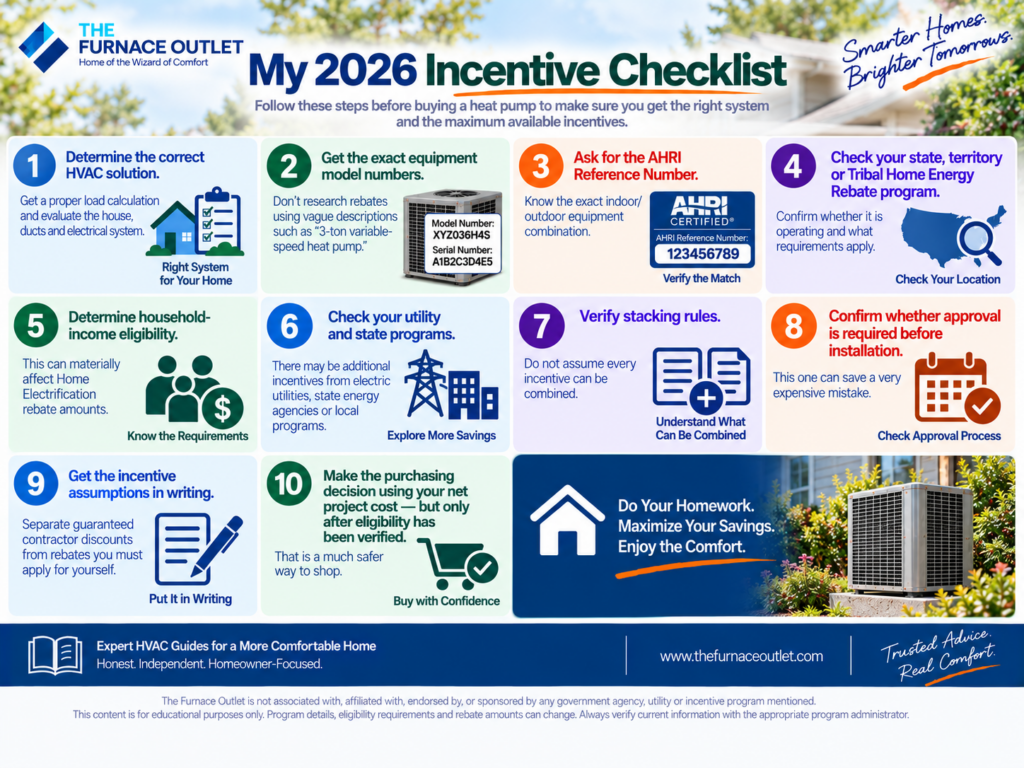
Before buying a heat pump, I would work through this sequence:
1. Determine the correct HVAC solution. Get a proper load calculation and evaluate the house, ducts and electrical system.
2. Get the exact equipment model numbers. Don’t research rebates using vague descriptions such as “3-ton variable-speed heat pump.”
3. Ask for the AHRI Reference Number. Know the exact indoor/outdoor equipment combination.
4. Check your state, territory or Tribal Home Energy Rebate program. Confirm whether it is operating and what requirements apply.
5. Determine household-income eligibility. This can materially change Home Electrification rebate amounts.
6. Check your utility and state programs. There may be additional incentives.
7. Verify stacking rules. Do not assume every incentive can be combined.
8. Confirm whether approval is required before installation. This one can save a very expensive mistake.
9. Get the incentive assumptions in writing. Separate guaranteed contractor discounts from rebates you must apply for yourself.
10. Make the purchasing decision using your net project cost — but only after eligibility has been verified. That is a much safer way to shop.
Heat-pump incentives still have the potential to make a meaningful difference for American homeowners in 2026, but the landscape is different from what many older HVAC articles describe.
The biggest change is straightforward: the former Section 25C federal Energy Efficient Home Improvement Credit is not available for heat pumps placed in service after December 31, 2025. The IRS also states that the Section 25D Residential Clean Energy Credit ended for expenditures after that date.
At the same time, the federal Home Energy Rebates initiative continues to provide potential assistance through programs administered by states, territories and Tribes. Under the federal Home Electrification framework, qualifying households may be eligible for up to $8,000 toward an eligible ENERGY STAR-certified electric heat pump, while HOMES rebates can support qualifying whole-home energy upgrades.
So I would not ask simply: “How big is the heat-pump rebate?”
I would ask: “What incentives are actually available for my household, in my location, for this exact system and this specific project?”
That question will get you much closer to the number that really matters.
— Jake Lawson, HVAC Specialist | The Furnace Outlet
Best Heat Pumps of 2026: The Complete Homeowner Buying Guide – The Furnace Outlet
For current program information, start with the U.S. Department of Energy Home Energy Rebates Program and DOE Energy Savings Hub. For federal tax-credit termination dates, use the IRS energy-credit modification FAQs and IRS Form 5695 instructions. These are better sources than relying on older HVAC articles because incentive rules and local program availability can change.
Editorial Disclosure: The Furnace Outlet is not associated with, affiliated with, endorsed by, or sponsored by any HVAC manufacturer, government agency, utility or incentive program mentioned in this article. We do not receive compensation from manufacturers for inclusion or rankings. This content is provided for independent educational and editorial purposes and should not be considered tax, legal or financial advice. Homeowners should verify current eligibility and program requirements with the relevant government agency, utility or program administrator before purchasing equipment.