Newsletter Subscribe
Enter your email address below and subscribe to our newsletter

HVAC made simple

When homeowners ask me, “Jake, what is the best heat pump brand?” I usually disappoint them a little at first because I don’t give them one name.
That is because buying a heat pump is not like buying a television. You cannot simply compare two boxes on a specification sheet, choose the one with the highest efficiency number and assume you have purchased the better system. A heat pump becomes part of your house. Its performance depends on the outdoor unit, indoor coil or air handler, controls, ductwork, electrical system, refrigerant piping, sizing and — perhaps most importantly — the contractor who designs and installs everything.
There are several manufacturers I would be comfortable considering in 2026, including American Standard, Carrier, Trane, Lennox, Bosch, Mitsubishi Electric, Daikin and Goodman. Each approaches the market somewhat differently. Some concentrate heavily on premium communicating systems. Others have particularly interesting cold-climate equipment, compact side-discharge designs or value-oriented inverter systems.
The goal of this guide is therefore not to create another simplistic “Brand A is #1 and Brand B is #8” ranking. I would rather show you what each manufacturer does particularly well, where I would look more carefully and how I would compare actual systems before spending thousands of dollars.
— Jake Lawson, HVAC Specialist | The Furnace Outlet
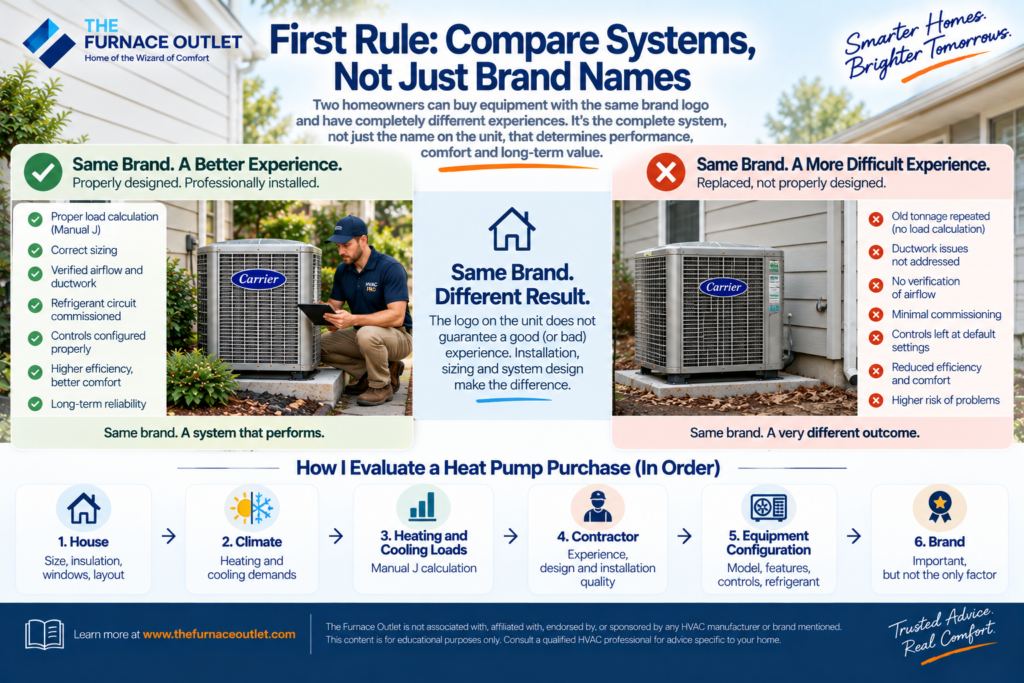
Two homeowners can buy equipment carrying the same manufacturer’s logo and have completely different experiences. One might receive a properly sized variable-speed system installed by an experienced contractor who performs a load calculation, verifies airflow, commissions the refrigerant circuit and configures the controls correctly. Another homeowner may receive equipment from the same brand that was selected primarily by replacing the old unit with the same tonnage and installed without addressing poor ductwork.
Those are not really equivalent HVAC systems. This is particularly important with today’s inverter and communicating heat pumps. The equipment has become more sophisticated, which makes good design and commissioning even more valuable.
I would consequently evaluate a heat-pump purchase in roughly this order: House → Climate → Heating and cooling loads → Contractor → Equipment configuration → Brand.
Brand matters. It simply shouldn’t be allowed to overpower everything else.
I don’t judge manufacturers solely by the highest SEER2 number they can print in a brochure. Instead, I look at the complete product offering and whether there is equipment appropriate for different houses and climates.

Important factors include SEER2 and HSPF2 efficiency, low-temperature heating performance, compressor technology, modulation range, sound levels, controls, indoor/outdoor equipment compatibility, refrigerant platform, serviceability, warranty terms and local contractor support.
Cold-climate homeowners need to go further. If your winter design temperature is around 5°F, for example, knowing that a heat pump has an impressive SEER2 rating tells me relatively little about its ability to heat your house on that particular morning. I want to see its actual heating capacity and efficiency at low outdoor temperatures. The same principle applies to warmer regions. A homeowner in Georgia may care more about cooling efficiency, humidity control and long low-capacity operation than the equipment’s ability to operate at temperatures far below zero.
There is no reason both homeowners should automatically buy the same heat pump.
American Standard deserves serious consideration when I am looking at conventional ducted premium heat-pump systems. Its AccuComfort Variable Speed Platinum 20 is particularly interesting. American Standard currently lists configurations reaching up to 22.4 SEER2 and 10.5 HSPF2, with variable-speed operation. The manufacturer also identifies the current product line as supporting lower-GWP refrigerant technology.
What I like about this type of system is not simply the peak efficiency number. Variable-speed equipment can adjust capacity rather than operating only at full output, which can support longer cycles, steadier indoor temperatures and better humidity management when the system is properly designed. American Standard also offers more conventional and side-discharge options, so homeowners do not necessarily have to purchase the flagship model simply because they like the manufacturer.
Where I would consider American Standard: homeowners looking for a premium ducted system, variable-speed comfort and a broad conventional HVAC ecosystem.
What I would verify: the exact indoor/outdoor combination, actual AHRI-rated performance, local dealer expertise and whether the premium equipment provides enough benefit to justify its installed cost.
Carrier’s Infinity 24 with Greenspeed Intelligence (25VNA4) remains one of the premium systems I would put on a serious comparison list. Carrier currently rates the system at up to 23 SEER2 and 10.5 HSPF2, with sound levels listed as low as 51 dB. Its variable-speed compressor can adjust between approximately 25% and 100% capacity when paired with the appropriate Infinity controls.
That modulation capability is what interests me more than simply seeing “23 SEER2.” A system capable of operating at substantially reduced capacity can spend more time matching the house’s smaller loads instead of repeatedly cycling between full output and off. Carrier also has a particularly interesting cold-climate offering. The company reports that its Infinity Variable-Speed Ultimate Cold Climate Heat Pump completed DOE’s Cold Climate Heat Pump Challenge and is designed for operation down to -23°F, with 100% heating capacity at 0°F under its published conditions.
That does not mean every Carrier heat pump provides those capabilities. Model numbers matter.
Where I would consider Carrier: premium whole-home systems, homeowners prioritizing sophisticated modulation and controls, and selected cold-climate applications.
What I would verify: exact model, low-temperature capacity where relevant, communicating-control requirements, dealer expertise and complete installed price.
Trane belongs on the shortlist whenever I am evaluating mainstream and premium ducted heat pumps. I tend to think of Trane and American Standard together because they share considerable engineering heritage and equipment architecture, although individual models, controls, dealer networks, pricing and product positioning can differ.
That last point is important. If you receive proposals for comparable Trane and American Standard systems, I would not make the decision based purely on which badge you recognize more easily. I would compare the actual model numbers, AHRI combinations, contractor quality, control package, warranty terms and installed price. A better contractor installing the correctly selected system is usually more valuable to me than winning an argument over two closely related brand names.
Where I would consider Trane: homeowners wanting an established ducted HVAC platform with options ranging from mainstream equipment through sophisticated variable-speed systems.
What I would verify: exact system ratings rather than brand-level marketing, dealer support, controls, low-temperature performance and installed cost.
If high efficiency and premium variable-capacity equipment are major priorities, Lennox deserves attention. The Lennox SL25XPV currently carries published ratings of up to 23 SEER2 and 10.3 HSPF2 and uses variable-capacity operation. Lennox’s current lineup also extends beyond the flagship model. Its heat-pump portfolio includes newer variable-capacity and cold-climate equipment, giving homeowners several efficiency and performance levels rather than forcing everyone into the most expensive product.
That is how I would shop Lennox. I would not automatically say, “Give me the highest-efficiency Lennox available.” Once equipment becomes very efficient, the additional purchase price can increase faster than the practical savings for some homes. If moving from a good mid-tier system to the flagship adds several thousand dollars to the installed proposal, I want the contractor to show me what I am receiving for that money — better low-load operation, improved cold-weather performance, quieter operation, controls, efficiency or some combination of those benefits.
Where I would consider Lennox: premium projects where variable-capacity comfort and high efficiency are priorities.
What I would verify: installed-price premium, exact matched-system ratings, controls, local parts/service support and realistic energy savings rather than relying solely on the maximum SEER2 figure.
Bosch has become one of the manufacturers I find particularly interesting when discussing modern ducted inverter heat pumps. Its IDS family includes several inverter ducted configurations, while the newer IDS Ultra targets cold-climate applications. Bosch’s current documentation also shows R-454B versions across multiple IDS product families.
From our earlier cold-climate comparison, the IDS Ultra stands out because Bosch publishes meaningful low-temperature information rather than merely advertising that the compressor can continue running at some extremely low outdoor temperature. That distinction matters.
A homeowner does not really need to know whether a compressor can technically operate at -10°F if the house requires substantially more heat than the system can deliver at that temperature. I want to compare available heating capacity against the home’s Manual J heating load. Bosch can also be attractive in retrofit situations because its IDS approach gives contractors flexibility in certain ducted applications.
Where I would consider Bosch: inverter retrofits, ducted electrification projects and cold-climate applications where the IDS Ultra’s performance fits the home’s load.
What I would verify: local Bosch expertise, exact indoor/outdoor combination, low-temperature capacity, controls and whether the installer has experience commissioning inverter equipment.
Mitsubishi Electric has long been associated with ductless and variable-refrigerant equipment, but homeowners should not assume Mitsubishi means “mini-split mounted on the wall.”. The company offers equipment that can serve ducted applications as well. Its P-Series PUZ-HA Hyper-Heating equipment is particularly relevant to colder regions. Mitsubishi states that the system uses its Flash Injection technology to maintain strong heating performance at low temperatures and guarantees heating operation down to -13°F.
Again, “operates to -13°F” should not be interpreted as “will heat every house at -13°F.” The home’s heating load still has to be compared with the equipment’s available capacity at the relevant outdoor temperature. Mitsubishi becomes especially interesting when a house has zoning challenges, additions, areas without existing ductwork or a design where multiple smaller zones make more sense than forcing everything through one central duct system.
Where I would consider Mitsubishi Electric: cold climates, ductless or mixed ducted/ductless projects, additions, zoning applications and homes where Hyper-Heating performance is valuable.
What I would verify: system configuration, low-temperature capacity, indoor-unit design, aesthetics where ductless heads are involved and availability of experienced local installers.
Daikin is another manufacturer I would put on a 2026 comparison list, particularly when looking at inverter equipment. Daikin has extensive experience with variable-speed refrigeration technology, and its FIT-style systems are particularly appealing where homeowners want a compact side-discharge outdoor unit rather than the traditional large top-discharge cabinet.
That can matter more than homeowners initially realize. Side-discharge equipment can be useful where property setbacks, narrow side yards, decks or other space constraints complicate placement. I also like having Daikin in the conversation because it gives homeowners another inverter-system option rather than assuming premium variable-speed automatically means one of the traditional U.S. flagship brands. As always, though, I would evaluate the complete matched system and dealer.
Where I would consider Daikin: inverter-focused projects, compact installations, side-yard applications and homeowners seeking variable-speed alternatives.
What I would verify: exact model generation, refrigerant, AHRI match, controls, installer familiarity and local support.
Goodman is often described as a “budget brand,” but that label has become too simplistic. Yes, Goodman remains attractive to homeowners looking for value. But its current heat-pump lineup also includes inverter equipment. The GZV6S, for example, is a side-discharge variable-speed inverter heat pump rated at up to 19 SEER2 and 8.8 HSPF2, with published quiet-mode operation as low as 45 dBA under specified conditions.
Goodman’s broader current lineup includes the GZV9S, GZV6S, GZV7S and more conventional models at different efficiency levels. This makes Goodman interesting when I am trying to balance equipment capability against project budget. But I would apply exactly the same rule to Goodman that I apply to Carrier, Lennox or any premium brand: installation quality matters enormously.
A less expensive heat pump does not become a bargain if the contractor oversizes it, ignores duct restrictions or fails to commission it correctly.
Where I would consider Goodman: value-conscious installations, homeowners who want inverter technology without automatically moving into the highest premium price category and straightforward ducted replacements.
What I would verify: contractor quality, exact model, matched indoor equipment, warranty registration requirements and local service support.
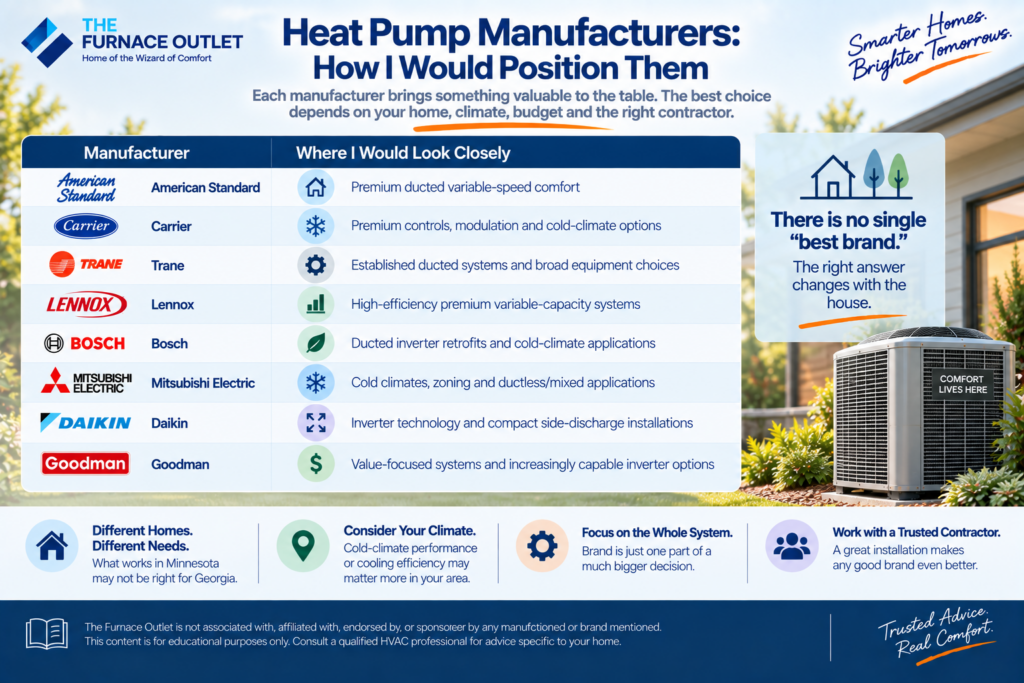
Rather than declaring winners and losers, this is a more useful way to think about the manufacturers we’ve discussed:
| Manufacturer | Where I Would Look Closely |
|---|---|
| American Standard | Premium ducted variable-speed comfort |
| Carrier | Premium controls, modulation and cold-climate options |
| Trane | Established ducted systems and broad equipment choices |
| Lennox | High-efficiency premium variable-capacity systems |
| Bosch | Ducted inverter retrofits and cold-climate applications |
| Mitsubishi Electric | Cold climates, zoning and ductless/mixed applications |
| Daikin | Inverter technology and compact side-discharge installations |
| Goodman | Value-focused systems and increasingly capable inverter options |
Notice that I deliberately did not add a column called “Best Brand.”
The right answer changes with the house.
If I lived somewhere with relatively mild winters, I would have a very broad field of equipment to choose from. Cooling efficiency, humidity management, sound, low-load modulation and price might become my biggest differentiators. If I lived in Minnesota, Maine or another genuinely cold region, I would change the comparison. Heating capacity at 5°F, 0°F and potentially lower temperatures would become much more important. I would want to understand capacity retention, COP, defrost behavior and supplemental-heating requirements.
That might push models from Bosch, Mitsubishi Electric, Carrier or other manufacturers with suitable cold-climate equipment higher on my particular shortlist. But notice that I said models, not simply brands. Carrier manufactures more than one heat pump. Mitsubishi manufactures more than one heat pump. Bosch manufactures more than one heat pump. Never transfer the performance of a manufacturer’s flagship cold-climate system to every heat pump carrying the same logo.
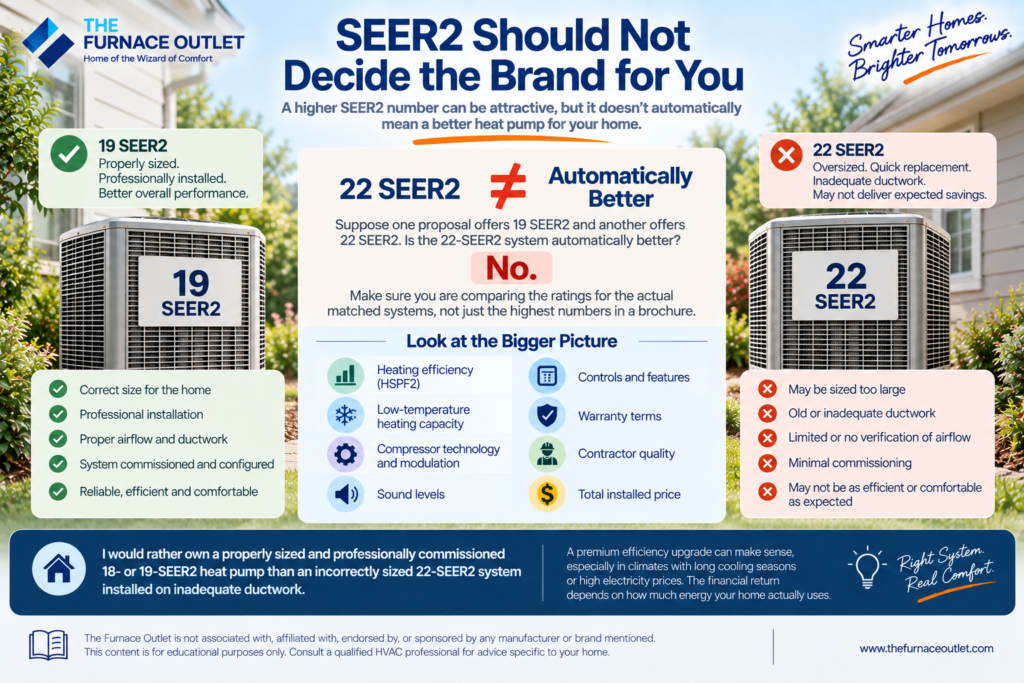
Suppose one proposal offers a heat pump rated at 19 SEER2 and another offers 22 SEER2. Is the 22-SEER2 system automatically better? No.
First, make sure you are comparing the ratings for the actual matched systems being proposed rather than maximum marketing numbers. Then compare heating efficiency, low-temperature capacity, compressor modulation, sound, controls, warranty, contractor quality and installed price. A premium efficiency upgrade can make sense, particularly in climates with long cooling seasons or high electricity prices. But the financial return depends on how much electricity the house actually uses for cooling and heating.
I would rather own a properly sized and professionally commissioned 18- or 19-SEER2 heat pump than an incorrectly sized 22-SEER2 system installed on inadequate ductwork.
Sound specifications can be useful, particularly where the outdoor unit will sit close to a bedroom, patio or neighboring property. Variable-speed equipment can be exceptionally quiet when operating at reduced capacity. Goodman publishes quiet-mode operation as low as 45 dBA for the GZV6S, while Carrier lists its Infinity 24 as low as 51 dB.
Those numbers should still be interpreted carefully because testing conditions, operating speeds and installation environments matter. The location of the equipment can sometimes matter as much as the brochure rating. A quiet heat pump placed beside a bedroom window or between reflective masonry walls may still be noticeable.
Treat sound as one design consideration, not another specification contest.
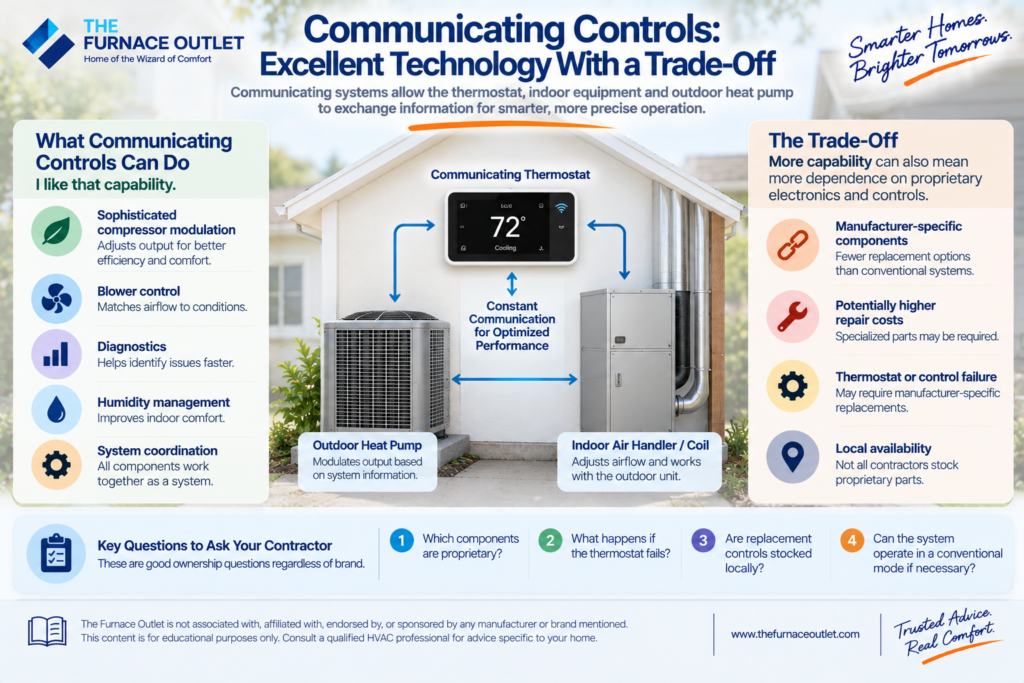
Many premium systems use proprietary communicating controls that allow the thermostat, indoor equipment and outdoor heat pump to exchange operating information. That can enable sophisticated compressor modulation, blower control, diagnostics, humidity management and system coordination. I like that capability.
The trade-off is that the system can become more dependent on manufacturer-specific electronics and controls. If a proprietary thermostat or communication board eventually fails, replacement choices may be more limited than with simpler conventional controls. That does not make communicating equipment bad. It simply means I would ask the contractor: Which components are proprietary? What happens if the thermostat fails? Are replacement controls stocked locally? Can the system operate in a conventional mode if necessary?
Those are good ownership questions regardless of brand.
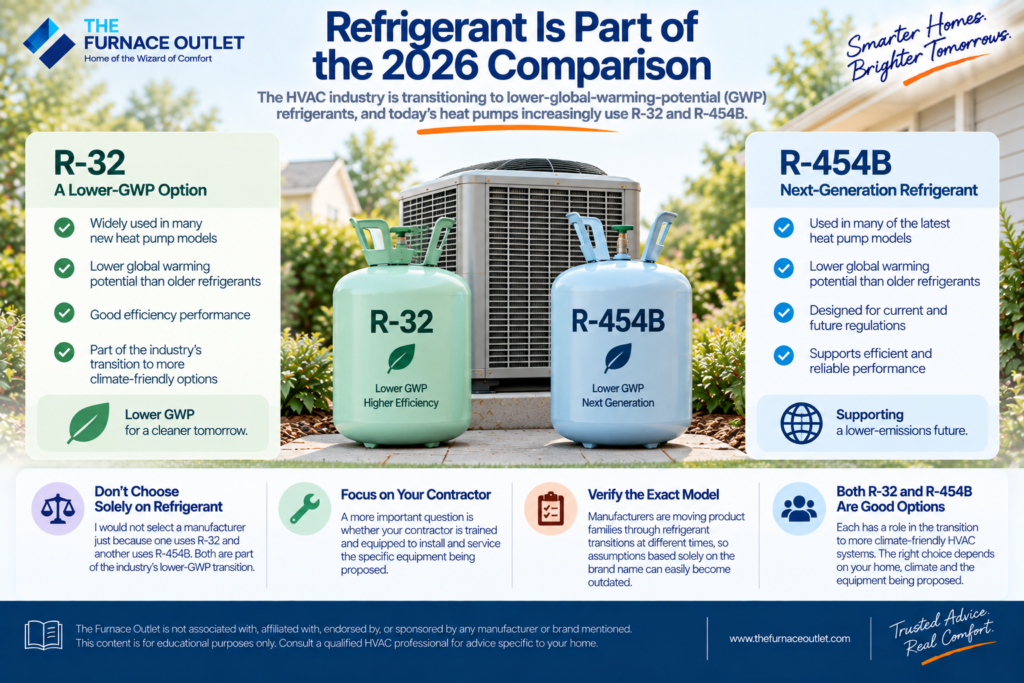
Homeowners shopping today are encountering equipment built around the industry’s transition toward lower-global-warming-potential refrigerants. Depending on manufacturer and product generation, you will increasingly encounter systems using refrigerants such as R-32 and R-454B. I would not select a manufacturer solely because one uses R-32 and another uses R-454B. Both are part of the industry’s lower-GWP transition, and the better question is whether your contractor is trained and equipped to install and service the specific equipment being proposed.
Also verify the exact model. Manufacturers are moving product families through refrigerant transitions at different times, so assumptions based solely on the brand name can easily become outdated.
This is one of the least exciting sections of a heat-pump buying guide, and it may be one of the most important. Suppose Brand A produces equipment I slightly prefer technically, but there are three excellent Brand B dealers within 20 miles of my house and almost nobody locally has significant experience servicing Brand A. I may choose Brand B.
Your heat pump will probably be in the house for well over a decade. At some point it may need a control board, sensor, fan motor, inverter component or another replacement part. You want technicians who understand the equipment and can obtain components without turning every repair into an investigation.
This becomes even more important with sophisticated inverter and communicating systems. A strong local dealer network can be a legitimate reason to choose one good manufacturer over another good manufacturer.

You could buy the most advanced heat pump discussed in this article and still end up disappointed if it is incorrectly sized. I want the contractor to determine the home’s heating and cooling requirements using a proper load calculation rather than simply reading the capacity from the old equipment. If the existing house has a 4-ton system, that does not prove the house needs another 4-ton system.
Insulation may have changed. Windows may have been replaced. Air sealing may have improved. The original equipment may simply have been oversized. For heat pumps in cold climates, sizing becomes particularly important because we also need to compare the home’s heating load with the equipment’s available capacity as outdoor temperature falls. That analysis should happen before brand loyalty determines the equipment.

This is one of my favorite homeowner questions: “What is the AHRI Certified Reference Number for the system you are proposing?”
Heat-pump efficiency ratings apply to tested combinations of outdoor and indoor equipment. Changing the indoor coil or air handler can change the certified performance of the system. The AHRI Directory allows certified equipment combinations to be verified.
If three contractors give you proposals, asking each for the AHRI reference number makes the comparison considerably more meaningful. You stop comparing logos and start comparing actual systems.
Premium equipment can be excellent. Variable-speed compressors, sophisticated controls, quieter operation and high efficiency can materially improve comfort. But homeowners should still ask what those benefits cost. Suppose one complete installed system costs $10,000 and another costs $16,000.
The $16,000 system may genuinely be better equipment. That does not automatically make it the better investment for that homeowner. Maybe the additional $6,000 produces substantial comfort benefits that the homeowner values. Perhaps cold-climate performance is dramatically better. Maybe electricity prices and operating hours make the efficiency upgrade financially attractive.
Or perhaps the less expensive system already provides everything that house needs. Best equipment and best value are not always the same thing.
If I were replacing the heat pump in my own house, I would not begin by requesting quotes for eight different manufacturers. I would first determine what the house requires. Then I would identify two or three excellent local HVAC contractors. I would ask each what equipment they install regularly and why they recommend a particular configuration for my house.
From there, I would probably narrow the decision to two or three complete systems. For each proposal I would compare the Manual J results, equipment capacities, SEER2, HSPF2, low-temperature heating performance where relevant, compressor technology, indoor equipment, AHRI reference number, refrigerant, controls, sound, parts warranty, labor coverage, installer warranty and total installed price.
That comparison tells me considerably more than an internet ranking saying one manufacturer scored 9.3 and another scored 8.7.
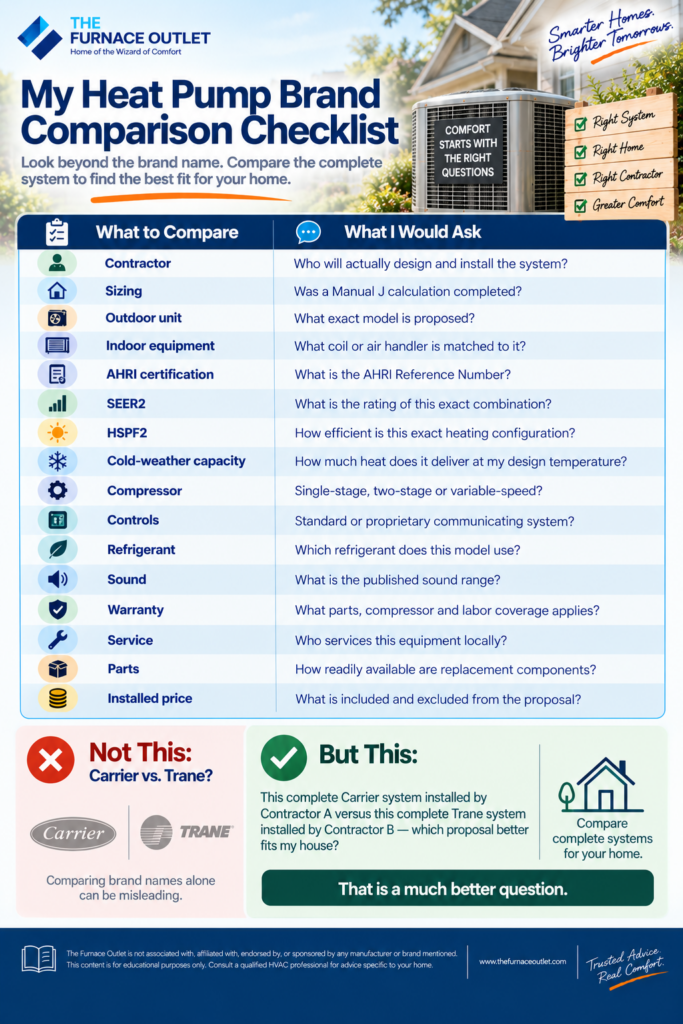
| What to Compare | What I Would Ask |
|---|---|
| Contractor | Who will actually design and install the system? |
| Sizing | Was a Manual J calculation completed? |
| Outdoor unit | What exact model is proposed? |
| Indoor equipment | What coil or air handler is matched to it? |
| AHRI certification | What is the AHRI Reference Number? |
| SEER2 | What is the rating of this exact combination? |
| HSPF2 | How efficient is this exact heating configuration? |
| Cold-weather capacity | How much heat does it deliver at my design temperature? |
| Compressor | Single-stage, two-stage or variable-speed? |
| Controls | Standard or proprietary communicating system? |
| Refrigerant | Which refrigerant does this model use? |
| Sound | What is the published sound range? |
| Warranty | What parts, compressor and labor coverage applies? |
| Service | Who services this equipment locally? |
| Parts | How readily available are replacement components? |
| Installed price | What is included and excluded from the proposal? |
That is the comparison I want homeowners making.
Not: Carrier vs. Trane?
But: This complete Carrier system installed by Contractor A versus this complete Trane system installed by Contractor B — which proposal better fits my house?
That is a much better question.
There are plenty of heat-pump manufacturers worth considering in 2026. American Standard, Carrier, Trane, Lennox, Bosch, Mitsubishi Electric, Daikin and Goodman can all belong on a homeowner’s shortlist depending on the application.
Carrier and American Standard offer sophisticated premium variable-speed systems. Lennox remains a serious high-efficiency contender. Bosch has compelling ducted inverter and cold-climate equipment. Mitsubishi Electric deserves particular attention for cold-weather and zoning applications. Daikin brings considerable inverter experience and compact configurations, while Goodman provides increasingly sophisticated equipment at value-oriented positions in the market. Trane remains an established choice across conventional and premium ducted HVAC applications.
But I would resist turning those observations into a universal ranking. The best heat pump brand is the manufacturer that offers the right equipment for your home’s load and climate, supported by a capable local contractor who can install, commission and service it correctly at a price that makes sense for you.
Get that combination right, and the name printed on the cabinet becomes only one part of a much better HVAC decision.
— Jake Lawson, HVAC Specialist | The Furnace Outlet
Best Heat Pumps of 2026: The Complete Homeowner Buying Guide – The Furnace Outlet
For current product specifications and system verification, useful primary resources include:
Manufacturer specifications should always be checked for the exact model and matched indoor/outdoor combination being proposed.
Editorial Disclosure: The Furnace Outlet is not associated with, affiliated with, endorsed by, or sponsored by any manufacturer or brand mentioned in this article. We do not receive compensation from manufacturers for inclusion or rankings. Brand and product discussions are provided for independent educational and editorial purposes.