Newsletter Subscribe
Enter your email address below and subscribe to our newsletter

HVAC made simple
By Jake Lawson — Jake the HVAC Specialist
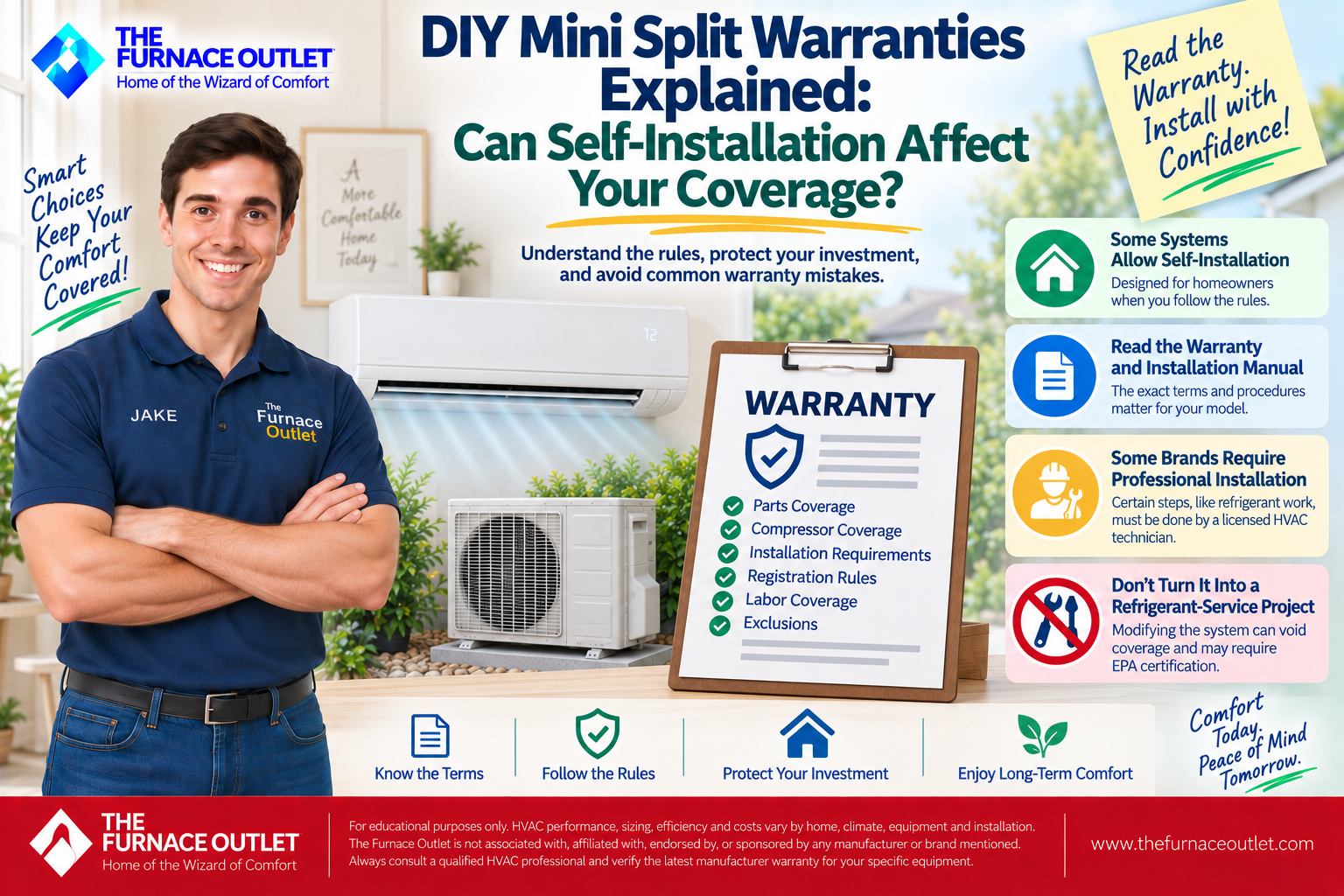
One of the biggest attractions of a DIY mini split is right there in the name: you may be able to perform much of the installation yourself instead of paying a contractor to complete the entire project. But before you mount the indoor air handler or connect a line set, there is another question worth answering: What happens to the manufacturer’s warranty when you install the equipment yourself?
There is no universal answer. Some mini splits are specifically engineered and warrantied for homeowner installation, while other systems require professional installation or professional completion of particular steps to maintain warranty coverage. Even within a single manufacturer, requirements can vary between product families and generations. Current MRCOOL documentation, for example, distinguishes its purpose-built DIY equipment from products intended for technician installation. Senville, meanwhile, currently states that certain refrigerant-side installation procedures must be performed by a licensed HVAC professional for its warranty to remain valid.
That distinction is the key to understanding DIY mini-split warranties. The important question isn’t simply, “Can I physically install this equipment myself?” The better question is, “What installation method does the written warranty for my exact system require?”
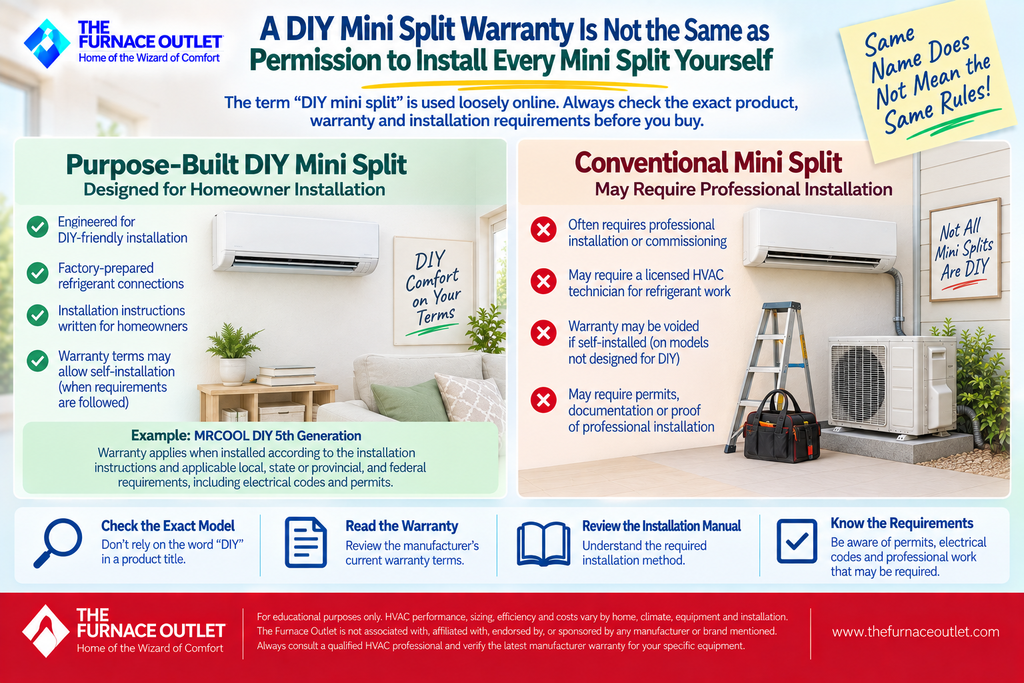
The term “DIY mini split” gets used loosely online. Sometimes it describes equipment genuinely designed around homeowner installation, including factory-prepared refrigerant connections and installation instructions specifically written for that purpose. In other cases, sellers or homeowners may casually describe an ordinary ductless system as DIY simply because somebody intends to install it themselves.
Those situations aren’t equivalent from a warranty perspective. A purpose-built homeowner-installable system may have warranty terms that anticipate self-installation, while a conventional mini split may require professional installation, refrigerant commissioning or documentation from a qualified contractor.
MRCOOL provides a useful current example. Its DIY 5th Generation warranty states that coverage applies when the system is installed according to its installation instructions and applicable local, state or provincial, and federal requirements, including relevant electrical codes and permits. MRCOOL separately warns that self-installing its technician-install equipment as an unlicensed individual may void the warranty.
That is why I would never make a warranty decision based only on the word “DIY” appearing in an online product title. Find the exact model number and product generation, locate the manufacturer’s current written warranty and installation manual, and read both before purchasing.
Homeowners sometimes assume that touching HVAC equipment themselves automatically eliminates manufacturer protection. That isn’t universally true.
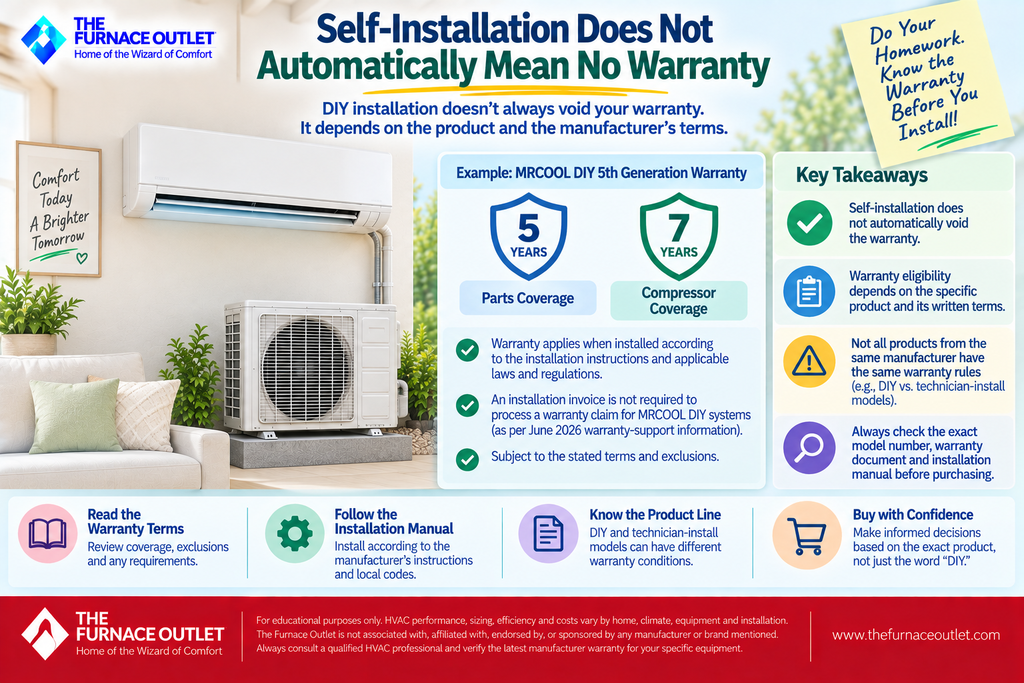
MRCOOL’s current DIY 5th Generation warranty provides a good counterexample. Its standard warranty lists five years of parts coverage and seven years of compressor coverage, subject to its stated terms and exclusions. The warranty applies to systems installed according to the installation instructions and applicable laws and regulations. MRCOOL’s June 2026 warranty-support information also says that an installation invoice is not required to process a warranty claim for its DIY systems, although other MRCOOL systems can have different requirements.
The lesson isn’t that every self-installed mini split receives warranty protection. It is that warranty eligibility depends on the particular product and its written terms, rather than on a universal rule that homeowner installation is either always acceptable or always prohibited.
This also demonstrates why manufacturer names alone aren’t enough. Saying “MRCOOL allows DIY installation,” for example, would be too broad because MRCOOL sells both homeowner-oriented and technician-install product families. Always bring the warranty discussion down to the exact product.
The opposite situation also exists. A mini split may be readily available online to homeowners even though its warranty requires professional involvement. Senville’s current warranty terms state that its limited warranty applies to systems installed by a state-certified or licensed HVAC contractor under applicable laws, codes, permits and Senville instructions. Senville’s support guidance further says homeowners may mount the indoor and outdoor units themselves, but refrigerant work such as vacuuming and pressure testing must be performed by a licensed HVAC technician to maintain warranty coverage.
This creates an important distinction between buying equipment yourself, performing some installation work yourself, and qualifying for warranty coverage. Those are three separate issues.
A homeowner might be perfectly capable of mounting an indoor unit, installing a condenser pad or planning a line-set route. But if the warranty requires a licensed contractor to perform or document particular installation steps, completing those steps yourself can create a warranty problem regardless of whether the system initially appears to operate correctly.
The warranty tells you what coverage is offered and under what conditions. The installation manual tells you how the manufacturer expects the equipment to be installed. I would treat those documents as a pair. Suppose the warranty requires installation according to the manufacturer’s instructions. If the installation manual specifies a particular line-set configuration, connection procedure, electrical arrangement or commissioning process, deviating from those requirements may become relevant if a later failure is connected to the installation.
This is especially important with purpose-built DIY systems because their homeowner-friendly status usually depends on following the installation method the manufacturer engineered. If the system uses factory-prepared connections, approved line sets or proprietary couplings, replacing those components with improvised alternatives can take the project outside the intended installation method.
MRCOOL’s DIY warranty, for example, excludes failures, damage or repairs resulting from faulty installation, misapplication, improper servicing or unauthorized alteration. It also excludes certain damage related to inadequate or interrupted electrical service and damage resulting from parts or products not supplied or designated by the company. DIY therefore doesn’t mean “install it any way that works.” From a warranty standpoint, following the documented installation procedure can be particularly important.
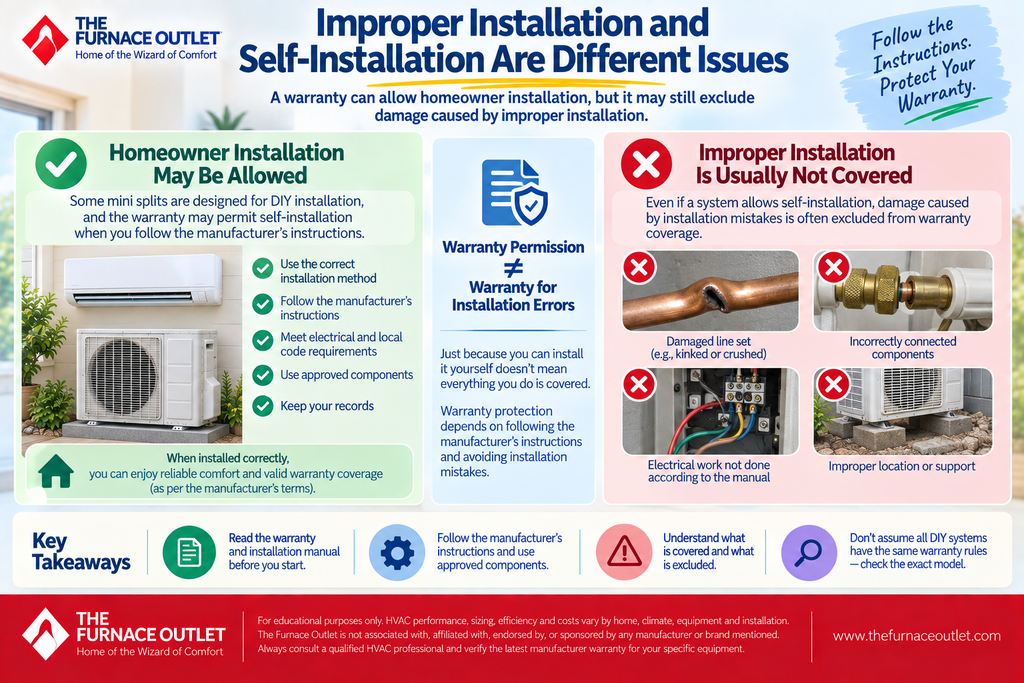
This distinction deserves emphasis. A warranty can permit homeowner installation while still excluding damage caused by improper installation. Imagine a genuine DIY mini split whose warranty allows self-installation. The homeowner damages the pre-charged line set, incorrectly connects components or installs electrical equipment contrary to the manual. The fact that homeowner installation was permitted does not necessarily mean damage caused by those errors must be covered.
Likewise, a manufacturer may warrant defects in materials or workmanship while excluding installation labor, maintenance problems, environmental damage or installation-related failures. This is why the statement “DIY installation doesn’t void the warranty” can be misleading when presented without context. A more useful statement is that a particular warranty may permit homeowner installation when its installation and warranty conditions are satisfied, while still excluding failures attributable to improper installation or other listed causes.
Another common warranty misunderstanding is assuming that “10-year warranty” or “5-year warranty” means everything connected with a repair is paid for during that period. HVAC warranties are often much more specific. Coverage can differ between parts and the compressor, and labor may not be included at all. A replacement component may therefore be covered while the homeowner remains responsible for diagnosis, technician travel, labor, refrigerant-related service or installation of the replacement component.
Senville’s current warranty page, for example, says its warranty covers replacement parts under the applicable terms but does not cover labor or service-call costs for installation, repair or replacement. MRCOOL’s DIY 5th Generation limited warranty similarly excludes labor and various costs associated with diagnosing, repairing, removing, installing, shipping, servicing or handling defective or replacement equipment.
When comparing mini splits, don’t judge warranty value by the largest number printed in a product listing. Determine what is covered, how long each category is covered and what expenses remain with the owner.
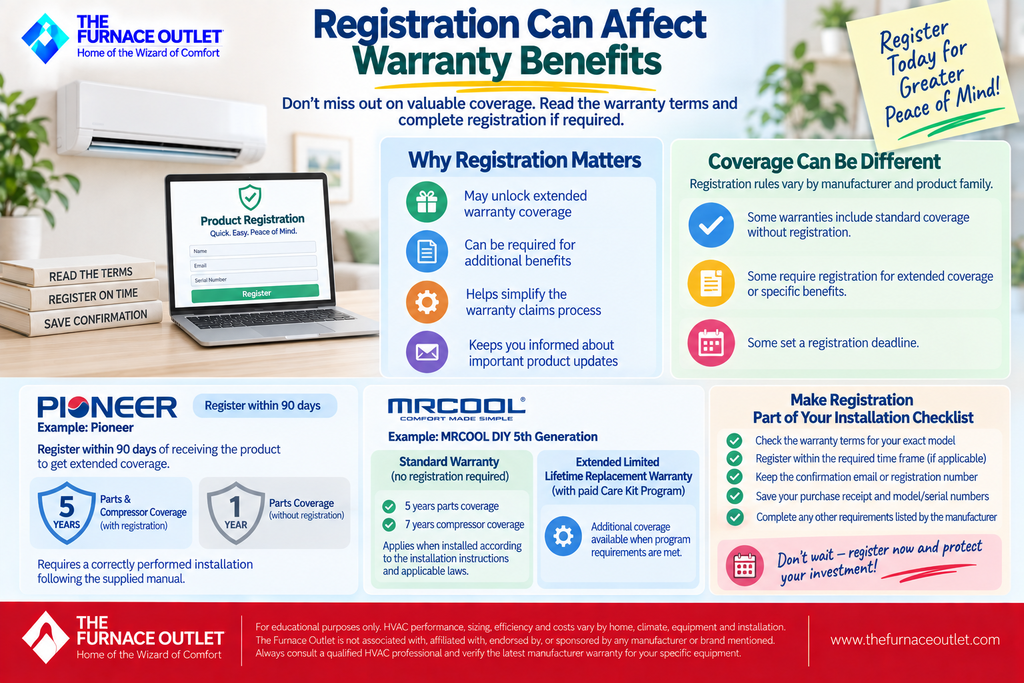
Registration is another area where homeowners can lose benefits simply because they didn’t read the paperwork. Requirements differ considerably by manufacturer and product family. Some warranties provide standard coverage without registration, while registration may be necessary for extended coverage or additional benefits. Others establish registration deadlines or use registration to simplify claims.
Pioneer’s current warranty-support page, for example, says its product warranty requires a correctly performed installation following the supplied manual. It also says customers who register within 90 days of receiving the product receive an extension to five years for parts and compressor coverage, while unregistered customers receive one year of parts coverage.
MRCOOL’s DIY 5th Generation warranty presents a different structure: it describes standard coverage without registration while offering an Extended Limited Lifetime Replacement Warranty through its paid Care Kit Program when applicable requirements are met. These examples show why registration should be treated as an installation-closeout task rather than something to remember months later. Save the confirmation after completing it.
Documentation can become extremely important when a warranty claim occurs years after installation. I recommend keeping the purchase invoice, model and serial numbers, photographs of equipment labels, warranty registration confirmation, installation date, electrical invoice if an electrician was used, HVAC invoice if professional commissioning was required, permit or inspection records where applicable, and copies of any important correspondence with the manufacturer or seller.
If the manufacturer requires a licensed professional for a particular step, keep evidence showing who performed that work and when it was completed. If you installed a genuine DIY system yourself, photographs taken during installation can also provide a useful record of equipment placement and the original installation.
Don’t rely entirely on an online retailer account remaining accessible for the life of the equipment. Download important documents and keep your own records.
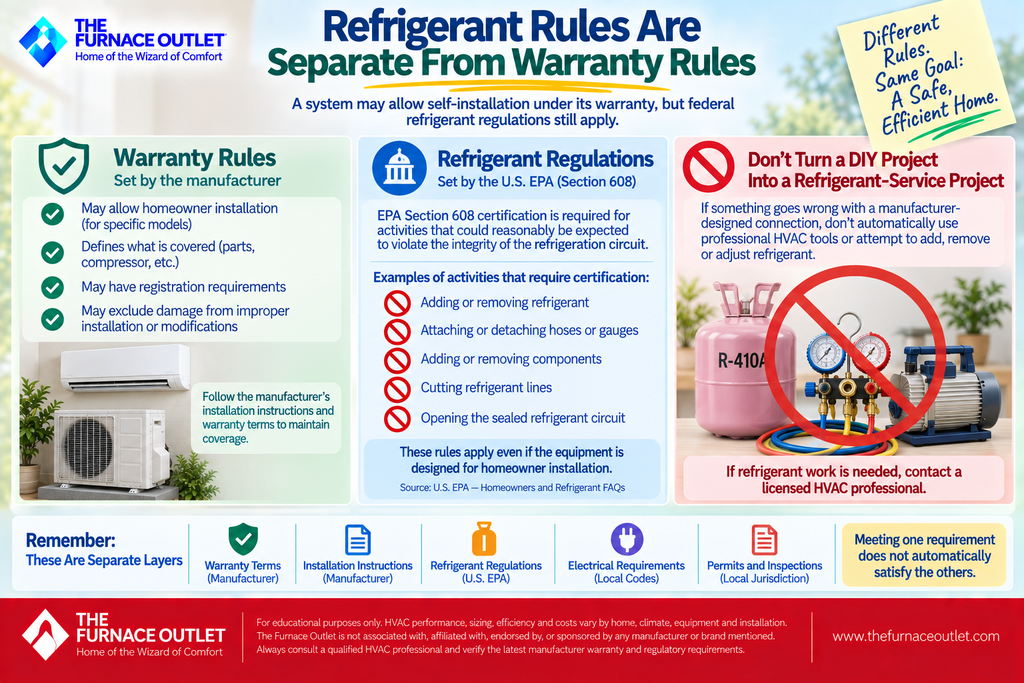
Warranty permission should also not be confused with regulatory permission. A manufacturer can design equipment for homeowner installation, but applicable refrigerant regulations still matter. The U.S. Environmental Protection Agency states that Section 608 technician certification is required for activities reasonably expected to violate the integrity of the refrigeration circuit. Its homeowner guidance specifically discusses activities including adding or removing refrigerant, attaching or detaching hoses or gauges, adding or removing components and cutting refrigerant lines.
U.S. EPA — Homeowners and Refrigerant FAQs
That is another reason not to turn a purpose-built DIY installation into an improvised refrigerant-service project. If something goes wrong with a manufacturer-designed connection, stop and determine the approved corrective procedure instead of automatically reaching for gauges, refrigerant cylinders, vacuum equipment or tubing tools.
The warranty, installation instructions, refrigerant regulations, electrical requirements and local permitting rules are separate layers. Satisfying one does not automatically satisfy all the others.

Homeowners sometimes encounter broad internet claims that a manufacturer “can’t void your warranty because you installed something yourself.” U.S. warranty law is more nuanced than that slogan suggests. The Federal Trade Commission explains that the Magnuson-Moss Warranty Act governs written warranties on consumer products and requires warrantors to provide consumers with information about warranty coverage. The FTC has also taken action against certain warranty practices that improperly condition warranty coverage on consumers using specified parts or service providers, unless applicable legal exceptions are satisfied.
FTC — Businessperson’s Guide to Federal Warranty Law
That does not mean every failure following a homeowner HVAC installation must be covered. A dispute can involve the exact warranty language, the cause of the failure, installation requirements, applicable law and other facts. For a specific denied claim, particularly one involving substantial money, qualified legal advice or an appropriate consumer-protection resource is more useful than relying on generalized online interpretations.
For an HVAC buying guide, the practical recommendation is simpler: read the written warranty before purchase and don’t assume either that all DIY installation automatically destroys coverage or that federal warranty law makes installation requirements irrelevant.
Installation isn’t necessarily the only warranty condition worth checking. Some HVAC warranties can contain requirements or exclusions related to the original purchaser, installation address, residential versus commercial application, approved components, proof of purchase or other conditions.
MRCOOL’s current DIY 5th Generation warranty, for example, contains ownership and installation-address conditions for certain warranty applications and describes coverage and exclusions in considerably more detail than the short warranty numbers commonly shown on retail pages. This is why I prefer reading the manufacturer’s actual warranty rather than relying on a marketplace seller’s bullet point saying something like “7-year compressor warranty.” The number tells you almost nothing about eligibility, exclusions or the claims process.
Before purchasing a mini split for self-installation, I would first confirm that the exact model is genuinely designated for homeowner installation rather than merely being sold directly to homeowners. I would then download the current warranty and installation manual and verify whether professional installation, professional commissioning, registration, permits or particular installation documentation are required. I would also check what the warranty actually covers, whether parts and compressor periods differ, whether labor is excluded, and what happens if installation-related damage occurs.
Next, I would confirm the approved line-set configuration and whether any planned extensions or accessories are manufacturer-approved. I would determine the electrical requirements before installation and arrange qualified electrical work whenever the project or applicable rules require it. After installation, I would complete any required registration promptly and save the purchase receipt, serial numbers, registration confirmation and professional invoices.
Finally, I would preserve those records for the life of the equipment. Warranty requirements can be difficult to reconstruct several years later when a compressor or control board fails and the original installer, retailer or paperwork is no longer easy to locate.
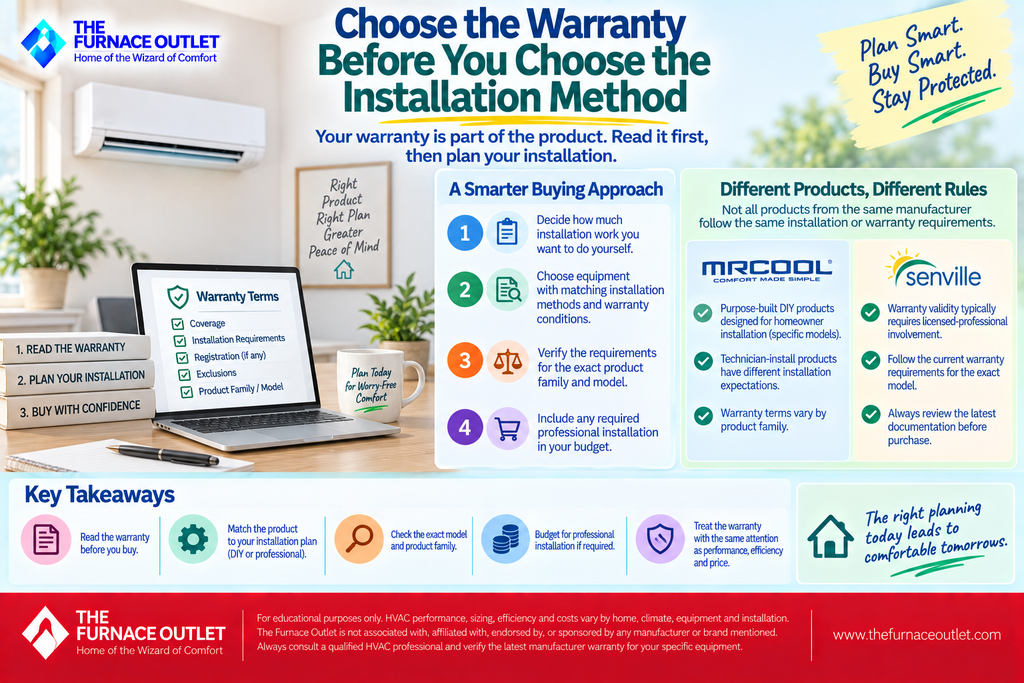
If warranty protection matters to you, don’t buy the mini split first and investigate the warranty after the equipment arrives. Reverse that process. Decide how much installation work you genuinely want to perform, then choose equipment whose documented installation method and warranty conditions match that plan. If you want a true homeowner-installable system, verify that the exact product family is designed and warrantied accordingly. If you’re considering a conventional mini split that requires professional commissioning, include that professional work in your project budget from the beginning.
Most importantly, don’t assume that all products from the same manufacturer follow the same rules. MRCOOL’s own documentation demonstrates the distinction clearly: its purpose-built DIY products and its technician-install products can have different installation expectations and warranty implications. Senville’s current requirements illustrate another approach, with licensed-professional involvement required for warranty validity.
A warranty is part of the product you’re buying. Treat it with the same attention you give capacity, efficiency, heating performance, noise and price, and you are much less likely to discover an unpleasant coverage surprise after the installation is complete.
Does installing a mini split yourself automatically void the warranty?
No universal rule applies. Some purpose-built DIY systems expressly accommodate homeowner installation when the manufacturer’s procedures and applicable requirements are followed, while other equipment requires professional installation or particular professional procedures for warranty eligibility. Always check the warranty for the exact model and generation.
Can I do part of the installation and have an HVAC technician finish it?
Potentially, and some manufacturers specifically describe arrangements in which homeowners perform limited mechanical work while a licensed professional completes required refrigerant procedures. Senville currently says homeowners may mount indoor and outdoor units themselves, but refrigerant work must be professionally completed to maintain warranty.
Does warranty coverage normally include installation labor?
Not necessarily. Manufacturer warranties frequently distinguish replacement-part coverage from labor. Both MRCOOL’s DIY 5th Generation warranty and Senville’s current warranty information contain labor-related exclusions, so the warranty document should be checked rather than assuming a covered component means a free repair.
Can improper DIY installation still cause a claim problem on a genuine DIY system?
Yes. A warranty that permits homeowner installation can still exclude damage caused by faulty installation, misuse, improper servicing or unauthorized modification. Following the exact installation procedure remains important even when professional installation isn’t universally required.
Should I register my mini split immediately?
Check the exact warranty because registration rules vary. Registration can affect extended coverage or other benefits for some products, and deadlines may apply. Completing applicable registration promptly and retaining confirmation is a sensible closeout step.
Editorial Disclosure: The Furnace Outlet is not associated with, affiliated with, endorsed by, or sponsored by any manufacturer or brand mentioned in this article. We do not receive manufacturer compensation for inclusion or rankings. Warranty terms, product generations and manufacturer policies can change, so verify the current written warranty for the exact equipment before purchase or installation. This article is for educational purposes and is not legal advice; HVAC installation, electrical, refrigerant, permitting and warranty requirements can vary by equipment and jurisdiction