Newsletter Subscribe
Enter your email address below and subscribe to our newsletter

HVAC made simple

Mark Callahan – the expert installer
Replacing a furnace is one of those home projects where the advertised equipment price can tell you surprisingly little about what you will ultimately pay. A furnace that looks reasonably priced online still has to be correctly sized, connected to the existing duct system, vented, wired, connected to fuel, configured for the air conditioner or heat pump, tested and commissioned. Depending on the house, those installation details can add considerably to the final price.
For 2026, current national consumer cost data puts a complete furnace installation across fuel types at roughly $2,823 to $6,896 for many projects, with an average around $4,814. Gas furnace replacements commonly fall higher, with Angi reporting a typical range of approximately $3,800 to $10,000, and some higher-efficiency installations reaching about $12,000.
Those figures are useful for budgeting, but I would never use them as a substitute for a detailed local estimate. A straightforward furnace swap and a high-efficiency installation requiring new venting, drainage, duct transitions and electrical work are very different projects.
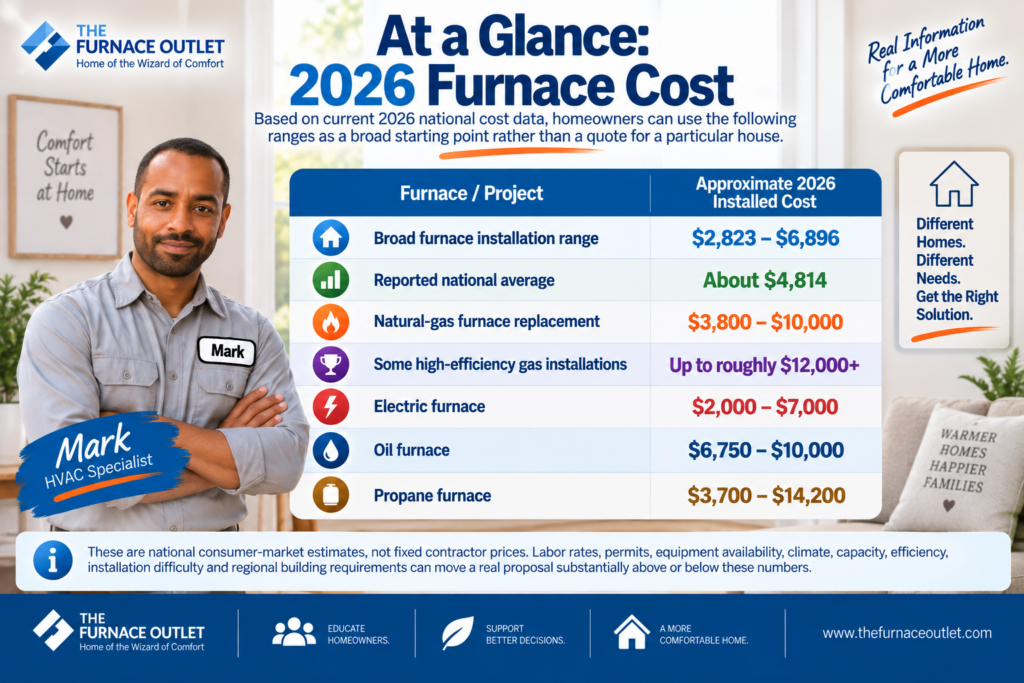
Based on current 2026 national cost data, homeowners can use the following ranges as a broad starting point rather than a quote for a particular house.
| Furnace / Project | Approximate 2026 Installed Cost |
|---|---|
| Broad furnace installation range | $2,823–$6,896 |
| Reported national average | About $4,814 |
| Natural-gas furnace replacement | $3,800–$10,000 |
| Some high-efficiency gas installations | Up to roughly $12,000+ |
| Electric furnace | $2,000–$7,000 |
| Oil furnace | $6,750–$10,000 |
| Propane furnace | $3,700–$14,200 |
These are national consumer-market estimates, not fixed contractor prices. Labor rates, permits, equipment availability, climate, capacity, efficiency, installation difficulty and regional building requirements can move a real proposal substantially above or below these numbers.
When homeowners compare estimates, one of the first things I recommend is separating the furnace itself from the complete installed system. The equipment is only one component of what the contractor is providing.
Angi estimates that the furnace itself can represent roughly 50% to 75% of a gas-furnace replacement project’s cost. The remainder can include labor, old-equipment removal, permits, sheet-metal transitions, gas piping, venting, condensate drainage, electrical modifications, thermostat work, duct adjustments and commissioning.
This explains why finding a furnace advertised for $2,500 does not mean you should expect a $2,500 finished installation. You are paying for the equipment and for turning that equipment into a properly functioning heating system.
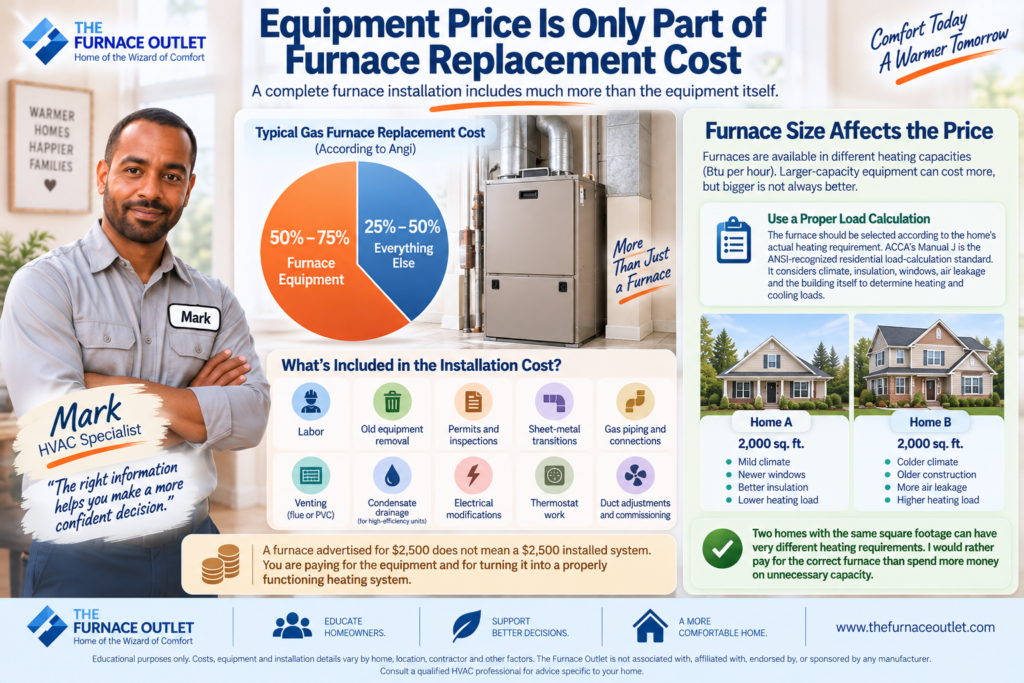
Furnaces are available in different heating capacities, normally expressed in Btu per hour. Larger-capacity equipment can cost more, but I would never recommend selecting furnace capacity simply by choosing the largest unit your budget allows.
The furnace should be selected according to the home’s actual heating requirement. ACCA’s Manual J is the ANSI-recognized residential load-calculation standard. It considers characteristics such as climate, insulation, windows, air leakage and the building itself to determine heating and cooling loads.
That is much more meaningful than saying, for example, that every 2,000-square-foot home needs the same furnace. Two houses with identical floor area can have very different heating requirements because of differences in construction, climate, insulation, windows and infiltration. I would rather pay for the correct furnace than spend more money on unnecessary capacity.
Oversizing is one of the furnace-buying mistakes I would particularly avoid. A larger furnace may sound reassuring, especially in a cold climate, but additional capacity is not automatically additional comfort. An oversized furnace can satisfy the thermostat quickly and shut down, then restart again as the house cools. That short cycling can contribute to temperature swings, additional equipment cycling and reduced comfort.
ACCA notes that oversized HVAC equipment can short cycle and that repeated startup cycles contribute to equipment wear. Its design approach is therefore based on calculating the load and selecting equipment appropriate for that requirement rather than simply installing extra capacity.
Correct sizing can sometimes mean buying a smaller furnace than the one being removed, particularly if the previous system was oversized or the home has received insulation, window or air-sealing improvements.
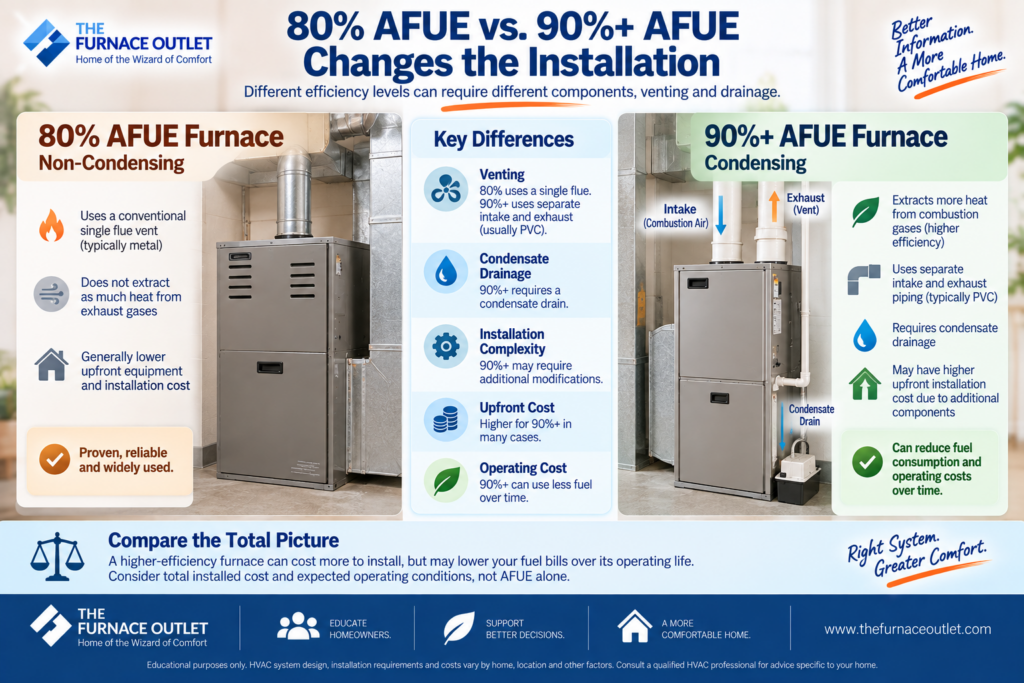
Efficiency can affect both the furnace price and the installation around it. An 80% AFUE furnace is generally a non-condensing furnace. A 90%+ AFUE furnace is typically condensing equipment that extracts additional heat from the combustion gases. That difference can require a different venting arrangement and condensate drainage.
Consequently, upgrading from an older 80% furnace to a high-efficiency condensing furnace may involve more than removing one cabinet and sliding another into the same location. The contractor may need to determine an appropriate route for intake and exhaust piping, establish condensate drainage and make other installation modifications.
That additional work can increase the initial price even when the higher-efficiency furnace may reduce fuel consumption over its operating life. I would compare total installed cost and expected operating conditions, not AFUE alone.
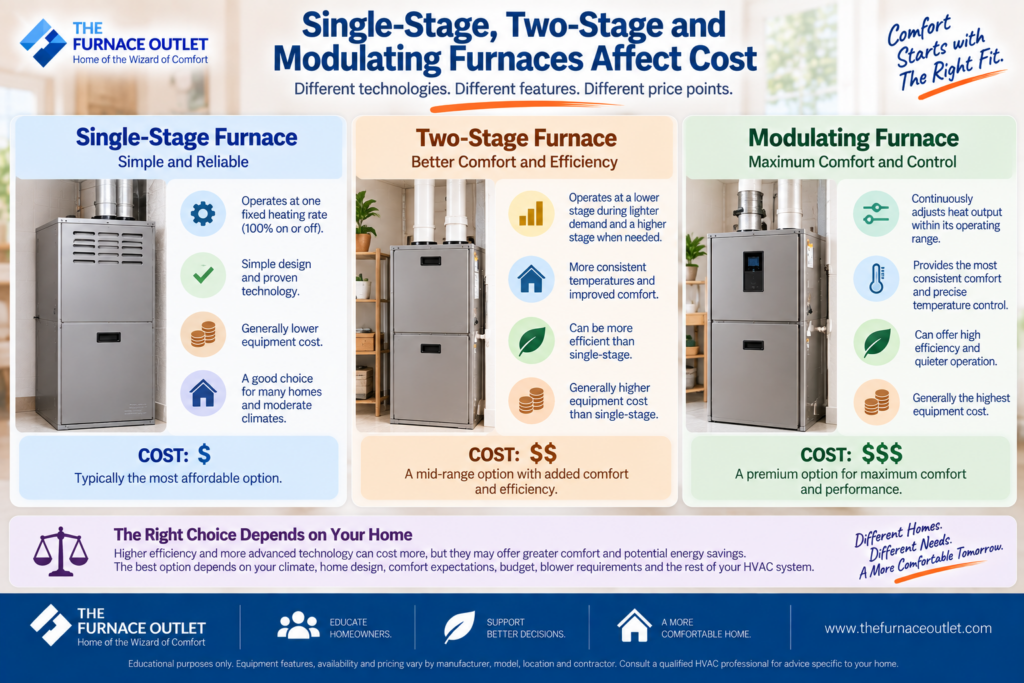
Furnace technology also influences equipment pricing. A basic single-stage furnace generally has simpler operating logic: when heating is required, the furnace operates at its designed firing rate and then shuts down. A two-stage furnace can operate at a lower heating stage during lighter demand and move to higher output when necessary. A modulating furnace can make finer adjustments to heat output within its designed operating range.
Current Angi data shows equipment prices generally increasing as furnace technology becomes more sophisticated, although actual installed pricing varies considerably by model and contractor. That does not mean every homeowner needs the most sophisticated furnace available. The right choice depends on climate, home design, comfort expectations, budget, blower requirements and the rest of the HVAC system.
Do not evaluate a furnace only by its gas valve and AFUE rating. The furnace blower is responsible for moving conditioned air through the duct system, and in a furnace-plus-central-AC installation it also moves air across the evaporator coil during cooling.
Furnaces may use different blower technologies, including various forms of electronically commutated motors. More advanced airflow control can support improved comfort and better integration with staged or variable-capacity equipment, but the exact benefit depends on the complete system. If you are replacing a furnace while keeping an existing air conditioner—or planning to install a new AC or heat pump soon—I would make sure the contractor considers the entire HVAC system before selecting the furnace.
Saving a little on the furnace today can become expensive if the new furnace is poorly suited to the cooling equipment you intend to install next year.
A straightforward replacement is usually less labor-intensive than a project requiring significant alterations. That is why two homeowners purchasing furnaces with similar specifications can receive very different installation estimates. A contractor may need to fabricate supply or return transitions, modify the filter cabinet, alter gas piping, install new venting, provide condensate drainage, make electrical changes, replace or configure controls, correct duct restrictions or bring portions of the installation up to applicable code.
Access matters as well. A furnace located in an open basement mechanical room is a very different installation from equipment squeezed into a difficult attic, crawlspace or tight utility closet. Instead of asking only, “How much is the furnace?”, ask the contractor to explain what installation work is included in the proposal.
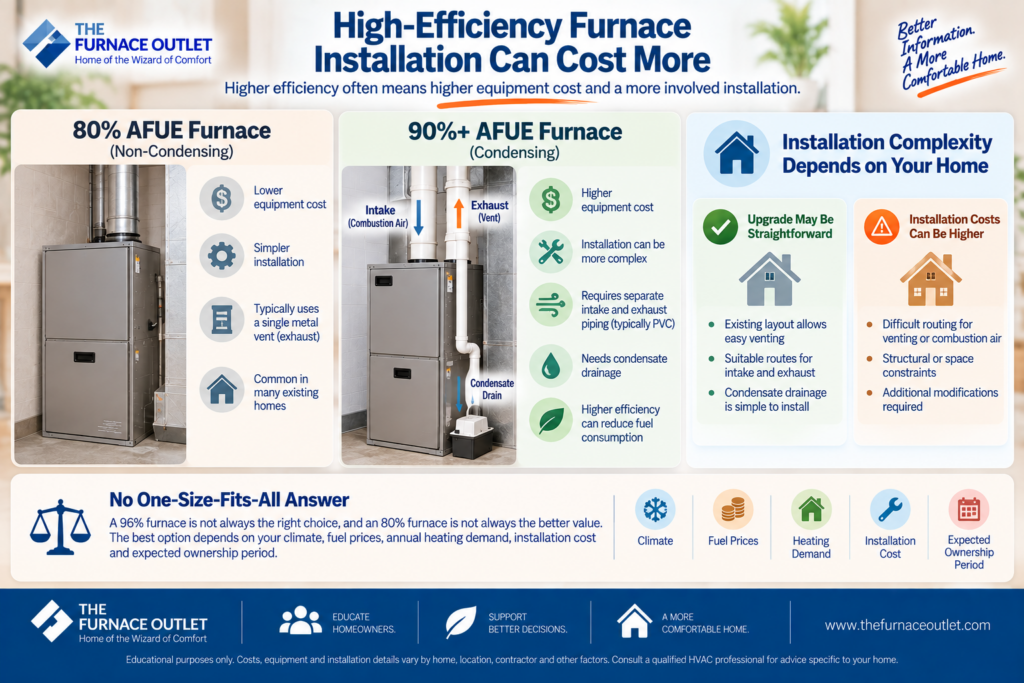
Higher-efficiency equipment usually carries a higher equipment price, and the installation itself can also become more involved. Angi’s 2026 gas-furnace data puts high-efficiency equipment above basic-efficiency models in typical equipment cost. The real premium, however, should be evaluated on a house-by-house basis because venting changes and installation complexity can differ substantially.
If an existing home makes high-efficiency venting relatively easy, the upgrade may be straightforward. If routing new vent and combustion-air piping is difficult, installation costs can rise. That is why I would not make a blanket statement that a 96% furnace is always financially preferable to an 80% furnace—or vice versa. Climate, fuel prices, annual heating demand, installation cost and expected ownership period all affect the economics.
Installing a new furnace does not repair an inadequate duct system. If the existing return duct is too restrictive, supply ducts are undersized, fittings create excessive resistance or portions of the ductwork are damaged or poorly connected, the contractor may recommend modifications.
ACCA’s residential design framework separates the process into complementary steps: Manual J calculates the load, Manual S addresses equipment selection and Manual D addresses duct-system design. I consider that distinction important because buying premium equipment without providing adequate airflow can be a poor investment. If an estimate includes duct modifications, ask the contractor why they are necessary and what airflow or static-pressure problem the changes are intended to solve.
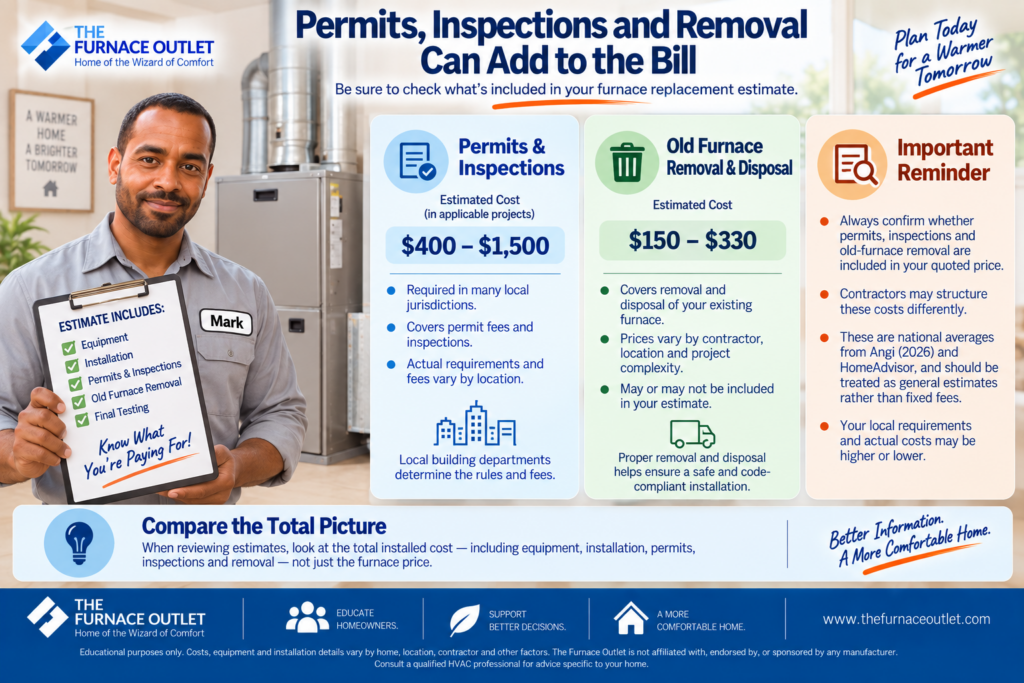
Homeowners should also check whether estimates include permits, inspections and removal of the existing furnace. Angi’s 2026 gas-furnace cost guide estimates approximately $400 to $1,500 for permits and inspections in applicable projects, although actual requirements and fees are local. HomeAdvisor separately estimates old-furnace removal and disposal at roughly $150 to $330 in its current cost data.
These figures should be treated as broad estimates rather than universal fees. Your local jurisdiction determines permitting requirements, while contractors may structure removal, disposal and administrative costs differently. The important thing is to determine whether those items are included in the quoted price before comparing proposals.
Replacing a gas furnace requires attention to the fuel supply and combustion system. The contractor needs to verify that the gas piping, shutoff arrangement, venting and combustion-air provisions are appropriate for the equipment being installed and comply with applicable requirements.
Moving the furnace, changing fuel type or changing furnace technology can make this work more extensive. A high-efficiency condensing furnace may use a very different venting arrangement from an older conventional furnace. If substantial modifications are required, the final project can cost considerably more than a simple like-for-like replacement.
This is one reason photographs and model numbers alone are rarely enough for an accurate installation price. A contractor needs to understand the house and existing installation.

Not necessarily. If the furnace needs replacement but the air conditioner is relatively new and in good condition, keeping the AC may make financial sense—provided the new furnace, blower, indoor coil and controls remain compatible. The opposite situation also occurs. If both systems are old, replacing them together can avoid paying for overlapping labor twice and allows the contractor to design a properly matched heating-and-cooling system from the beginning.
I would base the decision on equipment condition, age, compatibility, expected remaining life and economics rather than assuming that both pieces must always be replaced simultaneously.
The price on the contractor’s proposal and the homeowner’s final net cost are not always identical. Depending on the equipment, location and timing, utility programs, manufacturer promotions or government incentives may be available.
These programs can change, and eligibility requirements can be specific. I would therefore verify any incentive before purchasing the equipment rather than relying on an old article, advertisement or verbal assumption. Also ask whether the quoted price is before or after incentives. That makes comparisons between competing proposals much clearer.

When I compare furnace proposals, I would not automatically select the lowest number. I would want to know whether each contractor performed or reviewed a load calculation, what exact furnace model is included, its capacity and AFUE, what blower it uses, whether the furnace is compatible with the existing or proposed cooling system, and what duct, venting, gas, electrical and control work is included.
I would also ask about startup and commissioning. The installer should verify that the finished system actually operates as intended rather than simply confirming that the burners ignite and warm air comes from the registers. A $500 saving becomes insignificant if the system is oversized, noisy, poorly commissioned or requires corrective work later.
Before approving a furnace replacement, I would want the proposal to identify the exact equipment model, heating capacity, AFUE and blower configuration. It should explain whether permits, old-equipment removal, disposal, sheet-metal work, venting, condensate drainage, gas piping, electrical work, thermostat changes and duct modifications are included.
I would also ask whether a proper heating-load calculation was performed and how the proposed furnace was selected from that result. ACCA identifies Manual J as the ANSI-recognized method for producing residential HVAC equipment sizing loads, while Manual S principles connect equipment selection to those calculated loads and manufacturer performance information.
Finally, compare warranties and commissioning procedures as carefully as equipment prices. Two proposals that appear to contain similar furnaces can represent very different levels of installation work.
For 2026, a homeowner can reasonably begin budgeting around $2,800 to $6,900 for many furnace installations, while a natural-gas furnace replacement commonly falls around $3,800 to $10,000 in current national consumer cost data. More complicated installations, premium equipment, higher capacities and certain high-efficiency projects can exceed those ranges.
But I would use those figures only to establish a budget. Your real furnace cost is determined by much more than the metal cabinet sitting in the mechanical room. The better question is not simply, “What does a furnace cost?” It is, “What will it cost to install the right furnace correctly in my home?” Start with the heating load. Select the appropriate equipment. Evaluate the existing ductwork and cooling system. Understand exactly what installation modifications are included, and compare contractor proposals on equal terms.
A correctly sized $6,000 installation can be a much better investment than a poorly selected $4,500 installation. With furnaces expected to serve the home for many years, installation quality and system design deserve as much attention as the purchase price.
For current 2026 pricing benchmarks, see Angi’s 2026 Gas Furnace Cost Guide and Angi’s 2026 New Furnace Cost Guide. HomeAdvisor’s Furnace Replacement Cost Guide provides another current national pricing reference.
For technical design rather than pricing, homeowners can review ACCA Manual J Residential Load Calculation guidance and ACCA’s Residential System Design guidance for Manuals J, S and D.
Editorial Disclosure & Educational Disclaimer: The Furnace Outlet is an independent educational resource and is not associated with, affiliated with, endorsed by or sponsored by the companies, manufacturers or organizations referenced in this article. We do not receive manufacturer compensation for inclusion or rankings. Prices are general U.S. estimates and can vary substantially by location, equipment, home, contractor, permit requirements and installation conditions. Verify current pricing, specifications, incentives and requirements with qualified local HVAC professionals before making a purchasing decision.