Newsletter Subscribe
Enter your email address below and subscribe to our newsletter

HVAC made simple
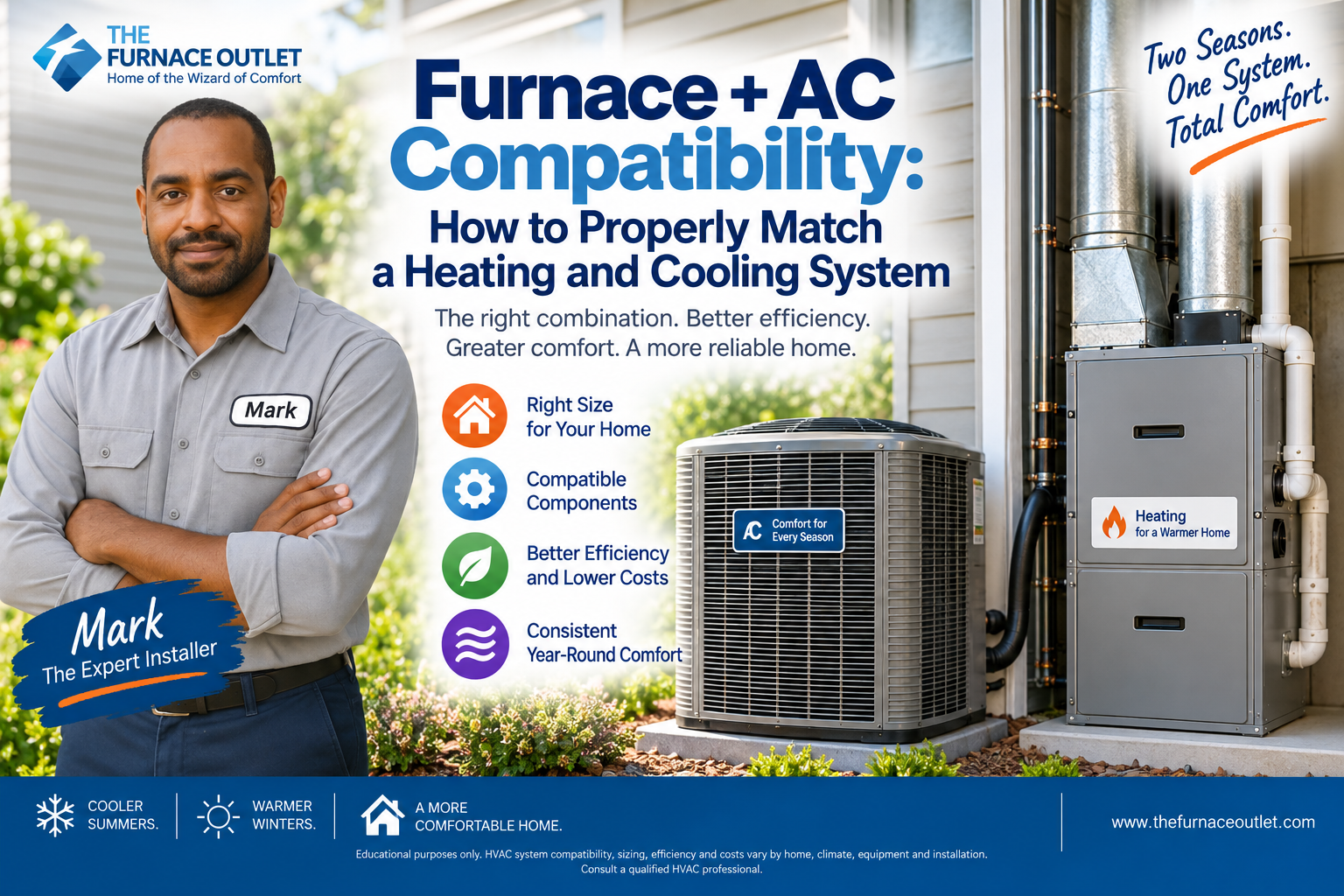
Mark Callahan – the expert installer
Replacing a furnace or central air conditioner often looks straightforward. If the furnace still works, why not install a new outdoor AC and connect it to the existing system? If the air conditioner is still relatively new, why not replace only the furnace underneath it?
Sometimes that approach works perfectly well. Other times, it creates a system that operates but is not truly matched.
I have seen enough HVAC installations to know that homeowners should think of the furnace and air conditioner as parts of one system rather than two completely independent appliances. During summer, the furnace blower moves air across the indoor evaporator coil. The outdoor condenser, indoor coil, blower, refrigerant circuit, ductwork and controls all have to work together. During winter, that same furnace and blower become responsible for heating and distributing air throughout the house.
That is why compatibility involves much more than asking whether the new equipment will physically connect to the old equipment.
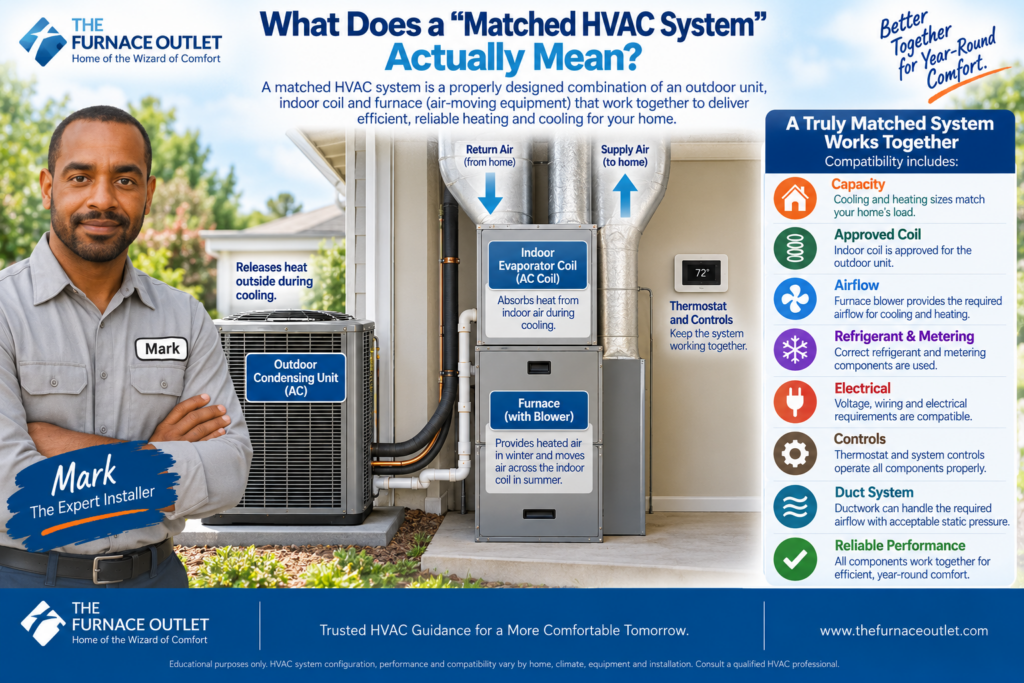
A typical split central air-conditioning system contains an outdoor condensing unit, indoor evaporator coil and indoor air-moving equipment. In a furnace-and-AC installation, the furnace usually provides that indoor airflow.
Trane describes an air conditioner and furnace as a matched-system arrangement in which the AC works with a furnace coil or air handler to cool the home.
For me, a properly matched furnace-and-AC system means several things are working together correctly: the cooling capacities are appropriate for the home’s load, the indoor coil is approved for the outdoor unit, the furnace blower can provide the airflow required by the cooling equipment, the refrigerant and metering components are correct, the controls can operate the equipment properly, and the duct system can actually handle the required airflow.
Compatibility therefore has electrical, mechanical, refrigerant, airflow, capacity and control-system dimensions.
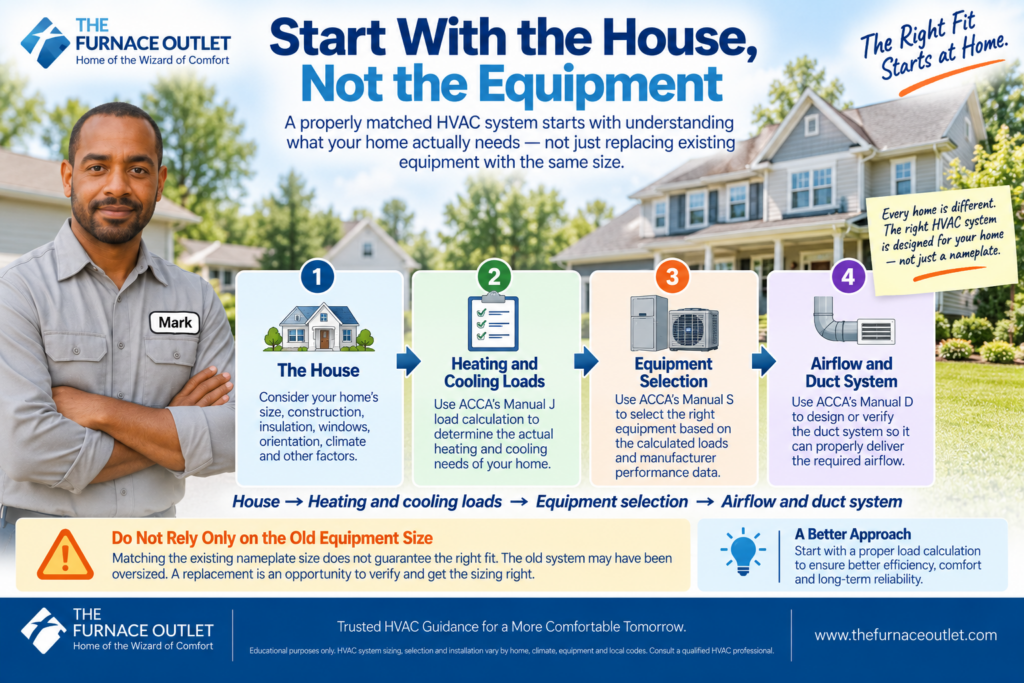
Before deciding which furnace and air conditioner belong together, determine what the house actually needs. ACCA’s Manual J is an ANSI-recognized residential load-calculation standard used to determine heating and cooling loads. ACCA then uses Manual S for equipment selection based on those loads and manufacturer performance data, while Manual D addresses duct-system design.
That sequence is important: House → Heating and cooling loads → Equipment selection → Airflow and duct system
I would be cautious when a contractor starts with the existing equipment’s nameplate and simply proposes another furnace and air conditioner with identical nominal capacities. The old equipment may have been correctly sized, but it may also have been oversized from the day it was installed. A replacement project is an opportunity to verify rather than assume.
One common source of confusion is comparing furnace capacity directly with air-conditioner capacity. A furnace is generally discussed in terms of BTU per hour input and output heating capacity. Central air conditioners are commonly described in tons, with one nominal ton corresponding to 12,000 Btu/h of cooling capacity.
Those measurements describe different loads. A house might need substantial winter heating but comparatively moderate summer cooling, or the opposite. Climate, insulation, windows, orientation, infiltration, occupancy and many other factors influence the two loads differently. There is therefore no rule that says a particular furnace BTU rating must always be paired with a particular AC tonnage. The load calculation should establish what the house needs. Equipment selection should follow.
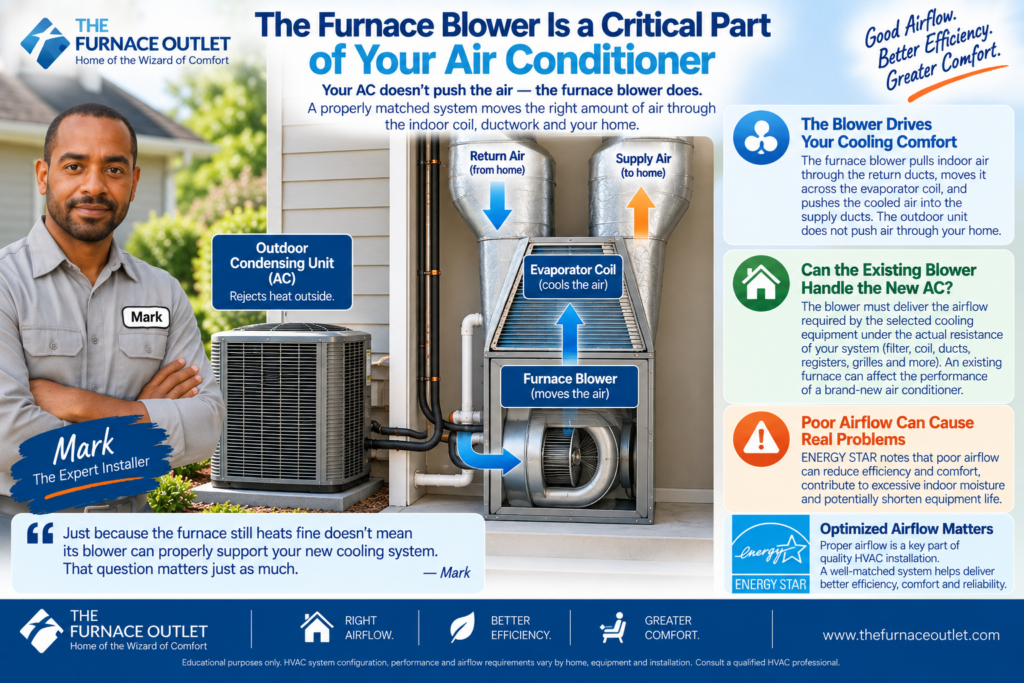
This is probably the most overlooked compatibility issue. When your AC operates, the outdoor condenser is not independently pushing cool air through the house. The furnace blower moves indoor air through the return system, across the evaporator coil and into the supply ductwork. That means an existing furnace can affect the performance of a brand-new air conditioner.
The blower must be capable of delivering the airflow required by the selected cooling equipment under the actual resistance of the installed system. That resistance includes the filter, evaporator coil, supply and return ducts, registers, grilles and other components. ENERGY STAR specifically identifies optimized system airflow as part of quality HVAC installation and notes that poor airflow can reduce efficiency and comfort, contribute to excessive indoor moisture and potentially shorten equipment life. So when somebody tells me, “We’re keeping the furnace because it still heats fine,” my next question is: Can its blower properly support the new cooling system? That question matters just as much.
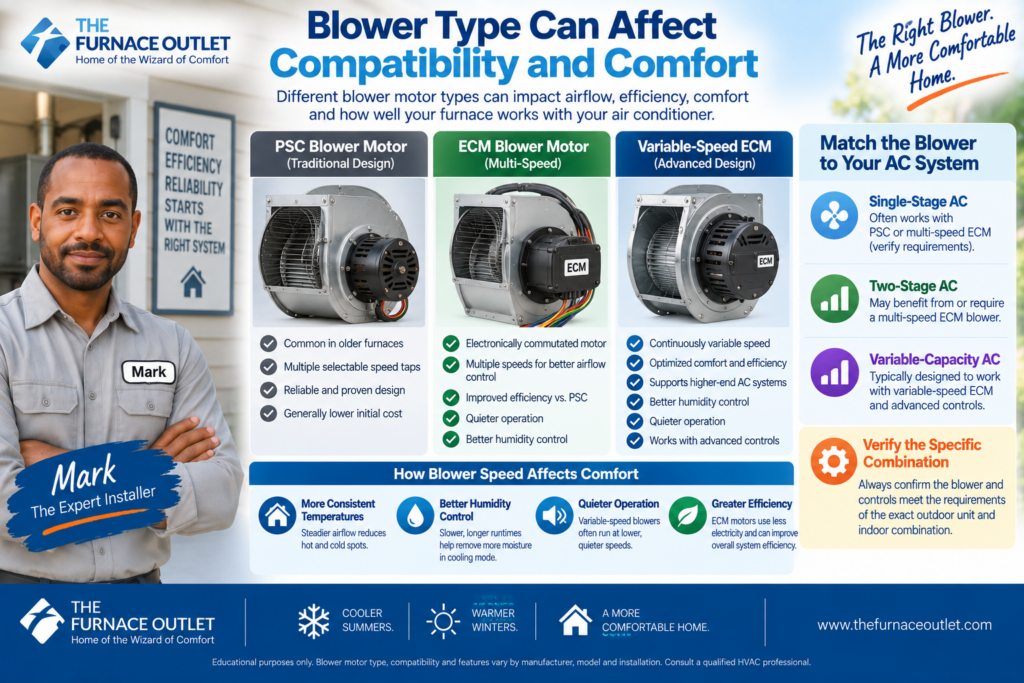
Older furnaces may use a traditional PSC blower motor with several selectable speed taps. Newer equipment increasingly uses electronically commutated motors, including multi-speed or variable-speed ECM designs. The distinction becomes particularly important with higher-end air conditioners.
A basic single-stage AC may have relatively straightforward airflow requirements. Two-stage and variable-capacity cooling equipment may benefit from or require more sophisticated indoor airflow and control capabilities. That does not mean every new AC requires a variable-speed furnace. It means the contractor must verify the requirements of the specific outdoor unit and indoor combination. If you are investing in advanced cooling equipment, I would make sure the indoor blower and controls can actually support the features you are paying for.
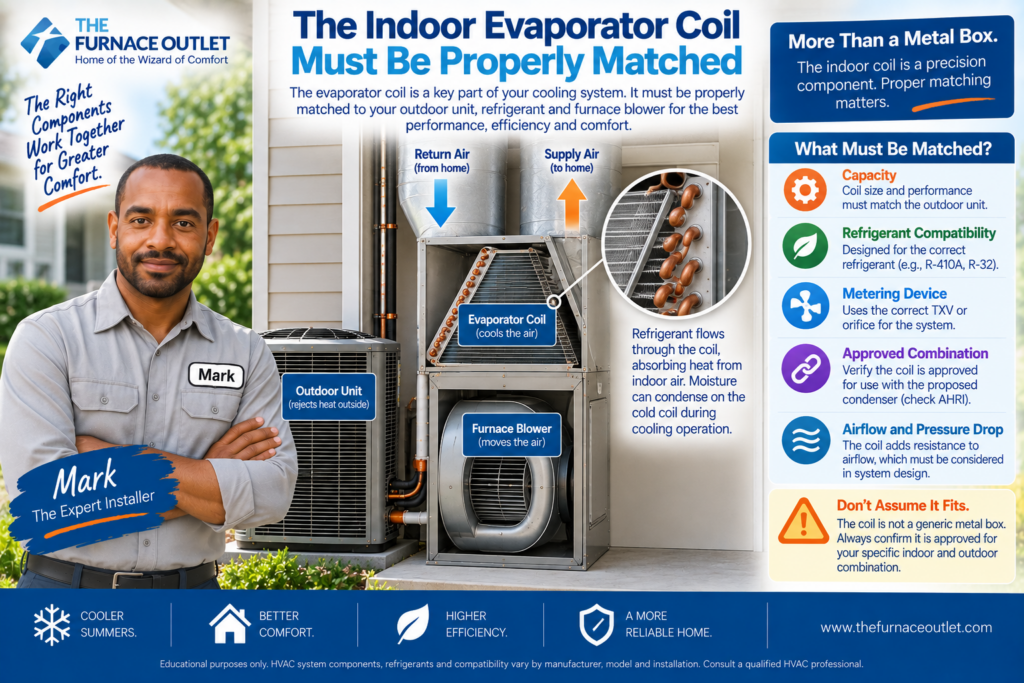
Between the furnace and the supply ductwork sits one of the most important components in the cooling system: the evaporator coil. Refrigerant passes through this coil while the blower moves indoor air across it. Heat is absorbed from the air, and moisture can condense on the cold coil during cooling operation. The coil cannot be treated as a generic metal box that happens to fit above the furnace.
Its capacity, refrigerant compatibility, metering device and approved equipment combination all matter. The coil also creates resistance to airflow, so its pressure drop becomes part of the total system. When replacing an outdoor AC while retaining an existing furnace and coil, I would specifically ask whether that indoor coil is approved for use with the proposed condenser.
One of the most useful resources for checking HVAC equipment combinations is the AHRI Directory of Certified Product Performance. AHRI publishes certified equipment combinations and their performance ratings. Instead of relying only on a salesperson saying that two components “should work together,” ask for the AHRI Certified Reference Number for the proposed system where applicable.
AHRI Directory of Certified Product Performance
An AHRI certificate can identify the specific outdoor unit and indoor components used to establish certified system performance. This becomes particularly important when comparing efficiency claims. The efficiency advertised for an outdoor condenser is not necessarily the rating your particular combination will achieve. The certified combination matters.
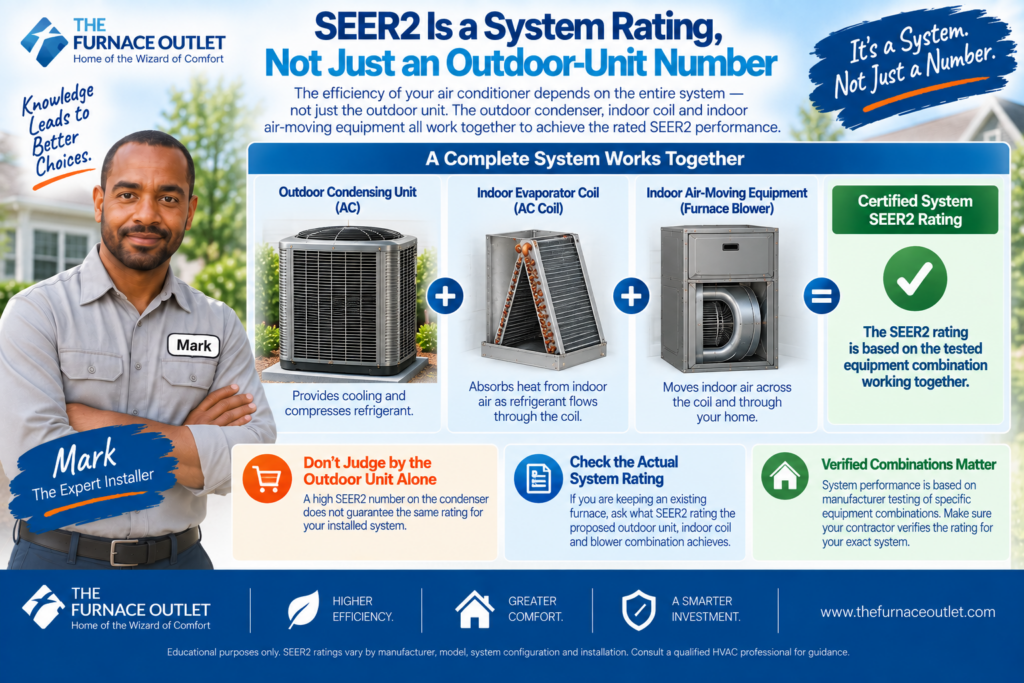
Homeowners often shop for central air conditioners by SEER2 rating. That is useful, but it can create the impression that the outdoor condenser alone determines cooling efficiency. In a split system, rated performance depends on the tested equipment combination.
The outdoor unit, indoor coil and indoor air-moving equipment all contribute to the certified configuration. If a contractor proposes keeping an older furnace while installing a new high-efficiency condenser, ask what efficiency rating the actual proposed combination achieves. Do not assume that buying a condenser marketed within a certain SEER2 range automatically gives your installed system the highest published rating for that product family.
Refrigerant compatibility deserves special attention when mixing old and new equipment. The HVAC market is transitioning toward newer lower-GWP refrigerants in many new residential systems. That makes it especially risky to assume that an older evaporator coil, metering device or other refrigerant-side component can automatically remain with a new outdoor unit.
The refrigerant circuit must be designed for the specific equipment. Coil approval, metering devices, refrigerant requirements, line-set considerations and manufacturer instructions all need to be verified. I would never approve a replacement proposal based simply on, “The old coil looks fine.”. The better question is, “Is this exact indoor coil approved and correctly configured for this exact outdoor unit and refrigerant?”
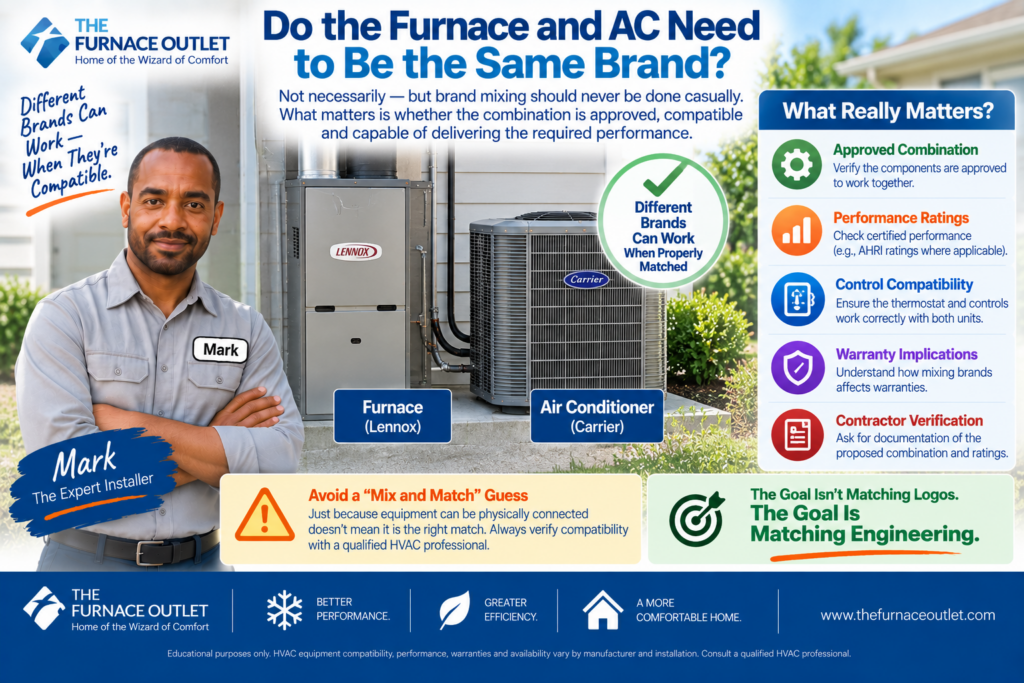
Not necessarily in every situation, but brand mixing should never be done casually. What matters technically is whether the proposed combination is approved, compatible and capable of delivering the required performance. Manufacturers often design families of furnaces, coils, condensers and controls to work together, which can simplify equipment matching.
Mixing brands may sometimes produce an acceptable approved combination, but the contractor should verify rather than improvise. I would want documentation showing the proposed combination, its certified performance where applicable, control compatibility and warranty implications. The goal is not matching logos. The goal is matching engineering.
You can select a perfectly matched furnace, evaporator coil and condenser and still end up with a disappointing HVAC system if the ductwork cannot move the required air. ACCA’s Manual D addresses residential duct-system design, while ACCA’s broader residential design process links Manual J load calculations, Manual S equipment selection and Manual D duct design.

Return-air capacity deserves particular attention. An undersized return can increase static pressure and restrict airflow through the furnace and evaporator coil. Undersized supply ducts, restrictive filters, closed dampers and poorly designed fittings can create similar problems. ENERGY STAR recommends that ducts be evaluated during quality HVAC installation and notes that duct leakage and reduced airflow can hurt comfort and performance. When replacing equipment, I want the contractor to look beyond the mechanical room.
If I were reviewing a furnace-and-AC installation, one of the measurements I would want after installation is total external static pressure. Think of static pressure as an indication of how much resistance the blower faces while trying to move air through the system. The equipment manufacturer provides operating limits and airflow information that technicians can use when setting up the blower.
High static pressure can result from restrictive ducts, an undersized return system, restrictive filters, coils or other system conditions. A sophisticated ECM blower can sometimes adjust its operation to maintain targeted airflow within its designed operating range, but it cannot turn inadequate ductwork into good ductwork. This is why equipment matching and airflow verification belong together.
Even correctly matched equipment can perform poorly if the refrigerant charge is wrong. ENERGY STAR specifically lists proper refrigerant charge as an element of HVAC quality installation, noting that proper charging helps reduce energy consumption and the risk of system failure.
Installation procedures vary by equipment and conditions. Line-set length, manufacturer specifications and the required charging method must all be considered. This is commissioning work, not something that should be assumed correct simply because the AC produces cold air.
Controls become increasingly important as equipment becomes more sophisticated. A conventional single-stage furnace paired with a single-stage AC may work with relatively simple thermostat controls. A two-stage furnace, two-stage AC or communicating variable-capacity system can require additional control capabilities.
Sometimes equipment can operate with simplified controls but lose functionality that the homeowner paid for. For example, advanced staging, blower modulation, humidity control or equipment diagnostics may depend on compatible controls. When comparing quotes, ask the contractor exactly which thermostat or communicating control will be installed and which equipment functions it will manage.
Do not wait until installation day to discover that an expensive feature requires another component.

Absolutely—when the existing furnace is genuinely compatible. I would consider keeping it when the furnace is in good condition, has reasonable remaining life, provides adequate blower capability, can deliver the required cooling airflow, works with the proposed controls and allows an approved indoor-coil/outdoor-unit combination.
The decision becomes less attractive when the furnace is already approaching replacement age, its blower is poorly suited to the new AC, the existing coil is incompatible, or keeping it substantially limits the performance of the new cooling equipment. There is also an economic consideration. Replacing the furnace a few years after installing the AC can mean paying twice for overlapping labor and disturbing recently installed components.
The right answer depends on the condition and compatibility of the existing equipment—not simply its age.
The same principle applies in reverse. If the outdoor AC and indoor coil still have substantial useful life, replacing only the furnace can make sense. The new furnace must provide appropriate airflow for the existing cooling system and work correctly with its controls and coil arrangement. I would also consider the physical dimensions of the equipment, cabinet transitions, drain arrangement, filter configuration and accessibility.
A new furnace should not be selected solely because its cabinet happens to fit beneath the old coil.
Poor matching can show up in ways homeowners may not immediately associate with equipment compatibility. You may experience inadequate cooling, excessive humidity, noisy airflow, short cycling, unusually long cycles, higher energy use, poor temperature distribution or premature component problems. In other cases, the system may appear to operate normally while failing to deliver the efficiency or comfort expected from the equipment.
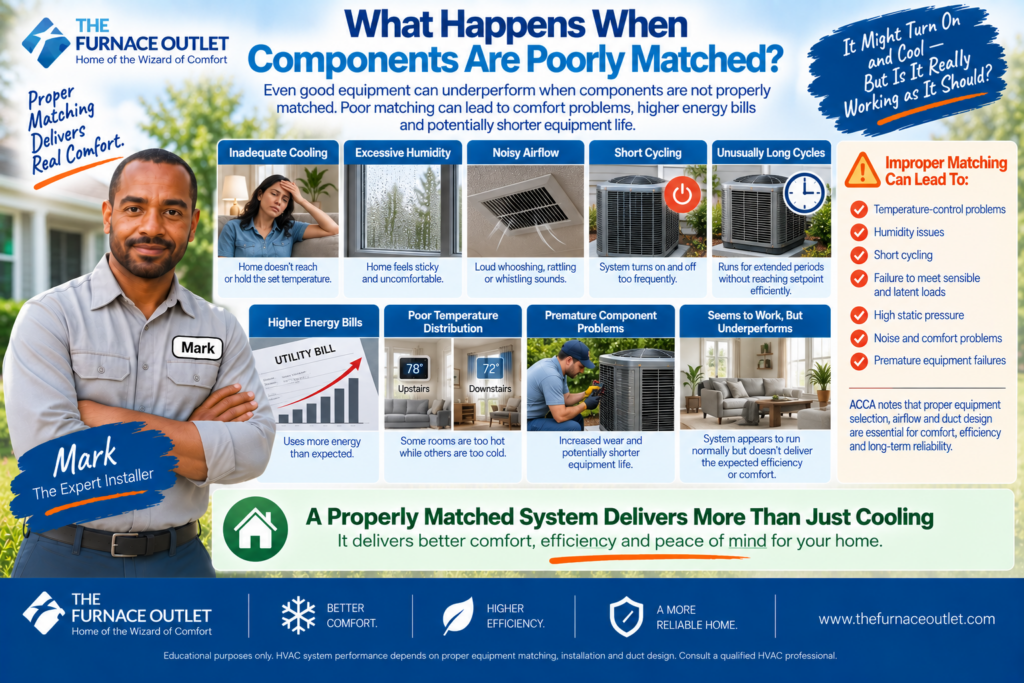
ACCA notes that improperly sized or selected equipment can contribute to temperature-control problems, humidity issues, short cycling and failure to meet sensible and latent loads. It also associates inadequate airflow and poor duct design with high static pressure, noise, comfort problems and premature failures. That is why “it turns on and cools” is not my definition of compatibility.
Before approving a furnace-and-air-conditioner combination, I would want the contractor to verify the home’s Manual J heating and cooling loads, equipment selection, outdoor condenser model, indoor evaporator-coil model, furnace model and blower capability.
I would also ask for the AHRI reference for the proposed combination where applicable, the certified efficiency rating, refrigerant type, required controls and confirmation that the duct system can support the required airflow. After installation, I would expect commissioning to include appropriate airflow verification, static-pressure evaluation, refrigerant-charge verification according to manufacturer procedures, condensate-drain inspection, control testing and confirmation that heating and cooling modes operate correctly.
That is a much better checklist than simply asking, “How many tons is the AC?”
When homeowners ask me whether a furnace and air conditioner are compatible, I do not start by looking at the logos on the cabinets. I start with the house and then work through the entire system.
Calculate the heating and cooling loads. Select equipment using appropriate performance data. Verify that the outdoor condenser, evaporator coil and furnace/blower combination are approved to work together. Confirm that the refrigerant, controls and electrical requirements are correct. Then make sure the ductwork can actually deliver the airflow the equipment needs.
If you are replacing only one half of an existing heating-and-cooling system, do not assume that the component you are keeping is automatically compatible because it still works. Have its capacity, condition, blower capability, coil compatibility and controls evaluated against the new equipment.
A premium furnace cannot compensate for a poorly matched air conditioner. A high-SEER2 condenser cannot overcome inadequate airflow. And a sophisticated variable-speed blower cannot rescue seriously restrictive ductwork.
The best HVAC system is not simply a collection of good components. It is a properly sized, properly matched and properly commissioned system in which every component is capable of doing its part.
For further technical guidance, homeowners and contractors can consult the AHRI Directory of Certified Product Performance for certified equipment combinations and ratings. ACCA’s Manual J residential load-calculation guidance explains the foundation of residential heating and cooling load calculations, while ACCA’s residential system-design guidance connects Manual J loads with Manual S equipment selection and Manual D duct design.
ENERGY STAR’s HVAC Quality Installation guidance provides homeowner guidance on sizing, airflow, refrigerant charge and duct evaluation. For a manufacturer explanation of how a furnace and central air conditioner operate as a matched system, see Trane’s Air Conditioner + Furnace Matched Systems guide.
Editorial Disclosure: The Furnace Outlet is an independent educational resource. We are not affiliated with, endorsed by, or sponsored by the manufacturers or organizations referenced in this article, and we do not receive manufacturer compensation for inclusion or rankings.
Educational Disclaimer: HVAC compatibility, efficiency, sizing, refrigerant requirements and installation specifications vary by home and equipment combination. Always verify current manufacturer documentation, AHRI-certified combinations where applicable, local codes and installation requirements with a qualified HVAC professional.