Newsletter Subscribe
Enter your email address below and subscribe to our newsletter

HVAC made simple
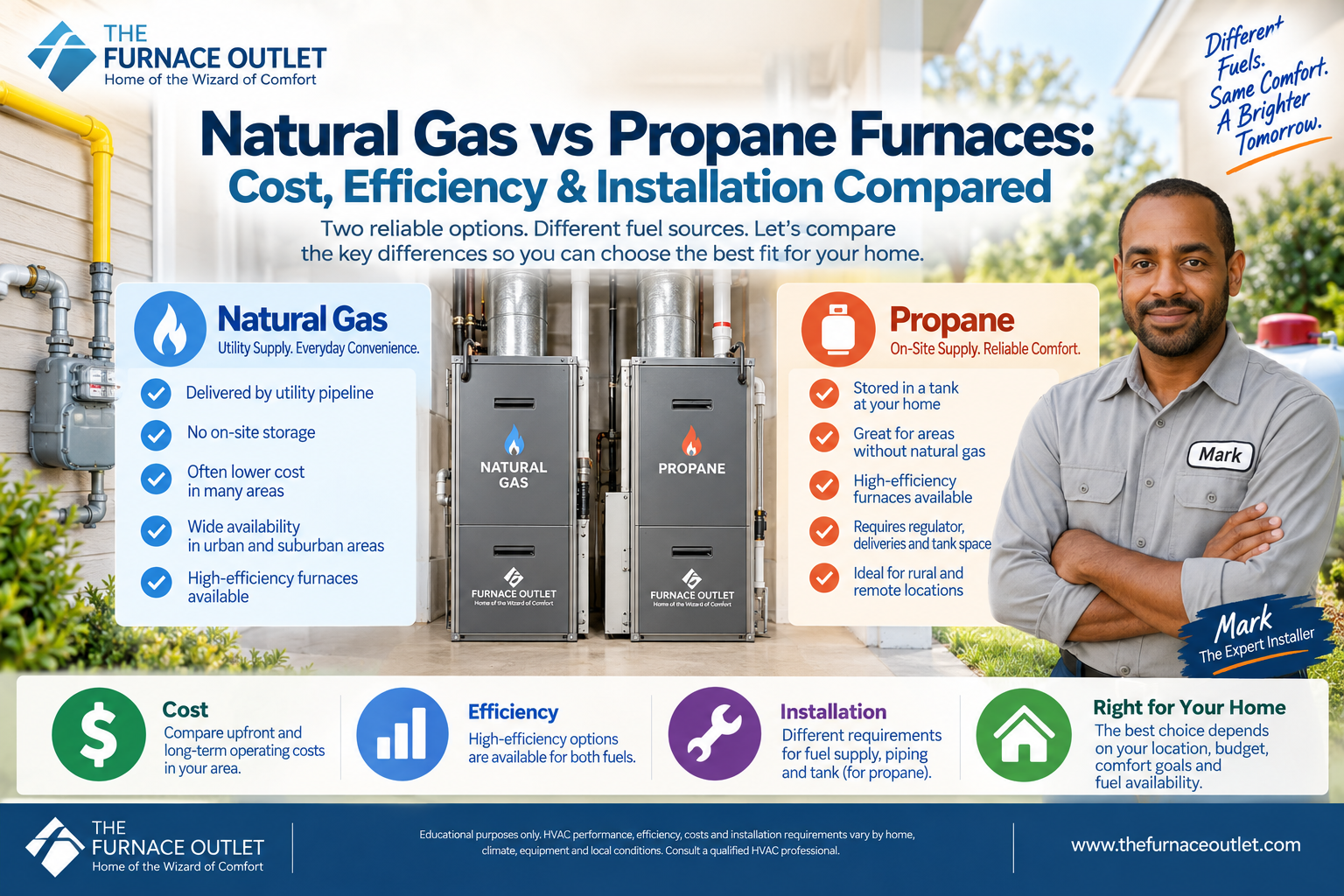
When homeowners compare natural gas and propane furnaces, the conversation often starts with fuel price. That matters, but it is only part of the decision. The better question is how the two fuels compare when you consider equipment efficiency, local fuel availability, installation requirements, storage, operating cost and the design of the house itself.
From the furnace’s point of view, natural gas and propane can both provide dependable forced-air heating. In fact, many residential gas furnaces are designed so that a qualified technician can configure an approved model for propane using the manufacturer’s conversion components and procedures. The major differences are usually outside the furnace cabinet: how the fuel reaches the home, how it is stored or supplied, what it costs locally and what infrastructure the property already has.
If a house already has a reliable natural-gas service, natural gas will often be the simpler fuel to continue using. If natural gas is unavailable, particularly in a rural or semi-rural location, propane can make a conventional high-efficiency gas furnace possible without requiring a utility gas main.
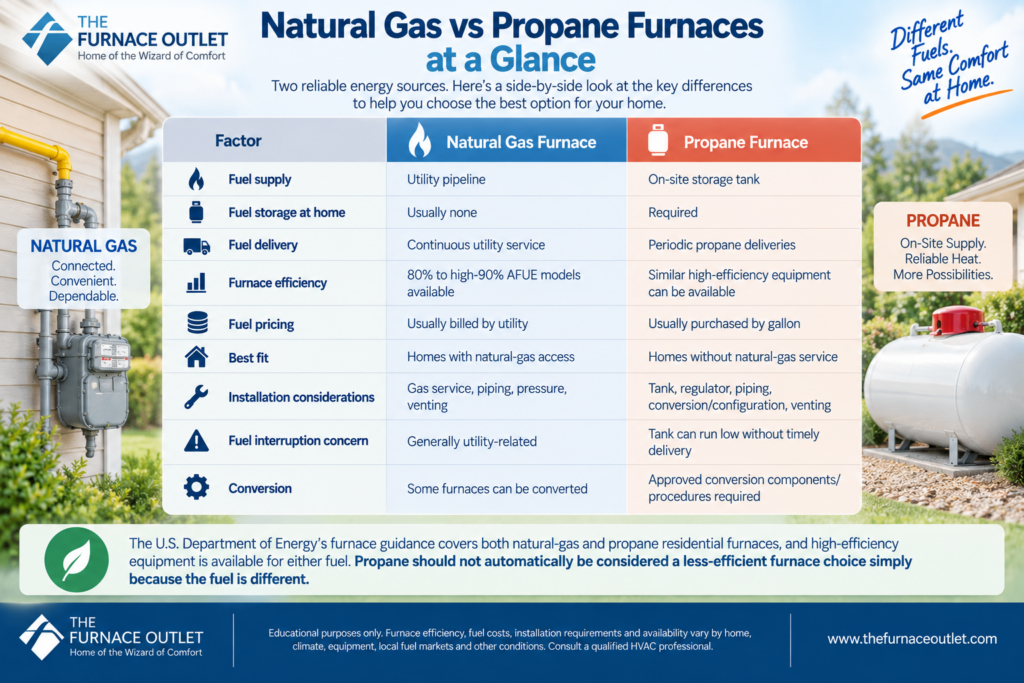
| Factor | Natural Gas Furnace | Propane Furnace |
|---|---|---|
| Fuel supply | Utility pipeline | On-site storage tank |
| Fuel storage at home | Usually none | Required |
| Fuel delivery | Continuous utility service | Periodic propane deliveries |
| Furnace efficiency | 80% to high-90% AFUE models available | Similar high-efficiency equipment can be available |
| Fuel pricing | Usually billed by utility | Usually purchased by gallon |
| Best fit | Homes with natural-gas access | Homes without natural-gas service |
| Installation considerations | Gas service, piping, pressure, venting | Tank, regulator, piping, conversion/configuration, venting |
| Fuel interruption concern | Generally utility-related | Tank can run low without timely delivery |
| Conversion | Some furnaces can be converted | Approved conversion components/procedures required |
The U.S. Department of Energy’s furnace guidance covers both natural-gas and propane residential furnaces, and high-efficiency equipment is available for either fuel. That is important because propane should not automatically be considered a less-efficient furnace choice simply because the fuel is different.
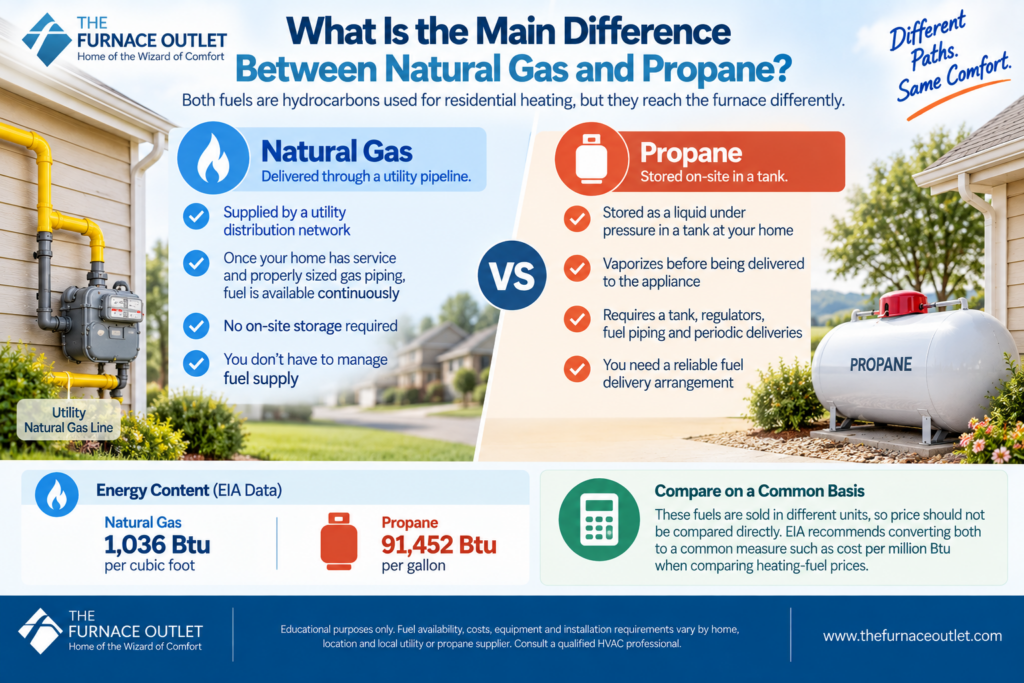
Both fuels are hydrocarbons used for residential heating, but they reach the furnace differently. Natural gas is normally delivered through a utility distribution network. Once the home has service and properly sized gas piping, fuel is available without a homeowner maintaining an on-site supply.
Propane is stored as a liquid under pressure in a tank located on the property. It vaporizes before being delivered to the appliance. That means a propane-heated home needs the appropriate tank, regulators, fuel piping and a reliable delivery arrangement.
The fuels also contain different amounts of energy per unit of measurement. EIA’s current conversion data uses approximately 1,036 Btu per cubic foot of natural gas and 91,452 Btu per gallon of propane. Those numbers should not be used to compare price directly because the fuels are sold in different units. EIA recommends converting both to a common measure such as cost per million Btu when comparing heating-fuel prices.
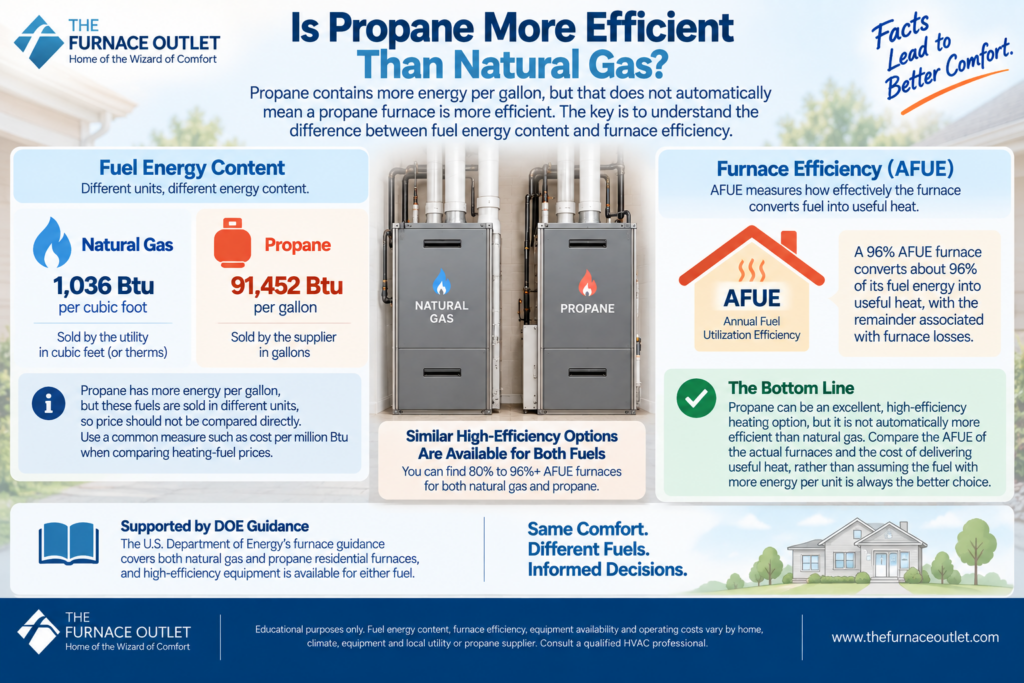
This question needs to be separated into fuel energy content and furnace efficiency. Propane contains a substantial amount of energy per gallon, but that does not mean a propane furnace automatically has a higher AFUE than a comparable natural-gas furnace.
AFUE, or Annual Fuel Utilization Efficiency, estimates how effectively the furnace converts its fuel input into useful heat over a heating season. A 96% AFUE furnace is designed to convert approximately 96% of its fuel energy into useful heating under the standardized AFUE methodology, with the remainder associated with furnace losses.
DOE guidance applies high-efficiency furnace criteria to both natural-gas and propane equipment. Consequently, you can find high-efficiency condensing furnaces configured for either fuel.
This is why I would not select between natural gas and propane based on statements such as “propane burns hotter, therefore the furnace is more efficient.” Compare the AFUE of the actual furnaces and the cost of delivering useful heat, rather than confusing the fuel’s heat content with the appliance’s efficiency.
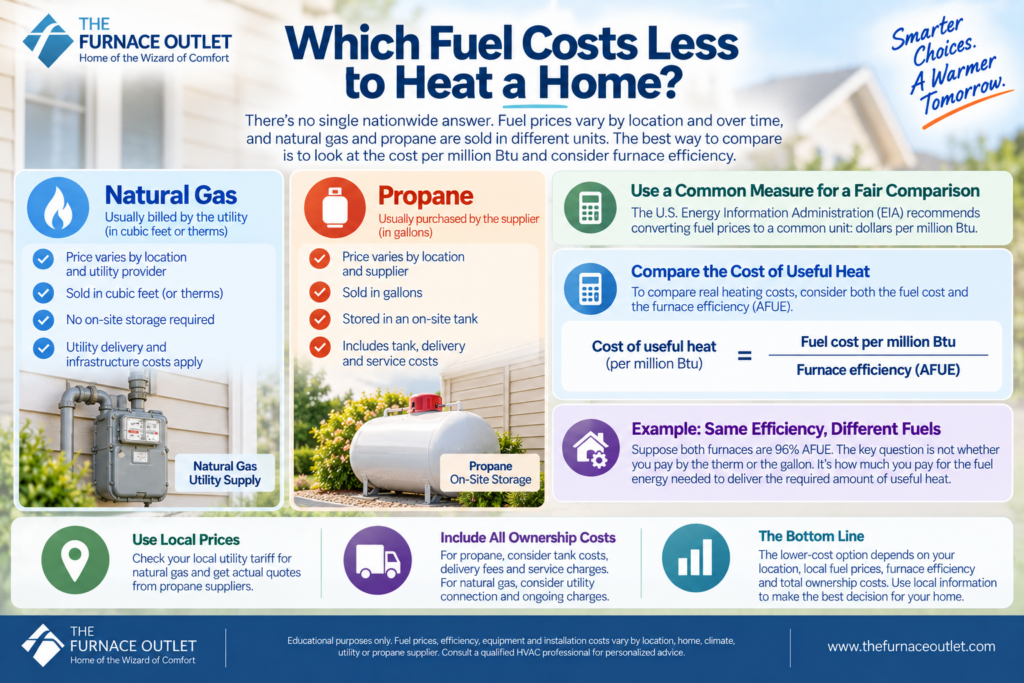
There is no responsible nationwide answer based solely on today’s price per therm or gallon because fuel prices vary by location and over time. Natural gas and propane are also sold using different units, making a direct comparison misleading. EIA recommends converting the fuel price into dollars per million Btu and then considering appliance efficiency.
For a homeowner comparison, I would take that one step further: Cost of useful heat ≈ fuel cost per million Btu ÷ furnace efficiency
Suppose two furnaces are both 96% AFUE. The meaningful question is not whether one household pays by the therm and another by the gallon. It is how much each household pays for the fuel energy necessary to deliver the required amount of useful heat. Local propane delivery charges, tank arrangements and natural-gas utility charges also belong in a real ownership-cost comparison. Instead of relying on a national average, use your local utility tariff and actual propane quotes.
A home that already has natural-gas service starts with a significant practical advantage: much of the infrastructure may already exist. There may be no propane tank to purchase or lease and no need to schedule fuel deliveries. For a straightforward furnace replacement, the contractor can evaluate the existing gas line, regulator arrangement, meter capacity, venting, electrical service, condensate system and ductwork. Existing infrastructure does not guarantee that everything is correctly sized for the new furnace, but it can make the project simpler.
Natural gas also eliminates the homeowner’s responsibility for monitoring an on-site fuel tank. For households with substantial winter heating loads, that convenience can be meaningful. I would still compare local costs rather than assuming natural gas is automatically inexpensive. Existing infrastructure makes natural gas convenient; local fuel pricing determines its operating economics.

Propane becomes particularly valuable where natural-gas infrastructure simply does not exist. Many rural properties would otherwise need to consider electricity, heating oil, wood or another heating arrangement. Propane allows these homes to use familiar central forced-air furnace technology.
A propane tank also gives the property its own stored fuel supply. Homeowners can monitor the tank level and arrange deliveries, with automatic-delivery programs available from many suppliers. Modern high-efficiency furnace technology is not exclusive to natural gas. Carrier, for example, states that its natural-gas furnace lineup can be converted for propane operation using the appropriate conversion process. The details are manufacturer- and model-specific, which is why the approved instructions matter.
For a home far from a natural-gas main, propane may therefore be much more practical than paying for a potentially expensive gas-service extension—assuming an extension is even available.
The biggest physical difference is the propane tank. A propane installation requires space for an appropriately sized storage tank and compliant placement, along with regulators and piping between the storage system and the appliances. Tank size should reflect more than the furnace’s input rating. If propane also supplies the water heater, cooking equipment, fireplace, generator or other appliances, the home’s total fuel demand matters.
Climate matters as well. A house experiencing long, cold winters can consume propane much faster than a comparable home in a mild climate. The homeowner and propane supplier should therefore establish an appropriate storage and delivery strategy rather than treating the tank as an afterthought. This also introduces a responsibility natural-gas customers generally do not have: the fuel inventory has to be managed. Automatic delivery and remote tank monitoring can reduce that concern, but it remains part of propane ownership.
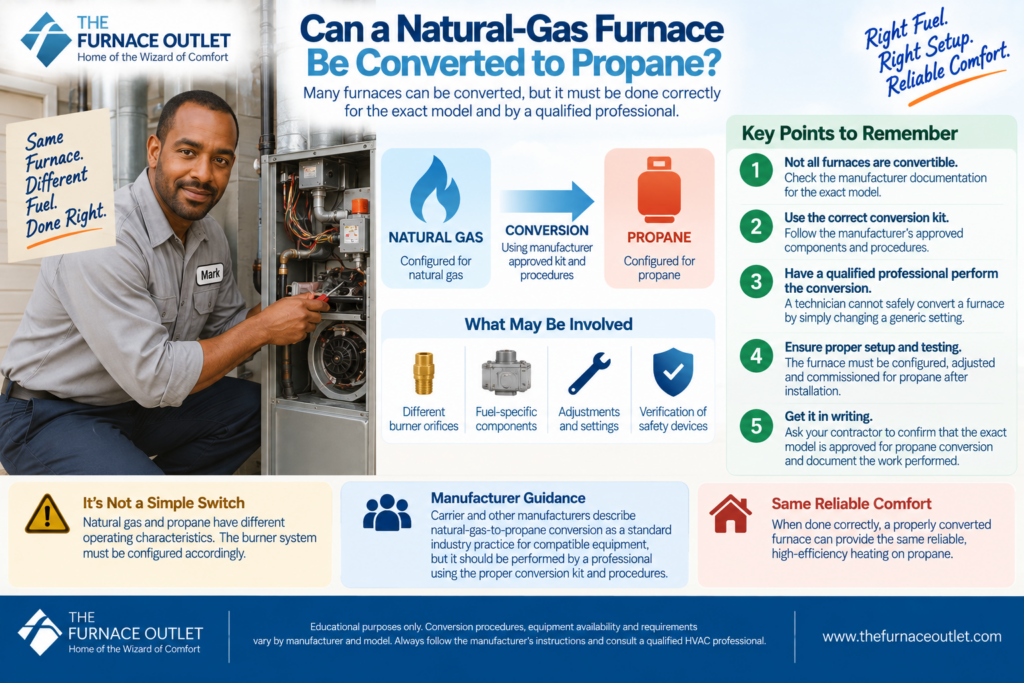
Many furnaces can, but this is an area where I would insist on following the documentation for the exact furnace model. A technician cannot safely convert a furnace simply by changing a generic setting. Natural gas and propane have different operating characteristics, and the burner system must be configured accordingly. Depending on the furnace, conversion may involve different burner orifices and other fuel-specific components, adjustments or safety devices.
Carrier describes natural-gas-to-propane conversion as a standard industry practice for compatible equipment but specifically states that it should be performed by a professional using the proper conversion kit and procedures. If you are buying a furnace for propane operation, I would have the contractor document that the exact model is approved for propane conversion, identify the correct manufacturer conversion kit and confirm the furnace will be commissioned for propane after installation.
Whether the furnace burns propane or natural gas, a quality installation involves much more than supplying fuel to the burners. The contractor should verify furnace sizing, gas pressure, venting, combustion setup, electrical requirements, return-air capacity, supply airflow, filter pressure drop, condensate drainage on a condensing furnace and thermostat/control configuration.
The gas piping itself must also be capable of supporting the connected appliance load. Adding a larger furnace or additional gas appliance can change the required piping capacity. For propane, the installation also involves the storage and regulation system. For natural gas, utility service and meter capacity may need consideration.
This is why I would not compare two furnace proposals by looking only at the equipment price. A lower equipment quote can become poor value if important installation work has been omitted.
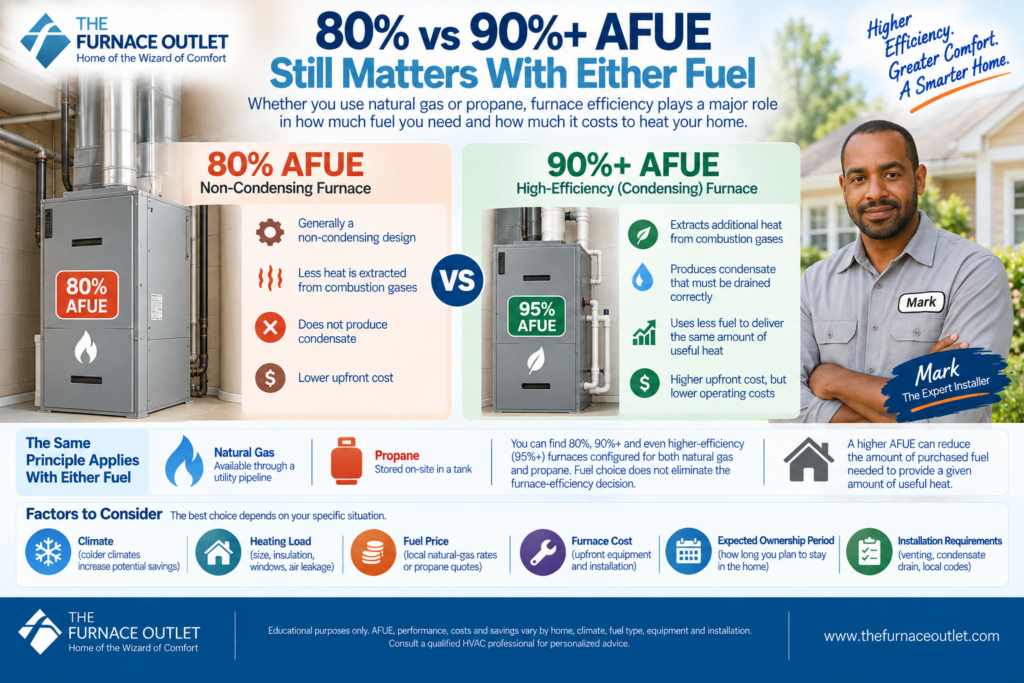
Fuel choice does not eliminate the normal furnace-efficiency decision. An approximately 80% AFUE furnace is generally a non-condensing design, while high-efficiency 90%+ furnaces extract additional heat from combustion gases and produce condensate that must be drained correctly.
DOE’s current purchasing guidance illustrates the scale of this efficiency difference: its comparison uses 80%, 95% and 99% AFUE residential furnace examples. The same basic efficiency principle applies regardless of whether an approved furnace is configured for natural gas or propane. For a high-heating-load home, improving AFUE can reduce the amount of purchased fuel needed to provide a given amount of useful heat. In a mild climate with limited furnace runtime, the financial return on a more expensive condensing furnace may be less dramatic.
The correct decision therefore combines climate, heating load, fuel price, furnace cost, expected ownership period and installation requirements.
A propane furnace should not automatically be larger or smaller than a natural-gas furnace simply because of the fuel. Furnace capacity should be based primarily on the home’s heating requirement. That means evaluating factors such as conditioned floor area, outdoor winter design temperature, insulation, windows, air leakage and building construction. A professional Manual J load calculation provides a much better foundation than selecting a furnace using square footage alone.
Once the heating load is understood, the contractor can select equipment with appropriate output capacity and configure it for the intended fuel. An oversized propane furnace wastes the advantages of good equipment just as an oversized natural-gas furnace can. Correct sizing comes before fuel configuration.
A well-installed natural-gas furnace and a properly configured propane furnace can both provide long service. I would place greater emphasis on equipment quality, installation, maintenance and operating conditions than on assuming one fuel automatically produces a more reliable furnace.
Both systems require routine furnace maintenance, including filter care and inspection of combustion and venting components. Propane installations add fuel-storage and delivery equipment that must also remain in appropriate condition. High-efficiency condensing furnaces deserve particular attention to condensate drainage and venting because those systems are integral to proper operation. Blower cleanliness, evaporator-coil condition and duct static pressure also matter regardless of fuel.
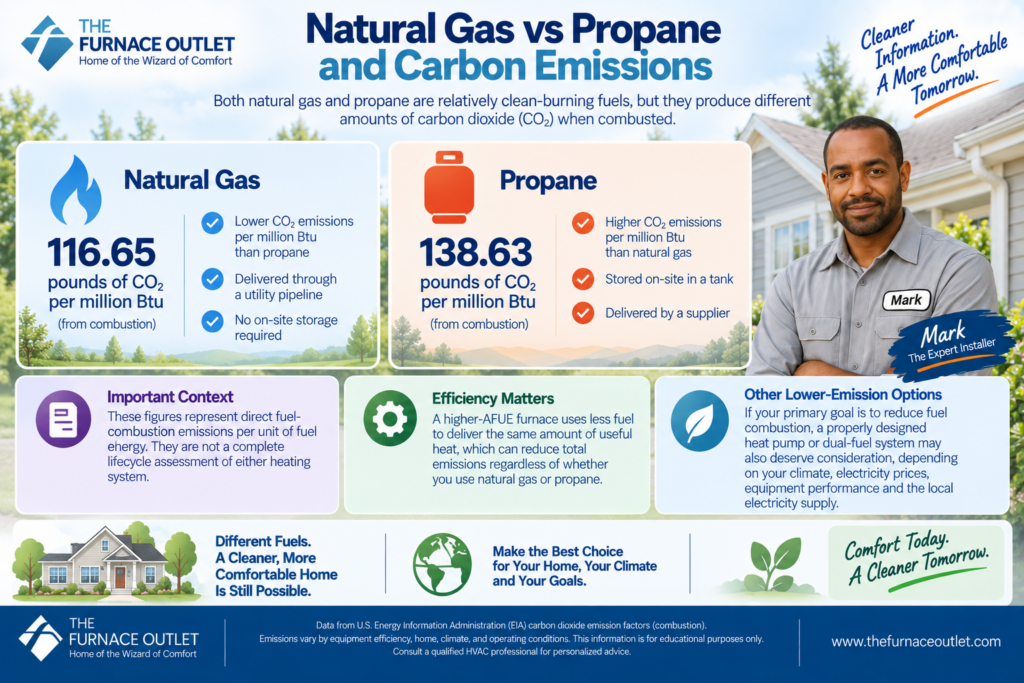
For homeowners considering direct combustion emissions, EIA’s published carbon-dioxide factors show a difference between the two fuels. Its current coefficients list approximately 116.65 pounds of CO₂ per million Btu for natural gas and 138.63 pounds per million Btu for propane from combustion.
Those figures describe direct fuel-combustion emissions per unit of fuel energy; they are not a complete lifecycle assessment of either heating system. Equipment efficiency also affects how much fuel must be burned to meet a home’s heating load.
For homeowners primarily focused on reducing fuel combustion rather than choosing between the two fuels, a properly designed heat-pump or dual-fuel system may also deserve consideration, depending on climate, electricity prices, equipment performance and the local electricity supply.
I would start with the infrastructure already available. If the home has dependable natural-gas service, correctly sized piping and competitive local rates, replacing a natural-gas furnace with another properly selected natural-gas furnace is often the most straightforward path.
If natural gas is unavailable and extending service would be impractical or expensive, propane becomes a very credible option. I would then obtain local propane pricing, understand the tank purchase or lease arrangement, evaluate delivery reliability and compare the annual heating economics against alternatives available at the property.
If both fuels are realistically available, I would compare total installed cost and estimated annual cost of useful heat, not simply furnace sticker prices.

Before signing a furnace proposal, I would want the contractor to explain whether natural gas is already available at adequate capacity, what propane infrastructure would be required if that fuel is selected, and whether the exact furnace model is factory-configured or manufacturer-approved for conversion.
I would also ask for the proposed BTU input, output capacity, AFUE, heating stages and blower type, along with confirmation that the furnace has been selected using an appropriate heating-load calculation. For propane, ask who owns and maintains the tank, how deliveries are scheduled and what happens if fuel runs low during severe weather.
Finally, ask what commissioning measurements will be taken after startup. Fuel choice matters, but correct combustion, airflow and system setup matter just as much once the furnace is installed.
I would not approach this decision by asking whether natural gas or propane is universally the “better” furnace fuel. Start with the house and the available infrastructure. A home already connected to natural gas may have a very different economic case from a rural property located miles from the nearest gas main.
Then compare the numbers correctly. Determine the home’s heating load, compare appropriately sized furnaces with similar AFUE and comfort features, obtain actual local fuel prices and convert those prices to the cost of useful heat. With propane, include the tank and delivery arrangement. With natural gas, consider any utility connection, meter or piping work that the project requires.
Most importantly, do not allow fuel choice to distract from installation quality. Whether the furnace burns natural gas or propane, proper sizing, correct fuel pressure and combustion setup, adequate airflow, sound ductwork, proper venting and thorough commissioning will have an enormous influence on how the system actually performs in the home.
For readers who want to verify the technical details, the U.S. Energy Information Administration fuel-cost comparison guide explains how to compare fuels on a common Btu basis, while the EIA energy-unit and heat-content guide provides current conversion factors for natural gas and propane. The U.S. Department of Energy residential furnace guidance covers furnace efficiency and purchasing considerations. Carrier’s propane furnace guide provides a manufacturer example of natural-gas-to-propane conversion requirements, and the EIA carbon-dioxide coefficients provide standardized direct-combustion emission factors.
Editorial Disclosure: The Furnace Outlet is an independent educational resource. We are not affiliated with, endorsed by, or sponsored by the manufacturers or organizations referenced in this guide, and we do not receive manufacturer compensation for inclusion or rankings.
Educational Disclaimer: Furnace efficiency, fuel costs, installation requirements and operating expenses vary by home, climate, local fuel market, equipment and installation. Verify current equipment specifications, codes and fuel requirements with the manufacturer, fuel supplier and a qualified HVAC professional