Newsletter Subscribe
Enter your email address below and subscribe to our newsletter

HVAC made simple

Mark Callahan – the expert installer
When homeowners compare furnaces, they usually focus on AFUE, BTU capacity, furnace stages and brand. The blower motor receives much less attention, even though it is responsible for moving heated and cooled air through the duct system every time the HVAC system operates. In a home with central air conditioning, the furnace blower may work during summer as well as winter, which means its performance can affect comfort throughout the year.
One term you will frequently encounter on newer furnaces is ECM, which stands for Electronically Commutated Motor. ECM technology can reduce the electrical energy required to move air compared with older conventional blower designs, while more sophisticated ECM systems can also provide better airflow control, quieter operation and improved comfort. Carrier describes modern ECM and variable-speed blower technology as an important development over traditional PSC motors, which generally offered fewer fixed-speed choices and less airflow flexibility.
However, there is an important distinction homeowners should understand from the beginning: ECM does not automatically mean variable-speed, and a variable-speed blower is not the same thing as a two-stage or modulating furnace. Those technologies control different parts of the heating system.

The furnace creates heat, but the blower is what distributes that heat through the house. A motor turns the blower wheel, drawing air through the return system and filter, moving it through the furnace and then pushing conditioned air into the supply ductwork.
The basic airflow path can be thought of as return air → filter → furnace/coil → blower-driven airflow → supply ducts → rooms. The blower therefore has to move enough air for the furnace to operate correctly while also supporting the air conditioner or heat pump when those components share the same duct system.
That makes the blower much more important than it may appear on a furnace specification sheet. Carrier notes that blower operation directly influences airflow, comfort, noise and electrical energy consumption, while Lennox similarly describes the blower motor as the component responsible for moving conditioned air throughout the home’s ductwork.
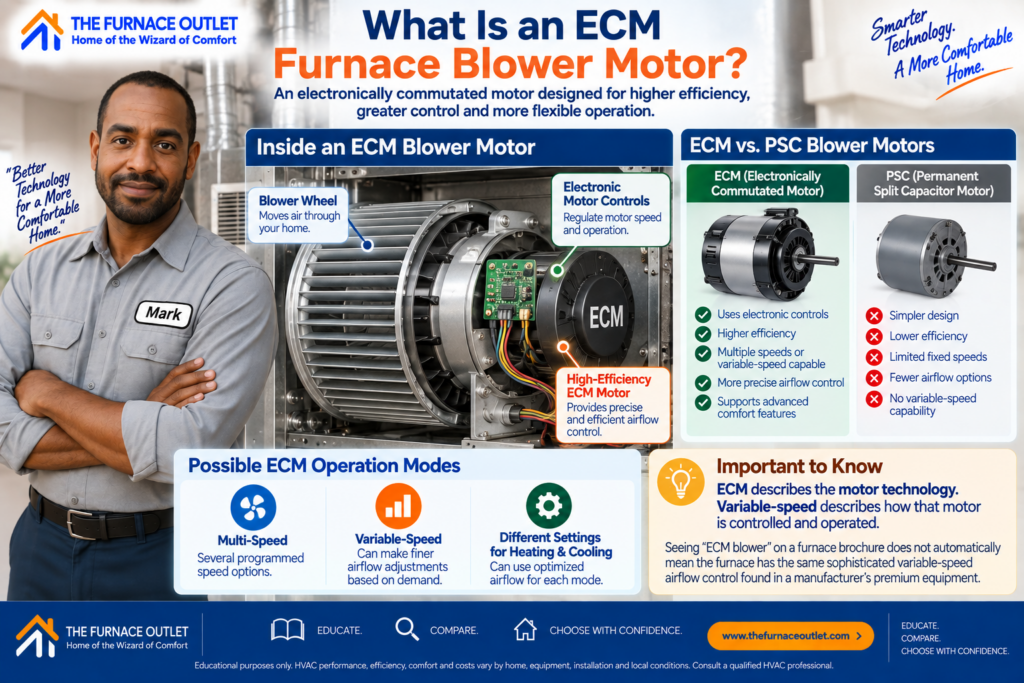
An ECM is an electronically commutated motor. Unlike the older PSC, or permanent split capacitor, motors commonly used in residential HVAC equipment, an ECM incorporates electronic motor controls that allow more efficient and sophisticated operation.
The electronics are one reason ECM technology can provide considerably more flexibility. Depending on the furnace and motor design, an ECM may operate at several programmed speeds, provide different airflow settings for heating and cooling, or operate as part of a true variable-speed system capable of making much finer airflow adjustments.
This is where homeowners should be careful with terminology. Seeing “ECM blower” on a furnace brochure does not necessarily mean that the furnace has the same sophisticated variable-speed airflow control found in a manufacturer’s premium equipment.
ECM describes the motor technology. Variable-speed describes how that motor is controlled and operated.
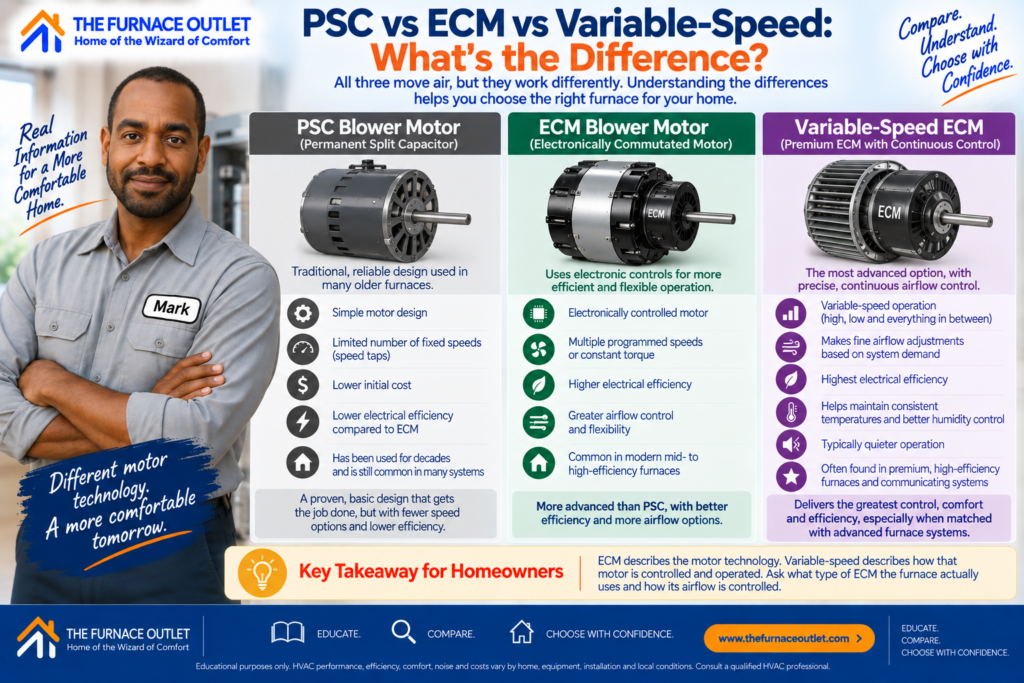
Older furnaces frequently used PSC blower motors. These are relatively simple motors that generally operate using a limited number of predefined speed taps. They have served residential HVAC systems for decades, but newer electronically controlled motors can provide greater electrical efficiency and control flexibility.
An ECM furnace may use a constant-torque or multi-speed electronically controlled motor, providing several airflow selections while still being more sophisticated than a conventional PSC arrangement. At the higher end, a variable-speed ECM can make finer airflow adjustments based on system demand and control strategy.
Lennox describes variable-speed motors as being able to operate at high speed, low speed or points in between, effectively ramping airflow rather than simply switching between full airflow and off. Carrier likewise distinguishes traditional PSC motors from newer ECM and variable-speed technology.
For homeowners, the practical lesson is simple: ask what type of ECM the furnace actually uses and how its airflow is controlled.
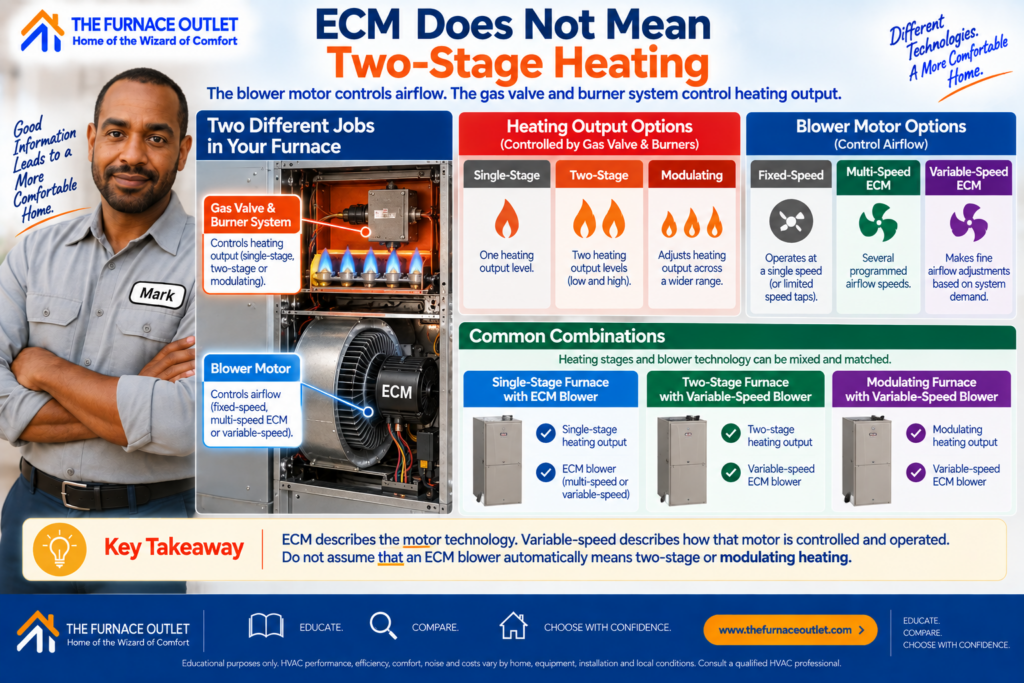
This distinction is particularly important because furnace terminology can become confusing very quickly. The blower motor controls airflow. The gas valve and burner system control heating output.
A single-stage furnace has one primary heating-output level. A two-stage furnace has two heating-output levels. A modulating furnace can adjust heat output across a broader range. Meanwhile, the blower may be fixed-speed, multi-speed ECM or variable-speed depending on the furnace design.
Carrier specifically explains that “modulating” refers to gas-valve and heating-output control, while “variable-speed” refers to the blower and the amount of air being circulated.
You can therefore encounter combinations such as a single-stage furnace with an advanced ECM blower, a two-stage furnace with a variable-speed blower, or a modulating furnace with sophisticated variable-speed airflow. Do not assume the heating stages and blower technology are the same specification.
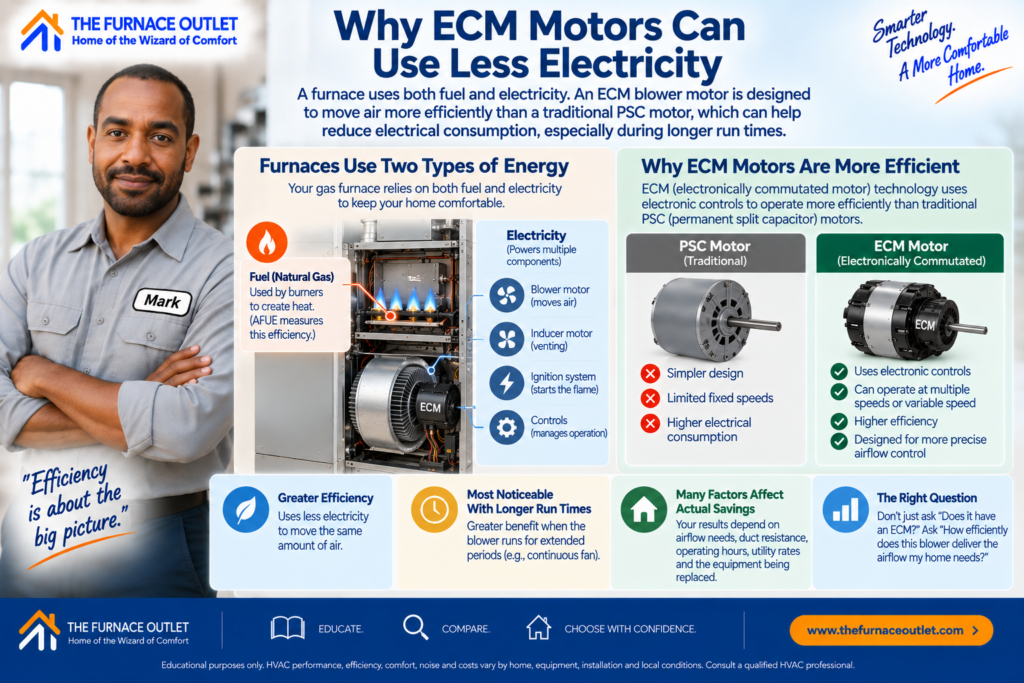
A furnace consumes energy in more than one way. Gas furnaces burn fuel to produce heat, but they also use electricity for components including the blower motor, inducer, ignition system and controls. AFUE primarily tells you about the furnace’s fuel-utilization efficiency. It does not tell the whole story about how much electricity the blower consumes while circulating air.
ECM technology is designed to operate more efficiently than traditional PSC motor technology. The advantage can become particularly meaningful when the blower operates for long periods, including homes where continuous or extended fan circulation is used. However, homeowners should avoid interpreting this as a guaranteed percentage reduction in the entire household energy bill. Actual savings depend on motor type, airflow requirement, operating hours, duct resistance, control strategy, utility rates and the equipment being replaced.
The correct comparison is therefore not simply, “Does this furnace have an ECM?” It is how efficiently does this particular blower deliver the airflow the HVAC system requires?
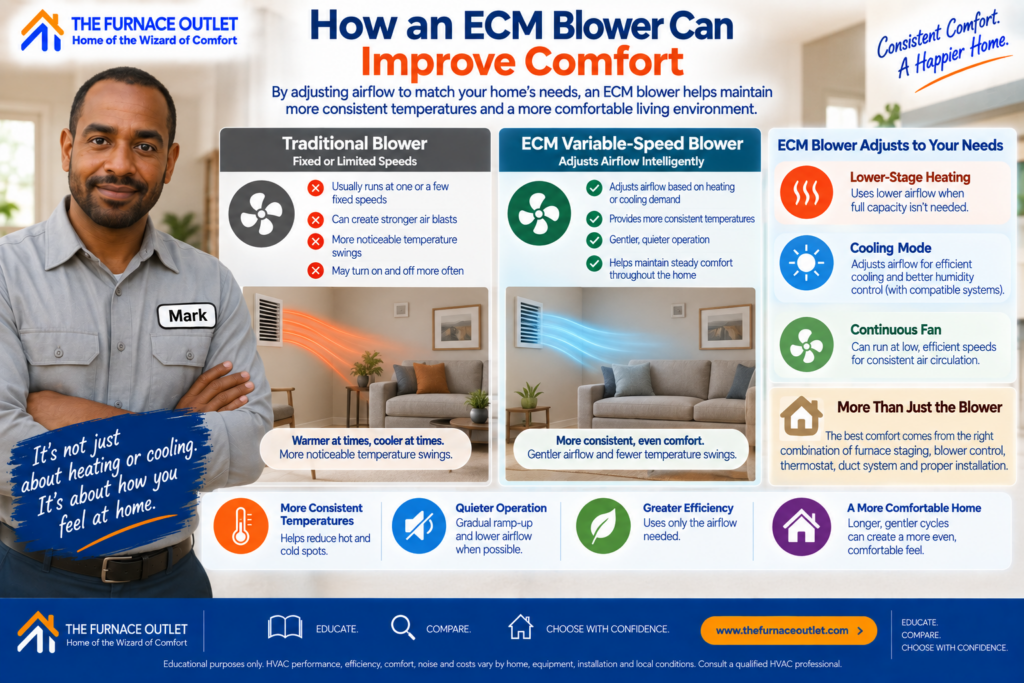
The comfort advantage becomes most noticeable with ECM systems that can vary airflow intelligently. Instead of producing the same airflow every time the equipment operates, a more advanced blower can use different airflow targets for different operating conditions.
During lower-stage heating, for example, the furnace may not need the same airflow required at maximum heating output. A variable-speed blower can coordinate airflow more closely with the heating demand. When properly matched with staged or modulating heating, that can create longer, gentler heating cycles and reduce the sensation of alternating between strong blasts of warm air and periods with no airflow.
Lennox’s current variable-speed furnace information describes its blower systems as gradually ramping airflow up or down and providing more consistent temperatures. Carrier likewise identifies enhanced temperature control as one of the benefits available from variable-speed blower technology.
The improvement does not come simply from the letters ECM. The control strategy, furnace staging, thermostat, duct system and equipment setup all contribute to the result.

Blower noise is closely connected to airflow. When a furnace immediately starts moving a large volume of air, homeowners may notice the startup through the return grille and supply registers. A variable-speed ECM can often begin more gradually and operate at reduced airflow when full capacity is unnecessary.
That can make the HVAC system less noticeable during normal operation. Lennox notes that variable-speed motors can ramp gradually rather than simply operating at full output, while Carrier associates variable-speed blower options with quieter furnace operation.
But I would be careful about promising that an ECM furnace will automatically make a noisy house quiet. Ductwork can overwhelm the benefits of an excellent blower motor. Undersized return ducts, restrictive filters, small supply ducts, poorly designed transitions and excessive static pressure can all create air noise.
If a contractor installs a premium variable-speed furnace and then forces it to move air through inadequate ductwork, the homeowner may still hear significant airflow noise.
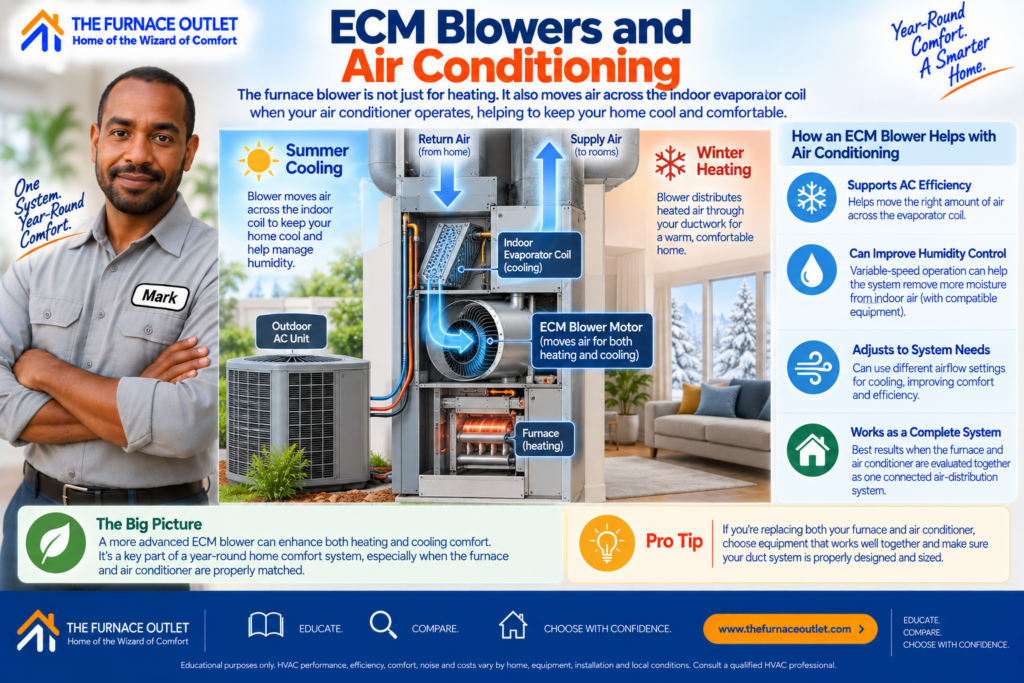
The furnace blower is not only a heating component. In many homes, it also moves air across the indoor evaporator coil when the central air conditioner operates. That means blower technology can affect summer comfort as well as winter heating. More sophisticated airflow control can coordinate blower operation with compatible cooling equipment and, in some systems, adjust airflow to support humidity management.
Carrier, for example, states that variable-speed blower operation on certain current furnaces can support air-conditioning efficiency and improved summer dehumidification. Its Performance 96 59SP6 uses a variable 25-speed blower and includes airflow-related humidity-control features.
This is one reason I recommend evaluating the furnace and air conditioner as one connected air-distribution system, particularly when both are being replaced together.
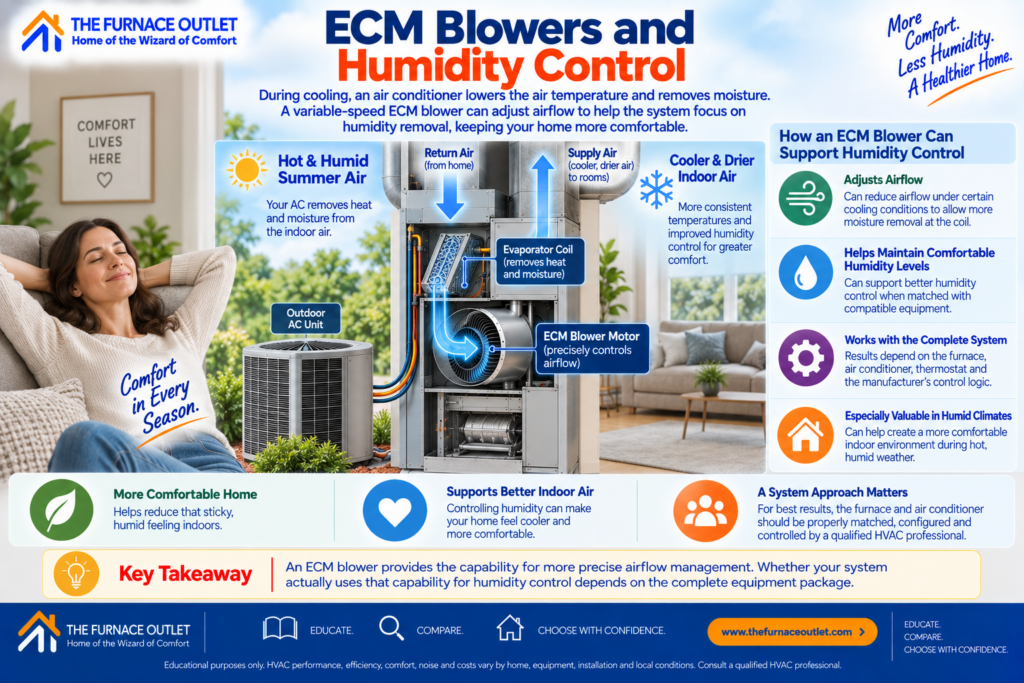
During cooling, an air conditioner does two jobs: it lowers air temperature and removes moisture. The amount of air moving across the evaporator coil influences both processes. Advanced blower controls can sometimes reduce airflow under specific cooling conditions, allowing the coil and compatible system controls to place greater emphasis on moisture removal. The exact strategy depends on the furnace, air conditioner, thermostat and manufacturer’s control logic.
This can be valuable in humid climates, but homeowners should not assume that installing any ECM motor automatically creates advanced dehumidification. The equipment needs to be properly matched, configured and controlled for those functions.
Think of the ECM as providing the capability for more precise airflow management. Whether the HVAC system actually uses that capability depends on the complete equipment package.
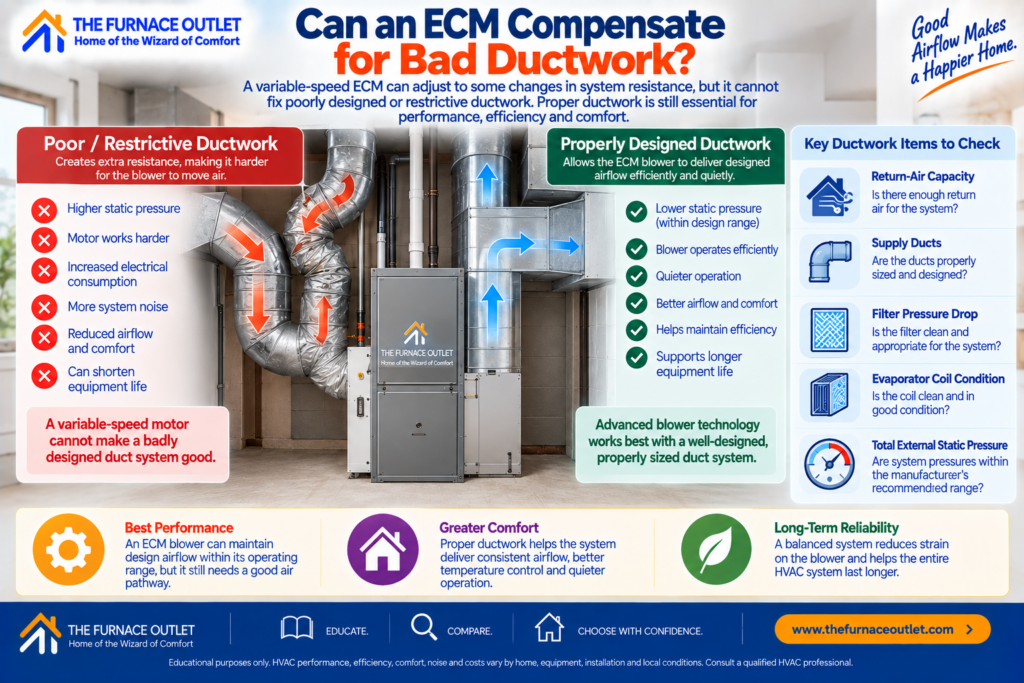
This is one of the most important limitations to understand. Some variable-speed ECM systems can adjust motor operation to maintain a targeted airflow as system resistance changes within their designed operating range. That capability can be useful, but it should never become an excuse for undersized or restrictive ductwork.
If static pressure becomes excessive, the motor may have to work harder to maintain airflow. That can increase electrical consumption and noise while placing additional demands on the blower system. A variable-speed motor cannot magically make a badly designed duct system good.
When I evaluate a furnace with advanced blower technology, I still want the contractor to inspect return-air capacity, supply ducts, filter pressure drop, evaporator coil condition and total external static pressure. Those measurements tell us whether the blower has a reasonable air pathway to work with.
High-efficiency filters can improve particle capture, but increased filtration can also create additional airflow resistance if the filter and cabinet are not properly selected.
A small one-inch filter with a restrictive media design may create considerably different pressure characteristics from a properly sized deep-media filter cabinet. As the filter loads with dust, resistance can increase further. Carrier specifically recommends keeping filters clean as an important way to reduce blower strain, and Lennox similarly notes that clean filters and clear ductwork help reduce stress on blower motors.
If you are investing in an advanced furnace, I would therefore include filter design and return-air capacity in the installation discussion rather than treating filtration as an afterthought.
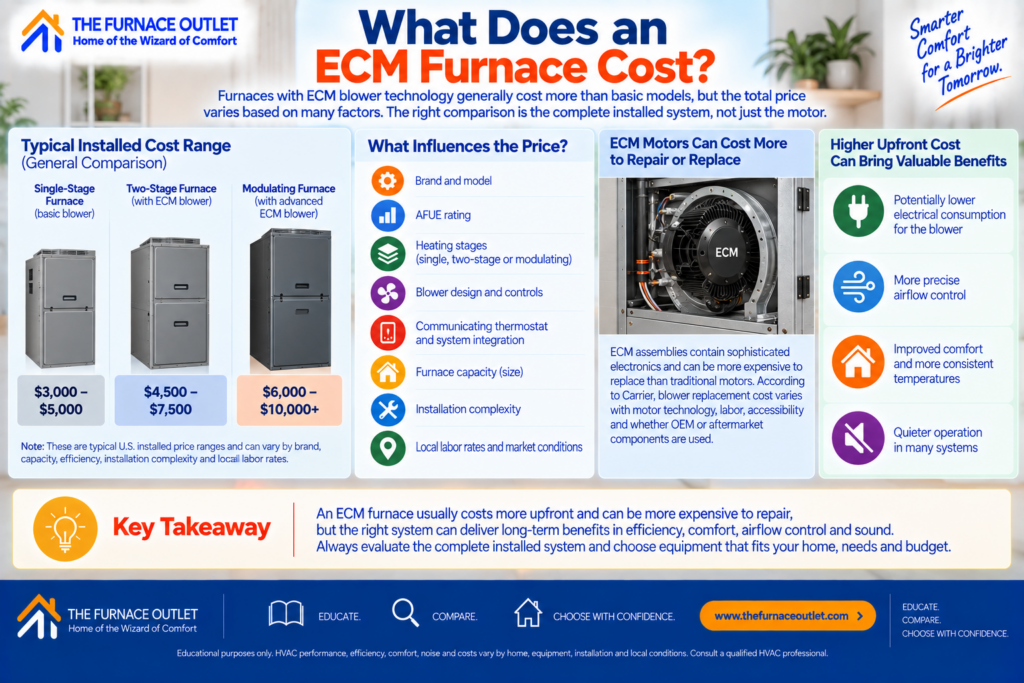
Furnaces equipped with more sophisticated blower technology generally cost more than basic equipment, but it is difficult to assign a meaningful universal ECM price premium. Furnace pricing is influenced by brand, AFUE, heating stages, blower design, communicating controls, capacity, installation complexity and local labor rates.
The important comparison is the complete installed system, not the price of the motor in isolation. A two-stage furnace with a quality ECM blower may represent a very different investment from a flagship modulating furnace with communicating variable-speed controls, even though both use electronically controlled blower technology.
Repair cost is another consideration. ECM assemblies contain sophisticated electronics and can be more expensive to replace than basic traditional motors. Carrier’s current homeowner guidance notes that blower replacement cost varies with motor technology, labor, accessibility and whether OEM or aftermarket components are used.
That higher component cost should be considered alongside the potential benefits in electrical efficiency, airflow control, comfort and sound.

For many homeowners purchasing a new furnace, I would investigate an ECM-equipped furnace very seriously, particularly if the blower will also serve central air conditioning or a heat pump.
The value becomes more compelling when the furnace uses two-stage or modulating heating because the blower can complement those varying heat-output levels with appropriate airflow. A quality variable-speed system can also be attractive for homeowners who value quieter operation, more consistent temperatures, continuous circulation or enhanced humidity management.
For a very budget-focused replacement in a mild climate with limited annual runtime, paying substantially more for the most sophisticated blower controls may be harder to justify. But that does not necessarily mean choosing the most basic motor available. There are useful levels of ECM technology between a traditional basic blower and a premium communicating variable-speed system.
When two furnace proposals use phrases such as “ECM,” “multi-speed,” “constant torque,” “variable-speed” or “communicating blower,” I would not assume they mean the same thing. Ask the contractor to explain exactly how the blower operates and what airflow capabilities the proposed furnace provides.
I would also ask whether airflow will be configured specifically for the furnace capacity and cooling equipment, whether static pressure will be checked during commissioning, what filter arrangement is proposed and whether the thermostat or communicating control is required to access the furnace’s advanced features.
That information tells you much more than seeing “ECM motor” printed on a quotation.
When I compare furnaces, I would never treat the blower motor as a minor specification buried near the bottom of the brochure. The furnace creates the heat, but the blower determines how that conditioned air is delivered through the house. It also frequently handles airflow for the air conditioner or heat pump, making it one of the few HVAC components that may work during every season.
For a budget-oriented system, a good ECM blower can provide an attractive improvement over older conventional motor technology without necessarily requiring the most sophisticated furnace available. For the broad middle of the market, I particularly like the combination of proper furnace sizing, two-stage heating and a quality ECM or variable-speed blower, provided the duct system supports the required airflow. For homeowners seeking premium comfort, sophisticated variable-speed airflow combined with modulating heating and compatible controls can provide extremely refined operation.
But I would not spend heavily on blower technology while ignoring the duct system. An expensive variable-speed ECM connected to restrictive returns, undersized ducts and a poorly selected filter is still working against a bad air-distribution system.
The sequence matters. Size the furnace correctly, verify the ductwork, select the appropriate blower technology, configure the airflow and then measure the completed system during commissioning. When those pieces work together, an ECM blower can contribute meaningfully to efficiency, quieter operation and more consistent comfort.
For additional technical and homeowner information, see Carrier’s Furnace Blower Motor Guide, which explains PSC, ECM and variable-speed blower technology, and Carrier’s Modulating vs. Variable-Speed Guide for the important distinction between heating output and blower airflow.
Lennox’s HVAC Blower Motor Guide provides another overview of single-speed, multi-speed and variable-speed blower designs, while Lennox’s Variable-Speed Motor Guide explains how electronically controlled variable-speed airflow works. For broader system-design guidance, homeowners can also consult ACCA’s Technical Manuals covering residential load calculations, equipment selection and duct design.
Editorial Disclosure: The Furnace Outlet is an independent educational resource. We are not affiliated with, endorsed by, or sponsored by any manufacturer or brand referenced in this guide, and we do not receive manufacturer compensation for inclusion or rankings.
Educational Disclaimer: HVAC performance, airflow, electrical consumption, sound and operating costs vary by equipment, home, duct system, controls and installation. Verify current manufacturer specifications and have equipment selection, airflow setup and commissioning performed by a qualified HVAC professional.