Newsletter Subscribe
Enter your email address below and subscribe to our newsletter

HVAC made simple
— Jake Lawson, HVAC Specialist | The Furnace Outlet
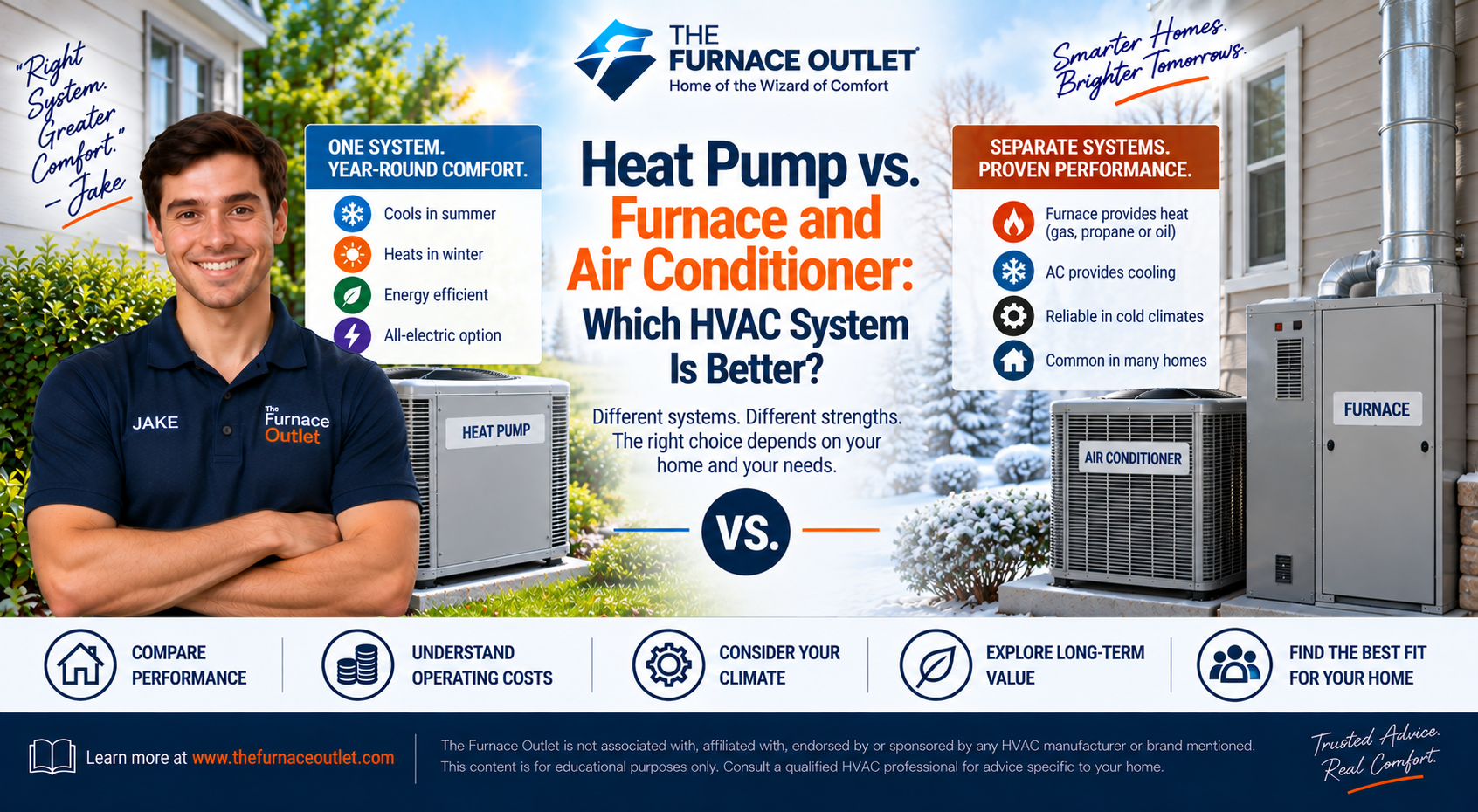
When homeowners ask me whether a heat pump is better than a traditional furnace and air conditioner, I usually tell them that we need to define what “better” means first. Are we trying to minimize the initial installation cost? Reduce heating energy use? Improve summer humidity control? Eliminate natural gas from the house? Get dependable heating during a severe winter? Or simply replace aging equipment without rebuilding half of the HVAC system?
Those questions matter because these two approaches accomplish the same basic job in different ways. A conventional furnace + central air conditioner uses separate equipment for heating and cooling. The furnace typically burns natural gas, propane or oil to create heat, while the air conditioner moves heat from inside the house to outdoors during summer. A heat pump, on the other hand, uses the refrigeration cycle in both directions. It cools the house during summer and reverses operation to move heat indoors during winter.
Modern heat pumps have become considerably more capable in colder weather, which has changed this conversation. But that does not mean furnaces have suddenly become obsolete. In my experience, the right answer depends much more on the house, climate, utility rates, existing infrastructure and installation design than on which technology sounds more modern.
A central heat pump looks very similar to a central air conditioner from outside the house because both systems contain compressors, coils, fans and refrigerant circuits. The important difference is that a heat pump can reverse the refrigeration cycle.
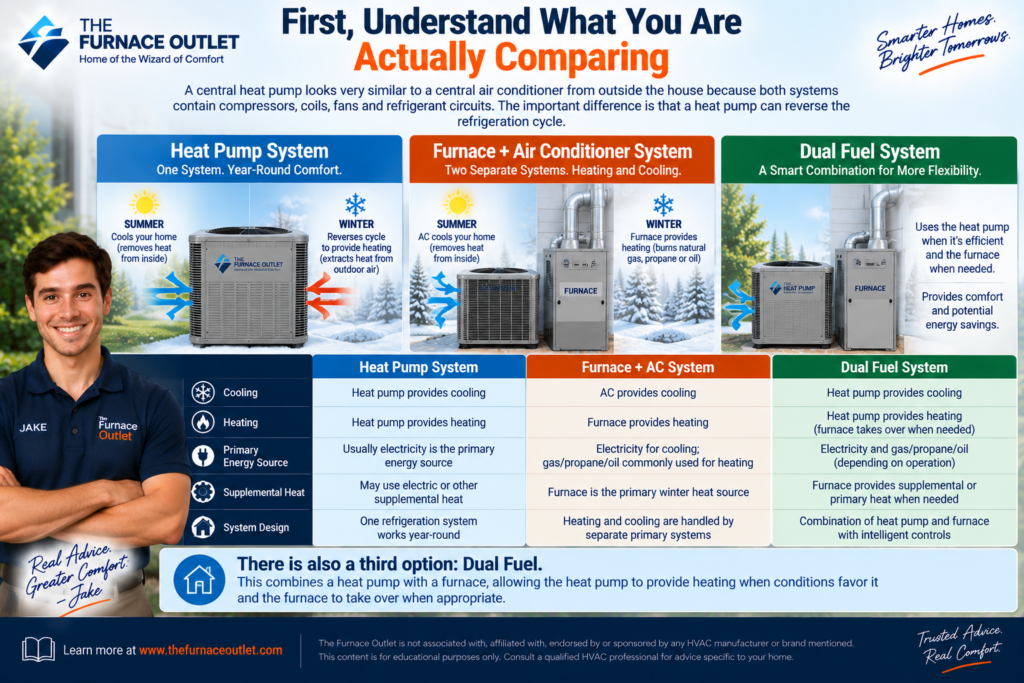
During summer, both systems essentially perform the same basic task: they absorb heat from the indoor air and reject it outdoors. During winter, the air conditioner normally sits idle while the furnace provides heat. A heat pump reverses its refrigerant cycle and extracts available heat from outdoor air, transferring that energy indoors.
That gives us two common configurations:
| Heat Pump System | Furnace + AC System |
|---|---|
| Heat pump provides cooling | AC provides cooling |
| Heat pump provides heating | Furnace provides heating |
| Usually electricity is the primary energy source | Electricity for cooling; gas/propane/oil commonly used for heating |
| May use electric or other supplemental heat | Furnace is the primary winter heat source |
| One refrigeration system works year-round | Heating and cooling are handled by separate primary systems |
There is also a third option that homeowners should not overlook: dual fuel. This combines a heat pump with a furnace, allowing the heat pump to provide heating when conditions favor it and the furnace to take over when appropriate. ENERGY STAR specifically identifies dual-fuel systems as an option that can provide flexibility between heat-pump and furnace heating.
This is where the comparison becomes much more interesting.
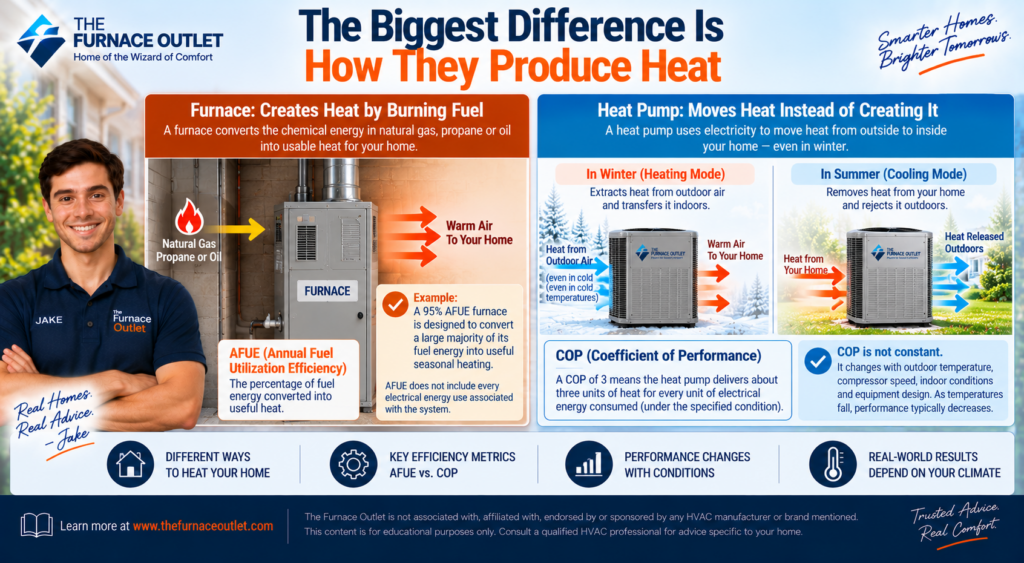
A furnace creates heat by converting fuel energy into usable heat. Furnace efficiency is generally described using AFUE — Annual Fuel Utilization Efficiency. DOE defines AFUE as the ratio of useful annual heating output to the fuel energy supplied to the furnace. For example, a furnace rated at 95% AFUE is designed to convert a large majority of its fuel energy into useful seasonal heating, although AFUE by itself does not include every electrical energy use associated with the system.
A heat pump works differently because it does not primarily create heat from electricity. It uses electricity to move heat. That distinction allows a heat pump to deliver more heat energy than the electrical energy consumed by its compressor and associated components.
This is why COP — Coefficient of Performance — is such a useful heat-pump metric. If a heat pump operates at a COP of 3 under a particular condition, it is delivering approximately three units of heat for each unit of electrical energy consumed under that test condition.
That does not mean a heat pump always operates at COP 3. Outdoor temperature, compressor speed, indoor conditions and equipment design all affect performance. As outdoor temperatures fall, the comparison becomes increasingly dependent on the particular heat pump rather than simply the words “heat pump” on the equipment.
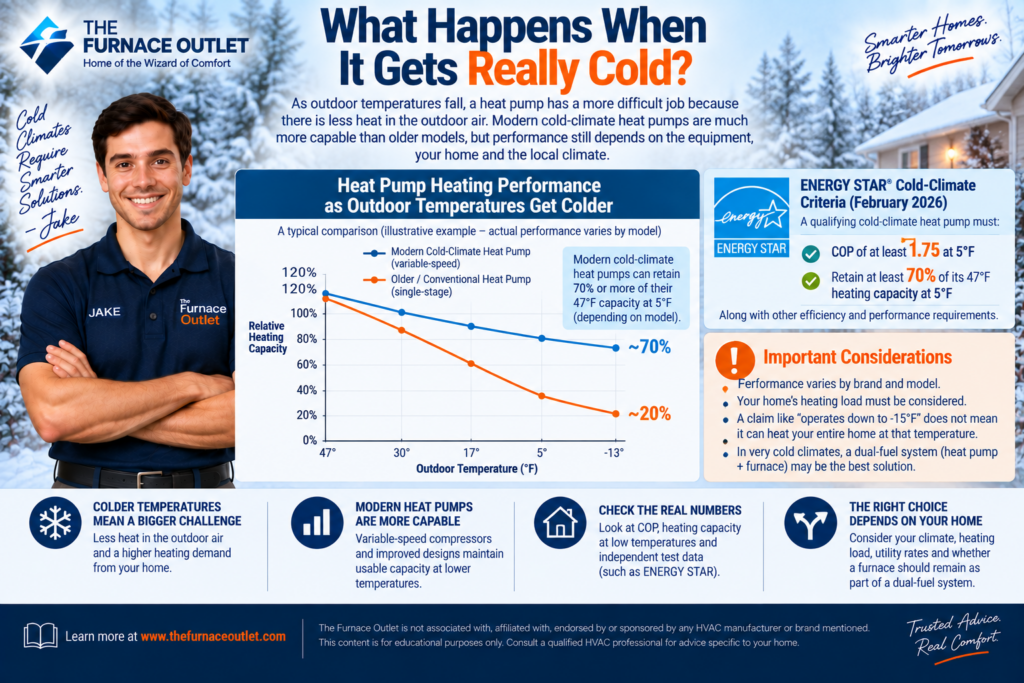
Older heat pumps developed a reputation for struggling in cold climates, and that reputation did not appear from nowhere. As outdoor temperatures fall, a conventional air-source heat pump generally has a more difficult job. The house requires more heat at precisely the time when extracting heat from outdoor air becomes more challenging.
Modern cold-climate equipment has changed that equation substantially. Variable-speed inverter compressors, improved controls and refrigeration-system designs allow some heat pumps to maintain useful heating capacity at temperatures where older systems would have relied heavily on supplemental heat.
ENERGY STAR’s current cold-climate criteria give us a useful benchmark. Under the February 2026 specification, a qualifying cold-climate heat pump must demonstrate a COP of at least 1.75 at 5°F and retain at least 70% of its 47°F heating capacity at 5°F, along with other requirements.
That is meaningful performance, but I still would not tell every homeowner in a northern climate to remove a perfectly good furnace. The house’s design heating load and the heat pump’s actual low-temperature capacity need to be compared. A brochure stating that a heat pump “operates down to -15°F” does not tell me whether it can actually carry your home’s heating load at that temperature.
A furnace remains a very practical heating solution, particularly in houses with an existing natural-gas system and substantial winter heating requirements.
When temperatures fall sharply, furnace heating capacity does not decline in the same way that the capacity of an air-source heat pump can. If a properly sized furnace can deliver 60,000 BTU/h of usable heating output, we are not depending on outdoor air to supply that heat.
That can simplify winter system design in extremely cold climates.
There is also a comfort characteristic homeowners sometimes notice. Furnace supply air can feel noticeably warmer than heat-pump supply air. A heat pump may run for longer periods and deliver gentler, steadier heat. A furnace may operate in more distinct heating cycles and deliver hotter air while the burner is operating.
Neither experience is automatically superior. Some homeowners like the strong blast of furnace heat; others prefer the steadier temperatures that a well-designed variable-speed heat-pump system can provide.
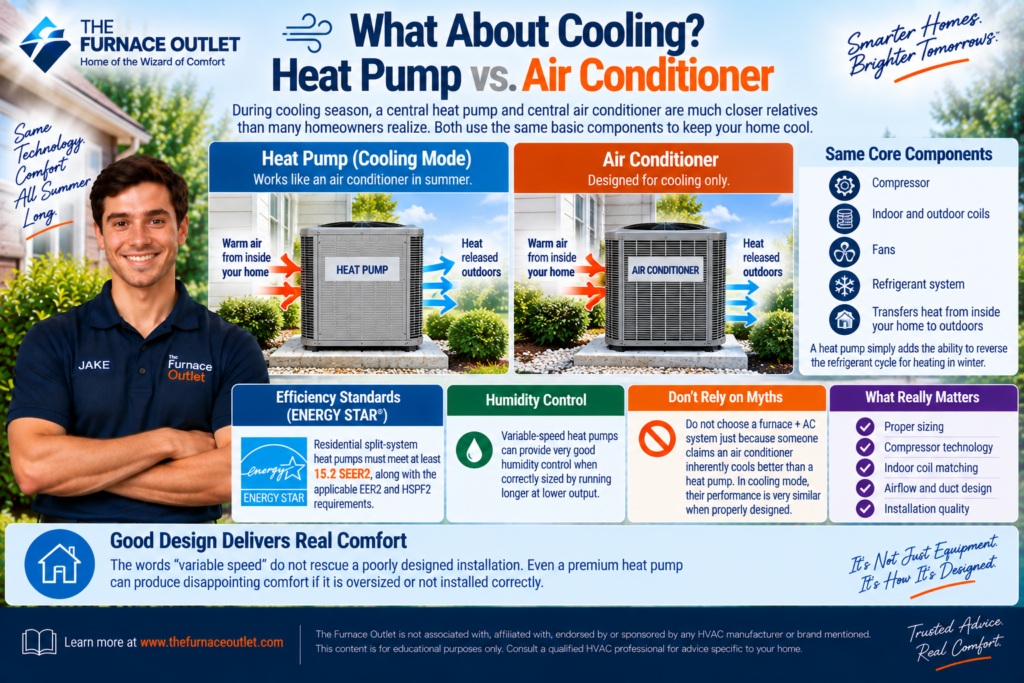
During cooling season, a central heat pump and central air conditioner are much closer relatives than many homeowners realize. Both use a compressor, indoor and outdoor coils, refrigerant and fans to transfer heat from inside the house to outdoors.
So I would not choose a furnace + AC system merely because someone claims that an air conditioner inherently cools better than a heat pump. Equipment efficiency, sizing, compressor technology, indoor coil matching, airflow, duct design and installation quality matter much more.
For current ENERGY STAR certification, residential split-system heat pumps must meet at least 15.2 SEER2, along with the applicable EER2 and HSPF2 requirements.
Variable-speed heat pumps can also provide very good humidity control when correctly sized because they can operate for longer periods at reduced output rather than repeatedly cycling between full output and off. But the words “variable speed” do not rescue a badly designed installation. An oversized premium heat pump can still produce disappointing comfort.
This is the question everyone wants answered, and it is also where I see some of the weakest HVAC sales claims.
There is no universal answer such as: “Heat pumps always cost less.”
Nor is it accurate to say: “Gas furnaces are always cheaper.”
Operating economics depend on several variables working together:
| Factor | Why It Matters |
|---|---|
| Electricity rate | Determines heat-pump operating cost |
| Natural-gas/propane/oil price | Determines furnace fuel cost |
| Outdoor temperature | Affects heat-pump capacity and COP |
| Furnace AFUE | Affects fuel-to-heat conversion |
| Heat-pump performance | Determines electrical energy needed for heating |
| House heating load | Determines how much heat must be supplied |
| Supplemental heat | Can materially affect heat-pump electricity use |
| Thermostat settings | Affect both systems |
| Duct condition | Can waste delivered heating or cooling |
If electricity is reasonably priced and winter temperatures are moderate, a heat pump can be financially attractive. If natural gas is inexpensive and the house experiences severe winters, the economics may look different. If propane or electric resistance heat is being replaced, the calculation changes again.
This is why I prefer an actual operating-cost estimate using local energy prices and equipment performance instead of a generic national savings percentage.
If I were evaluating a house in a moderate climate where both heating and air conditioning are needed, a heat pump would be very high on my list. Instead of purchasing an air conditioner that remains unused all winter, the outdoor refrigeration system can provide both cooling and heating.
A heat pump can also be particularly attractive when a homeowner wants to reduce or eliminate direct fossil-fuel use in the house, when natural gas is unavailable, or when the existing heating system relies heavily on electric resistance.
Another excellent opportunity occurs when the air conditioner already needs replacement. At that point, I would at least price the heat-pump alternative. ENERGY STAR makes a similar recommendation for homes where a central AC is being added or replaced, including situations where an existing furnace can remain and become part of a dual-fuel configuration.
The incremental decision can be very different from removing a relatively new furnace and air conditioner solely to install a heat pump.
Suppose I walk into a house in a very cold climate with an established natural-gas service, a properly sized high-efficiency furnace, suitable ductwork and an air conditioner that needs replacement.
I would not automatically tell that homeowner to remove everything.
Replacing the AC while retaining the furnace may make financial sense. Alternatively, replacing the failed AC with a heat pump while retaining the furnace can create a dual-fuel system. The best choice depends on equipment compatibility, controls, installation cost and local energy economics.
A furnace + AC combination can also make sense when the homeowner strongly values high heating capacity during extreme weather, when electricity prices are high relative to available fuel, or when installing sufficient electrical capacity for an all-electric heat-pump system would require expensive upgrades.
The important point is that keeping a furnace is not automatically old-fashioned, just as installing a heat pump is not automatically the best decision simply because the technology is newer.
I think dual fuel deserves more attention because homeowners sometimes treat the decision as though they must choose either a furnace or a heat pump. You don’t necessarily have to.
A dual-fuel system combines a heat pump with a furnace. During conditions where the heat pump can provide heating efficiently and economically, the heat pump operates. When outdoor conditions or operating economics favor the furnace, the controls can transition to furnace heating.
That gives homeowners the cooling function they already need, heat-pump heating during appropriate conditions and furnace capacity when required. But dual fuel also introduces additional equipment and control considerations. The switchover strategy should not simply be an arbitrary outdoor temperature programmed by someone during installation. Ideally, the contractor considers heat-pump capacity, house heating load, fuel prices, electricity prices and equipment performance when establishing the operating strategy.
The objective is not to make both pieces of equipment run as much as possible. It is to make them work together intelligently.
Comfort is much more complicated than achieving 72°F on a thermostat. A properly designed variable-speed heat pump can provide long, low-output operating cycles that help maintain consistent temperatures and can improve moisture removal during cooling. Variable-speed airflow can also reduce some of the noticeable starts and stops associated with basic single-stage equipment.
A modern two-stage or modulating furnace can also provide excellent comfort, however. Comparing a premium variable-speed heat pump with an inexpensive single-stage furnace is not really a fair technology comparison. I would look at the entire system: compressor staging, furnace modulation if applicable, blower capability, thermostat/control strategy, ductwork, filtration, zoning and — most importantly — sizing.
ENERGY STAR specifically recommends proper sizing and points homeowners toward Manual J load calculations rather than simply replacing existing equipment with the same nominal capacity.
This is one subject where heat pumps, furnaces and air conditioners all agree: bigger is not automatically better. An oversized air conditioner or heat pump can satisfy the thermostat quickly but may operate in short cycles, potentially reducing humidity removal and creating less consistent temperatures. Oversizing a furnace can also produce short heating cycles and comfort problems.
For heat pumps in colder climates, sizing becomes even more interesting because we need to evaluate both the home’s cooling load and heating load while also examining the heat pump’s available capacity at low outdoor temperatures. That does not necessarily mean selecting equipment large enough to cover every imaginable winter condition. Depending on the climate and system design, supplemental electric heat or a furnace may handle a portion of the extreme heating load.
The equipment should be selected after the house has been evaluated, not the other way around.
When comparing equipment proposals, I want more than the model number printed on the outdoor unit. Split HVAC equipment is rated as a system combination. The outdoor unit, indoor coil or air handler and other relevant components must be properly matched to achieve the published performance. AHRI recommends asking the installer for the AHRI Reference Number or Certificate of Certified Product Performance, which allows the homeowner to verify that the proposed indoor and outdoor equipment have been certified as a matched system.
This matters whether you are purchasing a heat pump or an air conditioner. A premium outdoor unit connected to an inappropriate indoor component does not magically produce the performance printed on the outdoor unit’s marketing sheet.
Homeowners shopping in 2026 are also encountering a changing refrigerant market. EPA’s Technology Transitions program has restricted higher-GWP HFC use in several HVAC categories, and manufacturers have been transitioning residential air-conditioning and heat-pump equipment toward lower-GWP alternatives.
As a homeowner, I would not turn the refrigerant name into the primary reason for choosing a furnace + AC or heat pump. Instead, confirm what refrigerant the proposed equipment uses, whether the contractor is properly trained to install and service that equipment, and whether replacement components and technical support are likely to be available. The quality of the entire installation remains more important than chasing a refrigerant acronym.
There is no reliable universal winner here either. If a home already has a usable furnace, suitable electrical service and compatible ductwork, replacing only a failed air conditioner could obviously cost less initially than redesigning the entire system. On another house where both the furnace and AC are near the end of their lives, replacing two aging pieces of equipment with a heat-pump system may make considerably more sense.
Cold-climate heat pumps and sophisticated variable-speed equipment can command higher equipment prices. Electrical upgrades, backup heat, duct modifications and controls can add to installation cost as well. Furnace + AC installations have their own potential expenses: venting, gas piping, combustion-air requirements, condensate management for condensing furnaces and two pieces of primary equipment instead of one reversible refrigeration system.
I would therefore compare complete installed proposals, not equipment prices from websites.
| Category | Heat Pump | Furnace + AC |
|---|---|---|
| Cooling | Excellent when properly designed | Excellent when properly designed |
| Heating method | Moves heat using refrigeration cycle | Furnace converts fuel to heat |
| Moderate-climate heating | Often an excellent fit | Very capable |
| Extreme-cold performance | Depends strongly on model and design | Strong furnace heating capacity |
| One system for heating/cooling | Yes | No |
| Natural gas required | No for all-electric HP | Usually for gas furnace |
| Supplemental heat | May be required depending on design | Furnace provides primary heating |
| Variable-speed options | Widely available | Available in premium AC/furnace combinations |
| Dual-fuel capability | Yes, with compatible furnace | Can become dual fuel by pairing furnace with HP |
| Best choice | Depends on house and climate | Depends on house and climate |
I would use this table to understand the differences, not to declare a universal winner.
If you ask me, “Jake, which system would you put in my house?”, I would need more information before giving you an answer.
I would want to know the heating and cooling loads, climate, existing duct system, electrical service, available fuel, utility rates, insulation and air leakage, current equipment condition and how long you expect to stay in the house. Then I would look at the actual performance of the equipment being proposed.
For a well-insulated house in a moderate climate, I might strongly favor a variable-speed heat pump. For a cold-climate home, I might recommend a properly selected cold-climate heat pump after checking its capacity and COP at low temperatures. In another house with inexpensive natural gas and a good existing furnace, keeping the furnace and installing a heat pump in place of the AC could create an excellent dual-fuel system.
What I would not do is declare one technology the winner before looking at the house.
For many U.S. homes in 2026, a modern heat pump is a serious alternative to the traditional furnace-and-air-conditioner combination. Today’s equipment can provide efficient cooling, effective heating and, in appropriately selected cold-climate models, substantial heating performance at temperatures where previous generations of heat pumps were much less capable.
But the furnace + AC combination remains a very good solution for many homes, particularly where strong winter heating capacity, existing gas infrastructure or favorable fuel economics make it practical. And for homeowners who want the advantages of both technologies, dual fuel can provide a compelling middle ground.
So my answer is not “heat pumps are better” or “furnaces are better.”
My answer is: the better HVAC system is the one properly sized, correctly matched and professionally installed for the actual house, climate and energy costs. Equipment technology matters, but good HVAC design matters even more.
— Jake Lawson, HVAC Specialist | The Furnace Outlet
Editorial Disclosure: The Furnace Outlet is not associated with, affiliated with, endorsed by, or sponsored by any HVAC manufacturer or brand mentioned in this article. We do not receive compensation from manufacturers for inclusion or rankings. Brand and product discussions are provided for independent educational and editorial purposes.