Newsletter Subscribe
Enter your email address below and subscribe to our newsletter

HVAC made simple

By Jake Lawson, HVAC Specialist | The Furnace Outlet
If you have started collecting heat-pump quotes in 2026, you may already have discovered something frustrating: two contractors can recommend systems that appear similar on paper and still give you prices that are thousands of dollars apart. That does not necessarily mean one contractor is overcharging. A heat-pump installation is much more than the outdoor unit sitting beside the house, and the final price can change considerably depending on the equipment, the home, the ductwork, electrical requirements, climate and complexity of the installation.
I also would not shop for a heat pump by asking only, “How much does a three-ton unit cost?” That is a little like asking how much a vehicle costs based only on engine size. It gives us one piece of information, but not nearly enough to understand what we are actually buying.
For a homeowner, I think it is more useful to divide the cost into three parts: what the equipment costs, what it costs to install the complete system correctly, and what it may cost to operate over the years you own it. The cheapest proposal does not always produce the lowest long-term cost, while the most expensive heat pump does not automatically produce the best value. Let’s work through what I would look at before deciding whether a heat-pump quote makes financial sense.
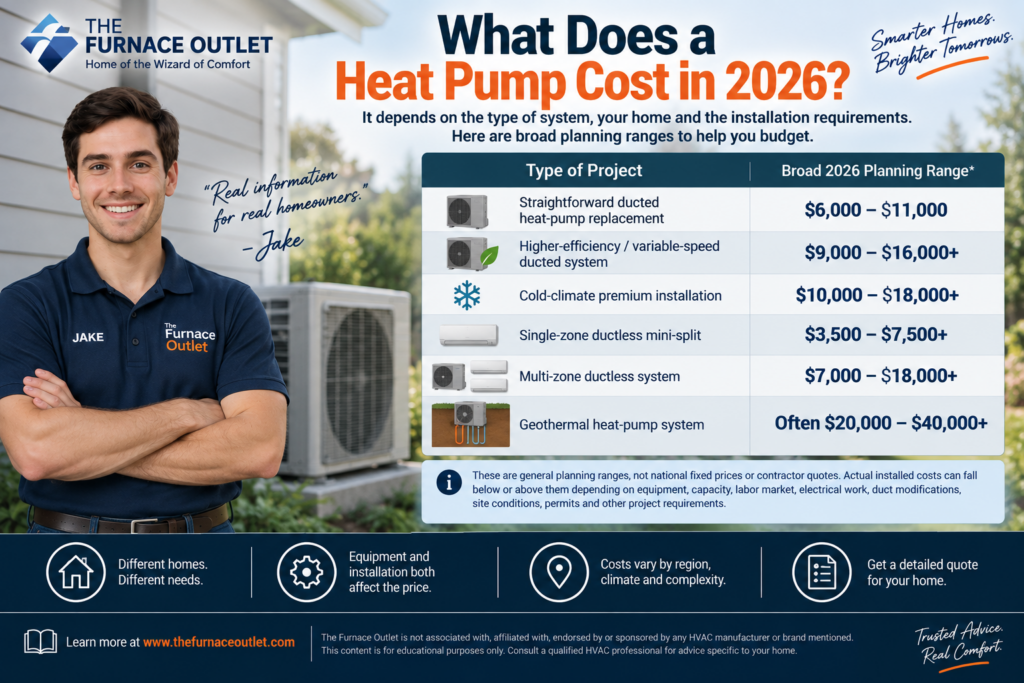
There is no single national price that accurately represents every heat-pump installation. For a conventional ducted air-source heat pump, a straightforward replacement may cost considerably less than a premium variable-speed system that requires electrical work, duct modifications, a new air handler and more complicated installation.
For planning purposes, homeowners will commonly encounter complete installed quotes ranging from roughly the mid-thousands into the mid-teens, while premium, large-capacity or complex projects can move above that range. Ductless multi-zone systems and geothermal heat pumps have their own cost structures and should not be compared directly with a basic ducted air-source replacement.
Rather than presenting one national “average” as though it applies to your house, I would use broad ranges only for early budgeting:
| Type of project | Broad 2026 planning range* |
|---|---|
| Straightforward ducted heat-pump replacement | $6,000–$11,000 |
| Higher-efficiency / variable-speed ducted system | $9,000–$16,000+ |
| Cold-climate premium installation | $10,000–$18,000+ |
| Single-zone ductless mini-split | $3,500–$7,500+ |
| Multi-zone ductless system | $7,000–$18,000+ |
| Geothermal heat-pump system | Often $20,000–$40,000+ |
*These are general planning ranges, not national fixed prices or contractor quotes. Actual installed costs can fall below or above them depending on equipment, capacity, labor market, electrical work, duct modifications, site conditions, permits and other project requirements.
I deliberately use broad ranges here because pretending that a heat pump should cost exactly $8,742 or $12,319 nationwide creates false precision. Labor costs in California will not necessarily resemble those in Ohio, and replacing equipment on an easily accessible ground-floor installation is very different from modifying ductwork and electrical service in an older house. The number that matters is ultimately the complete installed cost for the properly sized system your home requires.
When you look online, you may find heat-pump equipment advertised at prices considerably below the quote your HVAC contractor gave you. That often leads homeowners to wonder why installation appears so expensive. The reason is that you are comparing two different things. The online price may represent only an outdoor unit, while your installed HVAC system may require an outdoor heat pump, indoor air handler or coil, refrigerant-line components, thermostat or communicating controls, electrical components, condensate drainage, mounting equipment and numerous installation materials.
The exact indoor and outdoor equipment also needs to be properly matched. I would want the contractor to provide the AHRI Certified Reference Number for the proposed combination so I could verify that I am comparing the actual certified system rather than the highest efficiency number advertised for the product family.
Equipment price also rises as technology becomes more sophisticated. A basic single-stage heat pump will generally cost less than a premium inverter-driven variable-capacity system. Higher-efficiency compressors, communicating controls, enhanced low-temperature performance, quieter operation and premium components all add cost. Those features may be worth buying, but I want to know what I am paying extra for and what benefit it provides in my house.
A good proposal should make it reasonably clear what you are purchasing. I become cautious when a quote consists of nothing more than a model number and one large dollar figure.

Depending on the project, an installed price can include:
| Cost component | What it may involve |
|---|---|
| Outdoor heat pump | Compressor, coil, fan and controls |
| Indoor equipment | Air handler, evaporator coil or furnace interface |
| Thermostat/control | Standard, smart or communicating controls |
| Refrigerant work | Line set, evacuation, charging and commissioning |
| Electrical work | Disconnects, wiring, breakers or circuit changes |
| Condensate management | Drain piping, pump or safety switches |
| Equipment removal | Removal/disposal of old HVAC equipment |
| Labor | Installation, setup and commissioning |
| Permits | Local mechanical/electrical permits where required |
| Duct modifications | Transitions, plenums, repairs or resizing |
| Startup/testing | Airflow, refrigerant and operating verification |
| Warranty | Manufacturer and contractor coverage |
Not every installation requires every item in that table. The point is that installed cost represents a project rather than simply a piece of machinery.
When comparing proposals, I would therefore compare the scope of work before comparing the bottom-line price. A $9,500 quote that includes necessary duct modifications, electrical work and proper commissioning may represent better value than an $8,000 quote that excludes those items.
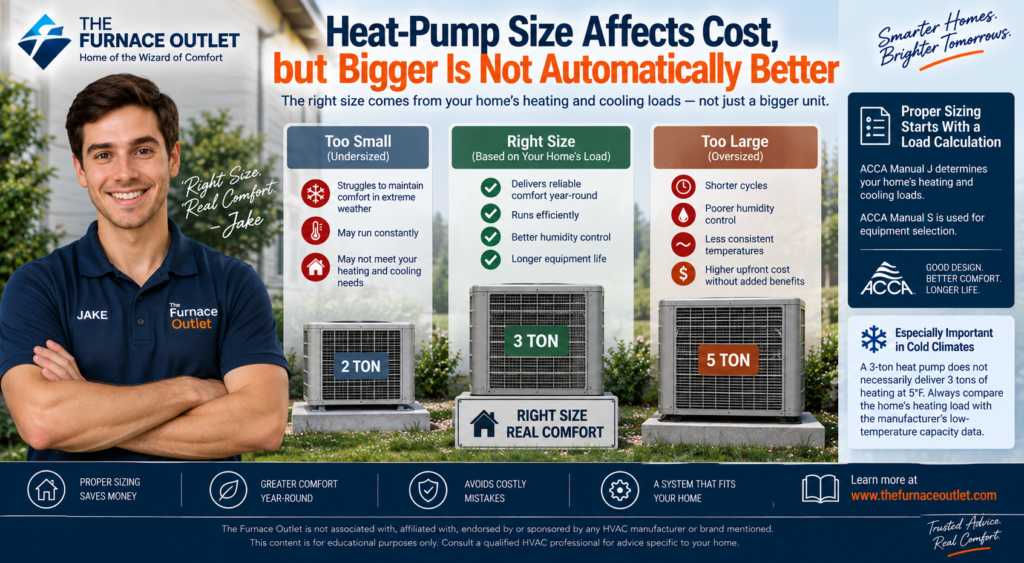
Larger-capacity heat pumps generally cost more, which can tempt homeowners into approaching sizing as a budget decision. I would resist that temptation. The correct size should come from the home’s heating and cooling loads. ACCA Manual J is the established residential load-calculation procedure, while Manual S addresses equipment selection. Once we know what the house needs, we can select equipment capable of meeting those requirements.
Buying additional tonnage simply because you can afford it is not an upgrade. Oversizing can contribute to shorter cooling cycles, poorer humidity control and less consistent operation. Undersizing creates a different problem because the equipment may not provide enough capacity under demanding conditions. This is particularly important with cold-climate heat pumps. A nominal three-ton unit does not necessarily provide three tons of heating capacity at 5°F. I want to compare the home’s heating load with the manufacturer’s low-temperature capacity data before deciding what equipment belongs there.
That sizing work may add a little time to the sales process, but it can prevent an expensive mistake that remains attached to your house for the next decade or longer.
One of the easiest expenses to overlook is the electrical side of the project. If you are replacing an existing central air conditioner with a heat pump, some of the required electrical infrastructure may already be available. That does not automatically mean the existing circuit, disconnect or wiring is appropriate for the new equipment.
An all-electric heat-pump installation can become more complicated when an air handler includes substantial electric resistance backup heat. Depending on the equipment and existing electrical service, additional circuits or electrical modifications may be required. An older home may present an even larger challenge if the electrical panel has limited capacity or there is insufficient space for new breakers. In some installations, panel or service upgrades can become a meaningful additional expense. I would rather discover that requirement while comparing proposals than after the old HVAC system has already been removed.

Existing ducts are often reused during a heat-pump replacement, but they should not automatically be assumed to be suitable. A new system may require a different airflow than the equipment being removed. If the return duct is undersized, supply ducts are badly restricted or major leakage exists in an attic or crawlspace, installing sophisticated new equipment on top of those problems does not make them disappear. Sometimes the solution involves relatively modest changes, such as replacing a transition or improving a return. Other houses may need more extensive duct repairs, sealing or redesign.
Those changes increase the initial project cost, but I would separate necessary HVAC design work from optional upgrades when evaluating the proposal. Spending money to correct a serious airflow problem is fundamentally different from paying for a premium thermostat or cosmetic accessory. The duct system is part of the heating and cooling system. If it cannot distribute the heat pump’s output properly, the money spent on premium equipment may never translate into premium comfort.

Cold-climate heat pumps often use more sophisticated technology than basic entry-level systems. Variable-speed inverter compressors, enhanced low-temperature refrigeration strategies, advanced controls and larger heat exchangers can all contribute to higher equipment prices. That does not mean everyone living somewhere with winter weather needs the most expensive cold-climate heat pump available.
The value depends on the climate and the house. If the heat pump can maintain substantially more heating capacity at low temperatures, it may reduce the amount of time the home depends on electric resistance backup heat. In other installations, a dual-fuel configuration may allow the heat pump and furnace to divide the heating work according to outdoor conditions and operating economics.
I would therefore compare more than HSPF2 when deciding whether a premium cold-climate model justifies the additional cost. Heating capacity at 5°F, COP at 5°F, capacity retention and expected supplemental-heat use can tell us much more about what we are buying. The premium should purchase useful performance, not simply a more impressive model name.
A heat pump can be inexpensive to purchase but relatively expensive to operate, or more expensive initially and less expensive to run. That is why I would never make a long-term HVAC decision based solely on the installation price. Heat pumps produce heat differently from electric resistance furnaces and baseboard heaters. Instead of converting electricity directly into heat at the point of use, they use refrigeration technology to transfer heat. The U.S. Department of Energy says today’s heat pumps can reduce electricity use for heating by approximately 65% compared with electric resistance heating.
That comparison is important, but it should not be misunderstood as a promise that every homeowner will cut the entire heating bill by 65%. Savings depend on the system being replaced, climate, energy prices, house efficiency, thermostat settings, equipment performance and installation. Replacing electric resistance heating can create a very different financial result from replacing a modern high-efficiency natural-gas furnace.
Electric utilities normally bill electricity in kilowatt-hours (kWh), so a useful first estimate of operating cost is: Operating cost = electricity consumed × electricity price
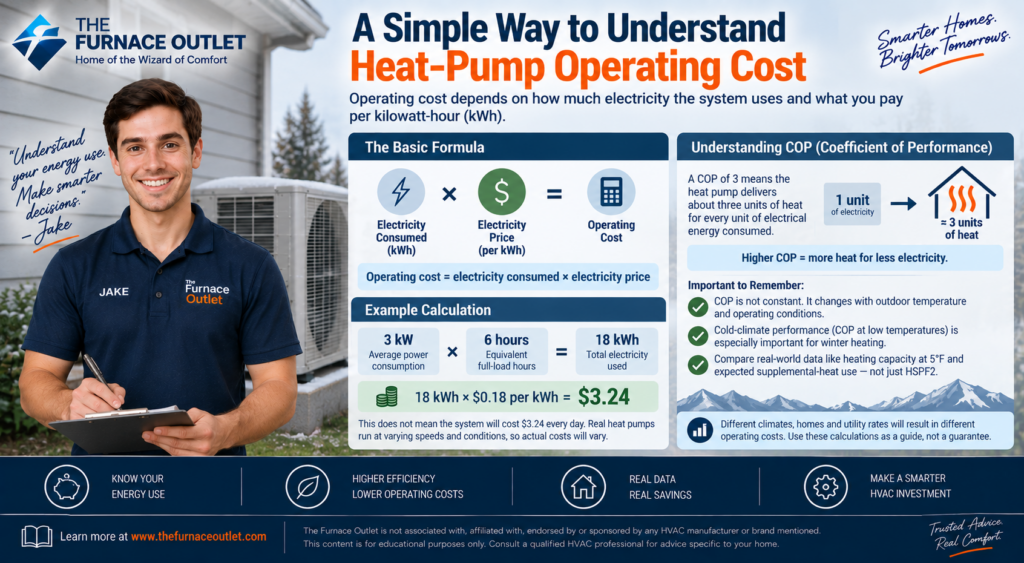
Suppose the complete heat-pump system consumes an average of 3 kW while operating under a particular condition and runs for six equivalent full-load hours. That represents approximately 18 kWh.
If electricity costs $0.18 per kWh: 18 kWh × $0.18 = $3.24
That does not mean the system will cost $3.24 every day. Real heat pumps continuously encounter changing outdoor temperatures and heating or cooling loads, and variable-speed systems may spend considerable time operating below maximum capacity. The example simply demonstrates why operating cost depends on both the equipment and the local utility rate.
For heating comparisons, COP—Coefficient of Performance—is especially useful. A COP of 3 means the heat pump is delivering approximately three units of heat for every unit of electrical energy consumed under the specified test condition. COP is not constant, however. It changes with operating conditions, particularly outdoor temperature. That is one reason I pay close attention to low-temperature COP when comparing cold-climate equipment.
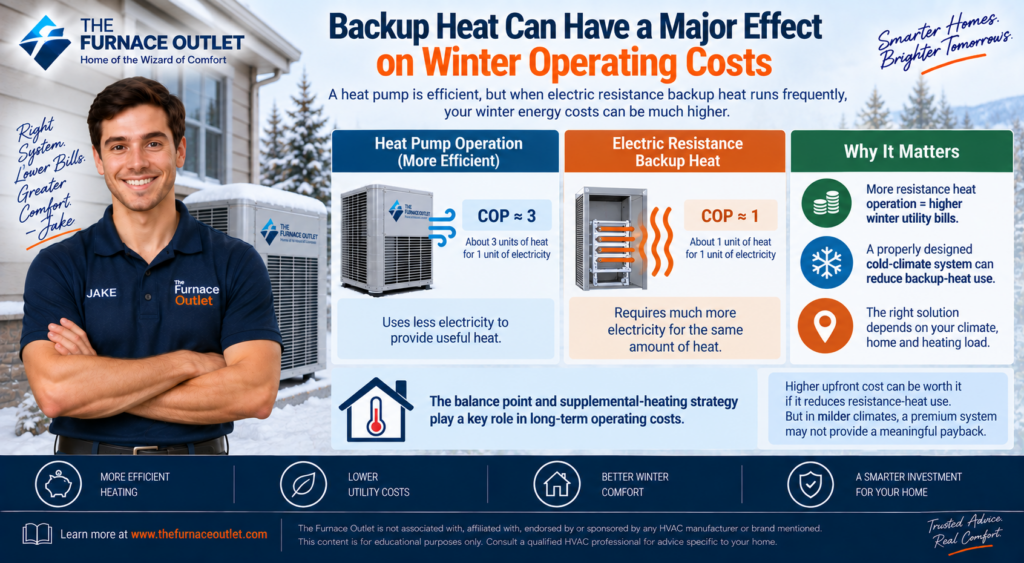
A heat pump may look extremely efficient until substantial electric resistance backup heat begins operating. Electric resistance heat is effective and simple, but it generally requires much more electricity to deliver the same amount of useful heat than a heat pump operating at a healthy COP.
Imagine the heat pump operating at a COP around 3 under a particular condition. In simplified terms, it can deliver about three units of heat for one unit of electrical input. Electric resistance heat is approximately one unit of heat for one unit of electricity at the point of use. That difference helps explain why the balance point and supplemental-heating strategy matter financially.
A properly designed cold-climate system may cost more upfront but reduce resistance-heat operation. Conversely, paying a large premium for equipment that provides little practical benefit in a mild climate may produce a very long financial payback. The correct comparison depends on where the house is located and how it actually loses heat.
We sometimes spend so much time comparing SEER2 and HSPF2 that we forget the equipment is conditioning a building. A house with substantial attic heat loss, uncontrolled air leakage, inefficient windows and leaky ducts requires more heating and cooling energy than a similar well-sealed home. Installing a high-efficiency heat pump does not eliminate those loads. This is why I sometimes prefer spending part of a homeowner’s budget on sensible building improvements rather than putting every available dollar into the highest equipment tier.
If air sealing, insulation or duct repairs reduce the heating load, the heat pump has less work to do for every winter that follows. Those improvements can also affect equipment sizing, which is why they are worth considering before the final heat pump is selected. DOE notes that residential heating is typically the largest household energy use and averages around 30% of utility energy spending, which helps explain why improving the complete heating system—not just the outdoor equipment—can matter financially.

SEER2 helps us compare seasonal cooling efficiency, while HSPF2 helps compare seasonal heating efficiency. Higher ratings can indicate lower energy consumption under standardized test procedures, but neither rating tells you exactly what your utility bill will be. Your actual bill depends on local weather, electricity rates, thermostat settings, building characteristics, system sizing, duct performance and how the equipment operates under real conditions.
Two homeowners with identical heat pumps can therefore have very different electricity bills. This is also why I am cautious when someone promises that upgrading from one efficiency level to another will “save exactly $700 per year.” Without knowing the house, climate, utility rates and existing equipment, that number may be little more than a sales estimate. Efficiency ratings are excellent comparison tools. They are not utility bills printed on an equipment label.
Sometimes yes. Sometimes no. Suppose System A costs $9,000 installed and System B costs $12,000. The second system therefore requires an additional $3,000 investment. If System B saves an estimated $300 per year under realistic conditions, the simple payback on the premium is roughly ten years: $3,000 ÷ $300 = 10 years
That calculation ignores financing, future energy-price changes, maintenance and other factors, but it provides a useful reality check. Efficiency is also not the only reason to buy premium equipment. A variable-capacity heat pump may provide quieter operation, better temperature stability, improved humidity management and better low-temperature performance. Those benefits have value even if the energy savings alone do not produce a rapid payback. I simply want homeowners to understand what they are buying. If the extra $3,000 is primarily purchasing comfort and quieter operation, that is perfectly legitimate. I would rather describe it accurately than pretend every premium feature will pay for itself through electricity savings.
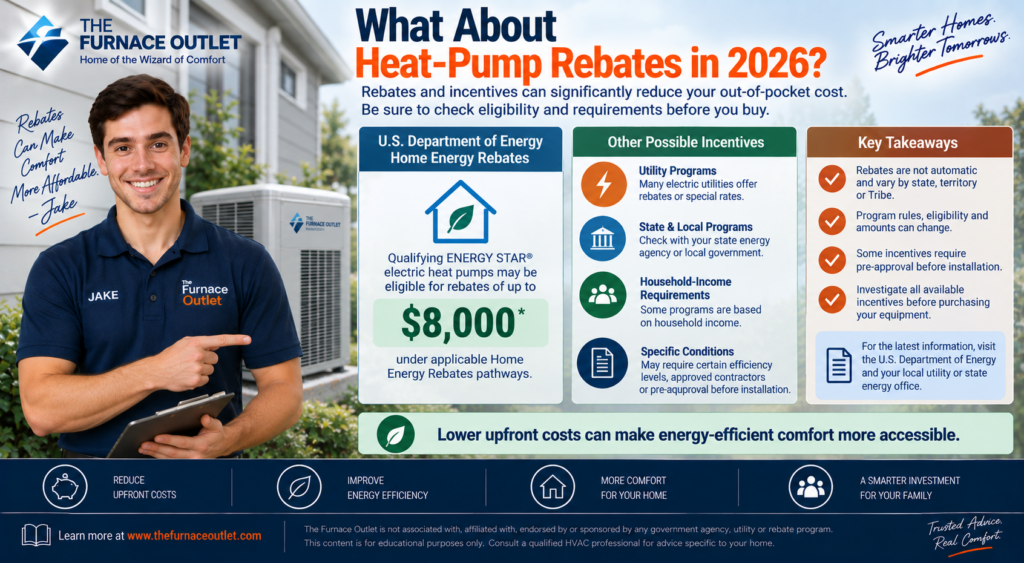
This is one area where homeowners should check carefully before signing a contract because incentives can materially change the net project cost. The Department of Energy’s Home Energy Rebates programs include potential assistance for qualifying heat-pump installations. DOE says an ENERGY STAR-certified electric heat pump for space heating and cooling may be eligible for rebates of up to $8,000 under applicable Home Energy Rebates pathways. Availability, eligibility, household-income requirements and program implementation vary by state, territory or Tribe, so that figure should never be treated as an automatic nationwide discount.
Utilities, municipalities and state energy agencies may also offer their own programs. Some incentives require particular efficiency levels, approved contractors or pre-approval before installation. My advice is to investigate incentives before purchasing the equipment. Finding out afterward that an application had to be submitted before installation is an unnecessarily expensive lesson.
This deserves its own section because there is a lot of outdated information online. Under the previous rules, qualifying heat pumps could receive an Energy Efficient Home Improvement Credit under Internal Revenue Code Section 25C of up to $2,000. You will still find hundreds of articles, contractor pages and older government documents discussing that incentive.
For equipment placed in service in 2026, however, homeowners should not budget around that credit. The IRS confirms that the Section 25C Energy Efficient Home Improvement Credit is not allowed for property placed in service after December 31, 2025. That distinction matters. A homeowner looking at a $12,000 heat-pump proposal in 2026 should not subtract $2,000 from the price simply because an older article says a qualifying heat pump receives a federal tax credit. State, utility and DOE-administered rebate programs may still be available, but they are separate programs with their own requirements.

Purchase price and electricity are not the only costs of owning a heat pump. Filters need attention, coils need to remain clean, condensate systems need to drain correctly and refrigerant-system performance should be evaluated if operating problems appear. Depending on the system and contractor, homeowners may also choose periodic professional maintenance.
More sophisticated equipment can introduce another financial consideration. Inverter boards, communicating controls and variable-speed components may cost more to replace than basic single-stage components if they eventually fail outside warranty. That does not make variable-speed equipment a bad investment. I install or recommend technology based on what it does for the house, not simply on how many electronic components it contains. But when comparing long-term ownership costs, I would examine parts warranties, labor warranties, contractor support and expected replacement-component availability. A ten-year parts warranty is not necessarily the same thing as ten years of completely free repairs. Labor, refrigerant and diagnostic charges may be handled differently depending on the warranty.
If three contractors handed me proposals, I would not immediately circle the lowest number.
I would build a comparison more like this:
| What I would compare | Quote A | Quote B | Quote C |
|---|---|---|---|
| Total installed price | — | — | — |
| Equipment model numbers | — | — | — |
| AHRI Reference Number | — | — | — |
| SEER2 | — | — | — |
| HSPF2 | — | — | — |
| Heating capacity at 5°F* | — | — | — |
| Manual J performed? | — | — | — |
| Duct modifications included? | — | — | — |
| Electrical work included? | — | — | — |
| Backup-heat strategy | — | — | — |
| Thermostat/controls | — | — | — |
| Parts warranty | — | — | — |
| Labor warranty | — | — | — |
| Permits included? | — | — | — |
| Available rebates | — | — | — |
| Final net cost | — | — | — |
*Especially important for cold-climate installations.
Once I had that information, the proposals would be much easier to understand. A contractor who is $2,000 more expensive may actually be providing a significantly different system and scope of work. Conversely, an expensive proposal may simply contain upgrades that provide little practical value for that particular home.
Price becomes meaningful only after we understand what the price includes.
If I were replacing the heat pump in my own home, I would first establish what capacity the house actually needs. Then I would compare several properly matched systems capable of meeting that load and look at the installed cost, expected operating performance, warranty, contractor quality and available incentives.
I would spend money first on things that affect whether the HVAC system works correctly: proper sizing, airflow, ductwork, electrical requirements, refrigerant installation and commissioning. Only after those fundamentals were covered would I start deciding how much additional money I wanted to spend on premium efficiency, sophisticated controls or quieter equipment.
I would also be skeptical of both extremes. The cheapest system can become expensive if it is poorly installed and consumes unnecessary energy or requires repeated repairs. At the other end, buying the most expensive heat pump in the catalog does not guarantee the lowest operating cost or best comfort. The best value usually comes from matching the technology and installation quality to the needs of the house.
The cost of a heat pump in 2026 cannot be reduced to one national number. Equipment capacity, compressor technology, efficiency, cold-weather performance, indoor equipment, ductwork, electrical modifications, installation complexity and local labor costs can all change the final price. That is why I would use national price ranges only to establish an initial budget. Once you begin requesting proposals, the more useful question becomes: What exactly am I receiving for this price?
I would want a properly sized system, a verified indoor/outdoor equipment match, appropriate ductwork and airflow, a clear backup-heating strategy where necessary, competent installation and realistic expectations about operating cost. I would also check available rebates before signing anything, while remembering that the former Section 25C federal heat-pump tax credit does not apply to property placed in service after December 31, 2025. A heat pump may remain in your home for many years. Spending a little more time understanding the complete project before choosing a contractor can therefore be far more valuable than saving a few hundred dollars on the initial quote.
For a broader comparison of heat-pump technology, efficiency, sizing, cold-weather performance and equipment choices, continue with Best Heat Pumps of 2026: The Complete Homeowner Buying Guide on TheFurnaceOutlet.com.
— Jake Lawson, HVAC Specialist | The Furnace Outlet
I would use these high-authority resources when researching the financial side of a heat-pump project. The U.S. Department of Energy Home Upgrades guide explains heat-pump energy benefits and current Home Energy Rebate opportunities, while DOE’s Home Upgrades incentive reference provides additional information on potential heat-pump rebates.
For federal tax information, the IRS Energy Efficient Home Improvement Credit page explains the former Section 25C heat-pump credit and its eligibility period. Most importantly for a 2026 article, the IRS guidance on the termination of home-energy credits confirms that Section 25C does not apply to property placed in service after December 31, 2025.
For verifying that the indoor and outdoor equipment proposed by a contractor form a certified combination, homeowners can also use the AHRI Directory of Certified Product Performance.
Editorial Disclosure: The Furnace Outlet is not associated with, affiliated with, endorsed by, or sponsored by any HVAC manufacturer or brand mentioned in this article. We do not receive any benefit or compensation from any company for inclusion or rankings. This content is provided for independent educational purposes. Prices, utility rates, rebates and equipment availability vary by location and can change; homeowners should obtain local contractor quotes and verify current incentive requirements before making a purchase.