Newsletter Subscribe
Enter your email address below and subscribe to our newsletter

HVAC made simple

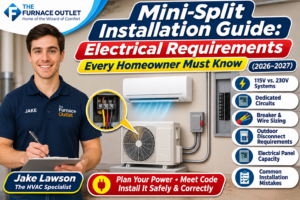
By Jake Lawson | HVAC Specialist | The Furnace Outlet | Updated November 2026
If you’re shopping for a ductless mini-split air conditioner, you’ve probably noticed that some models operate on 110–120 volts while others require 208–230 volts. At first glance, choosing between them might seem like a simple electrical decision, but the voltage you select can affect installation costs, equipment availability, circuit requirements, and future upgrades.
I’ve worked with enough mini-split installations to know that homeowners often focus on BTU capacity, efficiency ratings, and brand reputation while overlooking electrical compatibility. Unfortunately, discovering that your new mini split requires an unavailable electrical circuit can turn an otherwise straightforward installation into an expensive project.
The good news is that neither voltage is automatically better for every home. A properly selected 115V mini split can cool a small bedroom effectively, while a 230V system may be more appropriate for larger rooms, higher-capacity equipment, and multi-zone applications. Let’s examine the practical differences so you can choose the right power option without paying for unnecessary electrical work.
In the United States, homeowners commonly refer to household electrical supplies as 110V and 220V. However, the modern nominal residential supply is generally 120/240 volts, with equipment often labeled for 115V or 208/230V operation. For this guide, 110V refers to the common 115–120V mini-split category, while 220V refers to equipment designed for approximately 208–230V service.
The difference is the voltage supplied to the equipment, not necessarily the amount of cooling it produces. A 9,000 BTU mini split operating at 115V can provide comparable cooling capacity to a 9,000 BTU model operating at 230V when both are properly sized and installed. However, the electrical current required to deliver a given amount of power generally decreases as voltage increases, assuming similar power consumption. That difference becomes important when selecting circuits, conductors, disconnects, and overcurrent protection.
Yes, 115V mini splits can provide effective cooling and heating for appropriately sized spaces. These systems are commonly available in smaller capacities, particularly around 9,000 and 12,000 BTU/hr. Some manufacturers offer additional configurations, although availability varies. A 9,000 BTU mini split may be suitable for a smaller bedroom, office, or well-insulated living space, depending on the actual cooling load.
A 12,000 BTU system can serve larger rooms, but square footage alone shouldn’t determine capacity. Window exposure, ceiling height, insulation, climate, and occupancy all influence the amount of cooling required. The U.S. Department of Energy’s ductless mini-split guide explains how these systems operate and why correct equipment selection and installation matter. For modest cooling loads, a 115V mini split can be a practical choice without sacrificing essential comfort.
Higher-voltage mini splits are common in larger-capacity residential systems. Many 18,000, 24,000, and 36,000 BTU mini splits use 208/230V electrical supplies, although individual model specifications determine the actual requirement. These systems may serve larger living areas, open-plan spaces, garages, or multiple indoor zones. A 230V configuration can deliver substantial electrical power at a lower current than an equivalent 115V configuration.
However, that doesn’t automatically mean the equipment uses less electricity. The actual energy consumption depends on compressor technology, system efficiency, operating conditions, and heating or cooling demand. For homeowners considering larger systems or future multi-zone expansion, 230V equipment often provides a broader range of options.
When comparing mini splits, it’s useful to understand the typical relationship between voltage and cooling capacity. In the 9,000 BTU category, both 115V and 230V models are commonly available. The same is true for many 12,000 BTU systems. At approximately 18,000 BTU, 230V equipment becomes more common, although exceptions exist.
For 24,000 BTU and larger residential mini splits, 208/230V configurations are generally the standard choice. These are market tendencies rather than universal electrical rules. Manufacturers determine the voltage requirements for each model, and homeowners should never assume that a particular BTU rating guarantees compatibility with an existing circuit. Always verify the equipment nameplate and installation manual before purchasing.
This is one of the biggest misconceptions surrounding mini-split voltage. A 230V mini split doesn’t automatically consume fewer kilowatt-hours than a comparable 115V system. Electricity consumption is measured in kilowatt-hours, which depend on the power consumed and the operating duration. For example, a system drawing 1,000 watts for one hour consumes approximately one kilowatt-hour, regardless of whether it operates at 115V or 230V. At 115V, delivering 1,000 watts corresponds to approximately 8.7 amps at unity power factor. At 230V, the corresponding current is approximately 4.35 amps. Actual alternating-current equipment can have different power factors, so these figures are simplified illustrations.
Higher voltage reduces current for comparable electrical power, but efficiency ratings provide a more meaningful comparison of operating costs.
Mini-split efficiency is generally evaluated using ratings such as SEER2 for seasonal cooling and HSPF2 for seasonal heating. Higher ratings indicate better performance under standardized testing conditions. A 115V mini split with a higher SEER2 rating may use less electricity over a cooling season than a less efficient 230V model serving a similar load.
Likewise, a premium 230V inverter system may outperform a basic 115V unit. The ENERGY STAR mini-split heat pump information explains how certified heat pumps can deliver efficient heating and cooling. When comparing systems, focus on certified efficiency, capacity, and climate suitability rather than voltage alone.
Electrical installation requirements can significantly influence the total project cost. If your home already has a suitable dedicated 120V circuit, installing a compatible 115V mini split may involve less electrical work. However, an ordinary household receptacle doesn’t automatically mean the circuit is suitable for a mini split. Many mini splits require dedicated circuits, correctly sized conductors, approved disconnecting means, and specific overcurrent protection.
A 230V installation may require a new two-pole breaker and appropriately sized wiring from the electrical panel. Depending on panel capacity, circuit distance, and installation complexity, adding a new circuit may cost several hundred dollars or considerably more. In some homes, panel upgrades or other electrical modifications can increase the expense substantially. A qualified electrician should evaluate the existing electrical system before equipment selection is finalized.
Homeowners sometimes assume that a 115V mini split can be connected to any standard wall outlet. hat assumption can be dangerous. Most permanently installed mini-split systems are designed for dedicated electrical connections, often involving hardwired outdoor equipment. The exact requirements depend on the manufacturer’s installation instructions and applicable electrical codes.
Using extension cords, adapters, or improvised electrical connections can create overheating and fire hazards. Even if the equipment operates at approximately 115V, the existing circuit must meet the specified electrical requirements. Before installation, confirm the manufacturer’s minimum circuit ampacity, maximum overcurrent protection, grounding requirements, and connection method.
A mini split designed exclusively for 115V operation generally cannot be converted to 230V simply by changing its plug, breaker, or wiring. Compressors, electronic controls, fan motors, and other electrical components are designed for specified voltage ranges. Supplying 230V to equipment intended only for 115V can cause severe damage and create serious safety hazards. Likewise, a 230V mini split cannot normally operate correctly on a 115V supply.
Some equipment supports multiple electrical configurations, but this must be explicitly documented by the manufacturer. If your preferred system requires a different voltage, the appropriate solution is usually to install a compatible electrical circuit or select equipment designed for the available supply.
Garages present special heating and cooling challenges because insulation, air leakage, ceiling height, and solar exposure vary considerably. A small, insulated garage workshop may have a cooling load compatible with a 115V mini split.
A larger two-car garage with poor insulation or substantial heat gain may require a higher-capacity 230V system. However, choosing equipment based only on garage square footage can produce disappointing results. Garage doors, attic insulation, exterior walls, and how frequently the doors open can dramatically affect heating and cooling requirements.
If you plan to use the garage year-round, heating performance at your local winter temperatures also matters. The best choice is the voltage required by the properly sized equipment, not whichever electrical supply appears more convenient.
Multi-zone mini splits use one outdoor unit connected to multiple indoor air handlers. Because these systems may serve several rooms simultaneously, they generally require greater electrical capacity than small single-zone equipment. Most residential multi-zone outdoor units operate on 208/230V supplies, although exact requirements vary.
These systems can provide individual temperature control in bedrooms, offices, and living areas. However, multi-zone equipment must be sized carefully because total connected indoor capacity doesn’t always equal the outdoor unit’s available simultaneous output. Homeowners should evaluate room-by-room heating and cooling loads, electrical requirements, and manufacturer-approved equipment combinations.
Mini-split installation involves more than mounting indoor equipment and connecting refrigerant lines. Electrical connections must comply with the manufacturer’s instructions and applicable codes. The National Fire Protection Association’s electrical safety resources explain why safe electrical practices are essential in residential installations.
A qualified electrician or appropriately licensed HVAC professional should verify circuit sizing, grounding, disconnect requirements, and overcurrent protection. Mini-split refrigeration work may also require certified technicians and specialized equipment. Improper installation can reduce performance, void warranty coverage, and create avoidable safety risks.
One common mistake is assuming that a 115V system will always be cheaper to install. That may be true when a suitable dedicated circuit already exists, but a new 120V circuit can still require substantial electrical work. Another mistake is selecting a 230V mini split solely because it sounds more powerful or efficient. Voltage doesn’t determine cooling capacity or seasonal energy efficiency by itself.
Homeowners should also avoid buying equipment before confirming the available electrical supply and the required circuit specifications. Finally, choosing an undersized system simply to avoid installing a 230V circuit can lead to poor comfort and higher operating expenses.
Is a 220V mini split better than a 110V mini split? Not necessarily. A 230V system may be more practical for larger capacities, but a properly sized 115V unit can provide comparable comfort in smaller spaces. Efficiency depends on the specific equipment rather than voltage alone.
Can a 110V mini split heat a room in winter? Yes, if it’s a heat pump model designed for heating. Its effectiveness depends on heating capacity, outdoor temperature, and the equipment’s low-temperature performance.
Do 220V mini splits cost more to operate? Not automatically. Operating expenses depend primarily on electrical power consumption, system efficiency, usage patterns, and local electricity rates.
Can I install a 220V mini split in a house with 110V outlets? Many U.S. homes have 120/240V electrical service even though ordinary receptacles supply 120V. An electrician must verify panel capacity and install a suitable dedicated circuit if required.
When homeowners ask me whether they should purchase a 110V or 220V mini split, I recommend starting with the heating and cooling requirements rather than the electrical supply. A small bedroom or office may be perfectly comfortable with a properly sized 115V inverter mini split. Larger living spaces, garages, and multi-zone applications often benefit from the wider equipment selection available at 230V.
However, don’t assume that higher voltage guarantees better efficiency, quieter operation, or stronger heating performance. Compare the actual BTU capacity, SEER2 and HSPF2 ratings, low-temperature heating performance, installation requirements, and total project cost. Before purchasing, have a qualified contractor confirm the required equipment size and an electrician verify electrical compatibility. That approach helps avoid expensive surprises and ensures your mini split delivers the comfort you expect.